Efforts are underway in the U.S. House of Representatives and the U.S. Senate to provide relief for state and local government entities in response to the COVID-19 outbreak.
In the U.S. House of Representatives, Congressman T.J. Cox (CA-21) led a
bipartisan April 13 letter with Reps. Brad Schneider (IL-10), John Katko (NY-24), and Diana DeGette (CO-1) urging House and Senate Leadership to support state and local governments by making them eligible for emergency paid family and sick leave payroll tax credits under the Families First Coronavirus Response Act (FFCRA). Public employees are eligible for the emergency paid family and sick leave programs, but the FFCRA excluded public employers from these tax credits, while making them available to private sector employers.
In the U.S. Senate, a
bipartisan agreement was announced on April 19 by Senators Bill Cassidy (LA) and Bob Menendez (NJ) to introduce legislation that would create a $500 billion fund to help states and local governments respond to the current public health and economic crisis and to maintain essential services. The proposed State and Municipal Aid for Recovery and Transition (SMART) Fund would build upon an existing $150 billion set aside in the Coronavirus Aid, Relief, and Economic Security (CARES) Act to help states and local governments.
NACD continues to advance the
COVID-19 Response Stimulus Request sent to Congress on April 13 and has joined with other organizations including the National League of Cities, American Society of Civil Engineers, National Association of Counties, Association of Public and Land-grant Universities, International City/County Management Association, National Conference of State Legislatures, National School Boards Association, National Association of Clean Water Agencies and National Water Resources Association in requesting state and local government relief.
|
CONSERVATION DISTRICTS
LEAD NINE
RCPP PROJECTS
|
On Thursday, April 16, the Natural Resources Conservation Service (NRCS) announced nine conservation district-led projects as part of this year’s Regional Conservation Partnership Program (RCPP) awards.
First authorized by the 2014 Farm Bill and expanded under the 2018 Farm Bill, RCPP uses a partner-driven approach to fund innovative conservation projects to improve water quality and quantity, soil health and wildlife habitat. Project leaders work with private landowners and producers to implement conservation practices depending on the challenges of their local landscape.
“Conservation districts have led the charge in RCPP projects since the program’s inception,”
NACD President Tim Palmer said
. “Their local knowledge, expertise and relationships with producers, ranchers and landowners makes them an ideal partner to lead innovative solutions to natural resource challenges.”
The RCPP announcement consists of $206 million in funding for 48 projects across 29 states. Conservation districts are listed as the lead partner in nine:
Polk Soil and Water Conservation District
(SWCD), Ore.;
Clark Conservation District
, Wash.;
Gilliam SWCD
, Ore.;
San Rafael Conservation District
, Utah;
New Mexico Association of Conservation Districts
, N.M.;
San Juan SWCD
, N.M.;
Minnehaha Conservation District
, S.D.;
Barry Conservation District
, Mich.; and
Berks County Conservation District
, Pa.
“NACD is proud of all the conservation districts not only named as lead partners for RCPP this year, but also those that continue to work in partnership with their local collaborators to implement conservation through existing RCPP projects,”
Palmer said
. “Together, we’re all working to advance conservation practices across America’s landscapes.”
|
WOULD WE STILL HAVE FOOD IF THE
POLLINATORS DISAPPEAR?
|
What do tomatoes, basil, coffee and alfalfa have in common? On the surface, it appears to be very little. However, there is one thing they do share: They all owe their existence to the service of pollinators.
Grocery stores would be rather empty without the hard work of bees, birds, butterflies, bats and other pollinators. One out of every three bites of food we eat or beverages we drink every day are because of pollinators. That’s a whole different range of foods, from fruits to nuts to vegetables. But despite the importance of pollinators, they are taken for granted all too often.
If the pollinators that help provide so much of the food we eat were to vanish, what would we do without them? We would starve. That’s why protecting pollinators is essential to the survival of our daily food supply. Bees, for example, are facing a huge challenge to their survival due to pesticides, parasites, disease and habitat loss. Without bees, we would no longer be able to enjoy our favorite foods if they die out. Examples of bee-pollinated crops include watermelons, cantaloupe, citrus, apples, cucumbers, squash, most berry crops, broccoli, nuts, asparagus and more.
To honor and thank pollinators for the food that we enjoy every day, NACD is celebrating
Stewardship Week
from April 26–May 3 with the theme
Where Would We BEE Without Pollinators?
to foster education and awareness.
NACD established Stewardship Week 65 years ago to educate the public on the importance of soil health, water quality, pollinator habitat and other conservation topics. Stewardship Week helps to remind us all of the power each person has to conserve natural resources and improve the world.
For more ideas about how your conservation district can make a difference in your community during Stewardship Week, visit
NACD's Stewardship Week webpage
. Let us know how you plan on virtually celebrating Stewardship Week by
emailing us
.
|
SWCD FIGHTING FOREST INVASIVES THROUGH GOOD NEIGHBOR AUTHORITY
|
The
Madison County Soil and Water Conservation District
(SWCD) is working with the North Carolina Department of Agriculture and Consumer Services (NCDA&CS) and the U.S. Forest Service to manage invasive species through Good Neighbor Authority (GNA).
The district has five shovel-ready projects identified and hopes to begin prioritizing efforts in May,
Madison County SWCD Director Tyler Ross said
.
“The only way we’re going to get this stuff done for the future is for all of us to come together,”
he said
. “It’s a great partnership. Once we get the green light, we’ll develop a plan of attack.”
Madison County SWCD is working with the Appalachian Ranger District ranger and botanist and NEPA officer to develop projects that fall under the GNA agreement. Each will focus on invasive species eradication on federally managed lands on the Appalachian Ranger District of the Pisgah National Forest. Ross and Soil Conservationist
Brandon Young
have earned chainsaw certification for the Forest Service and licensure for public pesticide operations. They also have the ability to assist with prescribed burns.
Under the GNA agreement, Ross and Young are able to use best management practices that they already plan and oversee for the projects.
“It’s giving us an opportunity to expand our knowledge locally and do research with the Forest Service on eradicating nonnative species,”
Ross said
.
GNA allows the Forest Service to enter into agreements with state forestry agencies to do critical management work to keep forests healthy and productive. Few conservation districts have been directly involved in GNA agreements since the program rollout; Madison County SWCD is working with the NCDA&CS Division of Soil and Water Conservation on these projects.
“It fits into the directive of the district from a water quality standpoint,”
Ross said
.
|
|
D.C. Office Closed
Until May 15
|
NACD’s Washington, D.C. office will remain closed with staff teleworking until Friday, May 15 in light of the ongoing COVID-19 (coronavirus) outbreak.
NACD wants to ensure the continuity of normal business operations, and you can reach NACD staff during regular business hours as usual via email or by calling the main line: (202) 547-NACD. We will continue to update our members on any changes during this time.
|
Sign Up for
NACD's Daily Roundup
|
NACD is proud to launch Daily Roundup, a daily publication that provides the latest conservation updates and news. Roundup is available Monday through Thursday–
log into your NACD account
or
click here
to subscribe.
|
NRCS Extends
Project Deadlines
|
The Natural Resources Conservation Service (NRCS) and the nation’s conservation districts continue to work with landowners to implement farm bill conservation programs; however, during the current COVID-19 crisis, the agency is looking into any flexibilities that may be needed.
Yesterday, NRCS announced they are extending the deadline t
o May 29 for On-Farm Conservation Innovation Trials and the Regional Conservation Partnership Program (RCPP) Alternative Funding Arrangements (AFAs). More information on each program can be found on
NRCS's website
.
|
Trump Administration Finalizes WOTUS Rule
|
Today, the Trump administration is set to finalize the repeal of the Waters of the United States (WOTUS) rule under the Clean Water Act.
In September 2019, NACD released a statement supporting the revised definition of WOTUS, as it would give landowners and producers greater ability to handle local decision-making. The Trump administration released the rule in January. NACD anticipates the implemented rule will be subject to extensive litigation now that it is finalized.
|
Last week, NACD leaders shared the importance of conservation across the nation's airwaves.
On Tuesday, April 14,
NACD President Tim Palmer discussed with
Lorrie Boyer how conservation districts are adapting in the face of
COVID-19 on KSIR, and on Wednesday, April 15, Palmer
outlined NACD's requests for help for conservation districts in discussion with
Mike Adams on Adams on Agriculture.
NACD President-elect Michael Crowder
spoke with BARN Media's
Brian Allmer on Thursday about the current agricultural issues in light of the COVID-19 (coronavirus) pandemic. NACD continues to be your national voice for conservation.
|
Register Now:
NAPPC Webinar
|
On
Friday, April 24 at
10:00 a.m. Eastern, Smithsonian Institution will be hosting a webinar featuring the story of the North American Pollinator Protection Campaign (NAPPC), as part of its Earth Optimism Summit Deep Dive webinar series, which feature some of the world's biggest conservation challenges and solutions.
NACD is a proud member of NAPPC, whose mission is to promote the health of pollinators in Canada, the U.S. and Mexico. This webinar will feature a discussion panel and Q&A, and members of NAPPC will discuss its origin, progress and impacts of its accomplishments spanning 20 years.
|
Northeast Region Meeting Postponed
|
NACD's Northeast Region Meeting, scheduled for Aug. 30-Sept. 2 in Portsmouth, N.H., will be postponed due to COVID-19 (coronavirus) concerns.
|
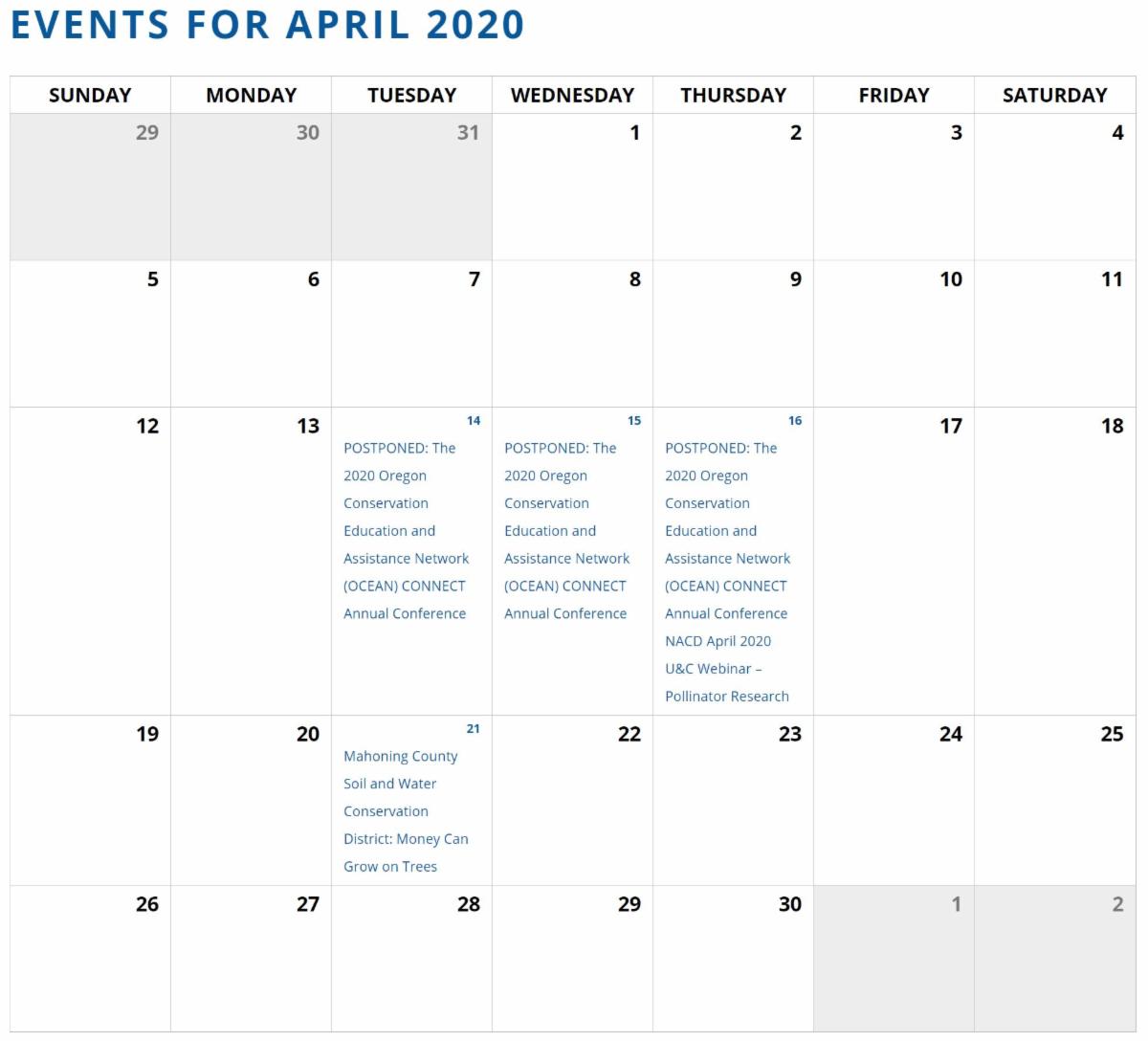
Promote your conservation district or state association's tree sale, annual meeting, webinar, field day or more on NACD's
Calendar of Events
!
|
|