|
American College of Vedic Astrology
The ACVA Newsletter 2025-05 (May 2025)
|
| |
Note from the President of ACVA
By Professor Charlotte Benson (Jyoti Devi) President, ACVA
May 2025
Dear Friends of ACVA,
We hope you enjoy the excellent articles in this edition of the ACVA News. Studying Jyotish is a life-time endeavor, isn’t it? I recently heard Warren Buffett remark that wealthy people educate themselves, while others merely entertain themselves. Thank heavens there’s always something new to learn in the fascinating Ocean of Jyotish.
As part of our ongoing monthly webinar series, Vaughn Paul Manley delivered an engaging webinar on the Double Transit of Jupiter and Saturn on May 10. There were many attendees from Türkiye on our global campus that day. The recording of this webinar will soon be available in our online store, where we have many wonderful MP3s and MP4s for sale. Do visit our store, even if you’re not enrolled as a student in our courses. The proceeds from all sales benefit ACVA’s several scholarship funds.
In the heavens, Jupiter/Guru has just transited into Gemini, eluding Saturn’s aspect from Pisces. This may signal more scope for peace where it’s needed. Meanwhile, with the planet of wisdom in the sign of information, let’s all be aware of opportunities to educate ourselves, to better process information, to become wealthy through ideas, transactions, and travel. Gemini is one of the signs associated with Jyotish. Studying, reading, thinking, writing, or talking about the principles of Jyotish will flourish during the next six months. This is a good time to put your studies of the stars into experimental practice. Rahu entering Aquarius in late May will also stimulate interest in Jyotish, while Jupiter’s forthcoming trinal aspect onto Rahu will be supportive.
Under these auspicious indications, ACVA has decided to revive our membership / alumni group. Please read about the qualifications and member benefits in a dedicated section of this edition of the newsletter from our Vice President, Dr. Sisira Amarasinghe.
On a personal note, I was honored to attend the wedding of Sophia Harness, daughter of ACVA’s President Emeritus, Dr. Dennis Harness, in Sedona on May 17. It was a charming celebration in a stunning setting. Congratulations to the happy couple and their parents!
Click here for more ...
| |
Professor Charlotte Benson (Jyoti Devi)
President, American College of Vedic Astrology
| | |
🌟 Announcing the ACVA Membership Program
A New Chapter in Community, Learning, and Professional Recognition
By Dr. Sisira K Amarasinghe. ACVA Vice President
May 2025
Dear Friends of ACVA,
The American College of Vedic Astrology™ is pleased to announce a new chapter in our mission to support students, practitioners, and admirers of Jyotisha around the world: the launch of our official ACVA Membership Program, beginning July 2024. This initiative represents a meaningful step in our evolution as a leading global institution in the field of Vedic Astrology. Designed to build community, encourage lifelong learning, and provide meaningful benefits to active participants, the ACVA Membership Program offers a rich array of opportunities to connect, grow, and stay engaged.
🎓 Membership Overview
Annual Membership Fee:
- $40 per year for the general public
-
Free for students currently enrolled in ACVA’s certification programs (Jyotisha Ratna or Jyotisha Prabhakara)
-
50% discounted rate ($20/year) for recent graduates during the first year after completing their certification
🌿 Membership Benefits
📰 Monthly Newsletter Subscription
Receive our expanded monthly newsletter featuring articles on astronomical transits, traditional holy days, and original content from senior and rising Vedic Astrology practitioners.
📡 Access to ACVA Monthly Webinars
Enjoy full access to our monthly webinar series featuring expert astrologers on topics ranging from classical chart analysis to applied Jyotisha. These webinars—previously priced at $18–$20 per session—will now be included in your membership.
💬 Quarterly Live Q&A Webinars
Participate in quarterly themed Q&A sessions with senior Jyotishis, where your Jyotisha questions can be addressed live in an interactive learning environment.
🎟️ Discounted Access to UAC 2026
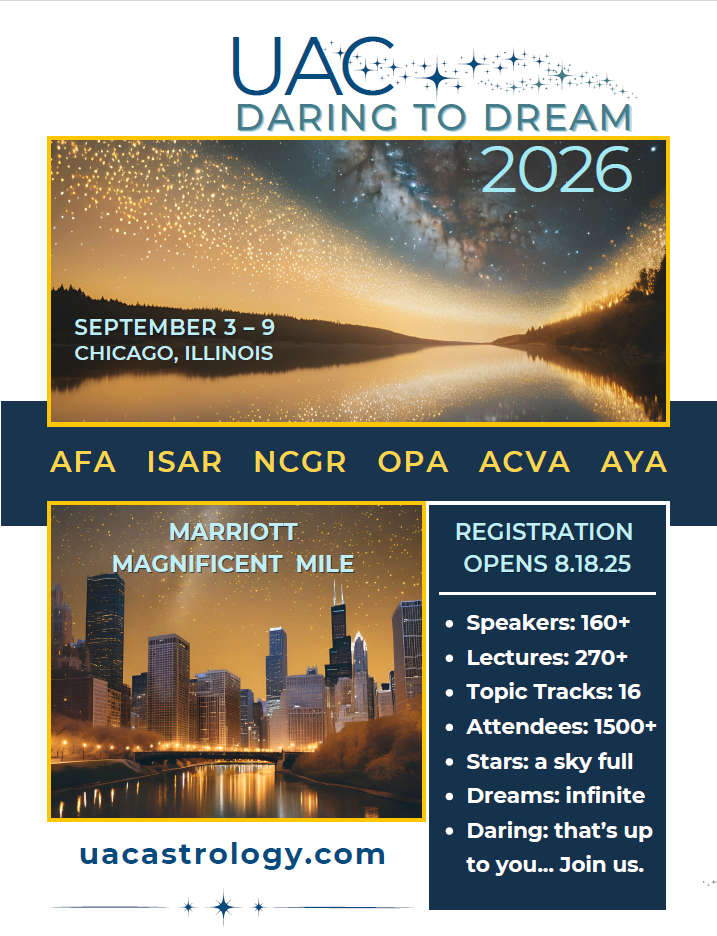
Registered ACVA members will qualify for discounted registration to the United Astrology Conference (UAC) — the largest astrology gathering in North America. UAC 2026 will feature 15 Vedic Astrology lectures delivered by experienced teachers. Member discounts will apply to early bird pricing and other registration phases.
🧭 ACVA Member Directory
Choose to be listed in ACVA’s online directory for alumni, students, and members—facilitating professional networking and community-building.
💬 ACVA Chat Room Access
Connect with other members in our monthly moderated chat room to discuss learning goals, techniques, and topics of interest in a collegial space.
🛍️ Discounts on MP3/MP4 Lecture Materials
Access our curated library of downloadable lectures in the ACVA online store—available at a discounted rate for all registered members.
🔗 https://acvaonline.org/store/
💡 Why Membership Matters
This program allows ACVA to more clearly define who we serve, reward active engagement, and strengthen the collective identity of our learning community. It also ensures that members can derive real, tangible benefits from their association with ACVA—whether as a current student, a graduate, or a lifelong practitioner of Vedic Astrology.
📌 How to Join
Membership enrollment will soon be available through our website.
Please stay tuned for updates at:
🔗 https://acvaonline.org/membership
We look forward to welcoming you into our growing community of committed students, scholars, and seekers of Vedic Astrology. Thank you for your continued support in carrying this sacred science forward.
Warm regards,
Dr. Sisira K. Amarasinghe
ACVA Vice President, Executive Director of Corporate Strategy & Technology
| | |
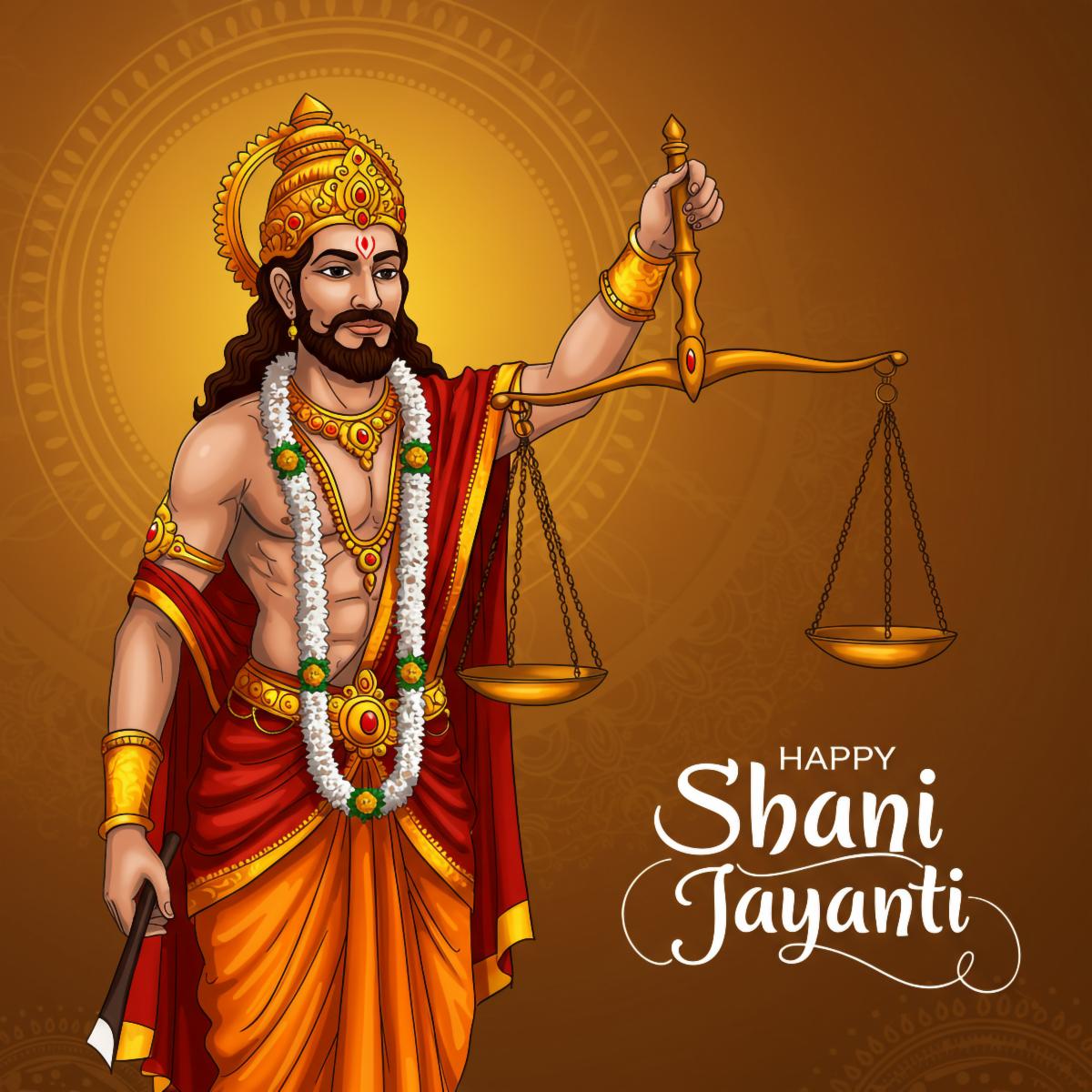
Shani Jayanti, Lord Shani’s Birthday!
By Professor Juliana Swanson
ACVA Provost and Dean of Academics
This year, Shani Jayanti will be celebrated on Monday, May 26 in North and South America, Africa, and Europe, and on Tuesday, May 27 elsewhere in the world (including India). Shani Jayanti is an important Vedic holy day which commemorates the birth of Shani Dev (Saturn), the lord of truth and karma. Shani Jayanti occurs annually at the New Moon in the Jyeshta Masa, the lunar month which will extend from May 27 to June 25 this year. More specifically, it is calculated for the lunar day when the amavasya tithi is in place by sunrise.
| | Prayers, pujas, and other rituals are traditionally performed in honor of Shani Dev on his birthday, according to a variety of Vedic traditions. Shani Jayanti is an especially important day to honor one's ancestors (shraddha or tarpana), and to make offerings to Lord Saturn. It is also a wonderful day to offer respect, service, and charity to the elderly and infirm, to spend time in contemplation, and to commune with Mother Nature. Lord Shiva is also propitiated on Shani Jayanti because Shani worships Shiva. For all of us, Saturn is the servant of the Divine who teaches us to humbly surrender and serve the divine power that exists within ourselves and the world. | | |
Shani Jayanti will occur on a Monday in the western half of the world this year, which is another powerful celebration known as Somvati Amavasya. This is a rare occasion which occurs when the amavasya tithi (the darkest day of the lunar month preceding the New Moon) falls on a Monday, the Vedic day of the week known as Somwar or Somavaar. The importance of this date is related to the fact that amavasya tithi and the Moon’s Day of the week each are connected to the worship of Lord Shiva. Again, this is a wonderful time to make charitable donations, perform ancestral healing and worship, take holy dips in sacred waters, and to seek the blessings of Lord Shiva, all toward the purpose of cleansing karma, seeking divine redemption and grace, and serving the common good.
Click here for more ...
| | |
The Observatory
By Dr. Lynn Bootes, MD
ACVA Dean of Students and Registrar
registrar@acvaonline.org
Sun in Taurus/Gemini Edition – May 14 - June 30, 2025
Dear Readers,
We begin the month of the Sun in Taurus on May 14, on the same day that Jupiter changes signs from Taurus to Gemini. Those who attended the webinar lecture with Paul Manley last weekend had a chance to concentrate on Jupiter and Saturn changing signs together. In short, Jupiter and Saturn both now make Vedic aspects on the sign of Sagittarius. People, activities, living beings, and places associated with the dual signs Gemini, Virgo, Sagittarius and Pisces will experience change, but especially Sagittarius. Already in the world newsfeed we can sense the quickening pace of changes that have seemingly been held back. The world has experienced many such changes, but as humans we have the ability to adapt.
All the visible planets are moving rapidly in direct motion. Mercury moves from Aries to Cancer in the next six weeks, changing its residence in Nakshatras every 5 to 8 days! Look for Mercury making a conjunction with Jupiter in Gemini on June 9. Venus leaves Pisces after a long stay of several months due to its recent retrogression, and enters Aries on June 1. On June 29 Venus will enter its own sign Taurus.
Mars is picking up speed in direct motion and finally leaves its debilitation sign Cancer to move into Leo, the sign of his Great Friend, on June 6. Remember that Mars has been in Gemini and Cancer since last August, and neither were favorable signs. Be ready for this significant change in status. After that date, Mars will be making a Vedic 1:8 aspect from Leo to Saturn in Pisces. This is a challenging aspect, but keep in mind that the sign rulers for Leo and Pisces are the Sun and Jupiter, who are exactly conjoined in Gemini on June 24-25.
Mercury spends much of June in its own sign Gemini wherein it disposes the Sun and Jupiter. There may be auspicious moments for communication and negotiation. If you’d like to write, or to study Jyotish, June might be an ideal time to begin.
Click here for more ...
| | |
Practical Pañcāṅga – Introduction
(Part 3)
By Pratik Mehta
Vedic Astrologer
| | |
Welcome back! Hopefully, by this point in our sojourn, you are convinced that the Pañcāṅga is a perfect blend of intrigue and utility when it comes to being part of the Jyotiṣi apparatus. Today, we will explore Yogas in the realm of Pañcāṅga.
First things first, the Yogas referenced in the context of Pañcāṅga are different from the Graha Yogas that we have all come to know and love. In that, Pañcāṅga Yogas, also called Nitya Yogas, aren’t formed by any Saṃbandha between two or more planets. Please always bear that in mind whenever Yogas are referenced in the context of Pañcāṅga. With that out of the way, let’s see what Yogas in Pañcāṅga are all about.
| |
Definition and Meaning
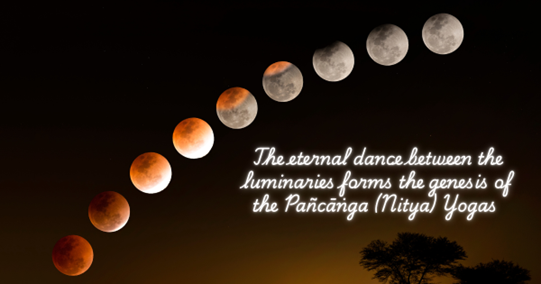
The word Nitya means constant or eternal. The romantic in me likes to think of Nitya Yoga as this never-ending ballroom dance between the luminaries against the backdrop of the ever-glittering and glimmering ecliptic. This dance between the primordial masculine and feminine energies birthed this existence as we know it, and will still be around when we’re all long gone. The dance analogy will make much more sense once you understand the way in which the Pañcāṅga Yogas are derived. The determination of Yoga is driven by the concept of Yogi Point. The Yogi Point, just like the Lagna, is a constantly changing locus, albeit slightly slower moving than the Lagna. It’s calculated as follows:
Yogi point = Sun’s longitude + Moon’s longitude + 93°20’
Some of you might be curious to know why the oddball 93°20’ is part of the math. Be patient, and that mystery will be unveiled in due course.
Starting from the point calculated above, each progression of the Yogi point by 13°20’ is considered to be a new Yoga. Note, the definition says progression of the Yogi point and not the Moon.
Most books and material out there will tell you that, just like Tithi, the Yoga changes when the Moon covers a distance of 13° 20’ from the Sun. That is NOT correct. The Yoga is determined by the Yogi point’s movement and not the Moon’s distance from the Sun. Please take a minute to digest that before moving on.
Click here for more ...
| | |
Star Gazers: The Birth Charts of Astrologers (Part 1)
By Marc Boney, M.A.
Astrological Teacher, Writer and Consultant
Copyright © 2022 Marc Boney, M.A. All Rights Reserved.
Dedicated to Shri K.N. Rao, who ignited in me the light of Jyotiṣa.
“Jyotiṣa is the art of seeing light, of guiding, of counseling based on the truth called the horoscope. Jyotiṣa is the pathway to God through the mazes of intuitions and the brilliance of an organized science, like any other science. Jyotiṣa is the fusion of the divine with the mundane, the metaphysical with the scientific methodology, a divine chorus of the music of the heavens and the dance of the stars. It is that divine ballet, Jyotiṣa, which is at once both a divinity and science that we are presenting.”
Introduction
As a teacher of Jyotiṣa, I have been asked many, many times. “Does my birth chart indicate that I can be a good astrologer?” How to answer such a question?
When assessing anything about a person’s life karma, I suggest starting with the planetary kāraka. For example, when evaluating a person’s karma with respect to love and intimate relationships, Venus should be seen first; for children, Jupiter; for mother, the Moon; for father, the Sun and so forth.
Mercury is the primary planetary kāraka for astrology, while the secondary kāraka is Jupiter, who rules Veda and vedāṅga. When I evaluate a person’s capacity for learning astrology and being a good practitioner, these are the components of a birth chart that I evaluate first. Of course, Mercury and Jupiter are also the two educational planets and therefore, people are often first attracted to studying Jyotiṣa when they’re running the major period of one or the other. As I’ll illustrate in this article later on, this is often particularly true when they run Mercury-Jupiter or Jupiter-Mercury.
In his book Yogis, Destiny and the Wheel of Time, K.N. Rao shared the views of his teacher, a man he referred to as Yogi Bhaskarananda, about what in a birth chart indicated a good capacity for doing Jyotiṣa. The following is a summary of those desirable features:
- Both for spirituality and astrology, he liked Ketu in the esoteric houses, ie, 4th, 8th or 12th, with the additional influence of strong natural benefics, especially Jupiter or Mercury, or alternatively, the influence of the 5th and 9th lords.
- For astrology, a strong Mercury and Jupiter were desirable in general. He thought Mercury in the 4th house was the best, second best in the 8th, and third best in the 10th. In general, he liked Mercury in the angles.
- Jupiter in the 10th house without affliction was the best in his view since it would aspect onto the 4th as well as the 2nd house of speech. This last point means that a person would speak truly, which is to say their predictions would be accurate. He liked Jupiter also in any of the esoteric houses (4th, 8th, 12th) from whence it would aspect the other two houses.
- Saturn in the 3rd, 5th and 9th houses could give a detached, unbiased view of matters, but only when without a blemish.
-
For lagnas he liked the Mercury-ruled rāśis as well as the intellectual air signs, Libra and Aquarius, but added that any lagna could be good as long as the four planets outlined above were well-placed.
In a classroom setting, I was once surprised to hear K.N. Rao mention that people will get attracted to studying Jyotiṣa in the period of the 4th lord or of planets in the 4th house. I can remember having the thought, “Why should it be so?” He went on to explain that the 4th, 8th and 12th houses were esoteric or occult houses. The point registered with me since at the time, I was studying Jyotiṣa with him in the period of my 4th lord, which in my case also happens to be Jupiter. After hearing that, I’ve seen the validity of it innumerable times.
For evidence of how these desirable elements come into play, let’s now look at the horoscopes of three notable astrologers from India.
| | |
Coming Attractions at ACVA
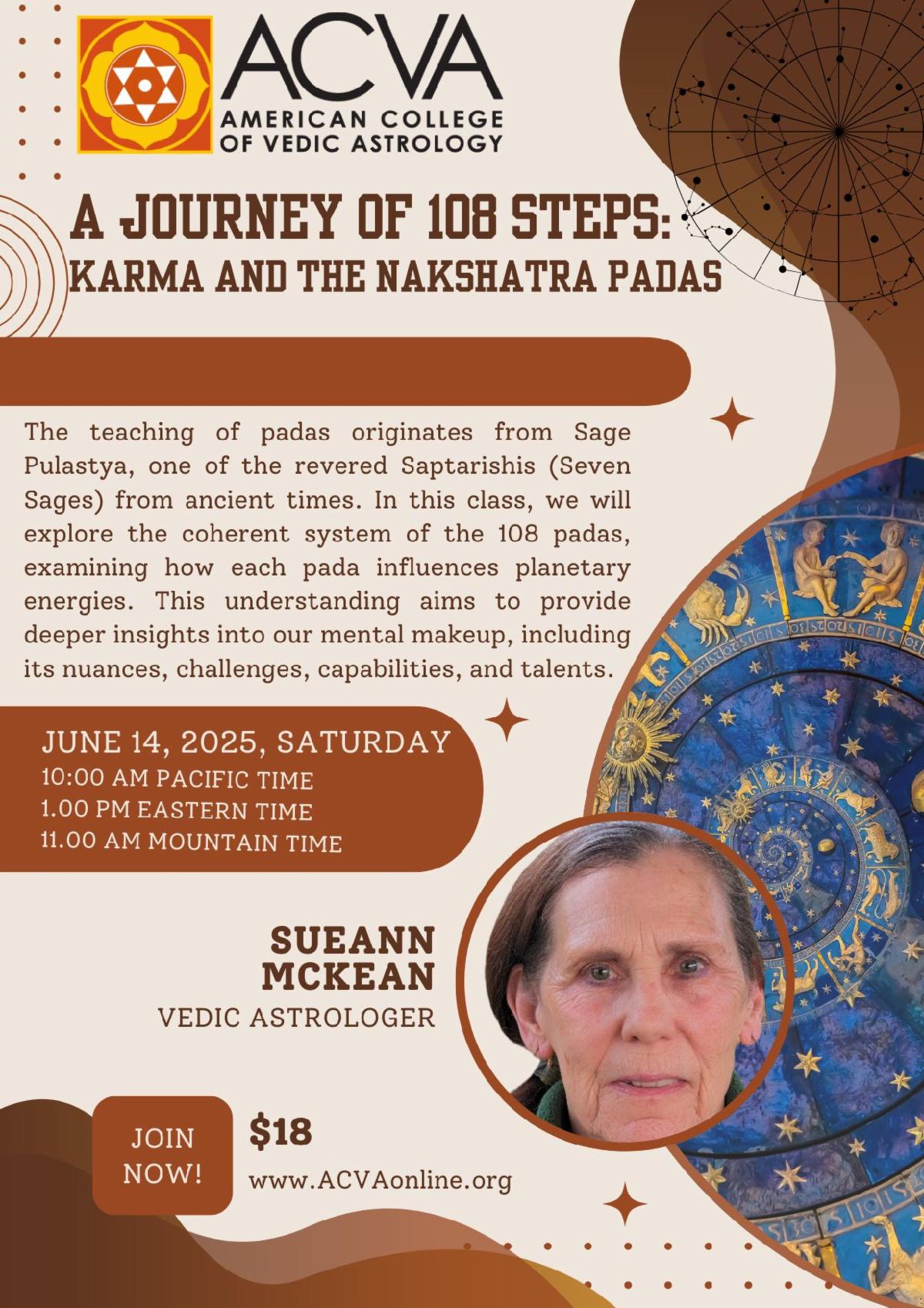
(1) ACVA webinar by Sue Ann McKean
(ACVA Scholarship Fund raising webinars – Jyotish Insights series)
Saturday, 14 June 2025 @ 10 AM Pacific / 1 PM Eastern time / 11.00 AM Mountain time. 1.5 Hours.
Topic: A Journey of 108 Steps: Karma and the Nakshatra Padas
Jupiter and Saturn, as the slower-moving of the outer planets, are major “chronocrators” or time-lords within the scheme of transits. Classically, Jupiter is considered the “greater benefic” while Saturn is the “greater malefic.” Thus, within their 12- and 29.5-year cycles, respectively, they exercise benign and malign influence upon the various houses of the horoscope. But when their simultaneous transits are in play, it requires careful judgment to assess their likely effects, the analysis of which is the subject of this webinar.
| | |
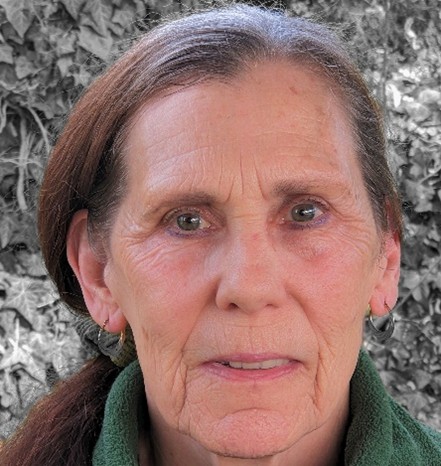
Speaker: Sue Ann McKean, Professional Vedic Astrologer
Sue Ann McKean is a life-long student of Vedic wisdom and consulting Vedic Astrologer. Her Jyotish journey began in 1990 while on a retreat in India. A founding member of ACVA and regular attendant at ACVA conferences, she studied Jyotish with Hart De Fouw and Ernst Wilhelm. She met her guru, Pundit Sanjay Rath in 2005, participating in the founding of his school Deva Guru Brihaspati as a student and mentor from 2009-12. In 2011 she completed the 5-year intensive Jaimini Sutras program conducted in the Himalayas with Pundit Sanjay Rath. From 2011 to 2018, Sue Ann was also a student and mentor at AIAC - Ancient Indian Astrology Classes where she studied with Pundit Souvik Dutta.
Webinar Registration link: https://us06web.zoom.us/webinar/register/WN_H9GXT0EETzi9iVosb8TIEQ
| | |
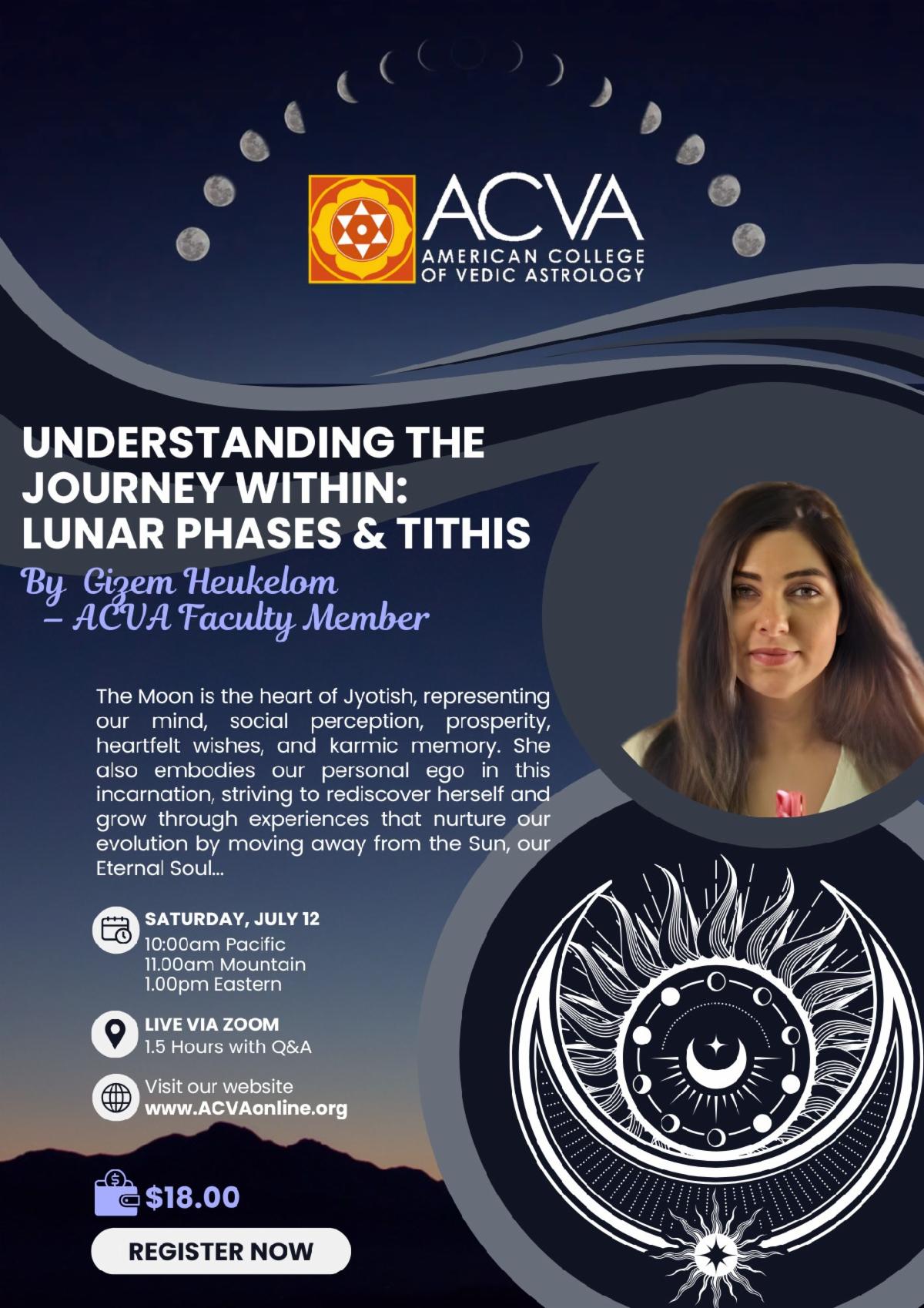
(2) ACVA webinar by Gizem Heukelom
(ACVA Scholarship Fund raising webinars – Jyotish Insights series)
Saturday, 12 July 2025 @ 10 AM Pacific / 1 PM Eastern time / 11.00 AM Mountain time. 1.5 Hours.
Topic: Understanding the Journey Within: Lunar Phases & Tithis
The Moon is the heart of Jyotish, representing our mind, social perception, prosperity, heartfelt wishes, and karmic memory. She also embodies our personal ego in this incarnation, striving to rediscover herself and grow through experiences that nurture our evolution by moving away from the Sun, our Eternal Soul. Lunar phases and tithis are all about this journey, based on the distance between the Sun and the Moon, a divine dance. By understanding what our lunar phase and tithi tell us, we can discover what our Moon seeks in this life and learn to harness this energy to align with our soul’s purpose.
| |
Speaker: Gizem Heukelom, Professional Vedic Astrologer
Gizem Heukelom is an accomplished astrologer, educator, and life coach with over 20 years of experience. Specializing in Vedic Astrology and trained in Classical Western and Esoteric Astrology, she founded DharmaVedas Vedic Astrology & Coaching and DharmaVedas Academy in 2020, where she currently teaches nearly 400 students in Turkey. Additionally, she serves as an instructor at the American College of Vedic Astrology. Gizem is originally from Turkey and resides in the Netherlands. www.dharmavedas.com
Webinar Registration link: https://us06web.zoom.us/webinar/register/WN_ty5GbRb8RJel2FtPnx-UcA
| | |
It is due to the generosity of our patrons that ACVA can continue to offer its current special tuition rates. Thank you.
ACVA is a 501-C3 not-for-profit educational institution that provides a very valuable service to learners of Vedic astrology.
It is due to the generosity of our volunteers and patrons that ACVA can continue to thrive. If you choose to press the "donate" button, your donation will be tax-deductible.
To donate, Visit our Website!!
https://acvaonline.org/donate/
In gratitude,
The Leadership Team
| | American College of Vedic Astrology | | |
ACVA Leadership Team
-
Prof. Charlotte Benson (Jyoti Devi) - President, ACVA’s External Relations Leader
-
Dr. Sisira K. Amarasinghe, Ph.D. – ACVA Vice President, Executive Director of Corporate Strategy and Technology
-
Prof. Juliana Swanson - ACVA Provost and Dean of Academics
-
Dr. Lynn Bootes, M.D.- Registrar, and Dean of Students
-
Julene Louis – Curriculum Leader
-
Arjun Kodikannath – ACVA Corporate Communications Officer
-
Alan Annand – ACVA Editor-in-Chief of Publications
ACVA Staff
-
Dr. Arjuna de Silva, MBBS (ACVA LMS & IT Operations Manager)
-
Sudath Mudalige (IT Administrator)
- Susheel Erramilli (Social Media and Digital Marketing Coordinator)
To contact any one of us
| | American College of Vedic Astrology Inc, 2675 W. S.R. 89A #190, Sedona, AZ 86336 | | | | |