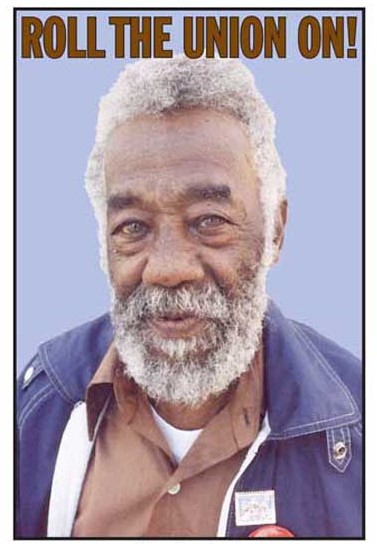
John Handcox
1904-1992
Union poet & troubadour
|
|
- Born in 1904 near Brinkley, Arkansas, the son of poor tenant farmers; his grandparents were enslaved.
-
He began picking cotton at age six; he became a tenant farmer, enduring a hard life during the era of the Depression and Jim Crow. He learned to read and to write poetry by reading Paul Laurence Dunbar, from a book of poems given to him by his father.
-
In 1935 he heard that socialists were organizing a new organization -- the Southern Tenant Farmers Union -- and he joined. He organized Black sharecroppers into the STFU and started writing songs which he sang at union meetings. According to historian Mike Honey, the SFTU "addressed each other as 'Mr.' and 'Mrs.,' held un-segregated interracial conventions and mass meetings, and organized a successful strike of cotton pickers in 1935, prompting 30,000 people to join the union." (Sharecropper's Troubadour.)
- From 1935 to 1937 John Handcox wrote dozens of poems and songs including "Roll the Union On," "There are Mean Things Happening in this Land," and "Raggedy, Raggedy Are We" which became labor classics. His songs and poems were published in the union's newspaper and audio recordings of him were made by the Library of Congress.
-
"Singing is inspirational," he told the Los Angeles Times in an interview (1985). "More inspirational than talk. It arouses people more, makes them feel part of things."
- In 1942 John moved to San Diego where he drove a food truck, ran a small grocery store and restaurant and worked as a carpenter. (He joined the local Carpenter's Union). He lived with his wife, Ruth, raising their 4 children.
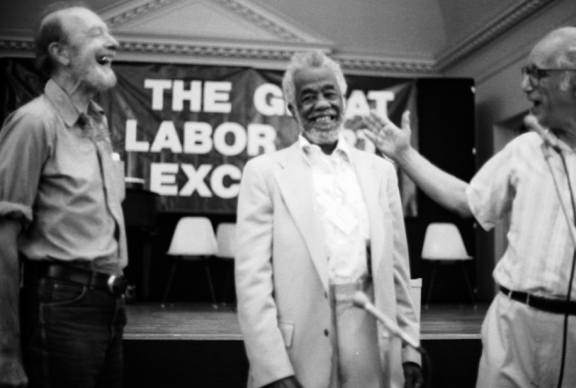
- John disappeared from music and poetry for nearly fifty years before he contacted Labor Heritage Foundation (LHF) Chair Joe Glazer. Joe alerted Pete Seeger and the Smithsonian's Ralph Rinzler and, in 1985, John was invited to the Great Labor Arts Exchange in Silver Spring, Md. In 1989 he received LHF's first annual Joe Hill Award for his work in the advancement of workers' culture. John was honored by the Western Workers Heritage Festival where he shared performance and workshop stages with many West Coast musicians and California activists.
- John Handcox died on Sept. 18,1992 in San Diego, California. At his memorial service the minister of the New Creation Church praised him as a "champion of the working man's cause."
|
|
Pete Seeger, John Handcox & Joe Glazer
Photo: Larry Rubin
|
|
(1:10 min.)
by
John Handcox
Note: The Original Talking Union with the Almanac Singers and other Union Songs (1955) included a folk-style version performed by
|
|
performed by
Village Harmony
Arrangement by Avery Book
Note: This video is from a Village Harmony concert held in Montpelier, Vermont in 2019. Avery Book is an organizer for the American Federation of Teachers (AFT Vermont) and is active in the Vermont Workers' Center.
|
|
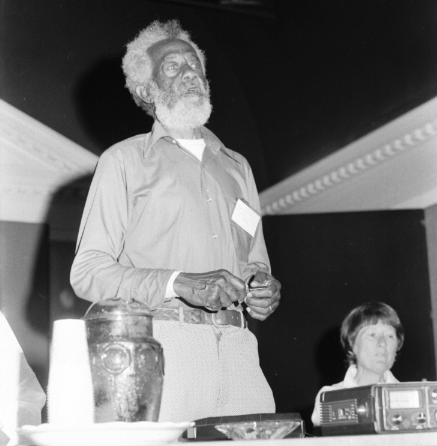
With Candie Carawan at the Great Labor Arts Exchange.
Photo by Larry Rubin, 1985.
|
|
Author Michael K. Honey is a historian and Haley Professor of Humanities at the University of Washington Tacoma where he teaches African-American, civil rights and labor history. Mike also wrote Going Down Jericho Road : The Memphis Strike, Martin Luther King's Last Campaign (2007).
|
|
Be Consolated
by
John Handcox
(1937)
Be of good cheer; be patient; be faithful.
And help the union to grow strong.
And if at any time you become the least discouraged.
Revive yourself by singing the good old union song.
|
|
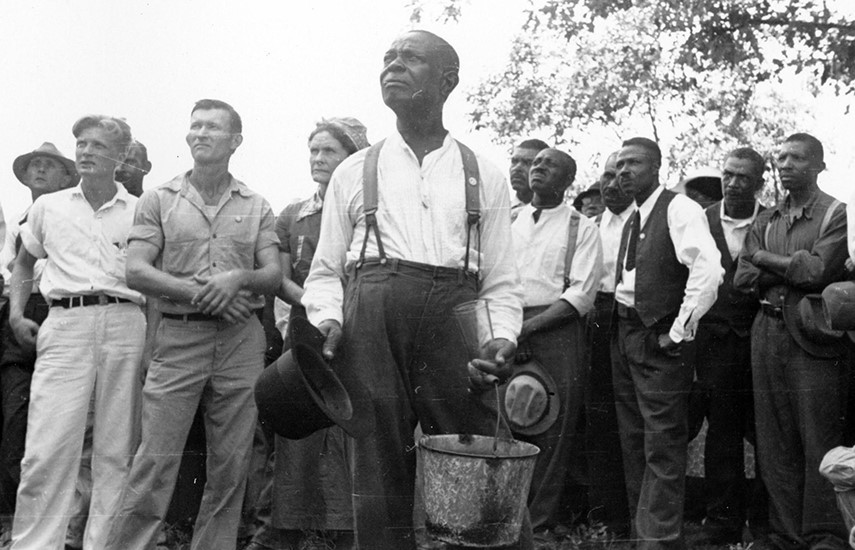
The Southern Tenant Farmers Union
Photo: Mean Things Happening in this Land by H. L. Mitchell
|
|
Sources form which I summarized, paraphased or quoted directly:
"Sharecropper's Troubadour : Songs of Solidarity in Hard Times" by Michael Honey, Smithsonian Folkways Magazine, Summer/Fall 2014; "John Handcox, 1905-1992," Labor Heritage Foundation Art Works, Fall/Winter 1992-93; Wikipedia; "Union Organizer, Songwriter John L. Handcox is Dead at 88," Los Angeles Times, 9/25/1992; "Socialist Gains Belated Recognition," Los Angeles Times, 4/14/1985; "Death Silences John Handcox," California AFL-CIO News, 9/25/1992.
|
|
|
|
|
|
|