How global conflict impacts the U.S. housing market
Global conflict affects housing through several key channels:
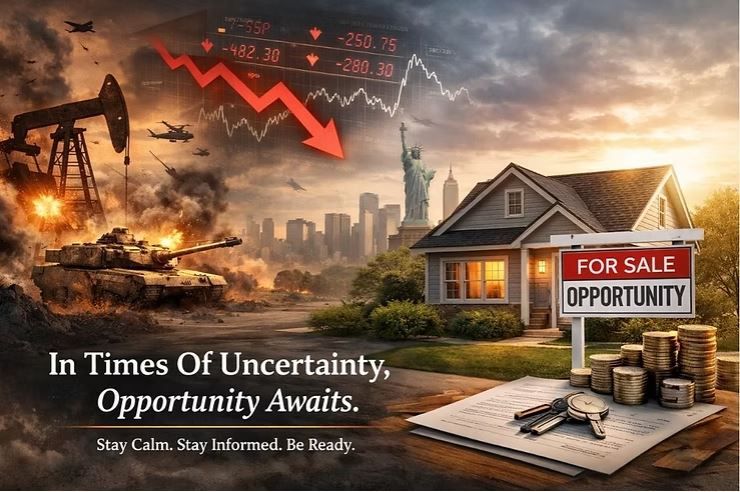
- Oil prices and inflation pressure: War and geopolitical instability, particularly in energy-producing regions, often disrupt oil supply. When oil prices rise, transportation, construction materials, and everyday living costs increase. This feeds inflation, prompting central banks to hold interest rates higher for longer. Higher rates can slow buyer activity, but they also reduce competition and cool overheated markets.
- Stock market volatility and buyer psychology: When global conflict rattles financial markets, investors often pull back. Stock market uncertainty shifts wealth behavior: some investors pause, while others move capital out of volatile equities and into hard assets like real estate, which historically provides long-term stability. At the same time, everyday buyers become cautious, not because housing fundamentals are weak, but because fear dominates decision-making.
- Uncertainty creates hesitation, not collapse: Contrary to popular belief, uncertainty does not automatically mean a housing crash. In most cases, it creates indecision. Sellers delay listing. Buyers wait for “clarity.” Transaction volume slows, but prices often stabilize rather than collapse, especially in markets with housing shortages. Fear reduces noise. And reduced noise is where strategic buyers thrive.
Why scared markets often create the best buying opportunities
Real estate history is clear. The best buying windows rarely feel comfortable. When people feel confident, prices are high, and competition is fierce. When people feel scared, opportunities quietly appear. In uncertain times:
- Fewer bidding wars
- More negotiable sellers
- Increased concessions and incentives
- Better terms for prepared buyers
Those who stay informed, not emotional, gain leverage.
The psychological side: Staying focused when the world feels unstable
Fear is contagious, but so is perspective. When global headlines feel overwhelming, it’s critical to separate what you can’t control from what you can. You can’t control wars, oil markets, or political tension. But you can control:
- Your financial education
- Your long-term strategy
- Your mindset
Staying focused on fundamentals, employment trends, local housing supply, population growth, and long-term demand keeps decisions grounded in reality rather than emotion.
Real estate as a stabilizing force in unstable times
Housing is not just a financial asset, it’s a basic human need. People will always need a place to live, regardless of global conflict. That reality gives real estate a unique resilience. For long-term investors and homebuyers, uncertain times can offer:
- Entry points that won’t exist in euphoric markets
- Appreciation potential when stability returns
- Protection against inflation over time
Fear fades. Assets remain.
A final thought: Calm is a competitive advantage
Every major conflict in history has eventually passed. Markets recover. Economies adapt. Those who stayed calm, informed, and intentional during turbulent periods are often the ones who benefited most afterward.
Uncertainty doesn’t mean stop, it means be selective, be strategic, and be patient. When others are frozen by fear, clarity becomes your edge. And sometimes, the best time to plant seeds is when the sky looks uncertain, because that’s when growth begins.
|