ASBURY FIRST MONDAY READER | SEPTEMBER 28, 2026

CONTENTS:

LOVE THEY NEIGHBOR: HELP WITHIN REACH by DAVID STITH

WORLD COMMUNION SUNDAY: A CELEBRATION OF UNITY AND SERVICE

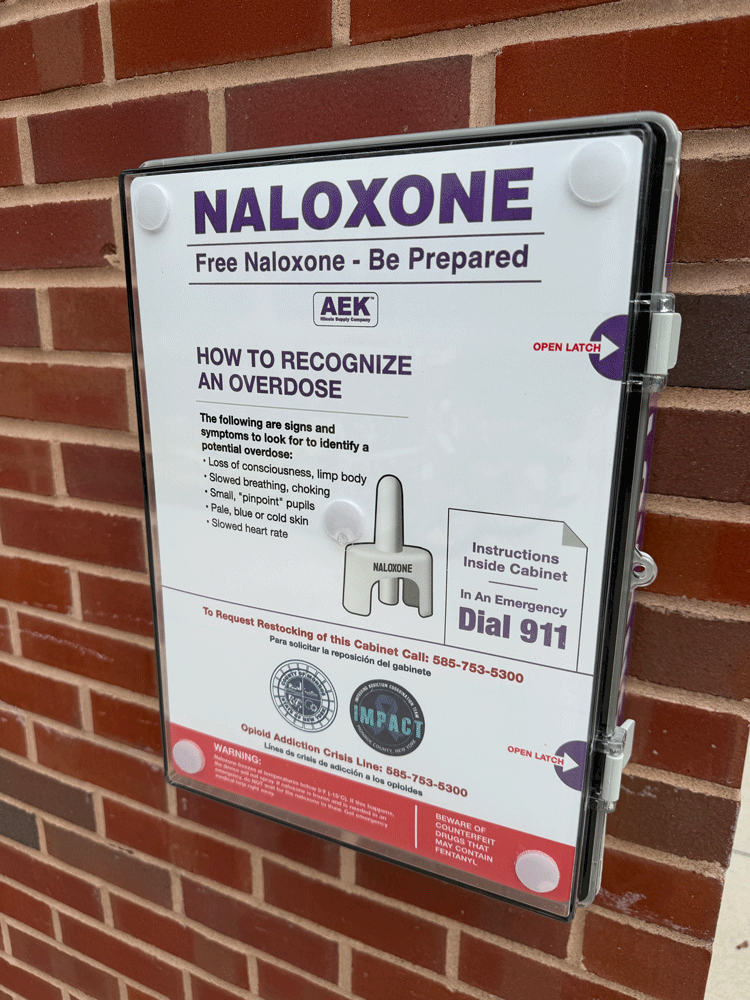
Keen observers who spend a lot of time on the Asbury First campus may have noticed something new lately: small boxes appearing on the side of the donation building, tucked into corners of the Community Outreach Center, quietly mounted in all three of our buildings. These aren’t decorative or incidental. They hold Naloxone, also known as Narcan, a medication that can reverse an opioid overdose in minutes and give someone a second chance at life.


Rochester, like so many communities across the country, has been living through a surge in opioid overdoses driven largely by fentanyl, a synthetic opioid many times more potent than heroin, often mixed into other drugs without the user's knowledge. A small miscalculation, a single pill, can be fatal. This crisis sits uncomfortably close, happening on our streets, in our neighborhoods, and within families that sit in our pews. 


This past Thursday, a small group of Asburians gathered to learn from the Monroe County Department of Public Health about the opioid crisis and about two of the tools making the greatest impact in lowering the yearly overdose numbers: Narcan, of course. But also a tool whose strength we so often underestimate: language. The way we speak to each other about addiction can add poison to an already deadly recipe.


Addiction doesn't respect zip codes or income brackets. It grips people who are housed and unhoused, employed and unemployed, churched and unchurched. If we want to be part of the solution, we have to retire the language of blame and shame, the assumption that overdose is something that happens to "other people" because of moral failure. An overdose is a medical emergency, and the people caught in it are our neighbors.

These small boxes are one way our church is trying to live that out, ensuring that if any of us ever encounters someone in crisis, help is within reach, not out of ignorance but out of love. Knowledge is power, and in this case, it might be the difference between life and death.


If you’d like to learn more about Narcan, Naloxone, or the work the Monroe County Department of Public Health is doing to slow the effects of fentanyl and other deadly street drugs in our community, visit www.monroecounty.gov/opioid-narcan. Every day there are new ways to love your neighbor. 

To learn where on our campus these boxes are located, click here.

Next Sunday, the first Sunday in October, Asbury First will join United Methodist churches and many other churches across the globe in celebrating World Communion Sunday.


World Communion Sunday began as World-Wide Communion Sunday at Shadyside Presbyterian Church in Pittsburg, Pennsylvania in 1933. The Rev. Hugh Thompson Kerr and his congregation sought to demonstrate the interconnectedness of Christian churches, regardless of denomination.


Rev. Kerr appropriately chose the sacrament of Holy Communion to symbolize this unity.


“The term Holy Communion invites us to focus…on the holiness of our communion with God and one another,” states This Holy Mystery, The United Methodist Church’s official statement on the sacrament.


In 1940, the Federal Council of Churches of Christ in America, which included all of the predecessor denominations of The United Methodist Church, adopted World-Wide Communion Sunday. The global celebration occurs on the first Sunday in October.


In connection with the celebration of World-Wide Communion Sunday, the Methodist Church collected a special offering for the Fellowship of Suffering and Service. The Methodist Commission on Overseas Relief, the forerunner of today’s United Methodist Committee on Relief received half of the offering. The other half was divided between two agencies that ministered to military members: the Methodist Commission on Chaplains and the Methodist Commission on Camp Activity.


Today, The United Methodist Church celebrates World Communion Sunday with congregations all over the globe. Followers of Jesus Christ in large churches and small, on farms and in cities, in ornate buildings and under tents, gather to receive the bread and cup of Holy Communion.


Some will receive cubes of bread. Some will tear from a common loaf. Some will receive a wafer.


Some will drink from a common chalice. Some will dip a piece of bread into the cup. Some will have individual glasses.


Some will use wine; some juice. Some will offer both.


Pastors will lead a variety of liturgies, in many languages. Clergy will dress traditionally, formally, and casually.


Despite the differences in our denominations and traditions, we celebrate our unity in Jesus Christ, our Lord and Savior.


In The United Methodist Church, World Communion Sunday continues to be a special giving Sunday. The monies raised help provide scholarships for racial and ethnic minority students in the US, and students worldwide.


Give generously to The United Methodist Church’s World Communion offering. Your gifts will assist those whom God has gifted to learn and to serve in the name of Jesus Christ.


Learn much more about the World Communion Sunday offering, and our other special giving Sundays at umcgiving.org.


Joe Iovino, UMC.org, United Methodist Communications, Nashville, TN.

Would you like to submit a story for inclusion in a future Monday Reader? Please do! 
We'd love to hear from you. Email David Stith at
dstith@asburyfirst.org to get started.

Asbury First United Methodist Church

1050 East Avenue, Rochester NY, 14607

(585) 271-1050

Facebook  Instagram  Youtube