|
By Dr. Barbara Ley Toffler
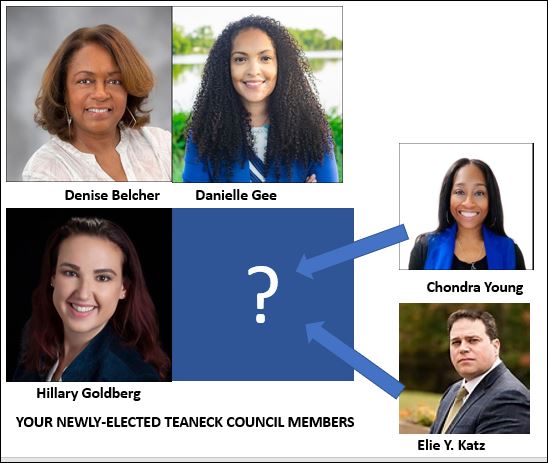
Tuesday night, November 8, 2022 we all were at the RISE 4 Teaneck party at Regina’s Restaurant, waiting for the results of the first Council election to be held at the general election in November. Our Fabulous Four Candidates -- Denise Belcher, Danielle Gee, Hillary Goldberg, Chondra Young – and their families were there. So were so many people from so many communities in Teaneck!
There, of course, were the four Women candidates. There were people of every color skin imaginable – Black, White, Brown, Ivory, Bronze, Tan and Tawny. There were a variety of head coverings – hijabs, kippahs, baseball caps (Yankees AND Red Sox). And all these colors and coverings were all mixed around the room. Everybody was talking to everybody!!
In between the cheering, the kisses, the hugs, the hi-fives, and the fist bumps, the same words were murmured or shouted around the crowded event: “This is what Teaneck looks like!” “This is the real Teaneck!” “This is us!”
But Regina’s was even more crowded on election night than it appeared. In the hearts and minds of all in the room were the many giants on whose shoulders we all stood – the giants who created the plan and fought for integrated schools and the equally impassioned giants who created the Teaneck Fair Housing Committee.
It is impossible to name the many, many courageous heroes of 1953 to 1965, but a few will serve symbolically for ALL.
There were Dr. Archie Lacey, husband and activist partner of Theodora Lacey, June and Mort Handler who with Clarice and BOE Trustee Ted Ley and Town Attorney Jack Schneider started the non-profit Teaneck League for Better Schools in 1953, School Superintendent Dr. Harvey Scribner, BOE members including Lamar Jones, Bernard Confer, George Larson, Dr. Milton Bell, Seymour Herr who voted for integration, Head of The Teaneck Fair Housing Committee (TFHC) Mrs. Myrna Gillespie, and pro bono attorney for TFHC the late NBA Commissioner David Stern.
From the Board of Education election in February, 1953 to the Board of Education and Council elections in November, 2022 – almost 70 years of activism, courage, incredibly hard work came to a well-earned NEXT STEP in Teaneck’s commitment to diversity, inclusion and equity in the model town of Teaneck, NJ.
History of the Desegregation of Teaneck Schools
(Bergen Record, May 11, 2014, 50 years after the historic vote to desegregate Teaneck’s Schools)
1953 - A budget referendum to expand and build schools to accommodate the township's growing Jewish and African-American population was defeated, with some attributing it to prejudice against Jews and blacks.
May 27, 1953 - The Teaneck League for Better Schools, a Jewish-led political association, forms to campaign and endorse candidates supporting school expansion, reform and, later, racial integration.
May 17, 1954 - U.S. Supreme Court rules racial segregation in public schools is unconstitutional in Brown vs. Board of Education of Topeka, Kan.
1955-1960 - More African-Americans move to Teaneck, leaving urban areas for the suburban town because of its reputation for welcoming minorities. However, racial steering by real estate agents creates majority black neighborhoods in northeast Teaneck and segregated neighborhood schools.
1961 - Newly hired schools Superintendent Harvey Scribner works with residents to integrate the town's schools.
1962 - African-American residents and school officials propose a volunteer-based busing program, which fails when only 13 black families and one white family sign up.
1964 - North East Community Organization, an interracial association started by African-American residents in the northeast section of Teaneck, formed to advocate for quality services and schools in the township.
May 13, 1964 - Teaneck becomes the first town in the nation to voluntarily integrate its schools when the Board of Education votes 7-2 in favor of busing students to a central sixth grade.
September 1964 - White and black sixth-graders attend class together at the integrated William Bryant School.
February 9, 1965 - Pro-integration voting bloc elects a school board that affirms districtwide integration.
|