September 2022 Newsletter |
|
PacIOOS Tools and Services |
|
Pauwela Wave Buoy Redeployed |
|
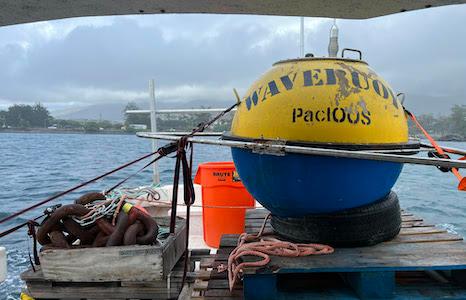
Mahalo nui to our partner, Young Brothers, for their support in transporting the boat, trailer, and truck from O‘ahu to Maui, and to Donna Brown and Melvin Hipolito at the University of Hawai‘i Maui College for receiving, storing, and staging the buoy prior to the deployment. [Photo: En route to the wave buoy mooring site. Credit: Olivia Hughes, PacIOOS]
|
|
Governing Council Membership Update |
|
Elections were held to fill five seats on the PacIOOS Governing Council. Elected for three-year terms, the incoming members will join our diverse council with representation from across the Pacific Islands region. Aloha and welcome to the following returning members: Billy Middleton, Liquid Robotics, Inc. (Hawai‘i seat); Erbai Xavier Matsutaro, Republic of Palau Office of Climate Change (Palau seat); Moriana Phillip, Marshall Islands Environmental Protection Authority (Marshall Islands seat); Ray Tanabe, NOAA National Weather Service Pacific Region (Regional seat); and Matt Ramsey, Western Pacific Regional Fishery Management Council (Regional seat).
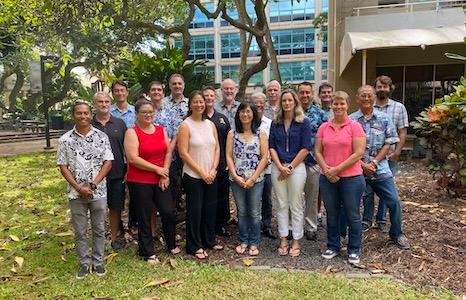
The full Governing Council will gather for its annual meeting on November 30th and December 1st, 2022, to advise on ongoing and future directions for PacIOOS and identify opportunities for synergy and collaborations to support ocean data needs. [Photo: Former PacIOOS Governing Council. Credit: PacIOOS]
|
|
Backyard Buoys Awarded Cooperative Agreement with National Science Foundation |
|
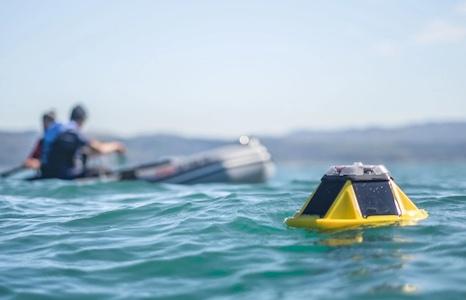
Backyard Buoys was awarded a $5 million cooperative agreement with the National Science Foundation Convergence Accelerator program to advance the project from Phase I to Phase II. The goal of this project is to empower Indigenous and other coastal communities in the Pacific Northwest, Alaska, and the Pacific Islands to collect, steward, and use wave data that complements their existing knowledge to support their blue economy. Through the collaboration among three IOOS Regional Associations ( NANOOS, AOOS, PacIOOS), Indigenous partners in each region, educational partners, and a wave buoy developer known as Sofar, Phase II will focus on multiple deliverables. These include co-developing Community Research Implementation and Stewardship Plans with communities to deploy and maintain low-cost Spotter buoys; co-designing web applications for easy access to near real-time wave and ocean data from the buoys; developing training modules to increase local capacity; and co-producing educational materials that integrate both Indigenous knowledge and ocean data from the buoys. Stay tuned for more updates! [Photo: Spotter buoy collects and transmits ocean data. Credit: Sofar] |
|
Western Pacific Regional Fishery Management Council Meetings |
|
The Western Pacific Regional Fishery Management Council held five public meetings this month in Honolulu, O‘ahu with opportunities for remote participation from across the Pacific Islands region. The meetings provided a platform for the public to provide input and recommendations to the Council surrounding fishery management issues in the Western Pacific region. PacIOOS presented at two Council meetings: 145th Scientific and Statistical Committee Meeting and 192nd Council Meeting. Director, Melissa Iwamoto, and Deputy Director, Jordan Watson, provided updates on PacIOOS operations, services, and tools, particularly the PacIOOS Voyager, an interactive mapping tool. Acoustic telemetry node manager, Tom TinHan, presented the Pacific Islands Region Acoustic Telemetry Network, which fosters data sharing and collaboration among scientists and researchers using acoustic telemetry as a research technique for the study of aquatic animals. |
|
NOAA Hydrographic Services Review Panel Public Meeting |
|
PacIOOS participated at the NOAA Hydrographic Services Review Panel (HSRP) public meeting, which included more than 28 presentations on matters relating to safe navigation, marine transportation, mapping and surveying, coastal spatial planning, and ocean stewardship. The meeting took place in Honolulu, O‘ahu and was open for public and stakeholder participation to express viewpoints on the value of National Ocean Service (NOS) products, and to offer recommendations to improve NOAA’s navigation, observation, and positioning data, services, and products.
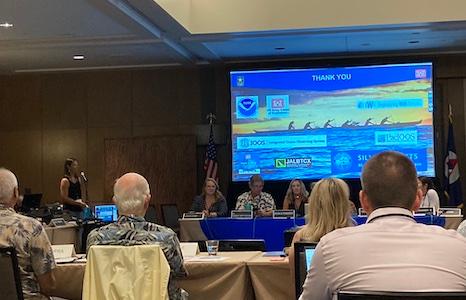
PacIOOS Director, Melissa Iwamoto, and HSRP Chair, Julie Thomas, co-moderated the session, “The Role of the Pacific ‘Ohana in Keeping Your Feet Dry on the Shoreline: NOS and NOAA’s Flooding, Inundation, Sea Level Data, Products and Service.” The session facilitated discussions on the use of NOAA data, services, and products to measure and monitor flooding and sea level rise in Federal, state, and local projects throughout Hawai‘i and the Pacific Islands. Several PacIOOS Governing Council members and partners presented on topics relating to local partnerships, operational needs, and climate resiliency. To view the presentations, visit the NOAA website. [Photo: PacIOOS Director co-moderating a panel during the HSRP. Credit: Jordan Watson, PacIOOS] |
|
14th Marine Technology Society Buoy Workshop |
|
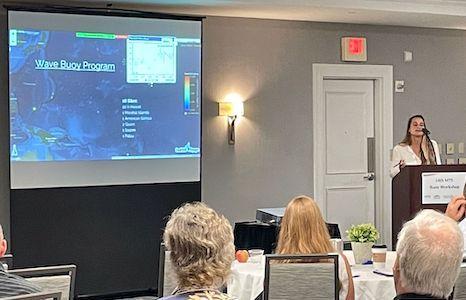
Hosted by the University of North Carolina Wilmington's Coastal Ocean Research and Monitoring Program, the four-day buoy workshop brought together operators, designers, assemblers, and users of buoy systems to exchange knowledge and insights of buoy-related work and projects. PacIOOS oceanographic technician, Andreia Queima, presented on the PacIOOS Wave Buoy Program and the value of providing reliable real-time wave data to inform harbor operations, validate wave forecasts, and assess coastal impacts. "The workshop was a super rich experience, and the real takeaways happened in the discussions, where experts in the field shared ideas, experiences, and suggestions about mooring design, failures, and solutions," Andreia said. [Photo: Andreia sharing about PacIOOS’ wave buoy network. Credit: John Yeh, Makai Ocean Engineering] |
|
Aloha New Deputy Director |
|
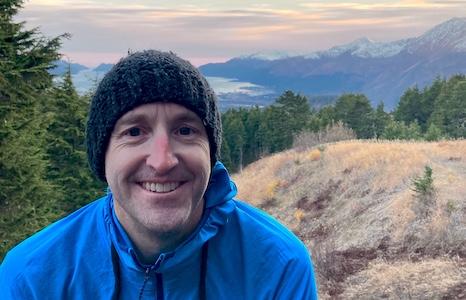
We are excited to welcome Jordan Watson to the PacIOOS team as our new Deputy Director. In this O‘ahu-based position, his primary role is to manage the operation and growth of data, outreach, and observing system components within PacIOOS.
Jordan comes to us most recently from the NOAA Alaska Fisheries Science Center where he worked for the last decade as a quantitative fisheries biologist, focusing on the role that environmental variability plays on fish and fishing distributions. In addition, he worked extensively on the development of more accessible and automated fishery data systems. Earlier this year, he completed a six month detail as the Deputy Director for the NOAA Center for Artificial Intelligence, where he engaged with leaders and researchers to expand artificial intelligence across NOAA’s mission areas, from fish to hurricanes.
Jordan has a PhD in fisheries from the University of Alaska Fairbanks, a masters in aquatic and fishery sciences from the University of Washington, and a B.S. in chemistry from the University of California Santa Barbara. When he isn't thinking about data, he can be found trail running, backcountry skiing, and doing just about anything in the ocean.
|
|
|
|
|
|
|