Greetings from home
We hope that you and your loved ones are well and safe. Nunavut continues to be one of the few places on earth with no reported cases of coronavirus.
As we head into the autumn and winter, continuing to shelter at home with rare, carefully planned excursions, we acquire more bits of odd knowledge. If you are looking for indigenous-themed face masks, you can find attractive selections at the McMichael Collection shop featuring Northwest Coast and Woodland designs.
|
|
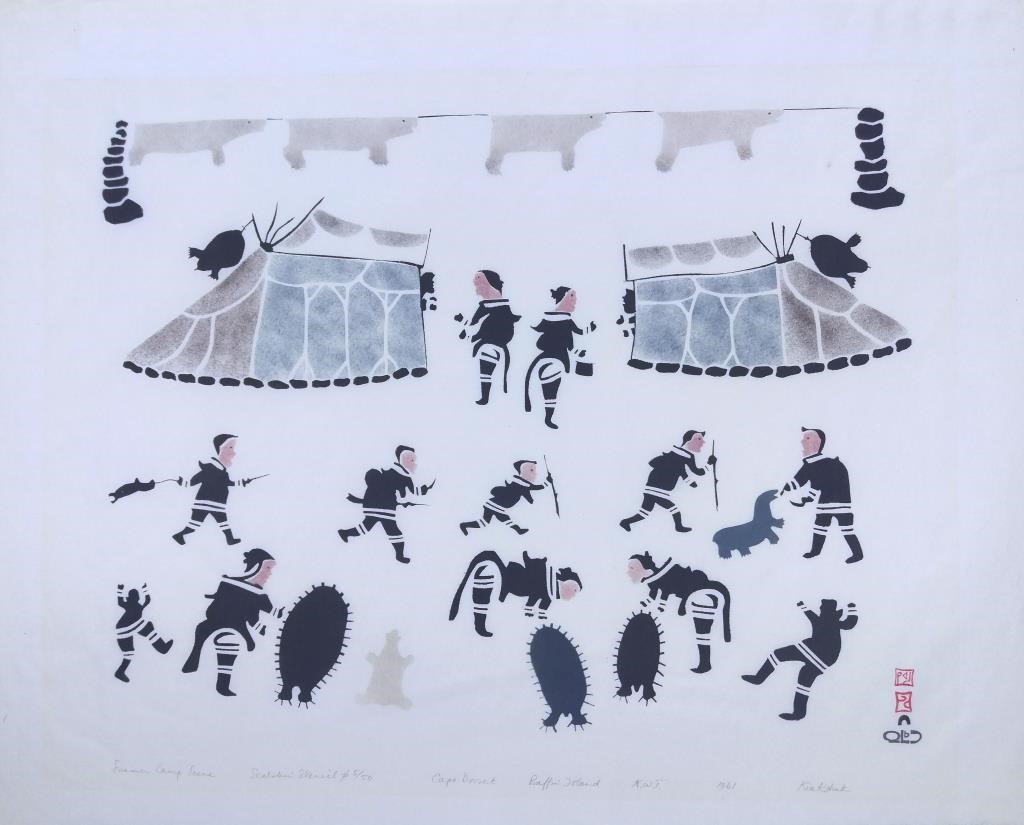
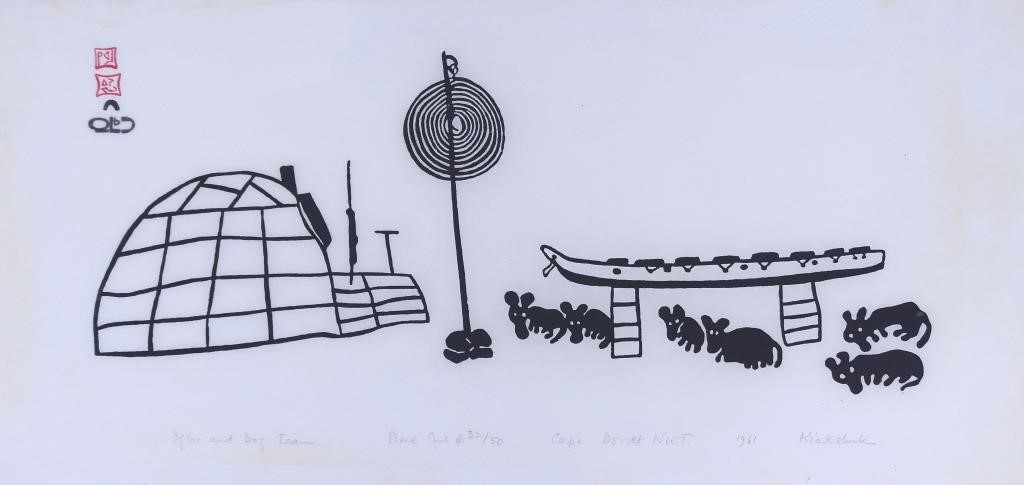
We have the good fortune to have three prints by Kiakshuk from 1961 and one from 1960, which demonstrate his mastery of a range of techniques.
Kiakshuk was born in 1886, and lived on the land most of his life. The Canadian government started to move the Inuit into permanent settlements in the 1950s, and Kiakshuk settled in Cape Dorset. When he was about 70, James Houston introduced printmaking techniques in Cape Dorset, and Kiakshuk became one of the first generation Inuit printmakers. In the last 10 years of his life, Kiakshuk produced 72 prints, consisting of 28 stonecuts, 23 engravings, 11 stencils, 4 stonecut-and-stencils, and 6 in other media.
Kiakshuk's subjects are primarily scenes from daily life, like "Summer Camp Scene," above. The print is made with a stencil, which allows for the soft colors in the tents and the polar bear skins drying on a line. In the foreground, women are drying sealskins and another polar bear skin, while the men and boys are off to hunt. The scene is both full of motion and serene.
|
|
"Igloo and Dog Team" is a stonecut, executed in black and white. Unlike "Summer Camp Scene," which is full of motion, "Igloo and Dog Team" is a still life. The dogs are all lying down under the komatik, or sled. Their harnesses are coiled neatly on a pole (where the dogs cannot reach them and chew on the sealskin harness). The igloo's construction is clearly depicted, but with no attempt at perspective. The dogs look like oversized mice. Although Kiakshuk clearly could draw more realistic animals -- as shown by the other two prints described in this newsletter -- in his stonecuts he frequently favored more abstract, almost cartoonish animals. Nevertheless, his compositions are sophisticated. See, for example, "Driving Moulting Geese into Stone Pens," "Three Bear Hunters," and "Legend of Lumiuk." The extreme example of this is "Stone Images Mark the Western Sea Route," in which he creates an animated parade of inukshuks.
|
|
"Owl Attacking Snow Goose" is completely different from "Summer Camp Scene" and "Igloo and Dog Team." It is a simple narrative. The two birds share the same wings, but the goose is a simple outline, while the owl is heavily textured. Kiakshuk's fondness for small accents is revealed in the goose's tongue, making it clear that the goose is squawking in terror. |
|
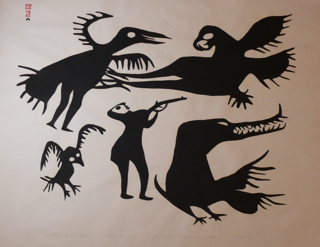
The last of our four Kiakshuks is from 1960. "Kikavik and the Hunter" shows an owl with outstretched wings (kikavik), a hunter, and three fantastic bird spirits. It is an arresting composition, and one of a series of prints of fantasy birds that came from Cape Dorset masters in the early 1960s. See Kenojuak Ashevak's "Night Spirits, " Pitseolak Ashoona's "Man with Beasts," and Angotigolu Teevee's "Spirits Reaching for the Moon,"
Look at these four prints, and reflect on the fact that these are the work of a 75-year-old man who had just been introduced to the concept of drawing and printmaking. Kiakshuk was, at the beginning of the Cape Dorset print workshop, a true precursor of what Kenojuak Ashevak would become. In her 80's, Kenojuak was still learning new techniques and demonstrating the breadth of her fertile imagination.
|
|
About
Alaska on Madison
In keeping with our self-description as a virtual gallery run by collectors for collectors, we offer a limited number of pieces. Every piece is one that we would be happy to have in our personal collection, and the description of each piece explains why.
We are happy to assist you with inquiries, with searches for particular pieces or artists, with organizing your collections and with buying or selling at auction. Our Inuit artist search tool is available on our website, and we would be delighted to help you use it. If you prefer to puzzle things out for yourself, Deciphering Inuktitut Signatures will help you to identify artists.
We are always pleased to answer questions or just chat. You can contact us by email or by phone at (908) 487-5757.
Our very best wishes to you all.
Ann and Michael Lesk
|
|
|
Alaska on Madison | (908) 487-5757 | alaskaonmadison@gmail.com | www,alaskaonmadison.com |
|
|
|
|
|
|