The American Society of Le Souvenir Français Inc.
Monthly Bulletin - Vol. IV. No 6 - June 2024
|
|
French Pioneers of the American West
(Part 3 of a series - The Rockies, the Far West and Texas - 1840-1880)
|
|
Cover illustration:
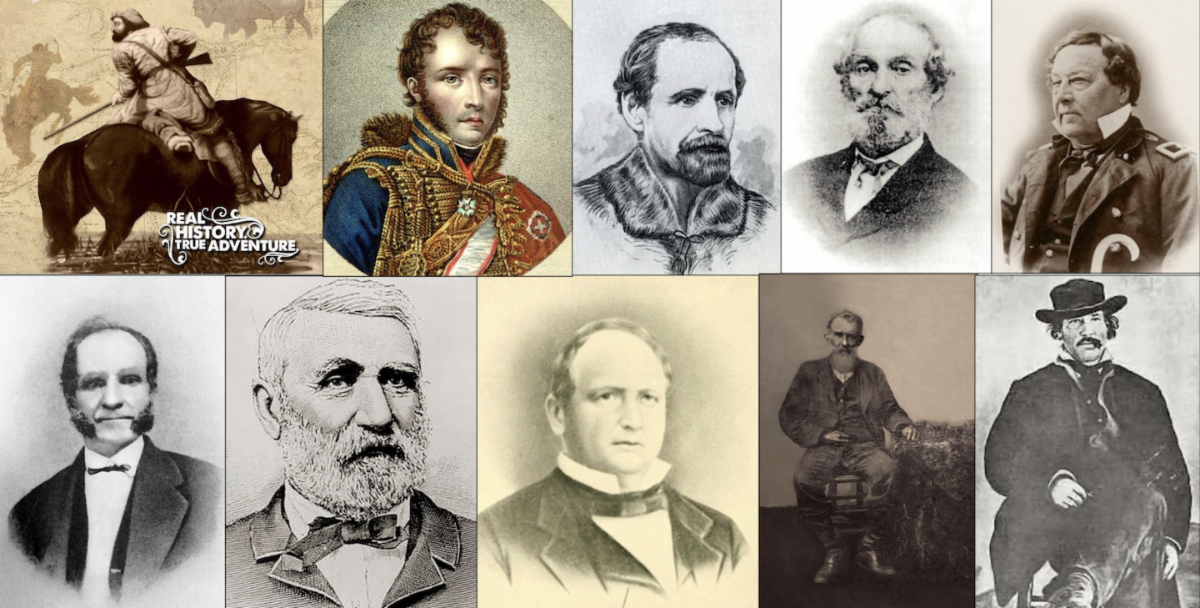
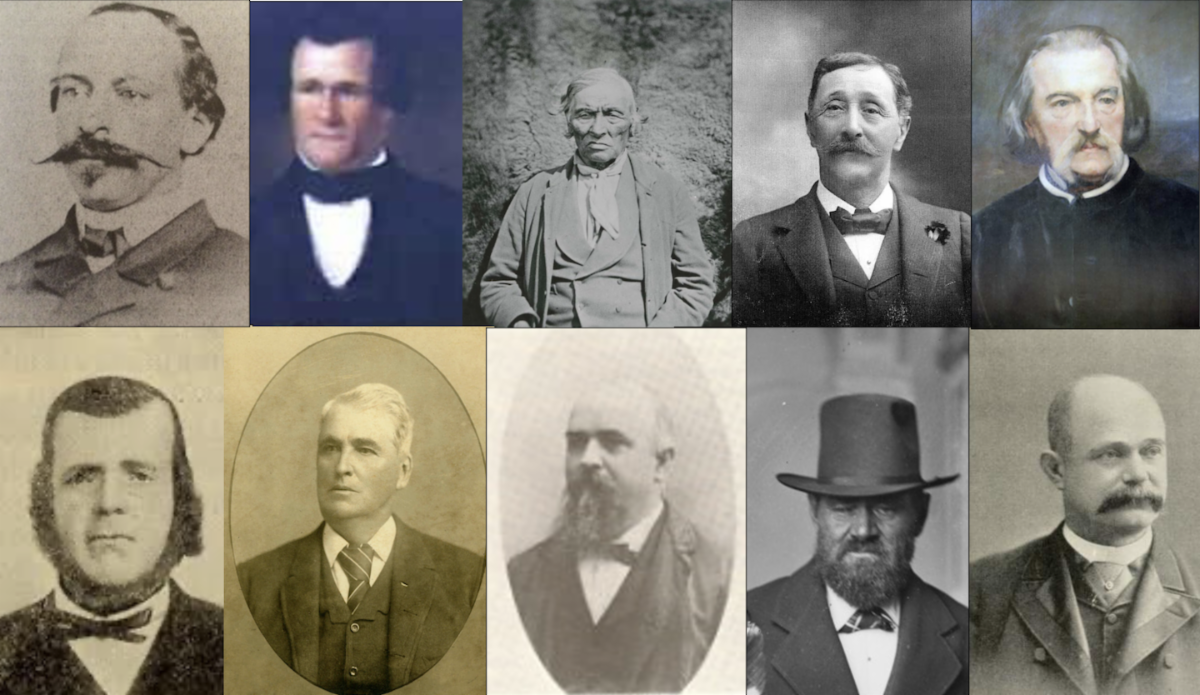
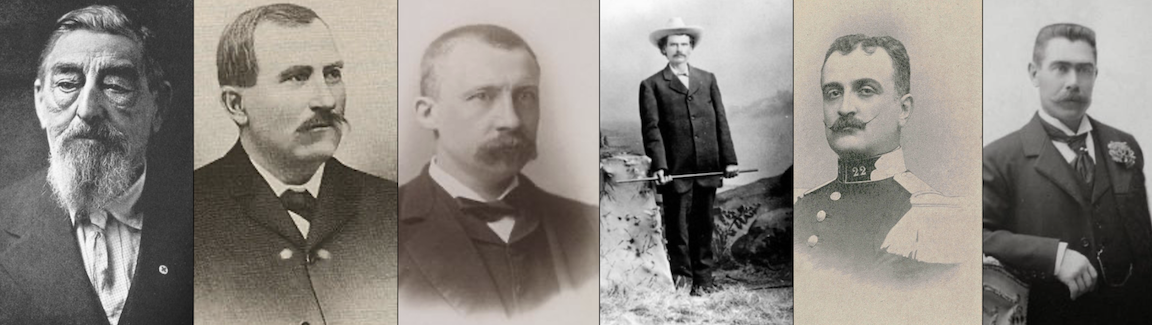
From top to bottom, left to right: Jacques La Ramée, General François-Antoine Lallemand, Etienne Provost, Antoine Robidoux, Captain Benjamin de Bonneville, Charles Larpenteur, Théophile Bruguier, Michel Branamour Menard, Charles Cronéa, Lucien Bonaparte Maxwell, Henri Castro, Pierre D. Papin, Pierre Garreau, Mayer Halff, Victor Considerant, Ceran Saint Vrain, Eugene Pillot,Jacques Adoue, Antoine Janis, Léon Blum, Alexandre Toponce, Charles Armand Schreiner Sr., Louis Dupuy, Thomas de Beau Soleil, Antoine Amédée Marie Vincent Manca de Vallambrosa, Marquis de Morès, Pierre Wibaux.
(photos credits further below)
|
|
EDITORIAL
France has a deep fascination for the "wild west." When I grew up as a young boy in France in the 60's, watching on TV The Adventures of Rin Tin Tin like millions of French kids, my favorite "panoplie" (outfit) was that of a cowboy, and among my preferred comics books were Lucky Luke and Blueberry. Truth be told, I equally liked to don my Indian "panoplie" at various times, as I instinctively felt respect for their bravery in combat - - or was it the appeal of (pretending) smoking the peace pipe?
Iconic figures such as Calamity Jane and Buffalo Bill were household names, and no weekend would be complete without watching a western movie.
Because they were dubbed in French, it never occured to me that John Wayne spoke English... The irony of this personal anecdote is that, after all, it wasn't far from the truth, since many of the very first settlers and pioneers spoke French, as we will discover in this Bulletin, the 3rd part of our series.
In this Bulletin you will meet some very colorful characters. One of them wrote about his long life in the Far West: when reading the "Reminiscences of Alexandre Toponce" you realize that in the 1850's, very few pioneers settled among the Indians, before waves of immigrants ventured with their wagons en route to California.
As summer is about to start, hopefully you will enjoy reading these narratives, and perhaps, if you plan a road trip from Texas to Colorado, or North & South Dakota, Wyoming, Utah, Idaho and Montana, throughout these vast ands and under an immense sky, you will visit several sites with monuments, statues, memorials, markers, tablets, and signs dedicated to these French, French Canadiens and French Metis who gave their names to cities, mountains, and lakes.
As is now a well-established tradition, we pay tribute to all those whose deeds profoundly contributed to the joint history of France and the United States.
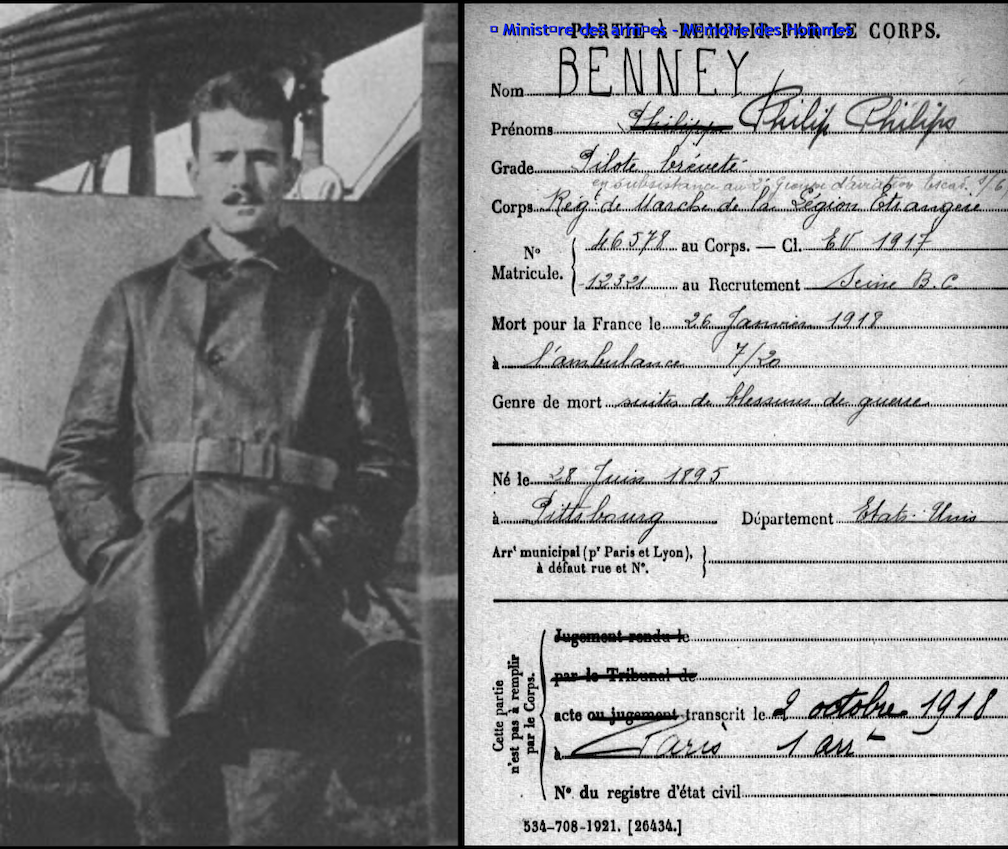
This month, we are paying tribute to Corp Philip Phillips 'Phil' Benney, who “Died for France” and whose remains rest at the Lafayette Escadrille Memorial in Marnes-la-Coquette just outside Paris.
Please read what his French brother-in-arm wrote about him. It is particularly poignant, and very appropriate to ponder during this month of June rich in commemorations.
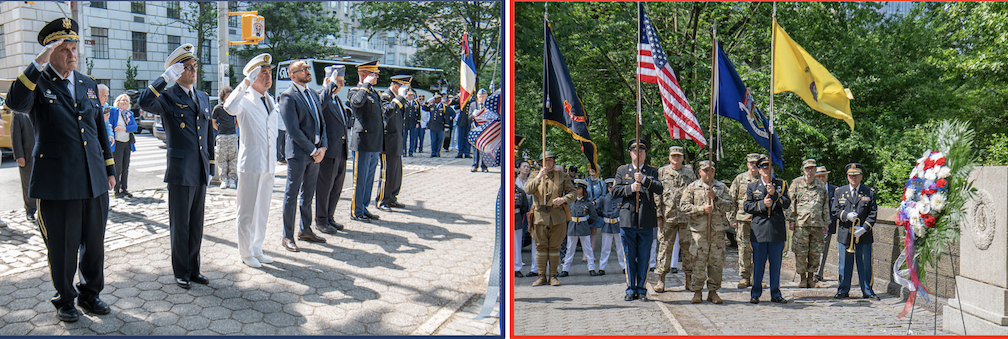
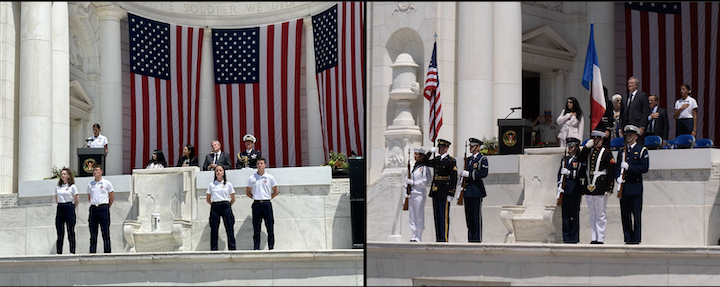
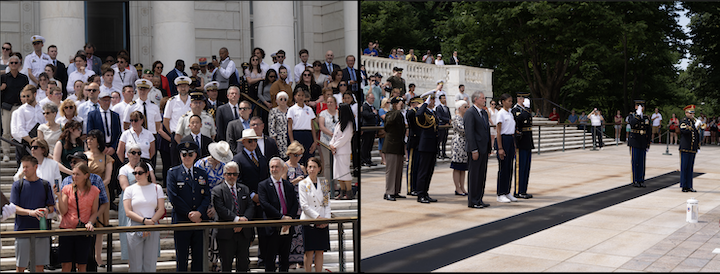
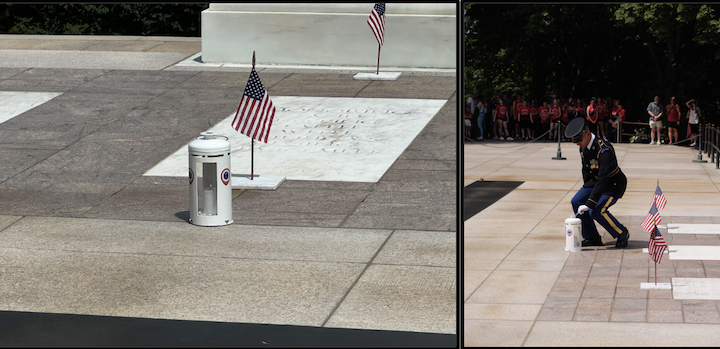
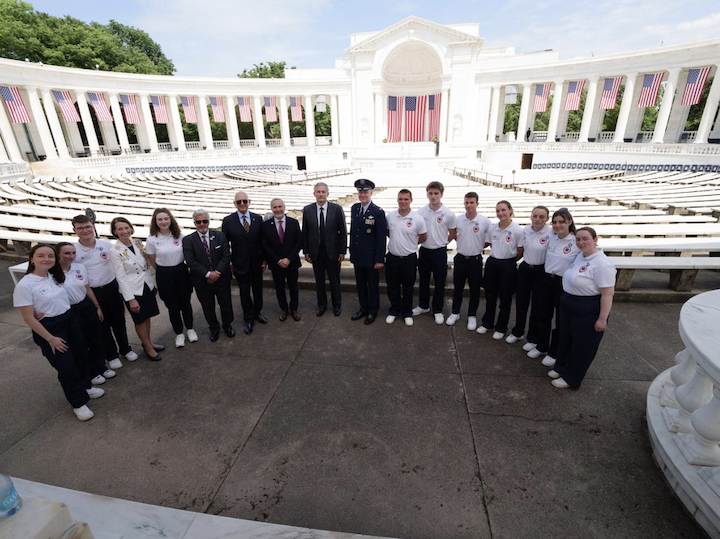
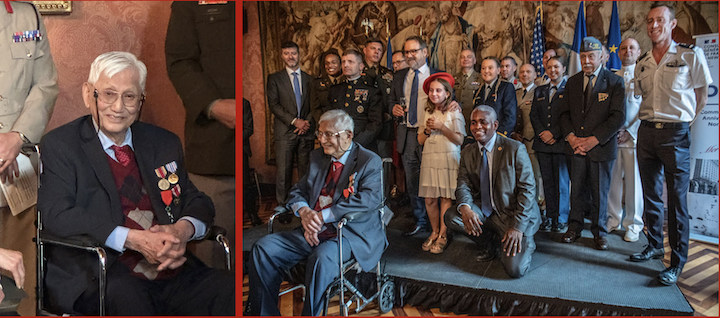
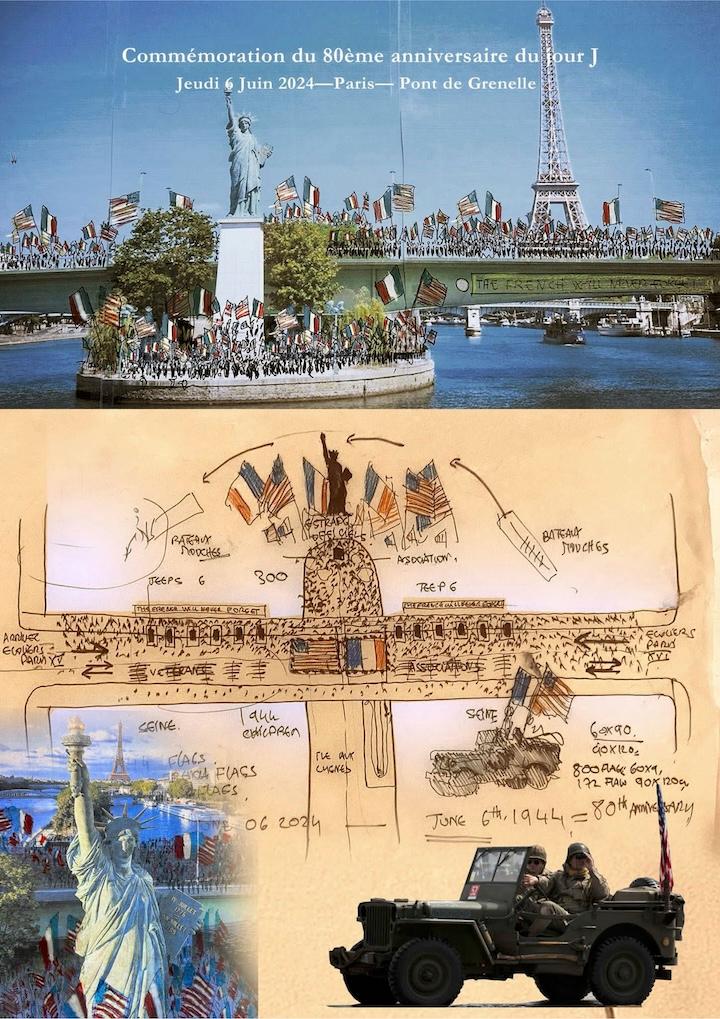
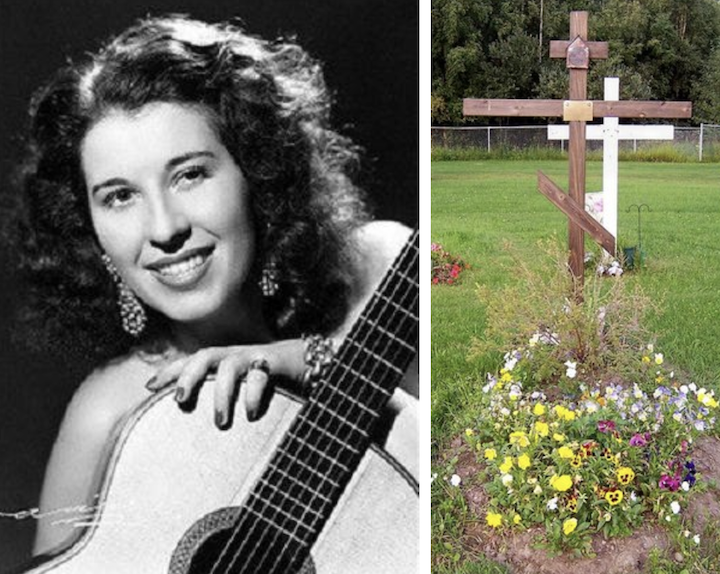
You all saw on TV the coverage of the 80th Anniversary of D-Day in France a few days ago. We will share some photos of two events that took place outside of Normandy: one in the heart of Paris, held on June 6th by our friends of TheFrenchWillNeverForget, the other one far away in Alaska, yet close in our hearts: a tribute to Anna Marly, composer of the "Chant des Partisans", in partnership with the Alaska Chapter of the Daughters of the American Revolution. We will also share photos of "Operation Mirror": 12 young French students brought "The flame of the Nation" from the French Unknown Soldier under the Arc de Triomphe in Paris to the Tomb of the Unknown Soldier at Arlington National Cemetery. These examples showcase the impressive achievements that dedicated citizens can make through their own efforts in our democratic societies.
Speaking of democracy, one of the most illustrious defender of liberty, and "America's best Friend", the Marquis de Lafayette, will take centerstage again! The Bicentennial of the Lafayette Farewell tour is about to debut!
We are honored to have worked all these past few months alongside many devoted volunteers of the American Friends of Lafayette. The Lafayette Bicentennial Committee has finalized the kick-off events in New York.
Please refer to the calendar and program details at the end of this Bulletin regarding the kickoff weekend of Friday, August 16 and Saturday, August 17.
We will of course publish details of many other events that are in the works in the next 13 months, and throughout the 24 States the legendary general visited in 1824 and 1825. You can already get an overview at www.Lafayette200.org. Please support these celebrations with your presence or financial help (the e-boutique is replete with wonderful gifts).
Before that, we look forward to see many of you in Newport, R.I. for the "Tribute to France" weekend on Saturday, July 13, celebrating the arrival of the French troops under Rochambeau on July 11, 1781. The next day is the traditional Bastille Day celebration at Central Park in New York on Sunday, July 14. All details are at the end of this Bulletin.
Wishing you an enjoyable summer...and do consider this road trip to the West!
On behalf of the Board of Directors,
Thierry Chaunu
President, American Society of Le Souvenir Français, Inc.
|
|
A new era starts: the expansion westward |
|
Above:
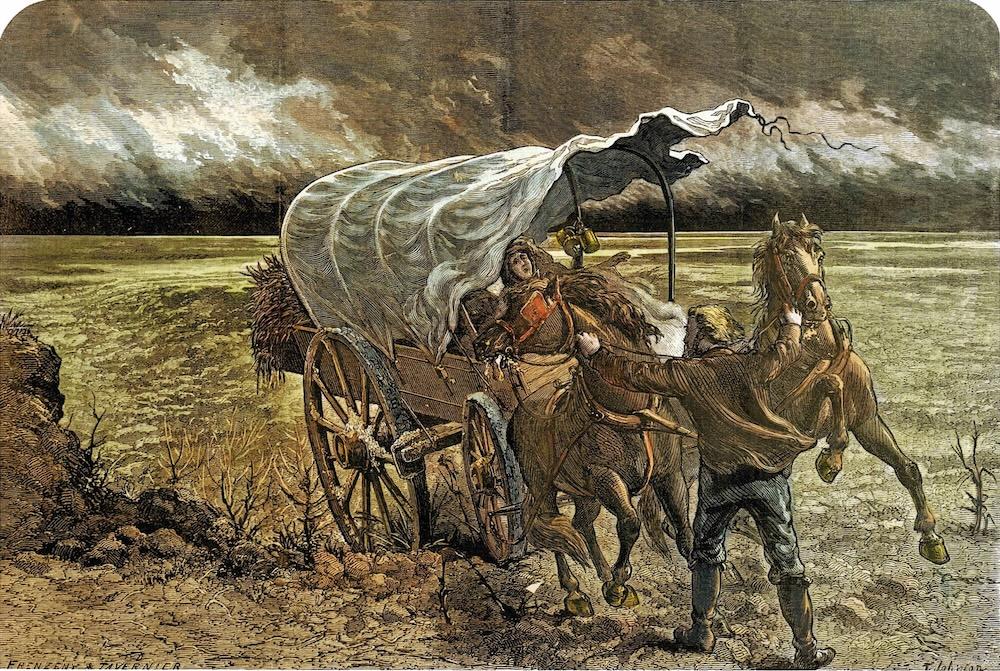
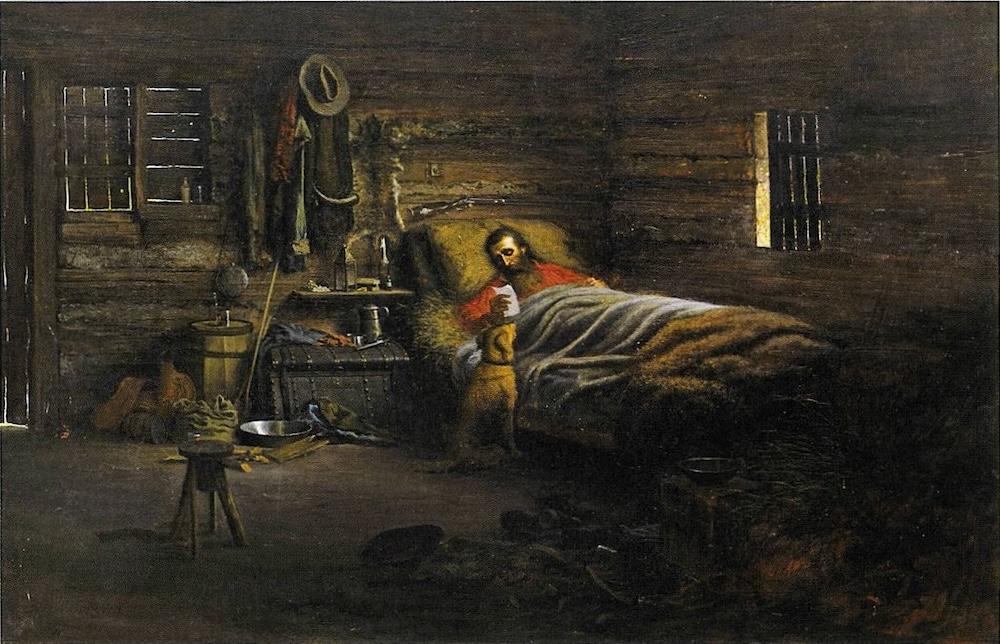
Top: "A Prairie Windstorm" by Paul Frenzeny and Jules Tavernier, May, 30, 1874, wood engraving with later hand coloring for Harper's Weekly, 9 x 13 3/8 in., private collection, By Paul Frenzeny and Jules Tavernier - Jules Tavernier, Artist & Adventurer by Claudine Chalmers, Scott A. Shields, and Alfred C. Harrison Jr., Pomegranate Communications, Portland, Oregon, 2014, Public Domain, https://commons.wikimedia.org/w/index.php?curid=41010672
Middle: "The Pioneer" by Jules Tavernier, 1877, oil on canvas, 29 x 45 in., The Society of California Pioneers. By Jules Tavernier - Jules Tavernier, Artist & Adventurer by Claudine Chalmers, Scott A. Shields, and Alfred C. Harrison Jr., Pomegranate Communications, Portland, Oregon, 2014, Public Domain, https://commons.wikimedia.org/w/index.php?curid=41202352
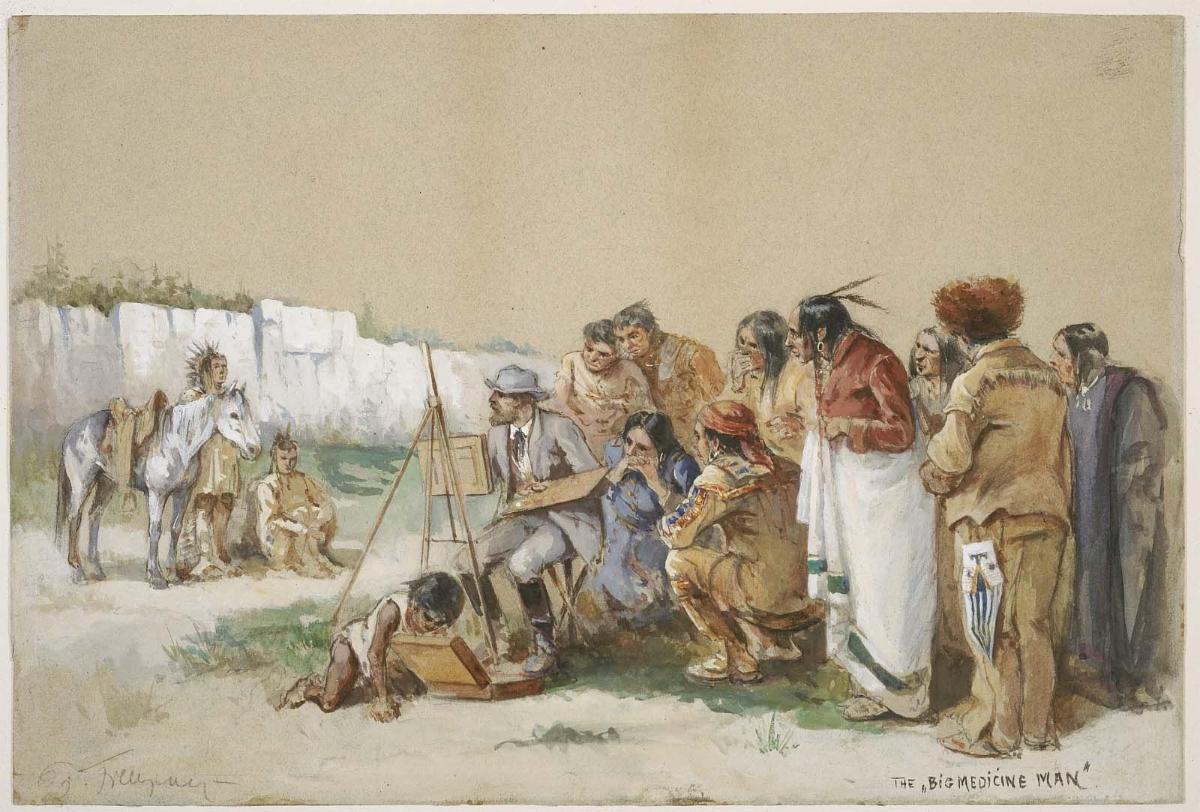
Bottom: "The Big Medicine Man,” 1873-87, by French artist Paul Frenzeny. Transparent and opaque watercolor over graphite pencil on blue-gray paper, 57.256, Gift of Maxim Karolik for the M. and M. Karolik Collection of American Watercolors and Drawings, 1800–1875, Museum of Fine Arts, Boston
Jules Tavernier and Paul Frenzeny travelled together to paint scenes of the Far West.
|
|
Vast lands at the confluence of Spanish, French, and American influences
• As we have seen in our past Bulletins, the French had long established interest in the West, exploring today's States of Wisconsin, Minnesota, Wyoming, North & South Dakota, Iowa, Arkansas, Kansas, Nebraska, Texas, worrying the Spanish on the northern frontiers of their Mexican holdings. Upon entering parts of present-day Colorado, the Spanish encountered evidence of Frenchmen having already visited the Great Plains. Native Americans relayed accounts of French traders arriving from the East, showcasing firearms as proof of increasing trade. As early as 1714, Louis Antoine Juchereau de St. Denis had established trading posts in Texas, in 1739, brothers Pierre Antoine & Paul Mallet brothers explored the Great Plains, and in 1756 Joseph Blancpain established yet another trading post in Texas. French explorers had also ventured into various remote areas.
• Even after France ceded its North American territories in 1763, French traders continued to explore the river systems of the Great Plains. These unnamed fur traders bestowed distinctive names upon familiar landmarks. For instance, Longs Peak and Mount Meeker were referred to as "Les deux Oreilles" (The Two Ears) by early French trappers who observed these prominent features from the plains, and later chosen by Jules Verne as the site of the telescope in his famous science fiction novel "From the Earth to the Moon".
• French names abound throughout the West: Laramie, Wyoming... Deschene, Utah... Havre, Montana... Frenchman Flat, Nevada... Boise, Idaho... Bordulac, ND... Belle Fourche, SD... Montclair, Colorado, La Prele Creek, in Wyoming, Cheyenne, WY (from the French pronunciation and spelling of the Dakota word Sahi'yena, a diminutive of Sahi'ya, a Dakotan name for the Cree people), Grand Teton National Park, WY (from French grands tétons, "large teats" - presumably referring to the mountains' shape)...
• In 1801, Napoleon Bonaparte successfully reacquired French control over the expansive Louisiana territory. Spanish territories began to diminish once more towards the south. However, Napoleon soon grew disillusioned with his vision of a vast North American empire and decided to sell these immense territories to the United States for $15 million, which promptly sent Lewis & Clark to explore a land route to the Pacific (narrated in the March Bulletin, in which many French trappers and guides participated). The disgruntled Spanish now faced a determined new neighbor, a nation with ambitious intentions to assert its claims all the way to the Continental Divide and beyond. The United States said the Louisiana Purchase included Texas, but Spain thought the border was at the Red River...
• The privately-led Long Expedition of 1819 aimed to seize Spanish Texas through filibustering. James Long led the expedition (also assisted by French trappers and guides) and managed to establish a separate government called the Republic of Texas (different from the later Republic of Texas formed during the Texas Revolution). Three French guides assisted in guiding Long's party towards the base of the Rockies. These individuals were identified as Joseph Bijeau, aka Joseph Bissonet, Le Doux, and Julien. Joseph Bijeau was praised as being exceptionally helpful due to his previous experience residing in these regions as a hunter and trapper for a significant period of six years. It was through Bijeau that the Long Expedition gained knowledge about the interior of the Rocky Mountains.
• French fur traders and trappers were not known for their literary talents. Little about their explorations is known; accounts of their journeys are typically vague. Although many of them probably penetrated today's Rocky Mountain National Park, their tracks and tales have long since vanished.
• Historian Hiram Chittenden observed that a mountain man's belongings were simple, including a rifle, traps, knives, hatchets, cooking utensils, tobacco, coffee, sugar, salt, bedding made of buffalo robe, and a horse with pack stock for carrying furs. The mountain men were described by him as "lonely hermits" who enjoyed being alone in the wilderness rather than in civilization. Chittenden depicted them as "ordinarily gaunt and spare, browned with exposure, his hair long and unkempt, while his general make up, with the queer dress which he wore, made it often difficult to distinguish him from an Indian."
• They spoke a jumbled language that combined English, Spanish, French, and Indian words, along with unique expressions commonly heard on the frontier. George Ruxton, a traveler in the 1840s, heard a trapper speak a mix of English, Spanish, French, and Indian words with frontier expressions. The trapper talked about hostile Indians during a campfire conversation:
“Enfant de Garce, me see bout honderd, when I pass Squirrel Creek, one dam war-party, parce-que, they no hosses, and have de lariats for steal des animaux. May be de Yutes in Bayou Salade." What he said was that “sneaky Indians who were ready to steal horses were lurking around. It didn't matter if those Arapaho were going to attack the Utes in South Park.”
• In 1846, historian Francis Parkman explored the Western region and spent an evening sitting around a campfire with a group of people "uncouth figures," among whom were "two or three of the half savage men who spend their reckless lives in trapping among the Rocky Mountains”...”They were all of Canadian extraction," he wrote, "their hard, weather-beaten faces and bushy moustaches looked out from beneath the hoods of their white capotes with a bad and brutish expression, as if their owners might be the willing agents of any villainy. And such in fact is the character of many of these men."
• These early explorers eventually led early French speaking pioneers to settle in these very sparsely populated regions, trading with Indians with whom they would often mix. They would meet in seasonal "Rendez-Vous" sites, and paved the way for waves of later immigrants of all European origins.
By the middle of the 19th Century, settlers came and developed their farms, ranches, and cities.
In this Bulletin, we selected just a few of these French, French Canadiens and French Métis settlers of the West (We will do so mostly in chronological order, thus jumping from State to State). Several others, memorialized by monuments, statues, markers, are listed in our compilation "French Memories in the United States".
But first, let us acknowledge the specificity and contributions of the French-Indian Métis.
|
|
Above:
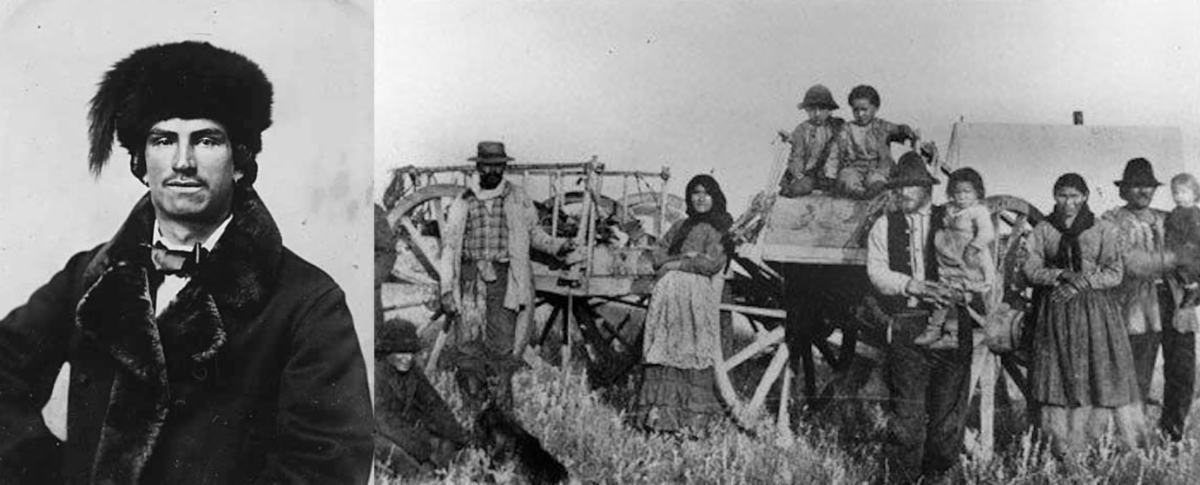
Left: Métis fur trader, c. 1870, By Unknown author - http://www.d.umn.edu/cla/faculty/troufs/Buffalo/PB42.html Minnesota Historical Society Location No. HD2.3 r7 Negative No. 10222, Public Domain, https://commons.wikimedia.org/w/index.php?curid=3125593
Right: A Metis family poses with their Red River carts in a field in western North Dakota. (1883) State Historical Society of North Dakota (A4365) By Unknown photographer - Métis Nation of Alberta and State Historical Society of North Dakota, Public Domain, https://commons.wikimedia.org/w/index.php?curid=61027009
|
|
The Métis are today recognized in Canada as one of three major groups of Indigenous peoples that were legally recognized in the Constitution Act of 1982, the other two groups being the First Nations and Inuit. Many Métis reside throughout the American West. A couple of selected markers explain their specificity:
Marker, “Between Two Worlds . . . the American Métis
Fort Laramie National Historic Site”
Fort Laramie WY 82212
• Inscription (excerpt):
“French, Spanish and Indian and mixed are very common here and all languages are being jabbered in promiscuous interchange.”
Charles B. Darwin, Fort Laramie, June 28, 1849
Métis (ma-tes’) – of mixed race, particularly, mixed Native American and French ancestry.
“All but forgotten, the mixed-blood peoples of the plains trace their origins to the heyday of the fur trade. Fur traders, predominately of French and French-Canadian ancestry, entered into “trade marriages” with Native American women, giving them social status within the tribes and trade advantages. Children produced by these unions, the “American Métis,” reflected the fusion of two rich cultures. Their mixed traditions and command of both European and Indian languages made them perfect intermediaries between two worlds.
As the fur trade declined in importance, the Métis adapted to change, finding work as interpreters, guides, and scouts for the government. There were social changes as well. As cities and towns sprang up, Victorian society no longer tolerated “squaw men” and “half breeds,” as the Métis were derisively called. Interethnic marriages, once seen as a proud social asset became a badge of disgrace. Instead of being the elite of plains society, the “American Métis” were now outside looking in.
Ward-Guerrier Trading Post
Across the Laramie River from where you are now standing, Seth Ward and William Guerrier operated a small trading post in the early 1850s. Typical of a plains trader, Guerrier married a Cheyenne woman and conducted his business in a broad area between Bent’s Fort and the Powder River country north of Fort Laramie. Guerrier died in 1858 while trading with the Lakota after accidentally igniting a keg of gunpowder in his wagon.”
Erected by National Park Service.”
Marker “Courthouse Historic District”
701 W Main St, Lewistown, MT 59457
• Inscription (excerpts):
“In 1879, Metis—people of French and Chippewa-Cree descent—homesteaded in this area, near the army’s Camp Lewis. Many street names memorialize these settlers, who included Francis A. Janeaux and Paul Morase” . [...]
Erected by The Montana National Register Sign Program.”
We will devote a future Bulletin to the French-American Métis, and their long history, from the first initial recorded "métis" child, a girl who was born around 1628 close to Lake Nipissing in today's Ontario. She was named Marguerite and her parents were a Nipissing Indian woman and Jean Nicollet de Belleborne, who was born around 1598 in Cherbourg, France.
Let us continue our Bulletin illustrating the contributions of several notable French, French Canadian and French Métis, presented in chronological order to accompany the development of the "Wild West".
|
|
Jacques La Ramée,
1810-1820, Laramie, Wyoming
|
|
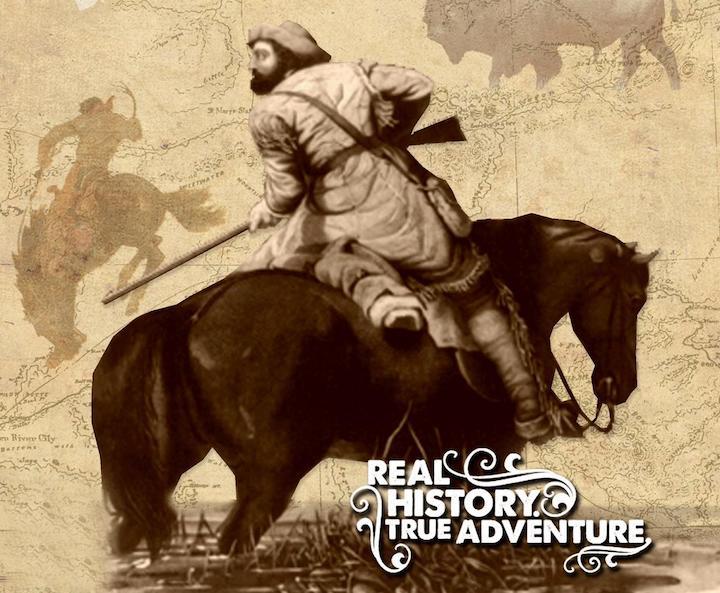
Above: Poster with an artist's illustration of Jacques La Ramée. No actual portrait exists.
|
|
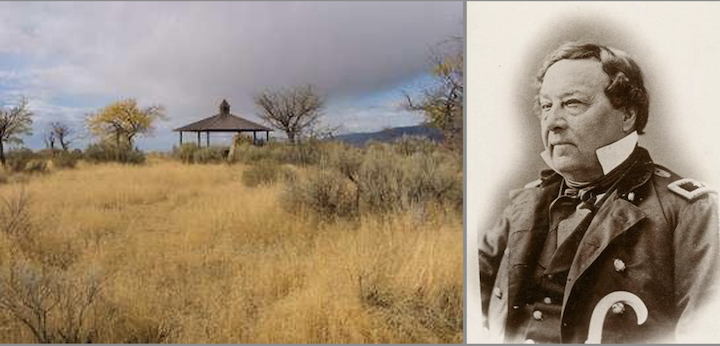
• Jacques La Ramée (born in Québec, June 8, 1784 – 1821) was a French Canadian and Métis "coureur des bois", frontiersman, trapper, fur trader, hunter, explorer, and mountain man who lived in what is now the U.S. state of Wyoming, having settled there in 1815. In 1820 he arrived for a season of trapping along the river that now bears his name; he was never seen or heard from again.
• Tradition says he was an honest, just, and courageous leader and trader.
• His name appears in several spellings, including LaRamee, Laramée, LaRamée, La Ramie, La Rami, La Remy, and Laramie. La Ramée is credited as an early explorer of what is now called the Laramie River of Wyoming and Colorado.
• The city of Laramie, Wyoming, with an Americanized spelling, was later named for him, as well Several geographic sites in Wyoming were named for La Ramée (anglicized to Laramie), including the Laramie River, Fort Laramie, Laramie Peak, and Laramie County.
Marker, “Laramie Timeline”
Jacques La Ramée, Founder of Laramie, Wyoming
106 Grand Ave, Laramie, WY 82070
• Inscription (excerpts):
"1810-1820"
“French Canadian Jacques LaRamie trapped beaver throughout the bountiful rivers and steams of southeast Wyoming.
Today a city, county river, mountain range, peak and fort bear his name.”
Marker, “Fort Laramie National Historic Site”
Fort Laramie National Historic Site, 965 Grey Rocks Road, Fort Laramie WY 82212
• Inscription (excerpt):
"The trapper"
“In the early part of the 19th century, a colorful, eccentric group of bold adventurers emerged on the American frontier. This was the time of the legendary “mountain man,” an adventurer, explorer, and part-time diplomat. Their heyday would last less than 30 years, yet these rugged individualists would leave a lasting mark on the history of the west.
Trappers lived hard lives, spending months wading in cold mountain streams trapping beaver and other fur-bearing mammals. Beginning in 1825 and continuing for the next 16 years trappers met at an annual “rendezvous” to exchange their year’s catch of furs for supplies and trade goods and celebrate a successful trapping season.
The river below, once abundant with beaver, was named for French-Canadian trapper Jacques LaRamee. Reportedly killed in the early 1820s on the stream that now bears his name, LaRamee remains an enigma. Little else is known about the man who has no less than seven geographic features in Wyoming named after him.”
Erected by National Park Service.”
|
|
Above:
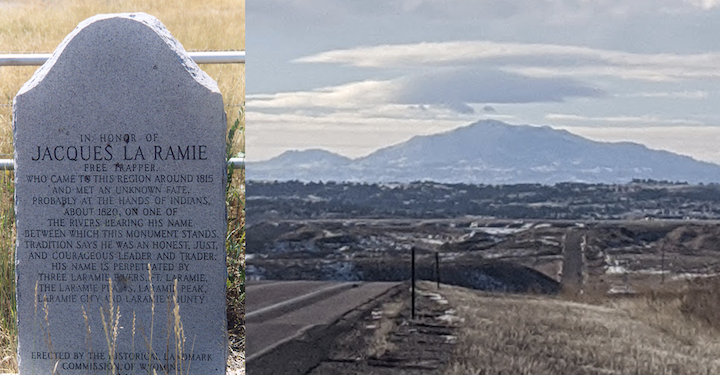
Left: Jacque La Ramie Monument, Wheatland, WY
|
|
• One of these geographic landmarks are memorialized with an interpretive marker:
Marker, “Laramie Peak”
Intersection of U.S. 26 and Interstate 25, Wheatland WY 82201
• Inscription (excerpts):
“As you journey through Wyoming, you are one of the countless travelers who has looked out to the west and seen the granite rising of Laramie Peak. Near Scottsbluff, Nebraska, approximately 80 miles east of Dwyer Junction, emigrants witnessed their first view of the western mountains with the hazy silhouette of Laramie Peak. Although the sight may have been awe-inspiring for the emigrants traveling on the Oregon and Mormon Trails, it also indicated the start of their journey into the mountains – a much more treacherous expedition than that across the plains. In their diaries, emigrants and other travelers usually noted seeing Laramie Peak”. [...]
“Visible from over 100 miles away, Laramie Peak is named for the early French trapper, Jacques La Ramie. While on a beaver trapping expedition, La Ramie vanished from what is now the Laramie River. Upon learning of his disappearance, other trappers in the region named the river after him. Soon the nearby mountains, plains, and many other areas also took the name.”
Erected by Wyoming State Historic Preservation Office.”
• While the exact date, circumstances and location of his death are unknown, a memorial has been erected:
Memorial, “Jacques La Ramie”
470 North Wheatland Highway, Wheatland WY 82201
• Inscription :
“In Honor of
Jacques La Ramie
Free trapper,
who came to this region around 1815
and met an unknown fate,
probably at the hands of Indians,
about 1820, on one of
the rivers bearing his name
between which this monument stands.
Tradition says he was an honest, just,
and courageous leader and trader.
His name is perpetuated by
three Laramie Rivers, Fort Laramie,
the Laramie Plains, Laramie Peak,
Laramie City, and Laramie County.
Erected 1941 by Historical Landmark Commission of Wyoming.”
|
|
Général François Antoine "Charles" Lallemand
1818 - Liberty, Texas
|
|
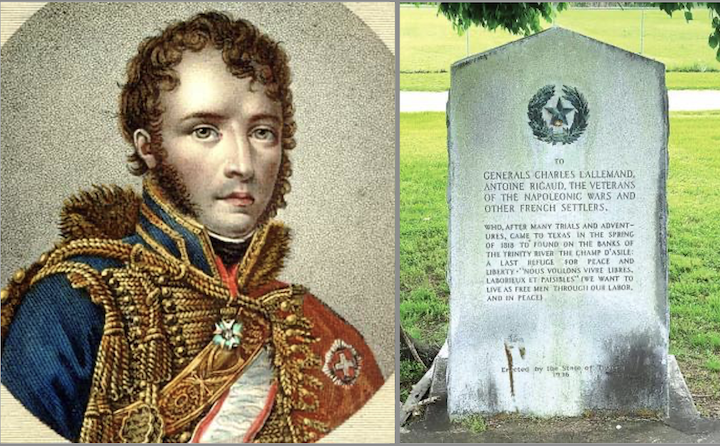
• This short-lived colony was founded in 1818 by General François-Antoine Lallemand of the Napoleonic wars, some 100 foreigners and 200 French veterans from the Grande Armée, some coming from the Vine & Olive colony in Alabama*.
• The land had been granted to these French refugees by a vote of Congress in 1817. However, following the Adams-Onis treaty settling the border dispute with Mexico, the Spanish governor, under instructions from the Bourbon Kings of France and Spain, intervened and dispersed the nascent colony.
Marker, Lallemand, Rigaud and Other French Settlers at “Champ d’Asile”, a short-lived French colony in Texas
422 US-90, Liberty TX 77575
• Inscription:
"To
Generals Charles Lallemand,
Antoine Rigaud, the veterans
of the Napoleonic Wars and
other French settlers,
who, after many trials and adventures, came to Texas in the spring of 1818 to found on the banks of the Trinity River the Champ D'Asile: a last refuge for peace and liberty "Nous voulons vivre libres, laborieux et paisibles"
(We want to live as free men through our labor, and in peace)
Erected 1936 by the State of Texas. (Marker Number 9671.) "
Note *: Not to be confused with his younger brother Henri Dominique Lallemand, who was also one of Napoléon’s generals, and who led several French exiles to another short lived settlement in Marengo County, Alabama in 1818, called "The Vine & Olive Colony".
|
|
Etienne Provost
1824, Provo, Utah
|
|
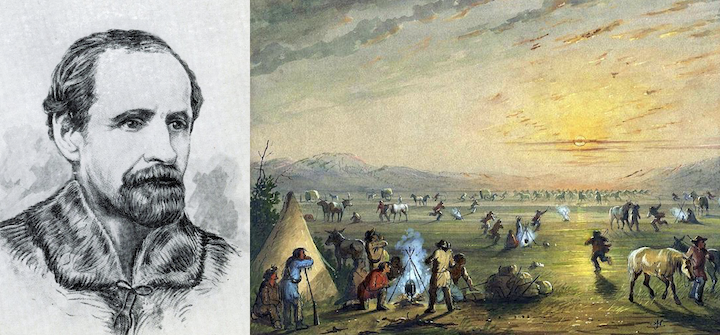
Above:
Left: Engraving portrait of Etienne Provost, Image from the Utah Historical Quarterly (1940s)
https://www.findagrave.com/memorial/61677667/etienne-provost
Right: "Catching Up" Painting by American painter Alfred Jacob Miller, around 1860. Photo by Guerinf - https://commons.wikimedia.org/w/index.php?curid=89209837.
Miller was the only painter to portray during their heyday the men who "may be said to lead the van in the march of civilization,- from the Canadas in the North to California in the South;- from the Mississippi East to the Pacific West; every river and mountain stream, in all probability, have [sic] been at one time or another visited and inspected by them. Perhaps they numbered no more than a thousand, but their impact was incalculable".
The pot-bellied man to the left shouting instructions is said to be Étienne Provost.
|
|
• Étienne Provost, also known as Proveau and Provot, was a Canadian fur trader who engaged in trapping and trading activities in the American southwest. He was born on December 21, 1785, in Chambly, Quebec, to Albert Provost and Marie Anne Menard. Little is known about his early life. Provost spent ten years in St. Louis, Missouri,. In late 1814, he left St. Louis with Auguste Chouteau and Jules deMun to pursue trade with the Indians and was imprisoned twice in Santa Fe, New Mexico. As the leader of a company headquartered in Taos, New Mexico, Provost was active in the Green River drainage and the central portion of modern Utah.
• He was one of the first people of European descent to see the Great Salt Lake, purportedly reaching its shores around 1824–25. However, maps from the 1600s may show the Great Salt Lake, possibly indicating European explorers reached the area over a century before Prevost or Bridger. Around 1822, Provost returned to New Mexico as one of the early traders and formed a partnership with a certain Leclerc to trap in the Uinta Basin. In October 1824, his party was attacked by Snake Indians at the Jordan River near its mouth at the Great Salt Lake, resulting in the loss of eight men. However, Provost survived and established trading posts on the banks of both Utah Lake and the Great Salt Lake.
• Provost's company of trappers preceded the men of the Rocky Mountain Fur Company in the central Rocky Mountains. After returning to St. Louis in 1826, he became an employee of John Jacob Astor's American Fur Company. He continued his own trapping ventures, as well as leading AFC men on ventures on the upper Missouri River. Provost married in 1829 but continued escorting AFC caravans to the annual rendezvous until 1838. From 1839 until his death on July 3, 1850, he continued to recruit and escort the employees of the fur company and various private expeditions, including John Audubon's natural history expedition of 1843.
• The Provo River and Provo Canyon in central Utah are named for the fur trader, as is the adjacent city of Provo. Provost is memorialized on the “This Is the Place” Monument in Salt Lake City.
Marker, “Provo’s Name Has an Interesting History”
Spring Creek, Provo, UT 84606
• Inscription (excerpts):
“Provo received its name from the Provo River, and how the Provo River received its name is quite a story.
When Spanish Fathers Dominguez and Escalante visited Utah Valley in 1776, they found it inhabited by Timpanogots Utes. […] Nearly fifty years later, French-Canadian mountain man Etienne Provost led a group of ten trappers down the Timpanogos River and into Utah Valley. They rode around the north end of the lake, followed its outlet into Salt Lake Valley, and met a band of Shoshone warriors.
Provost and his companions were unaware that a year earlier men from the Hudson Bay Fur Company had clashed with these Indians, stolen some of their horses, and killed one of their warriors. The Shoshone longed for revenge and almost all of Provost’s men became their victims. While the two groups were smoking the pipe of peace, the Shoshone chief gave a prearranged signal. The Shoshone threw off their blankets, under which they had concealed their weapons, and attacked the surprised trappers. Only Provost and one of his men escaped.
After this time, the trappers called the river near which the incident occurred, Proveaux’s Fork. They renamed Timpanogos Lake, calling it Utah Lake in honor of the Ute Indians who lived near it. After the Mormon settlers arrived in 1847, they renamed Proveaux’s Fork the Jordan River, and switched the name “Provo” to what had been known as the Timpanogos River. In 1849, the first colonists in Utah Valley called their stockade Fort Utah. Since their town site, which was over a mile east of the fort, was further away from Utah Lake but still close to the Provo River, the colony was called the “Settlement on the Provo” and then just “Provo.”
Erected by Rotary International and Provo Parks & Recreation. (Marker Number 54.)”
|
|
Antoine Robidoux
1824, Colorado
|
|
Above:
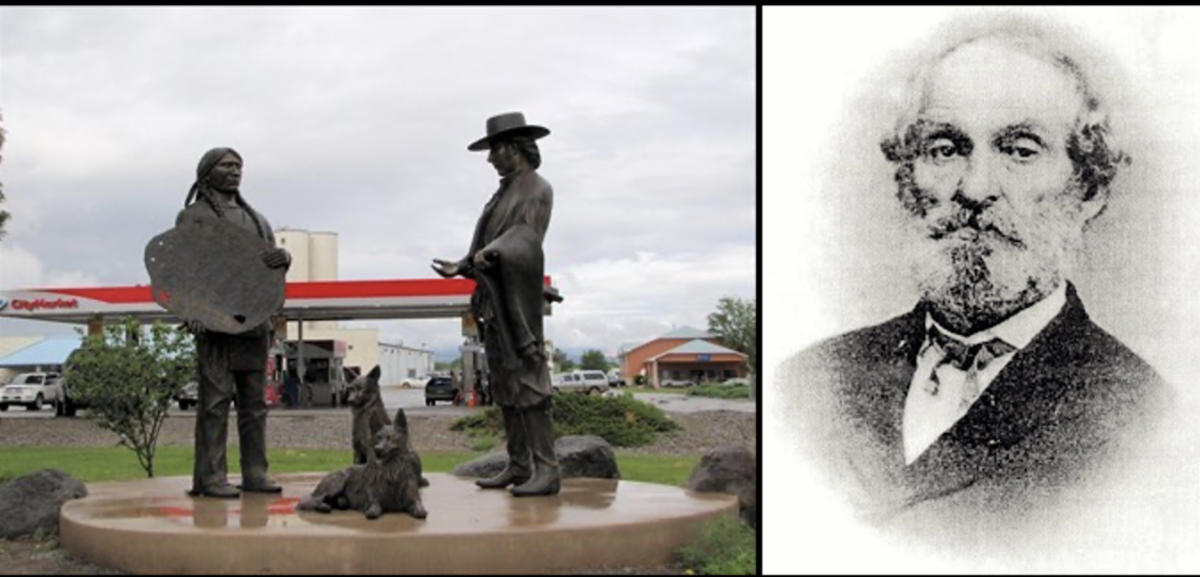
Left: Monument to Antoine Robidoux and the Ute Indians with which he began trade at Fort Umcompahgre, 108 Gunnison River Dr., Delta, CO 81416, Photo: by MathsTeacher, https://www.waymarking.com/waymarks/wm94GF_Antoine_Robidoux_and_the_Ute_Indians_Delta_CO
Right: Portrait of Antoine Robidoux - artist and date unknown
|
|
Antoine Robidoux
"Kingpin in the Colorado River Fur Trade, 1824-1844"
• Antoine Robidoux (b. in Saint Louis, September 24, 1794 – August 29, 1860) was a fur trapper and trader of French-Canadian descent best known for his exploits in the American Southwest in the first half of the 19th century.
In our May Bulletin, we introduced one of his five brothers, Joseph Robidoux IV, who established the Blacksnake Hills Trading Post that eventually became the town of St. Joseph, Missouri.
• Antoine settled in Santa Fe and became one of its most prominent citizens in 1830.
• Robidoux's post at Uncompahgre river was arguably the first permanent trading operation west of the continental divide. He did several expeditions in the far West, notably in Utah and worked in various capacities as an emigrant guide and a U.S. Army interpreter. In 1846, Robidoux served as an interpreter with General Stephen W. Kearny during the Mexican–American War. He was severely wounded at the Battle of San Pasqual. He died in St Joseph, Missouri, in 1860.
• We will talk about another one of his brothers, Louis, who settled in California.
Statue, “Antoine Robidoux and the Ute Indians”
Welcome Park, 108 Gunnison River Dr., Delta, CO 81416
• This bronze statue was installed in March 2010
• The statue is located directly in front of the Delta City Market and adjacent to US Highway 50. The sign was designed and provided by the Interpretive Association who operates Fort Uncompahgre Interpretive Center located at 440 N Palmer St.
• An interpretive marker has been installed nearby:
Marker “Fort Uncompahgre”
440 Palmer St, Delta, CO 81416
• Inscription:
“One of the many trading posts built by Antoine (Anton French) Robidoux, First built around 1828 at the juncture of the Grand (Gunnison) and Uncompahgre Rivers then a territory of Mexico and Ute Indian country on the well traveled "Old Spanish Route" that ended in Taos and Santa Fe, New Mexico. Kit Carson, Robert B. Lee and Joe Meek were frequent visitors. The fort remained until Sept. 1844, when most of the occupants were killed in an attack by the Ute Indians. Constructed
at Delta, Colorado in 1990, this living, working museum is open to the public.
Erected 2004 by the Al Packer Chapter 100 Colorado E. Clampus Vitus and the City of Delta Colorado.”
• Antoine Robidoux is very much present in other sites in Colorado:
Marker “Old Spanish Trail”
4729 US-160, Hesperus, CO 81326
• Inscription (excerpts):
“[...] One prominent traveler on the trail was Antoine Robidoux. He used this snow-free route to supply Fort Uncompahgre which he located on the Gunnison River. Robidouxtraded cotton, blankets, tobacco, tea, coffee, knives, liquor (“Taos Lightning,”) and an occasional rifle to the Ute Indians in exchange for deer skin clothes, beaver pelts, and castoreum – a beaver scent gland that was used to make perfume and medicine..”
[...]
Antoine Robidoux, a French Canadian, became a Mexican citizen and married the daughter of the Mexican Governor. Through marriage, he was granted the right to control trade in what would later be western Colorado and eastern Utah. In 1828, Robidouxestablished Fort Uncompahgre on the Gunnison River and Fort Uintah on the Green River...
Erected by Old Spanish Trail Association (OSTA).
• There are duplicate markers, one in Durango, the other one in Silverton:
Markers “Trails to Rails, Routes to Southwest Colorado - 1”
1171 Greene St, Silverton, CO 81433
461 Main Ave, Durango, CO 81301
• Inscription (excerpts):
“Explorers & Trappers:
French and American pathfinders began exploring and trapping in Western Colorado in the early 1800s. Taos and Santa Fe were the centers for the Southwest Colorado fur trade” [...]
“In 1828 Antoine Robidoux of St. Louis built the first western Colorado trading post (near present-day Delta). He initially packed supplies from Santa Fe along the Spanish Trail, then from 1841 used the easier "Northern Spanish Trail" across Cochetopa Pass.”
Erected by Durango Railroad Historical Society.
For further reading:
|
|
Benjamin de Bonneville
1832 Wyoming, 1833 Idaho & Utah
|
|
Above:
Left: Bonneville Point Site Overview, Photo National Park Service
|
|
• Benjamin Louis Eulalie de Bonneville (April 14, 1796 – June 12, 1878) was born in Paris. His godfather was none other than Thomas Paine, who lodged at his parents when he was a deputy at the National Convention during the French Revolution. Thomas Paine paid for the family passage to the US in 1803, eventually bequeathed his 40 acres estate in New Rochelle, NY, to the Bonneville family. Young Benjamin graduated from West Point, had an illustrious career in the US Army and explored many parts of the Far West.
• Lafayette hosted him during a trip to France in early 1824.
Marker, “Captain Bonneville, discoverer of Boise, Idaho"
Bonneville Point, Rte of the Oregon Trail, Boise, ID 83716
• Inscription:
“According to tradition, a hunting party led by the explorer Captain Benjamin Bonneville reached this promontory in 1833. They saw the lush river valley below and exclaimed in French, “Les bois; les bois; voyez le bois!” (“The woods; the woods; see the woods!”) In this way, Captain Bonneville’s party became credited with naming the Boise Valley. A career soldier, Bonneville secured a leave of absence from the Army to “examine the locations, habits and trading practices of the Indian tribes, visit the American and British establishments, and study the best means of making the country available to American citizens.” He left St. Louis in May 1832 with 110 men and 20 wagons. Bonneville explored Utah’s Great Salt Lake and crossed southern Idaho several times. His routes helped establish what became the Oregon Trail for settlers entering the Boise River Valley. He finally returned to the East in 1835.
Today, Bonneville County, Idaho, the Bonneville Salt Flats in Utah, and Bonneville Dam on the Columbia River are named in his honor.”
• Bonneville Point is named for U.S. Army Captain Benjamin Bonneville.
It became a fondly remembered location for emigrants on the Oregon Trail as they took in their first view of the Boise River Valley from the here.
Marker, “Bonneville Point”
Rte of the Oregon Trail, Boise, ID 83716
• Inscription:
“From this old Indian trail later known as the Old Oregon Trail Captain B,L,E, Bonnevillespartner on first sighting the river May 1833 exclaimed - Les Bois Les Bois Voyes Les Bois meaning The Woods The Woods See The Woods
Capt Bonneville therefore named the stream Riviere Boise - also indirectly the mountains and city.
Erected 1927 by Kiwanis Club of Boise.”
• Bonneville's namesakes include:
- Booneville, Arkansas, an altered spelling of Bonneville
- Bonneville Avenue, Las Vegas, Nevada
- Bonneville County, Idaho
- Bonneville Mountain, Wallowa Mountains of Oregon
- Bonneville Salt Flats
- Lake Bonneville, the Pleistocene ancestor of the Great Salt Lake
- Bonneville Slide
- Bonneville Peak in the Portneuf Range
- Bonneville High School in Idaho Falls, Idaho
- Bonneville High School in Washington Terrace, Utah
- Bonneville Elementary School in Salt Lake City, Utah
- Bonneville Dam, after which the Bonneville Power Administration (BPA) was named
- Pontiac Bonneville, an automobile produced by General Motors from 1957 to 2005
- Bonneville International, a broadcasting company
- The Bonneville House, Event Center in Fort Smith, Arkansas
- SS Benjamin Bonneville, a World War II Liberty Ship.
- Bonneville (crater) on planet Mars!
|
|
Charles Larpenteur
Théophile Bruguier
1833, Wyoming
|
|
Above:
Left: Charles Larpenteur
https://www.legendsofamerica.com/charles-larpenteur/
Middle: Charles Larpenteur's short-lived trading post. It was located adjacent to the Fort Union–Fort Benton road and several hundred yards west Fort Union Trading Post. This road, which visitors can still see traces of today, followed a traditional Assiniboine war path into enemy territories to the west.By William H. Illingworth/ John Carbutt - NPS Fort Union Trading Post Retrieved 2017-10-28, Public Domain, https://commons.wikimedia.org/w/index.php?curid=63682695
Right: Théophile Bruguier, (Sioux City Public Museum)
|
|
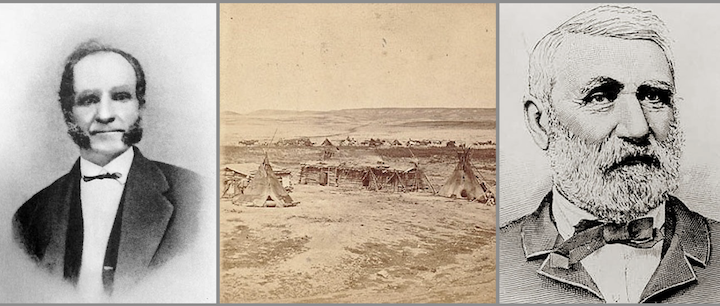
• Charles Larpenteur (born in Fontainebleau, France in 1807 –died November 15, 1872, in Little Sioux, Iowa) was a French fur trader. At the age of 12, he and his family immigrated to Baltimore, MD. At 21, Larpenteur went to St. Louis, MO and joined the Rocky Mountain Fur Company in 1833. He joined an expedition and co-founded Fort William, later known as Fort Laramie, WY. He then went to Fort Union, and constructed Fort Alexander, a trading post situated along the Yellowstone River. He married an Assiniboine woman, who died in 1837 and re-married with “Makes Cloud”, another Assiniboine woman, with whom he had five children. In 1848, Larpenteur became a free trader. Around 1850, he settled on a farm near Little Sioux, Iowa, which he named
Fontainebleau after his birthplace. In 1860, he founded Larpenteur, Smith & Company. He also served as an interpreter for the government, playing a crucial role in negotiating treaties with various Indian tribes. He retired from his travels in 1871 and returned to his Iowa farm.
Marker, “Post Vermillion"
SD Route 50, Gayville SD 57031
• Inscription:
"In 1822, the Columbus Fur Company established a post at Audubon’s Point, opposite the mouth of Petite Arc Creek. Later taken over by the American Fur Company. William Dickson was factor from 1832 until his death before 1840 when Father Christian Hoecken baptized his daughter, Louise, there on May 30th. Theophile Bruguier was later in charge. Father Hoecken was again there in December, 1850, and Charles Larpenteur was then the factor."
Erected 1966 by Clay Post 3061, V.F.W., Vermillion and State Highway Commission. (Marker Number 415.)”
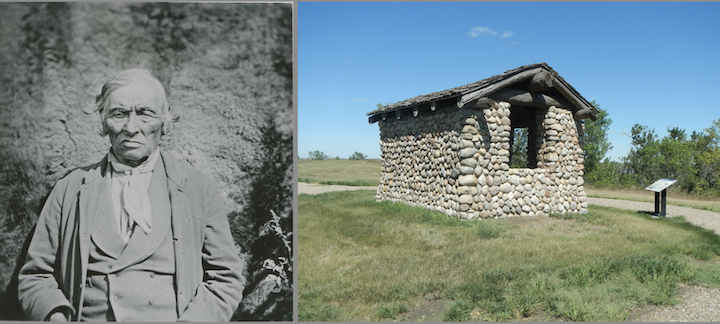
• Théophile Wowapikaga “Clerk” Bruguier,
(born 31 Aug 1813 in L'Assomption, Lanaudière Region, Québec – died February 18, 1896in Salix, Woodbury County, Iowa) was the first white settler in the Sioux City area in today's State of Iowa, arriving there in 1836. He had been educated as a lawyer in Canada but headed to St. Louis to work for the American Fur Company after the death of his fiancée. His work as a fur-trader and interpreter took him to Dakota Territory where he learned the Sioux language and traded with Chief War Eagle’s people. Bruguier later married two of the chief’s daughters. Like Charles Larpenteur, he retired in his cabin in Sioux City, Iowa.
The cabin can still be visited at 1298-1272 Council Oak Dr, Sioux City, IA 51109 (GPS: 42.496800, -96.474900)
|
|
Michel Branamour Menard
1833, Galveston, Texas
|
|
Above:
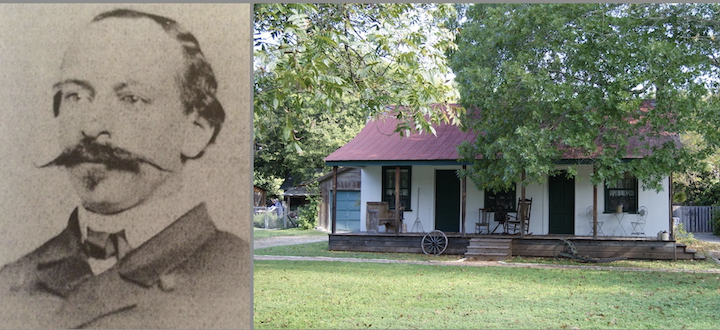
Left: Portrait of Michel (Michael) Branamour Menard
Right: Home of Michel B. Menard
|
|
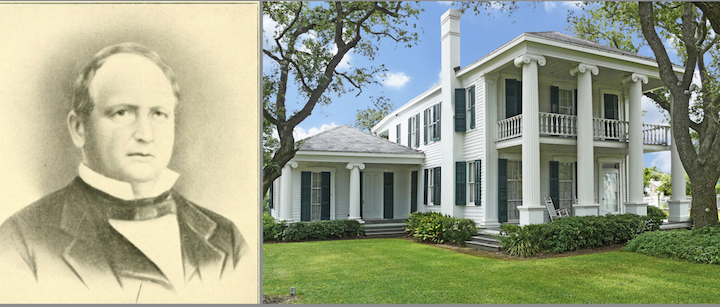
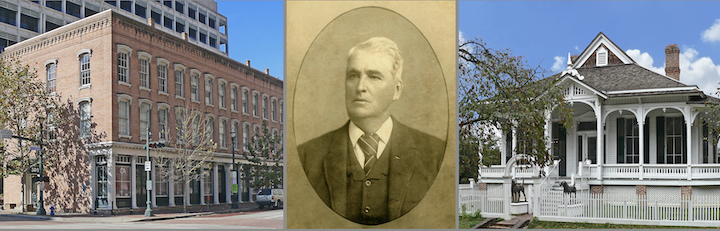
• Michel Branamour Menard (born on December 5, 1805, at La Prairie, near Montreal, Quebec, died Sept 2, 1856 in Galveston, TX) ) was a cousin of Médard Menard and nephew of Pierre Menard, the first governor of Illinois. He was the Founder of the city of Galveston, a signer of the Texas Declaration of Independence, a Member of the Congress of the Republic of Texas.
Marker, “Michel B. Menard”
Old Catholic Cemetery, Avenue K Rear, Galveston, TX 77550
• Inscription:
“A native of Canada, Michel B. Menard came to Texas in 1829. He lived in Nacogdoches and Liberty before settling in Galveston in 1833. He was one of the signers of the Texas Declaration of Independence in 1836, and later represented Galveston in the Congress of the Republic of Texas. As one of the founders of the Galveston City Company he was instrumental in the development of the island. Menard County was created in 1858 and named in his honor.”
Erected 1994 by Texas Historical Commission. (Marker Number 7529.)”
• His home is the oldest home in Galveston, TX.
Ménard requested the building of a two-story house in the Greek Revival style. The house was dismantled and transported from Maine in separate parts. The Michel B. Menard House is located at 1605 Thirty-Third Street in Galveston and remains intact to this day. It is recognized as a historic landmark and is listed on the National Register of Historic Places. His home was later sold to the Allen brothers, founders of Houston. As of 2018, it holds the distinction of being the oldest standing house in Galveston.
Marker, “Site of the Home of Michel Branamour Menard”
1604 33rd St, Galveston, TX 77550
• Inscription:
“A signer of the Texas Declaration of Independence. Founder of the city of Galveston. Member of the Congress of the Republic of Texas.
Erected 1936 by The State of Texas. (Marker Number 7530.)”
|
|
Charles Cronéa
1835, High Island, Texas
|
|
Above:
Left: Photo: http://dandjreed.homedns.org/cronea/d1.html
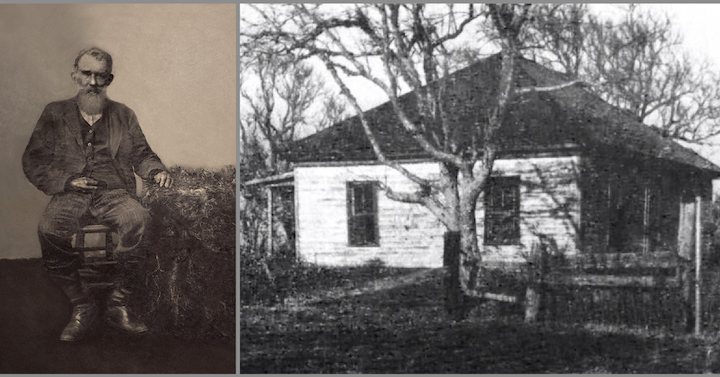
Right: Home of Charlie Cronea in High Island, Texas. Source: Gulf Coast Peninsula Features&Facts History Photographs Maps by A.Pat Daniels. The home of pirate Jean Lafitte's cabin boy, and Veteran of War against Mexico, Charlie Cronéa, is believed to be the oldest building in Bolivar Peninsula. It is located on a hill southeast of the main business district of High Island. Cronéa built this home in 1876. It was remodeled about 1972. Yet we have not been able to find the exact address and GPS online.
|
|
"Uncle Charlie" Charles Cronéa, the Last of Lafitte's Pirates
Marker, “Charles Cronea (January 14, 1805 - March 4, 1893)”
High Island, TX 77623
• Inscription:
“Born in Marseilles, France, Charles Cronea came to America on a French frigate as a cabin boy in 1818. Soon after, boarding a ship out of Charleston, South Carolina, Croneaand several companions entered the service of Jean Laffite of Galveston engaged in privateering cruises off the coast of Spanish Mexico. After nearly a year under the command of Capt. James Campbell, he left the ship when it was burned at the mouth of the Mermentau River in Louisiana.
Cronea married Amanda Richey in 1830. By 1835 he had settled in the Mexican municipality of Jefferson. The Texas Revolution broke out that fall. Cronea joined Capt. David Garner's company of frontier farmers and participated in the Siege of Bexar. Some records say Cronea's company joined with the forces of Sam Houston in 1836, and that during the Battle of San Jacinto, Cronea was guarding prisoners nearby. In 1846 he entered the U. S. Army in the war against Mexico under Gen. Zachary Taylor.
Later a farmer in Sabine Pass, Cronea married Mary Louisa Elender in 1845. They moved their family to High Island in 1876. Cronea was awarded 1,280 acres as a surviving soldier of the Texas Revolution in 1885. Cronea is buried in this cemetery.”
Erected 1996 by Texas Historical Commission. (Marker Number 7423.)”
|
|
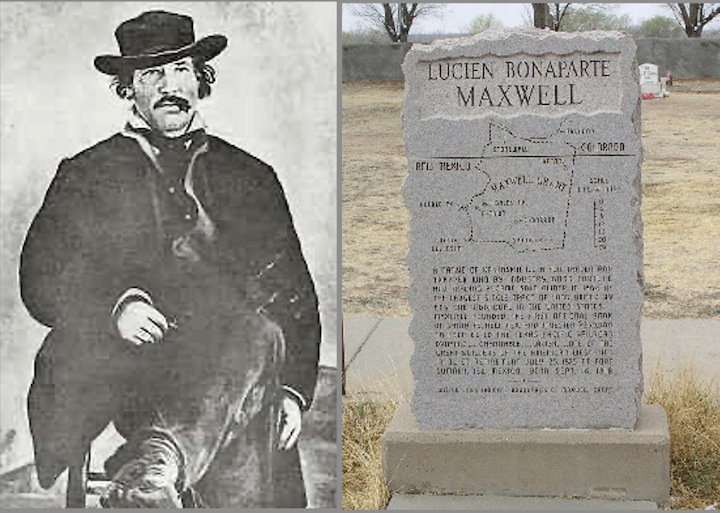
Lucien Bonaparte Maxwell
1841, Fort Sumner, New Mexico
|
|
Above:
Bottom left: Photo of plaque by Billy Hathorn at en.wikipedia, CC BY-SA 3.0, https://commons.wikimedia.org/w/index.php?curid=17701756
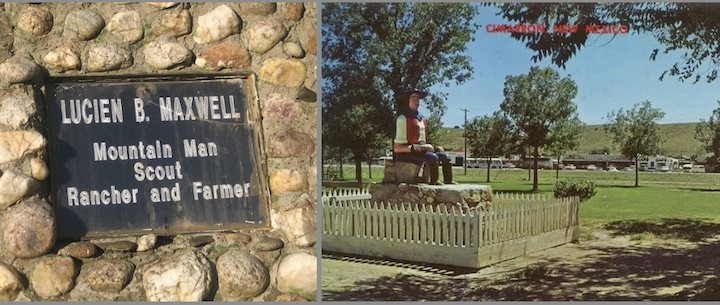
Bottom right: Cimarron NM Stone Statue Of Lucien B. Maxwell Postcard - New Mexico (undated)
|
|
Although Lucien Bonaparte Maxwell was half Irish and half French, we include him, well, because of his first and middle names! And also because of his adventurous life and association with Kit Carson (another household name in France, like the Daltons, Buffalo Bill, Geronimo...and Billy the Kid).
• Lucien Bonaparte Maxwell (September 14, 1818 – July 25, 1875) was a mountain man, rancher, scout, and farmer who at one point owned more than 1,700,000 acres (6,900 km2). Maxwell was one of the largest private landowners in United States history. In 1959, he was inducted into the Hall of Great Westerners of the National Cowboy & Western Heritage Museum.
• Maxwell was born in Kaskaskia, Illinois Territory. He was the son of Hugh Maxwell, an Irish immigrant, and Odile Menard, daughter of Pierre Menard, a French Canadian fur trader who was the first Lieutenant Governor of the State of Illinois shortly after Maxwell's birth (Pierre Menard was featured in our previous May Bulletin)
• He met and became fast friends with Kit Carson, who was almost nine years older. Both were to sign up in 1841 for western expeditions, with Carson serving as guide, and Maxwell as chief hunter.
• Eventually his landholdings then peaked at 1,714,765 acres (6,939.41 km2). The entire area is referred to as the Maxwell Land Grant, and he leased his land to gold miners, making him immensely rich.
• Outlaw Billy the Kid was killed on Maxwell’s ranch, where both graves can be visited.
Marker, “Lucien Bonaparte Maxwell”
3501 Billy the Kid Road, Fort Sumner, NM 88119
• Inscription:
“A native of Kaskaskia, Ill, a fur trader and trapper who by industry, good fortune and trading became sole owner in 1864 of the largest single tract of land owned by any one individual in the United States.
Maxwell founded the First National Bank of Santa Fe, New Mex. and invested $250,000 to help build the Texas Pacific Railroad. Dynamic….Charitable….Lavish….One of the great builders of the American West, died in quiet retirement, July 25, 1875 at Fort Sumner, New Mexico. Born Sept. 14, 1818”
Donated by Erickson Memorial Co, Denver, CO, Wayne D. Gordon, Designer
Statue, “Lucien Bonaparte Maxwell”
Corner of N. Lincoln Ave and 9th St, Cimarron, NM 87714
• This statue of land baron Lucien Maxwell shows him in patriotic (red, white and blue) frontier garb, "guarding" the town of Cimarron, NM. Maxwell was a prominent rancher in the 1800s. He owned over 2 million acres of land.
• The statue is the work of Domenico “Professor Dom” Poglianich , called Professor Dom because he had a unique way of analyzing situations . He was a miner, gold prospector, and Philippine–American War veteran. Poglianich worked odd jobs and lived in a two-story cave in town. In the mid-1930s, Poglianich felt Cimarrón needed something to recognize its founder.
• The brightly painted concrete depiction of Maxwell is actually Poglianich’s second attempt (the first was destroyed by vandals), for which he was paid $5.
• Inscription:
“Lucien B. Maxwell
Mountain Man
Scout
Rancher and Farmer”
|
|
Henri Castro
and Alsatians immigrants
1843, Castroville, Texas
|
|
Marker, “Henri Castro (July 17, 1786 - November 3, 1865)”
307 Lafayette Street, Castroville, TX 78009
• Inscription:
“Henri Castro, a native of Bayonne, France, and the descendant of Portuguese nobility, served briefly in Napoleon's French Army. In 1813 he married Marie Amelia Mathias. He later immigrated to the United States and in 1827 became a naturalized U.S. Citizen. He returned to France in 1838 and joined the banking house of Lafitte and Company. While there he helped negotiate a loan for the Republic of Texas for which a grateful President Sam Houston later appointed him Texas' General Consul in Paris. Between 1843 and 1847 Castro administered, as Empresario, the settlement of at least 2,134 European colonists in this area.
Castro eventually exhausted his own personal wealth to sustain his colonial effort. His extraordinary dedication to his colonists has led many to compare him favorably to the legendary Stephen F. Austin. Henri and Marie lived in Castroville with their four foster children. By 1860, however, the family was living in San Antonio. Henri and his son, Lorenzo, traveled to Eagle Pass to run a family mercantile business.
On his way to France in 1865, Castro was diverted to Monterrey, Mexico, where he became ill and died. He was buried in Monterrey in 1865. In 1876 the newly created Castro County, Texas, was named for Henri Castro.”
Erected 1994 by Texas Historical Commission”
Marker, “Alsatian Immigration through Lavaca Bay”
610 Harbor St, Port Lavaca, TX 77979
• Inscription:
“Texas land empresario Henri Castro contracted to bring colonists of various European nationalities to Texas beginning in 1842. The first of these were Alsatians, most of whom spoke German and held German sympathies. They arrived at Galveston, their official port of entry, with 114 passengers from France in early 1843; most then sailed for Lavaca (later Port Lavaca). They waited here before beginning their overland journey to what became Medina County, to establish the town of Castroville. Another, largely Alsatian, group of 129 arrived at Galveston January 1, 1844. About 40 continued to Lavaca, landing on the 10th. Conditions were difficult, and many immigrants succumbed to various coastal fevers. Other ships followed in 1845 and 1846. Castro's contract expired in 1847, after he had transported more than 2,000 colonists to Texas, most through Lavaca Bay.”
Erected by Calhoun County Historical Commission George Fred Rhodes, Chairman
Erected 1999 by Texas Historical Commission. (Marker Number 1147.)”
Marker, “Site of the homestead of Henri Castro”
1109 Fiorella St, Castroville, TX 78009
• Inscription:
“Henri Castro (1786-1861), a naturalized American of French origin, befriended the Republic of Texas and became interested in settling here. In 1842 he was given authority to establish a colony of Europeans in Southwest Texas. He succeeded in obtaining some land here on the Medina, from a 1766 grant made by Chares III of Spain. He recruited 485 families and 457 single men, mostly Alsatians. Using his personal wealth, he cared for the colonists as though they were his children. In 1844 he had the Castroville townsite platted, reserving as his homestead this block next to the courthouse site, in the center of town. He erected a stone dwelling and outbuildings, and planted an experimental garden, to discover crops suited to the locality. Bringing his wife Amelia (Mathias) and their four foster children from France, he lived here permanently. As a moral obligation, he continued to direct the state affairs for his colony, although it had impoverished him.
On the eve of a trip abroad when the Civil War was beginning (1861), Castro and his wife deeded the homestead to their adopted son, Lorenzo. Castro died at Monterrey, Mexico, soon afterwards, and was buried there. Lorenzo sold the homestead in 1872.
Erected 1978 by Texas Historical Commission.”
|
|
Pierre Didier Papin
1845, Fort Pierre, Wyoming
|
|
Above:
Left: Image capture Nov 2021 (c) 2021 Google
|
|
• Pierre D. Papin was the son of Marie-Louise Chouteau and grandson of Pierre Laclède, Founder of St Louis, Missouri, whom we introduced in our Bulletin last month in May.
Marker, “Pierre Papin Grave”
At the intersection of County Road 20 and Peaceful Valley Road Gering, NE 69341
• Inscription (excerpts): Pierre Didier Papin
“Pierre D. Papin was a trusted and valued employee of the American Fur Company and its successors for over thirty years. He was born March 7, 1798, In St. Louis. The Papins were a prominent French merchant family in that city. Papin joined "the Company" in the early 1820s... Papin established his own trading company in 1829 but was soon bought out by the American Fur Company, which then rehired him. By 1842 Papin had moved to Fort John (popularly known as Fort Laramie) on the Laramie River and in 1845 became chief agent at that post. Meanwhile, the company had reorganized as Pierre Chouteau Jr. & Co., but operations remained essentially unchanged.”
“In 1849 Fort Laramie was purchased by the U.S. Army and [Andrew] Drips established a company trading post here in Helvas Canyon. Papin was at this post with the company's Fort John Outfit when he died in May 1853. He was buried here, his grave marked by a large cedar cross. Papin was survived by his wife, Catherine, and four children. There were twenty-six grandchildren. Research by William A. Goff, Kansas City, Mo.
Signing and Funding by Oregon-California Trails Association
This is a part of your American heritage. Honor it, protect it, preserve it for your children.”
“Erected 1991 by Oregon-California Trails Association”
Marker, “Fort Pierre”
310 1st St (US Hwy 83), Fort Pierre, SD 57532
• Inscription:
“The oldest continuous white settlement in the area of South Dakota.”
“First visited by Verendrye, who took over for France by planting a lead plate on March 31, 1743. A monument marks the spot. It is over the R.R. track first street to right, on hill to you left .6 miles.”
“Joseph LaFramboise started first fur post here in 1817 on west bank of Missouri just south of mouth of Bad river. Whites here since then.”
“Practically on same site, French Fur Co., Pierre D. Papin & Pascual Cerres had post Ft. Teton 1827 sold to Am. Fur Co., 1830. Bad River, then called Little Missouri was site where Father Hoecken on June 12-13, 1840 baptized 25 children, offspring of 13 traders and trappers, among them Dorion, Papin, Halsey, Campbell, Brazeau and Alleron.”
“All these things happened in limits of Ft. Pierre.”
Erected 1955 by R. S. Howe Co. and State Highway Commission.”
• Fort Pierre Chouteau, also just Fort Pierre, was established in 1832 by Pierre Chouteau, Jr. of St. Louis, Missouri, whose family were major fur traders as we narrated in our previous Bulletin of May 2024. This facility operated through the 1850s.
Marker, “Fort Pierre "
Native American Scenic Byway (Highway 83) Fort Pierre SD 57532
• Inscription:
“The oldest continuous white settlement in the area of South Dakota.
First visited by Verendrye, who took over for France by planting a lead plate on March 31, 1743. A monument marks the spot. It is over the R.R. track first street to right, on hill to you left .6 miles.
Joseph LaFromboise started first fur post here in 1817 on west bank of Missouri just south of mouth of Bad river. Whites here since then.
Practically on same site, French Fur Co., Pierre D. Papin & Pascual Cerres had post Ft. Teton 1827 sold to Am. Fur Co., 1830. Bad River, then called Little Missouri was site where Father Hoecken on June 12-13, 1840 baptized 25 children, offspring of 13 traders and trappers, among them Dorion, Papin, Halsey, Campbell, Brazeau and Alleron.
All these things happened in limits of Ft. Pierre.
Erected 1955 by R. S. Howe Co. and State Highway Commission. (Marker Number 42.)”
|
|
Pierre Garreau
1850, Stanton, North Dakota
|
|
Above:
Left: Photo: stereograph of Pierre Garreau an Indian interpreter, Smithsonian Institution
Right: Lodge at Fort Clark, Photographed By Barry Swackhamer, August 28, 2020
|
|
• Pierre Garreau was the son of Antoine Garreau, a French trader working for Sublette & Campbell, who originally came from Canada. Antoine's first wife, Josette, was a half breed Arikara. They had children together, including Josette who later became the mother of Maggie Dawson and wife of Andrew Dawson. They also had another daughter who passed away at Ft. Clark, and a son who lived among the Arikara and was eventually killed by Bears' Ears, an Arikara leader. Bears' Ears fled to the Sioux after the murder and later became a U.S. government scout at old Ft. Lincoln. Antoine's second wife was a full blood Mandan.
• Pierre Garreau was a trader at Fort Clark and Fort Berthold among the Indians. he was an Interpreter at Fort Berthold for the traders and for the United States army. He worked for the Pierre Choteau, Jr. Co. as an interpreter. He died in his hut at Fort Berthold in 1870, in a fire accident.
Marker, “Pierre Garreau's Lodge, Fort Clark State Historic Site”
Fort Clark State Historic Site, Stanton, ND 58571
• Inscription:
“ This earthlodge was the home of Pierre Garreau. Garreau, the son of a French father and an Arikara mother, was employed by the American Fur Company as an interpreter. He was well known for his strength and bravery. Interpreters, such as Garreau, served a vital role in the fur trade. Communication between trading parties may have required the use of multiple languages and several interpreters.
Surrounding Garreau's lodge and drying racks was a palisade wall of closely spaced vertical posts, about eight feet high, This is depicted in the sketch by artist William Jacob Hays.”
Erected by State Historical Society of North Dakota.”
|
|
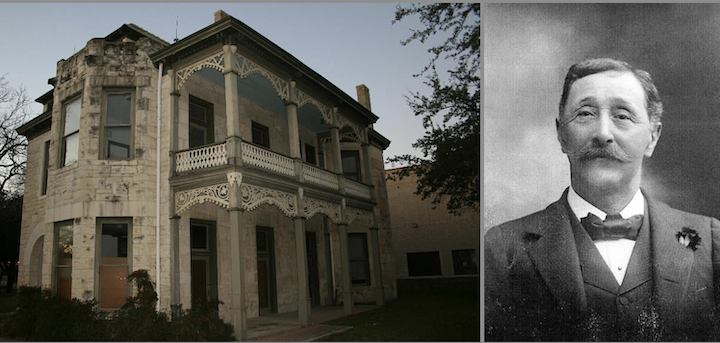
Mayer Halff
1850, San Antonio, Texas
|
|
Marker, ”Halff House”
623 E Nueva St, San Antonio, TX 78205
• Inscription:
“Mayer Halff (1836-1905) immigrated to Texas from Lauterborg, Alsace Lorraine, France, in 1850. In partnership with his brother Solomon, he opened a mercantile business in Liberty and began a cattle ranching enterprise. They moved to San Antonio in 1864 and established M. Halff & Brother, a wholesale dry goods company. Their ranching interests grew to include over a million acres of land in Texas and other states, and they also became interested in banking.
Mayer Halff purchased land at this site in 1890, and three years later he and his wife Rachel (Hart) had this house built for their family. Exhibiting Eastlake and Richardsonian Romanesque stylistic influences, the Victorian-Era house features a prominent round arch entry, two-story crenellated bay, two-story full-length side porch with eastlake detailing. Originally built on Goliad Street, the house remained on its original site when the street was removed for construction of the Hemisfair facilities in the 1960s.
The Halff family played an important role in the development of San Antonio and the Texas cattle industry. Many of their descendants, some of whom married into the pioneer Oppenheimer family, still reside in the city.”
Erected 1966 by Texas Historical Commission. (Marker Number 2333.)”
|
|
Victor Considerant
1850, La Réunion, Dallas, Texas
|
|
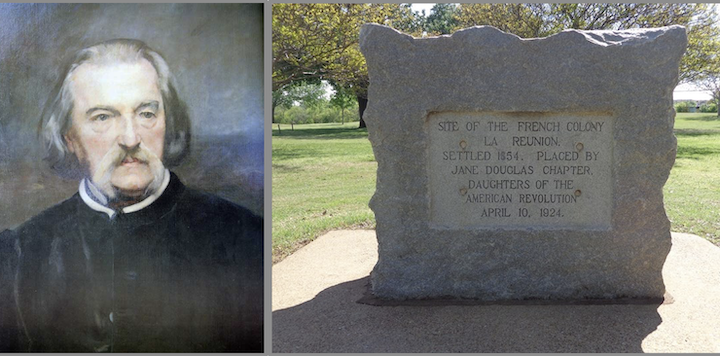
• Victor Prosper Considerant (12 October 1808 – 27 December 1893) was a French utopian socialist philosopher and economist who was a disciple of Charles Fourier, and later took part in the Paris Commune upraising of 1870.
• La Réunion was a utopian socialist community formed in 1855 by French colonists, joined by Belgian and Swiss. The founder of the community, Victor Prosper Considerant, was a French democratic socialist who directed an international movement based on Fourierism, a set of economic, political, and social beliefs advocated by French philosopher François Marie Charles Fourier. It wasa "communal experiment administered by a system of direct democracy."
• Some 200 settlers came from France and landed near Houston, where they walked 250 miles with ox carts to present-day Dallas. La Réunion existed for only eighteen months with its demise attributable to financial insolvency, a shortage of skilled participants, inclement weather, inability to succeed at farming, and rising costs. In 1857 the colony had no choice but to dissolve. By 1860, what remained was incorporated into the expanding city of Dallas. Several went back to France, some stayed, and eventually prospered on their own, such as Maxime Guillot who opened a carriage factory who was famous in Texas until the advent of the automobile. The last house standing in 1930 is now in ruins.
• The cemetery on the old colony site still serves as the final resting place for some of the colonists. It is maintained by the City of Dallas.
Marker “La Réunion”, Dallas, TX
2100 W Colorado Boulevard, Dallas TX 75211
• Inscription:
“Site of the French Colony La Reunion. Settled 1854. Placed by Jane Douglas Chapter, Daughters of the American Revolution April 10, 1924”
|
|
Céran Saint Vrain
1855, Colorado
|
|
• Ceran St. Vrain, whose full name was Ceran de Hault de Lassus de Saint-Vrain, was born on May 5, 1802 in St Louis, Missouri, and passed away on October 28, 1870. He was the son of Jacques Marcellin Ceran de Hault de Lassus Saint-Vrain, a French aristocrat and Navy officer, who immigrated to Louisiana during the French Revolution. His mother, Marie Félicité Chauvet Dubreuil, hailed from St. Louis, Missouri, which had a predominantly French population. Seeking excitement and new experiences, Ceran St. Vrain embarked on a trading venture in Taos, New Mexico in 1824. At the time, Taos was part of the newly independent Mexico. In 1831, St. Vrain became a naturalized Mexican citizen while residing in Taos. This status allowed him to bypass the restrictions imposed on American traders in Mexican territory. Shortly after, he formed a partnership with American trader William Bent, establishing the company known as Bent, St. Vrain & Company.
• The company's trading operations extended across Wyoming, New Mexico, Kansas, and Colorado. In 1855, Ceran St. Vrain settled in Mora County, where he constructed St. Vrain's Mill, a flour mill. He also took on the role of publisher, launching the Santa Fe Gazette, one of the earliest English-language newspapers in Northern New Mexico. During his funeral, more than 2,000 individuals paid their respects, including the U.S. Army garrison from Fort Union. St. Vrain was laid to rest in what is now known as St. Vrain Cemetery in Mora.
• Several landmarks and institutions bear Ceran St. Vrain's name as a tribute to his legacy. St. Vrain Canyon, situated near Lyons, Colorado, and St. Vrain Creek, which flows into the South Platte River, both honor his contributions. Additionally, the St. Vrain School District in Colorado and St. Vrain Street in central Colorado Springs are named after him.
Marker, “Mountain Men to Merchants Bent’s”
“Old Fort National Historic Site”
La Junta CO 81050
• Inscription (excerpts):
“ I wish I was capable to do Bent and St. Vrain justice for the kindness received at their hands. I can only say their equals were never in the mountains.”
- Christopher “Kit” Carson
Square-hewn and black-headed, Ceran was a savvy businessman who never shied away from a fight. Though far removed from the courts of France where his grandfather reportedly advised the King, he infused gentility and hospitality into frontier operations. He presided over the table at Bent’s Fort with “memorable grace.”
Erected by National Park Service.”
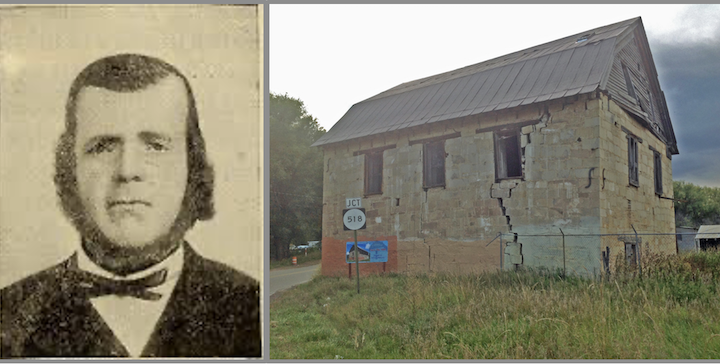
Marker, “St Vrain Mill”
Intersection of New Mexico Route 434 and 518,, Mora NM 87732
• Inscription :
St. Vrain Mill
“The St. Vrain Mill is a stone, water-powered, vertical gristmill. The mill (molino de piedrain Spanish) was one of several in the Mora Valley that supplied flour and meal to nearby Fort Union in the mid-1800s. The mill was built in 1864 by Ceran St. Vrain after his wood mill in Taos burned. St. Vrain operated the mill until his death in 1870. The mill continued to supply flour and grain to Mora Valley residents until 1933. After years of neglect, rehabilitation of the mill began in 2015.”
• Ceran St. Vrain possessed much of the acreage on his vast Mexican Land Grant which encompassed Huerfano and parts of Pueblo and Las Animas counties.
• The only person known to occupy the Beaubois “fort” in early days was Félix St. Vrain, wayward son of Ceran.
Marker, “Huerfano Butte, Beacon to Settlement”
US-87, Walsenburg, CO 81089
• Inscription (excerpts):
“Here, in the shadow of the Spanish Peaks and the Wet Mountains, stands El Huerfano - "the orphan." This stark and lonely volcanic outcrop, named in the late 1700s by an unknown Spanish trader, had for centuries guided earlier Hispanos and Indian peoples passing through this country. After 1821 when this land became part of Mexico, Huerfano Butte served as a beacon to settlement [...] Eager to settle its far northern frontier, the Mexican government granted to a few favored individuals vast tracts of land in present Southern Colorado. Here on the sprawling Vigil-St. Vrain Grant (over 4 million acres), Huerfano Butte and its rich surrounding grasslands attracted many hopeful settlers, including at least one Frenchman - a man names Beaubois, who in 1858 established a ranch and later built a fort one-half mile north of this point.
Erected 1996 by Colorado Historical Society. (Marker Number 181.)”
|
|
Eugène Pillot
1858, Houston Texas
|
|
Above:
Left: Original building listed on the National Register of Historic Places in 1974. The structure suffered severe damage in the 1980s and collapsed in 1988. A replica, incorporating some of the original cast iron columns, sills, and lintels, was completed in 1990
Center: Eugene Pillot (1820-1896)
Right: The Pillot House in Sam Houston Park
|
|
• Eugène Pillot (born 10 Feb 1820 in Lure, Departement de la Haute-Saône, Franche-Comté, France - died 10 Oct 1896 in Houston, Harris County, Texas) was a French immigrant who had relocated with his parents and siblings to the Republic of Texas from New York City in 1837.
Pillot operated a lumber business with his father and developed other properties in Houston, including the 1858 Pillot Building (still standing at Fannin and Congress) and Pillot's Opera House.
• The 1868 Pillot House was originally located at 1803 McKinney in downtown Houston. He lived in the house with his wife Zeolide and their six children, one of whom was a partner in Henke & Pillot grocery. The home was continuously occupied by the Pillot family until they donated it to The Heritage Society in 1965 when it was moved to Sam Houston Park. The Pillot House was one of the first in Houston to have an attached kitchen (complete with running water), closets, and gas lighting. Architectural enhancements such as full-length windows and wrap-around porches illustrate how residences were designed for Houston's hot climate.
• Henke & Pillot was a chain of 27 supermarkets headquartered in Houston, Texas created in 1872 and which was absorbed by the Kroger Co. in 1966.
Marker, “Pillot Family”
504 N Pine St, Tomball, TX 77375
• Inscription:
“Frenchman Claude Nicholas Pillot (1793-1862) came to this area with his family in 1837. He and his son Eugene (1820-1896) worked in the timber business and were active in the community, serving as officials in the short-lived Spring Creek County. The Willow Settlement formed around the Pillot family and other French settlers. The Pillots owned much of the land in the area and remained active in the community. A successful lumberman, Eugene also became a prominent builder in Houston, maintaining homes both in the Willow Creek area and in the city. His 1860 home was moved to this site in 1965 to serve as a reminder of the prosperous Pillot family and its contributions.”
Erected 2004 by Texas Historical Commission. (Marker Number 14850.)”
Marker, “Pillot House”
1000 Bagby Street, Houston TX 77002
• Inscription:
“Built 1868 by Eugene Pillot, at 1803 McKinney. Occupied for almost a century by his family.”
Marker, “Pillot Building”
300 Fannin St & 1006 Congress Avenue, Houston, TX 77002
• Inscription:
“The original building at this site, a cast iron front structure, was built between 1857 and 1869. Early tenants of the building, owned by French-born merchant and Houston civic leader Eugene Pillot (1820-1896), included attorneys, real estate brokers, and a dry goods merchant. Subsequently a hotel, a barbershop, restaurants, and bars occupied the building. Owned by Pillot heirs until 1944, the structure suffered severe damage in the 1980s and collapsed in 1988. A replica, incorporating some of the original cast iron columns, sills, and lintels, was completed in 1990.”
Erected 1992 by Texas Historical Commission. (Marker Number 10744.)
• Here is an excerpt of a Notice published in 1895, which French-born readers of this Bulletin who immigrated to the United States will surely relate to:
" In the last twenty years he (Eugene Pillot) has made no less than seven trips to Europe, spending a considerable portion of the time during his absence in his native country, where he has traveled amidst the scenes of his childhood, and looked up places of interest in connection with the history of his family. While he cherishes that feeling of attachment which it is most natural for one to have towards the place of his nativity, he still regards the country of his adoption as the one to which he owes the strongest allegiance, and of Texas especially he speaks with that peculiar pride and affection which all old Texans are wont to show in referring to the State in which they have so long lived and the making of whose history they have watched from its infancy up".
Marker, “Pillot Cemetery”
Tomball TX 77375
• Inscription:
“The earliest known settler on Willow Creek was Frenchman Claude Nicholas Pillot(1793-1862), whose family immigrated to the United States in 1832 and to Texas in 1837. He and his wife, Jeanne, established a home and farm in the area, and soon other French settlers joined them. Church services and school classes were held in private homes until permanent structures could be built.
This cemetery began as a family burial ground upon the death of August Pillot, 21-year-old son of Claude and Jeanne, in September 1844. The Pillots also provided burial spaces to their friends and neighbors, but the Pillot family plot remains the focal point of the graveyard. The large monument in the center of the plot was manufactured in France and shipped to Cypress for transportation to the cemetery. Although Claude Pillot died in New Orleans after a business trip, Jeanne died at home in 1866 and is buried in the family plot. Although there were a few burials over the next several decades, for the most part the graveyard was untended. In 1959, efforts began to re-establish the site as a community cemetery, and the last known burial took place in 1997. There are approximately 70 graves in the Pillot Cemetery, including three veterans of the Civil War. Through its burials and tombstones, the cemetery is an important reflection of the area's history.
Incise in base: Sponsored by Chaparral Genealogical Society
Erected 2002 by Texas Historical Commission. (Marker Number 12830.)”
|
|
Jacques Adoue
1860, Calvert, Texas
|
|
Above:
Right: Jacques Adoue, photographer unknown
|
|
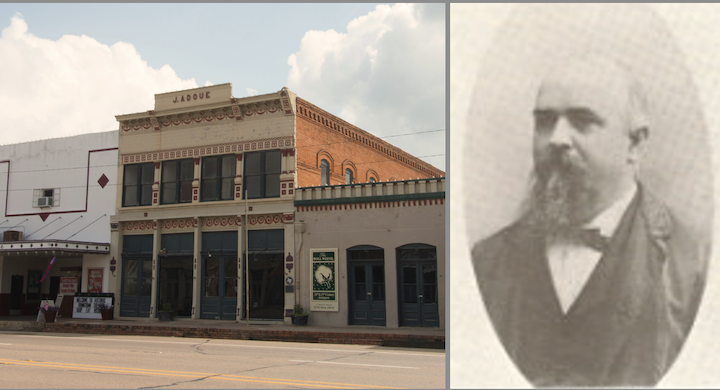
• Jacques Adoue (born 26 Jun 1851 in Aurignac, Haute-Garonne - died October 4, 1906 in Calvert, TX) was a banker and an entrepreneur, and a prominent figure in Central Texas. He and his brother Bertrand possessed and operated the Calvert Ice, Water and Electric Co. This establishment served as a storage facility for Adolph Busch's beer from St. Louis.
• The notice on his funerals reads:
“The large concourse of mourning friends testified in a small degree the love in which he was held by the people of our city. For over thirty years he had been a friend and counselor of ever one even the humblest of our citizens”. Morning Eagle Newspaper, Oct 6, 1906
• Marker, “Jacques Adoue Building”
506 Main St, Calvert, TX 77837
• Inscription:
“Relic of colorful career of Jacques Adoue (1851-1906), youngest of three French brothers who came to Texas (1860s) to become Calvert, Dallas, and Galveston business leaders. Jacques Adoue owned numerous enterprises. This store, built for Collat, Adoue & Risser Dry Goods, set an ambitious style for the town. It was said by friends that Adoue'sdeath, years later, from injuries sustained in Calvert compress fire, marked passing of an era.”
Recorded Texas Historic Landmark - 1973
Erected 1973 by State Historical Survey Committee. (Marker Number 10897.)”
|
|
Antoine Janis
1858, Founder of Laporte, Colorado
|
|
Above:
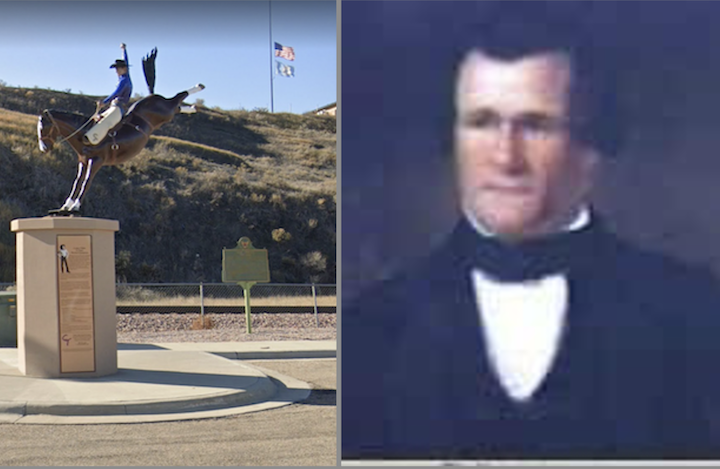
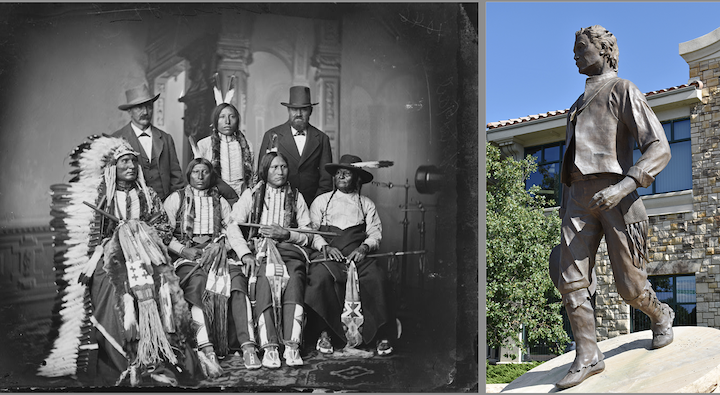
Left: Janis (standing to the right) with a group of Sioux and Arapaho, 1877. Friday, seated at lower right, often camped with his band along the Poudre River near where Janis staked his claim.. Photo: By Mathew Brady or Levin Handy - Library of Congress, Brady-Handy Photograph Collection. Public Domain, https://commons.wikimedia.org/w/index.php?curid=849866
Right: Statue of Antoine Janis in Fort Collins, CO
|
|
• Antoine Janis (March 26, 1824 in St Charles, Missouri – died April 10 1890 in Pine Ridge, SD) was a French-American fur trader and the first white homesteader in Larimer County, Colorado, where he founded the town of Laporte in 1858 (originally spelled La Porte then LaPorte).
• Janis was born in Missouri to French parents and his father freighted supplies from St. Louis to Wyoming during the heyday of the fur trade.
• While still a young boy in 1836, he traveled with his father to explore the Cache La Poudre river (so named by French trappers when they had to bury their gunpowder along the banks of the river during a snowstorm).
• In 1844 he journeyed west on his own, working with brother Nicholas as a scout and interpreter out of Fort Laramie, where he married First Elk Woman of the Oglala Sioux tribe. In an exploration trip of the Poudre Valley, which he called "the loveliest spot on earth”, he staked a claim but had to wait 1858 to file a legal homestead when that part of the country became the Nebraska Territory.
• Antoine Janis was the first white man to hold a land deed in Larimer County.
• He settled there with fellow trappers by the name of John B. Provost, his brothers Francis and Nicholas Janis, Antoine LeBeau, Tood Randall, E.W. Raymond, B. Goodman, Laroque Bosquet (aka: Rock Bush) and Oliver Morrisette…and opened a general store and a saloon. Unfortunately, his Indian wife was forced to join a reservation in 1878, where he joined her and died in 1890.
Statue, “Antoine Janis”
Corner of Horsetooth and Shields. Fort Collins, CO 80525
• Inscription:
“Antoine Janis”
• This 9 feet, 900 pounds bronze statue is the work of Fort Collins sculptor Shelley Kerr. The head was initially too large and was recast by the artist.
• “The plaque behind the statue’s base notes that Janis was born in Missouri and that he was the first known permanent white settler in Northern Colorado, but little else is said — nothing about the fact that his father was French, that his mother was mixed race, and that his wife was First Elk Woman of the Oglala Sioux. Nothing about the fact that when his wife was forcibly relocated to the Pine Ridge reservation in South Dakota in 1878, he followed her, along with most of the rest of the French/Indian families who had founded and settled this gateway to the Rockies”
Marker, “Dedicated to the Memory of Antoine Janis”
3507 Galway Dr, Laporte, CO 80535
• Inscription:
“1844-1916
Dedicated to the Memory of
Antoine Janis
First Settler
in Larimer County, Colorado
Erected 1916 by Daughters of the American Revolution Cache La Poudre Chapter.”
Stele, “Dedicated to the Memory of Antoine Janis”
3507 Galway Dr, Laporte, CO 80535
• Inscription:
“Antoine Janis first came to Larimer County in 1836 as a boy of twelve with his father who was leading a large party of French trappers and employees of the American Fur Company to Green River, Wyoming. In 1844, Janis returned to the Cache La Poudre Valley and was given many acres of valley land by his friend, Bold Wolf, a chief of the Arapahoes."
|
|
Léon & Alexandre Blum
1859, Galveston, Texas
|
|
Above:
Top Left: Léon Blum, photographer unknown,
Right: Leon Blum Bldg, Galveston TX
|
|
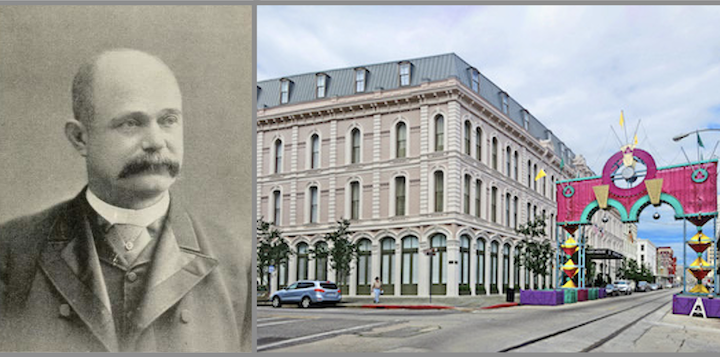
• Léon Blum (born 20 August 1836 in Gundershoffen, Departement du Bas-Rhin, Alsace, France - died 28 Apr 1906 (aged 69) in Galveston, Galveston County, Texas). His parents were Isaac and Julie Blum. He started as a tinsmith apprentice and moved to the United States in 1854. Initially, he established a mercantile business in Richmond, Texas, but later relocated it to Galveston. Leon and H. Blum, his company, was a stockholder in the Gulf, Colorado, and Santa Fe railroad. He was also the president of Blum Land Company and supported various charities, including the Bayland Orphans' Home for Boys. Leon was married to Henrietta Levy, a native of Corpus Christi, Texas, and they had two children.
Marker, “Leon & H. Blum Co. Building”
2300-2398 Mechanic St, Galveston, TX 77550
• Inscription:
"A young Alsatian immigrant, Leon Blum, joined his brother Alexander in a business partnership in Richmond, Texas, about 1852. The company, A.Blum & Bro., moved to Galveston in 1859. The new firm of Leon & H. Blum was founded late in 1868, composed of brothers, Leon, Alexander, and Sylvain, and cousins Hyman and Joseph. The firm was Galveston's leading importer and wholesale dealer in dry goods for more than twenty years. Leon & H. Blum served the southwestern United States, Indian Territory, and Mexico, and had offices in New York, Boston, and Paris, France.
Headquarters were established in this building in 1880. Designed for the company by Eugene Heiner (1852-1901), the Blum building was enlarged in 1882 with the input of noted Galveston architect Nicholas Clayton (1840-1916).
The nationwide Depression of the 1890s severely affected the business of Leon & H. Blum, and in 1896 the firm was dissolved. Since that time, the building has housed numerous establishments. The Mistrot & Bros. Company operated a large retail store here until 1917. Vacant for several years, the building later housed offices of the "Galveston Tribune." Texas Sesquicentennial 1836-1986.”
Erected 1986 by Texas Historical Commission. (Marker Number 7515.)”
|
|
Alexandre Toponce
1860 - Colorado, North Dakota, Idaho, Montana, Utah
|
|
• Alexandre Toponce (born November 10, 1839 in Belfort, France – died in Ogden, Utah, May 13, 1923). At the age of 23, he led a train of some 180 pioneers into the Far West from Denver.
• Toponce knew, and was known to, a remarkable number and range of pioneers in Utah, Idaho, Montana, Wyoming and Nevada.
• In his heyday, he could obtain thousands of dollars in credit on little more than a word and a handshake!
• He established coach lines, invested in mining, ranching, and even hydro-electric projects, still active by the age of 80...
• He created the Bonanza Route and co-founded Corinne, UT.
• His memoirs, The Reminiscences of Alexander Toponce, published in 1923, tell the story of the development of the far West.
Marker, “Alex Toponce”
11464 Custer Mtwy, Challis, ID 83226
• Inscription (excerpts):
“Lack of development and limited government services in the western territories created opportunities for entrepreneurs like Alex Toponce. Arriving from France at age seven, Toponce traveled west and by age 18 had worked as a bullwhacker. By 1860 he was working in the gold fields of Colorado, Montana and Idaho. [...] He negotiated contracts to haul freight and mail to Custer and gold bullion out to market. Toponce also operated a four-horse stage line from Challis to the nearest railway at Blackfoot, Idaho, a distance of 156 miles covered by stage in twenty-four hours. "The mail came in this evening for the last time on the pony, and in the future will come in on the Toponce-Meyers Stage." Yankee Fork Herald, October 2, 1879”
Erected by U.S. Forest Service, Idaho Department of Parks and Recreation, and the Bureau of Land Management."
• Here are a few passages from his Memoirs, just to give a flavor of the Old West, a mere 150 years ago:
...“They tried Stinson and sentenced him to be hung. It was a fair trial and it lasted three days. When he was sentenced to be hung a lot of women came and cried and carried on so that they changed the sentence to banishment.
He was to have one hour to leave Alder Gulch and after that any man could kill him at sight, if he returned. The judge asked Stinson, “Can you get away within one hour?”
Stinson said, “I’ll be gone in fifteen minutes if the mule doesn’t buck”.
He did not leave Montana, but went over to Bannock County and the sheriff there made him a deputy…”
..."At Virginia City, Nevada, […] the miners working in the big mines all bought stock generally, on ten per cent margins, Some made wonderful winnings but most of them lost. There was a great gathering of gamblers, tinhorns, swindlers, prostitutes, dancing girls, saloon keepers, and adventurers of both sexes in Virginia City, all buying and selling mining stocks. There was no “under world”. Vice and all kinds of sin were open and above board and were the rule and not the exception and nobody seemed of be ashamed of anything. Because I could speak French I got acquainted with several Frenchmen. I remember one who ate at the same restaurant that I patronized. One day he said to me “It is great - ze American language. I read in de pape sat Yellow Jacket - he boom. So I buy some. I put in $1,000.I lost de mon. Den I read ze Webster dictionary, I find ze boom is a long stick to fix ze sail on to catch ze wind. It is great - ze American language” [...]
...“The first elections in Montana were favorable to the Democrats. Colonel Samuel McLean was elected Congressman. […] Some of the Republicans in the audience casked him some questions and criticized his failure to get certain legislation passed.
He came back at them like this: Some gentlemen seem to be dissatisfied with what I have succeeded in getting done in the interest of Montana. But hey do not understand the situation. When a Democratic Congressman goes to Washington where there is a Republican House, a Republican Senate and a Republican President, do you know what is the best thing he can do, and what he will do?”
Of course someone yelled “No.”
“Well, I can tell you”, he said.
“What is it?” The crowd demanded.
“The best thing he can do”, said McLean, “is to take a drink every time anybody asks him”.
...“[Utah] Governor Murray […] always remained a good friend.
On one occasion I went to see him at his office in Salt Lake […] and I found him busy reading bills that had just been turned over to him for approval by the Legislature. He had a bunch of these bills on his desk and he said “Come in, Alex, I am glad you came in. I want to talk to you about some of these bills. Now, here is one about sheep. “ and he read it to me. The bill specified that shep could not be pastured on the headwaters of a stream if there was a house or a settlement, on the stream within 20 miles below.
“Why do you think of that bill? “, he said, “as a practical sheep man?”
“Throw it in the waste basket”, I told him.
He laughed, “All right, I’ll do it”, he said, and he did.
Then he read me on e that provided that a calf could not be healed until it had been branded, and not even then until the pound keeper of the precinct had been notified and had a chance to come and inspect the brand […].
“What should I do with that?” He asked.
“Waste basket”, I said, and he chucked it into the waste basket.
There were two or three other freak bills and I got the Governor to throw them in the waste basket and one or two of them he signed. Then he shut up his office and we went over to the White House and had dinner. He said it was a good big day’s work for a Governor.”
"Reminiscences of Alex Toponce, Written by Himself" published 1923
Note: if you ever drive between Las Vegas and Reno, it is worth the detour to visit Virginia City, NV:
|
|
Charles Schreiner
1869, Kerville, Texas
|
|
Above:
Left: Charles Armand Schreiner Sr.
Right: The Capt. Charles Schreiner Mansion in Kerrville, Texas, United States. The house was designated a Recorded Texas Historic Landmark in 1962 and listed on the National Register of Historic Places on April 14, 1975. By Larry D. Moore, CC BY 4.0, https://commons.wikimedia.org/w/index.php?curid=7356087
|
|
• Charles Armand Schreiner Sr. (born February 22, 1838 in Riquewihr, France – died in Kerrville, TX February 9, 1927), was a cattle and sheep rancher, merchant, banker, politician, and philanthropist from his adopted city of Kerrville in the Texas Hill Country. He is often called the "father of the Hill Country". Schreiner gave away more than a million dollars; his largest gift was to endow Schreiner Institute, since Schreiner University.
Marker “Charles A. Schreiner”
Intersection of State Highway 16 and Main Street, Kerrville TX 78028
• Inscription:
“Charles A. Schreiner (1838-1927) was born in Riquewihr, France, and moved to San Antonio, Texas, in 1852. He served in the Texas Rangers from 1854-1857 and the Confederate Army from 1861-1865. On this site in 1869, he opened a small store made of cypress planks. From that humble beginning he built a large business empire that included banking, ranching, land holdings, and marketing wool and mohair. Schreiner's was one of the first businesses in the country to recognize the value of mohair and in 1930 Kerrville became known as the Mohair Capital of the World. He was elected Captain of the Kerrville Mounted Rifles in 1875, and carried this title for the remainder of his life. One of his major contributions to the Kerrville community was the founding of Schreiner Institute, now Schreiner University, in 1923.”
|
|
Adolphe François Gerard, aka Louis Dupuy
Hôtel de Paris
1870, Georgetown, Colorado
|
|
Above:
Photos: By Thierry Chaunu, August 14, 1973 - © ASSFI 2024
Before starting my senior year at Lake Forest High School, IL, my host family took me on a memorable road trip to Colorado that summer of 1973. When I saw the Hôtel de Paris building and mural, I felt like I was about to meet a compatriot on the doorstep - - alas Louis Dupuy was long gone, but his spirit definitely lives in this charming mining town. (take exit 228 from I-70 E)
|
|
• Adolphe François Gerard was born in Alençon, France on Oct 14, 1844. He moved to Paris at 20 to train as a chef. He later went to London to work for a newspaper. In 1966, he relocated to New York City to work for another newspaper. In 1868, he joined the U.S. Army at Fort Hamilton, New York and was stationed at Fort D. A. Russell (now Fort Warren) near Cheyenne, Wyoming. By April 1869, he deserted to Denver, Colorado and adopted the name Louis Dupuy. That same year, he began working for the Rocky Mountain News as a reporter covering mining camps.
• Louis fell in love with the mining life in Colorado and decided to become a miner himself. Unfortunately, in 1873, he suffered a severe injury due to a dynamite explosion. Unable to continue mining, the kind-hearted people of Georgetown raised enough money for Louis to rent a building. Within a few years, he was able to purchase the building and transform it into a successful restaurant and hotel named Hotel de Paris.
• Louis Dupuy, a passionate reader of literature and philosophy, had a wide command of languages including French, English, German, and Latin. He died of pneumonia on October 7, 1900. Following his death, his housekeeper Sophie Gally inherited the hotel, but she also passed away just four months later.
• Both Louis Dupuy and Sophie Gally rest together, sharing a grave marker engraved with the words "Deux Bons Amis" meaning "Two Good Friends."
• In 1985, famed novelist Louis L'Amour immortalized Louis Dupuy by incorporating him as a fictional character in his novel "The Proving Trail."
• The Hotel de Paris is now a museum located in the town of Georgetown, Colorado. The building stands on 6th Street, across from Georgetown Town Hall, in the eastern end of the town. By the early 1890s, the original building had undergone significant changes. It had tripled in size and now featured numerous rooms, a formal dining room, a spacious kitchen, and even an apartment for Louis. The Hotel de Paris boasted modern amenities such as indoor plumbing with washbasins in each room and electric lighting, which replaced gas lamps in 1893. Guests were treated to exquisite dining experiences with meals served on fine Haviland china from Limoges, France. The table settings were adorned with elegant linens and imported glassware. The menu offered a variety of dishes, including steaks from Louis' own ranch, Troublesome Creek, as well as delicacies like oysters and anchovies in olive oil imported from France.The museum is a popular tourist attraction, known for its well-preserved interiors containing over 5,000 items from the Victorian era, 90% of which are original to the Dupuy era. In 1954, the National Society of The Colonial Dames of America in the State of Colorado acquired the property and transformed it into a museum.
Marker & Museum ”Hôtel de Paris”
409 Sixth Street, Georgetown CO 80444
•Inscription:
“A Norman inn built in a great silver mining camp by a mysterious Frenchman called Louis Dupuy, opened in 1875, richly furnished from New York ad abroad, it became nationally noted for continental delicacies and the literary bent of its proprietor, a philosopher, social rebel and master cook. Upon his death in 1900, Dupuy was revealed as Adolphe Francois Gerard, a French gentleman and refugee, formerly a journalist in Paris, London and New York.
Erected 1954 by The State Historical Society of Colorado and the Colonial Dames Society in Colorado.”
Marker & Museum ”Hôtel de Paris”
409 Sixth Street, Georgetown CO 80444
• Inscription:
“Frenchman Louis Dupuy came to Georgetown in 1870 to seek his fortune in silver mining. A mine accident ended those dreams, and he soon opened the first phase of his extraordinary Hotel de Paris. The hotel, completed in 1890, featured steam heat, hot and cold running water in each room, the finest carpets, gas lights, black walnut woodwork, and many works of art. This jewel in the mountains truly represents successful American entrepreneurship in the late 19th century.
After Dupuy’s death in 1900, the building continued as a hotel or boarding house until purchased in 1954 by the National Society of the Colonial Dames of America in the State of Colorado. The Dames have done extensive restoration and operate the Hotel de Paris Museum with a substantial collection of artifacts from Louis Dupuy’s era.
Erected 2007 by Town of Georgetown and Historic Georgetown, Inc.”
|
|
Thomas de Beau Soleil
1872, Wyoming
|
|
Above:
Left: Thomas de Beau Soleil, c. 1880, Photographer Unknown
|
|
• Thomas DeBeau Soleil ( born on 28th Feb. 1844 in Vermont – died 5th June 1909 in Denver, CO) was a French Canadian. At the age of 11, he left his home to go to Montana to seek out his uncle. During his travels, he met a trapper named Dakota in St Louis, with whom he formed a friendship. Dakota taught him survival on the plains and how to interact with Indians while trapping. In 1872, Soleil constructed a log cabin on Sweetwater Creek near Devil's Gate, which marked the inception of the Sun Ranch. He made two trips to Oregon and brought back 4,000 head of cattle, which he used to expand his ranch into an empire that covered over three million acres, making it the largest operation in Wyoming. The ranch boasts the most extensive uninterrupted stretch of the Oregon Trail.
Marker, “Sun Ranch”
State Hwy 220, Alcova WY 82620
• Inscription (excerpts):
“In front of you is the Sun Ranch, one of the first large open range ranches in Wyoming. The original ranch building, [...], was constructed in 1872.
Tom de Beau Soleil (a French Canadian name later anglicized to "Sun") came to Wyoming after the Civil War. He worked as a trapper and as a military scout with William "Buffalo Bill" Cody. He also cut railroad ties under contract with the Union Pacific Railroad. The 1872 cabin was used as headquarters for a successful ranching and hunting guide business. It later became the "Hub and Spoke Ranch," with operations extending well into the Great Divide Basin. The Sun Ranch is a Registered National Historic Landmark. [...]
Erected by U.S. Department of the Interior, Bureau of Land Management.”
|
|
Marquis de Morès
1883, Medora, Wyoming
|
|
Above:
Right: Photo: Statue of Marquis De Mores Medora North Dakota Badlands, vintage postcard
|
|
• Antoine Amédée Marie Vincent Manca de Vallambrosa, Marquis de Morès, (born 14 June 1858 in Paris - died 9 June 1896 in El Ouatia, Tunisia) was was a French duelist, an excentric adventurer, a frontiersman in the rugged Badlands of Dakota Territory in the last days of the American Old West, and a pioneer for railroads in Vietnam.a French Army officer who graduated from St Cyr Military Academy in 1879, and was a classmate of Philippe Pétain. He soon resigned his commission and moved to the US to become an entrepreneur. His soon married Medora Von Hoffman, the daughter of a wealthy Wall Street banker of German descent, moved to the Far West and became a key player in the North Dakota badlands in the 1880s. He founded the town of Medora, named after his wife. He and Theodore Roosevelt had a tumultuous business relationship during the latter’s ranching days (He even challenged him to a duel...) The Marquis was as well known for his skill as a rifleman. He founded a meatpacking industry on the Northern Great Plains that he theorized would result in higher quality meat at lower prices for consumers. After his business failed in the West, he re-enlisted, tried to build a railroad in Vietnam, and got killed in North Africa during an expedition in murky circumstances. He was a noted anti-semite during the Dreyfus Affair and even wounded Captain Dreyfus in a duel.
Marquis de Morès, Founder of Medora, North Dakota
Marker, “Château de Mores” (State Historic Site)
Pacific Avenue, Medora ND 58645
• Inscription:
“ The grey and red building that you see to the south is the Chateau built in 1883 by Marquis de Mores, a French nobleman, who founded the town of Medora. It was occupied as a part-time residence until the fall of 1886 and was frequently the scene of entertainment for nobility and eastern friends of Madame de Mores (nee Medora von Hoffman) daughter of a New York banker. In the Chateau are household furnishings and personal effects left by the de Mores family.
Many of these 19th century articles were brought from France and have been heirlooms in the family for over 100 years. Visitors Welcome.”
• Antoine-Amédée-Marie-Vincent Manca-Amat de Vallombrosa, Marquis de Mores, (1858 - 1896) founded the village of Medora (after his wife's first name) in 1883. De Mores Park in Medora, Dakota North, was listed on the National Register of Historic Places in 2019. The park is located in downtown Medora. It includes a 1926 bronze statue of the Marquis de Mores, donated by his sons.
Marker & Statue, “De Mores”
250 3rd Ave, Medora, ND 58645
• Inscription:
“ In memory of
Antoine Manca de Vallombrosa
Marquis de Mores
Lieutenant French Cavalry
Born in Paris 1858
Killed in North Africa 1896
and of his wife
Medora
who founded this town in 1883”
Marker, “De Mores Packing Plant”
201 E River Rd, Medora, ND 58645
• Inscription:
“De Mores Packing Plant was built on this site by the Marquis De Mores in 1883 to furnish dressed beef directly from the western ranges. It was successfully operated for several years, destroyed by fire 1907”
Exhibits on other side:
"Site of the De Mores Packing Plant"
“The ruins on this site are all that remain of the meat packing establishment built by the Marquis de Mores, a French nobleman who came to the Badlands and founded the town of Medora in the spring of 1883. The packing plant was the nucleus of an extensive scheme to slaughter beef on the range and to provide facilities for refrigeration, transportation and marketing of dressed beef. The Medora Abattoir (French term for slaughterhouse) continued to operate until late in the fall of 1886. The lack of a constant supply of range cattle in prime condition for slaughtering prevented the operation of the plant year-round, and was a principal reason for the failure of this venture. A fire of unknown origin destroyed the plant on March 17, 1907. In 1936 Louis Vallombrosa, the Marquis’ eldest son, donated the site to the State of North Dakota with the State Historical Society as trustee.”
Marker, “Dreams of a Cattle Empire
Chimney Park, De Mores State Historic Site”
201 E River Rd, Medora, ND 58645
• Inscription:
“ Antoine Amédée Marie Vincent Amat Manca de Vallombrosa, more commonly known as the Marquis de Mores, was a French aristocrat with an entrepreneurial spirit typical of the late 1800s. The Marquis was one of many who sought to profit from the cattle boom of the post-Civil War era. He came west in the spring of 1883 with the dream of gaining great wealth. His business ideas included letting sheep out on shares to local ranchers, owning his own cattle and running them on his range, slaughtering the animals here in Medora and shipping dressed meat to the markets in the east in refrigerated rail cars, and eventually owning his own butcher shops in New York City and selling his meat direct to the customer. The slaughterhouse business had the corporate name, Northern Pacific Refrigerator Car Co.”
” The cornerstone of his plan was the slaughterhouse in Medora. The first slaughterhouse could handle 15-25 beef carcasses per day and was in operation by October of 1883. The Marquis expanded the plant in 1885 to the complex of buildings shown in the photograph. This plant could easily handle 150 beef carcasses per day, but it is unknown if it ever reached full capacity. The building complex included three icehouses, a kill room, chill room, vats, fertilizer room, cooper shop, boiler and engine room, and office space.”
|
|
Pierre Wibaux
1883, Wibaux, Montana
|
|
Above:
Left: Photo of Pierre Wibaux, State Historical Society of North Dakota
Right: Photo: http://www.tworvgypsies.us/!USA-2012-trip-5/12a-Wilbaux_Montana.html
Bottom: A 20-dollar bill signed by Pierre Wibaux, head of the State National Bank of Miles City.
|
|
• Pierre Wibaux (born in Roubaix, Northern France, in January 12, 1858 – died March 21, 1913 in Chicago, IL) was a French cattle owner and ranchman in Montana during the turn of the 20th century. He immigrated from France to seek business opportunities in America and was among the most successful in the second wave of "Frontier Cowboys". He was the scion of a prominent textile industrial family in Roubaix, a Dragoon officer and excellent rider.
• In the 1890s, Wibaux had amassed one of the largest herds in the world, with over 65 000 cattle heads and became friend with Theodore Roosevelt, also a rancher. He owned gold mines, opened his own national bank in Forsythe of which he was the president, which gave him the right to sign dollar bills to issue money, making him the only ever Frenchman ever to do so. He was a philanthropist and gave a lot of his fortune to his native town of Roubaix.
Pierre Wibaux, “Founder of the city of Wibaux”
Marker, “Wibaux House”
112 Orgain Ave, Wibaux, MT 59353
• Inscription (excerpts):
“Pierre Wibaux, scion of a distinguished French textile family, arrived here at the settlement of Mingusville in 1883, establishing a cattle ranch about 12 miles north. His herds fared well during the devastating “Hard Winter of 1886-1887,” after which he borrowed family money to buy out less fortunate ranchers. By the mid-1890s, his ranch was one of the largest cattle operations in the nation, running about 65,000 head of cattle and 300 of horses. He sold from 3,000 to 9,000 cattle each year. Wibaux and others persuaded the Northern Pacific Railroad to build stockyards here in 1883, and to enlarge them in 1894. Wibaux campaigned to have Mingusville platted and renamed for him, both of which occurred in 1894.”
Erected by Montana Historical Society.”
Statue “Pierre Wibaux”
505 2nd Ave Ne, Wibaux, MT 59353
• At the time of his death in 1913, he was president of the State National Bank of Miles City, and his estate was appraised at more than a half-million dollars.
• Pierre Wibaux's twice-life-size statue depicts him dressed as a cowboy and stands on a hill about six blocks west of the Wibaux museum. The statue, which he had commissioned before his death, faces north, overlooking the ranch he loved.
• The Pierre Wibaux Museum is housed in Pierre's office building at 112 East OrgainAvenue. Several antiques which belonged to Pierre and his wife Mary Ellen (Cooper) Wibaux are housed in the museum along with items from early day settlers in this area. Pierre was the world's largest cattle rancher in the late 1800's.
Plaque “Pierre Wibaux”
115 Orgain Avenue, Wibaux MT 59353
• Inscription (excerpts):
“In 1876, this was strictly buffalo and Indian country. From 1876 to 1881, the U.S. Army rounded up the Indians and forced them onto reservations while buffalo hunters cleared the range for the cattle boom of the Eighties.
Pierre Wibaux ran one of the biggest cattle spreads around here in the early days. A native of France, he arrived in Montana in 1883 after studying the cattle industry from car to packing house. Within a decade of his arrival, he had amassed a herd of 65,000 cattle and prospered from business investments throughout the region. Wibaux had boundless optimism for his adopted state and once said that "If a man is intelligent, has courage, and can see things clearly, he can make money." Through his guidance, the wide-open cow town of Mingusville was renamed Wibaux and became a significant cattle and sheep shipping point on the Northern Pacific Railway. When he died in 1913, his will provided a fund to erect a statue of himself in the town named for him.
From this end of Montana to the west end is just about the same distance as from New York to Chicago. You have to push a lot of ground behind you to get places in this State. “
“Erected by Montana Department of Transportation”
|
|
There are many other noteworthy French immigrants who are listed in our compilation "Memories of France".
Among them, let us mention:
ND - 1818 François Payette
NM 1818 - Joseph Bijeau (Bissonet)
CO - 1832 - Louis Vasquez
TX - 1840 TX - 1840 Francois Joseph II and Marie Anne Haby
WY - 1852 Jean-Baptiste Richard, Joseph Bissonette, Charles Bordeaux, Louis Guinard
TX - TX - 1854 Pierre Dusseau
SD - 1858 Auguste Bruyer
CO - 1858 Sam Deon
TX - 1860 Joseph Kleiber
TX - 1868 Joseph Levy with his brother Bernard "Ben" Levy
CO - 1863 François (Frank) Mayol
TX - 1869 Jean-Pierre Casimir
CO - 1870 - Louis Dupuy hôtel de Paris
NV - 1874 Frères Garats
MT - 1878 Jean (John) Furst
WY - 1880 Vic Arland
TX - 1886 Raymond Martin
ID - 1887 Pierre Albeni, of Albeni Falls fame
TX 1890 Nicolas Bluntzer
WY - 1890 Emile Garnier
MT - 1890 Joseph & Arthur Nadeau
MT - 1890 - Paumie sisters
WY - 1909 Joseph Allemand
TX - 1917 Anthelm Bidault
|
|
To be continued!
End of Part Three of our series
Long before the celebrated Lewis & Clark expedition, several French explorers had ventured far into the West, trying to find this direct route to China, claiming land for the King of France. Although they are duly recognized at many sites (some of them rediscovered at the beginning of the 20th Century) with markers, statues and monuments, they are mostly forgotten or barely mentioned in school textbooks, in the United States and in France as well.
They had lived for generations with the local Indian tribes, trading with them, mixing blood lines. That was before the "Conquest of the West " and the forced relocation of so many native tribes. These French pioneers of the American Frontier founded many cities.
In Part Three of our series we paid tribute to some French-Americans of the Far West, The Rockies and Texas, who were before or among the very first cohorts of immigrants.
In Part Four we will reach the Pacific along these early French immigrants to California, Oregon, Washington, Alaska, and Hawai'i.
|
|
Tribute to Corp. Philip Phillips 'Phil' Benney
Lafayette Flying Corps
"Died for France"
on January 26, 1918, at Montfaucon (Doubs)
We continue our series started this past October with tributes to members of the Escadrille Lafayette, later part of the Lafayette Flying Corps. For access to our Bulletin dedicated to the Escadrille Lafayette, please click on:
This month, we pay hommage to Corp. Philip Phillips 'Phil' Benney, who "Died for France" while serving in World War One.
|
|
Photos above, from Left to Right: "Pilote breveté" Philip Phillips Benney
Page from Corp. Penney "Livret Militaire" with citation "Mort Pour la France" ("Died for France")
Buried at Escadrille Lafayette Monument, Marnes-la-Coquette, France.
|
|
Decoration:
Croix de Guerre with Palm
Service:
Born June 28, 1895, in Pittsburgh, Pennsylvania. Son of George Andrew and Eugenia Hill Benney. Educated Shady Side Academy, Pittsburgh. Volunteer civilian cruise, U. S. Navy, 1916. Joined American Field Service, January 8, 1917; attached Section Twelve until July 11, 1917. Enlisted French Aviation. Trained, Avord, Pau, and le Plessis-Belleville. Caporal pilote, Spad Escadrille 67. Died at hospital of Glorieux, January 26, 1918, of wounds received in combat over Montfaucon the previous day.
Philip Phillips Benney combined with his enthusiasm a special aptitude for flying which led his commander to write that he had "rarely seen in a pilote the qualities of courage, enterprise, and daring that he possessed." But it was his likable personality that most impressed "Phil's" comrades --that and his courage. "A braver, finer, and more lovable boy never lived. He seemed to make friends no matter where he was," wrote R. B. Hoeber, of Escadrille 103, and gives a suggestion of "Phil's" character and ability when he says: "Phil was the best friend I had over here,---we had been through all the schools together, where he was extremely popular and did ripping good work. Then finally when he got out here he was so happy, and, while he had a good deal of hard luck with his machines, he was flying beautifully." Captain d'Indy helps on the description saying that "Phil" "from his arrival won every heart by his intelligence and sincere good-fellowship," and his uncle tells how the same French officer "spoke several times of Philip's wonderful courage and what a great loss it was . . . . . because of the fact that he was loved by them all," and himself adds, "No one could help loving him, he was so frank, charming, and brave."
• Having spent six years at Shady Side Academy, Philip entered the automobile business as a salesman, gaining experience there which led, when he was recommended for a reserve commission, after his summer of 1916 on a battleship with the volunteer civilian cruise, to the remark that he was especially proficient in engineering. The spirit which later caused "Phil" to enter hazardous chasse work made it impossible for him to sit at home while France battled for her existence and in January, 1917, he gave up his business and sailed for France. He went to the front with Section Twelve of the Field Service, but despite his excellent record and friendships made, he was not satisfied, and when America entered the war he waited only until his term of enlistment was ended before joining the Foreign Legion as a private and then transferring to aviation.
• He entered into the training for a chasse pilote eagerly, saying that his eleven days of acrobatics at Pau "were the most wonderful days of my life," and speaking of the splendid flying days when he "worked like a dog, flying an average of five hours a day." His zest was unbounded and his happiness in service shone from his letters, while he had also a keen eye for the beautiful and was sensitive to the wonders of flying.
He joined Spad Escadrille 67 where, his officer said, "So ardent was he that I had long delayed the moment of sending him against the enemy, fearing a little too much audacity and too little experience." On January 25, 1918, with four other planes, "Phil" went on his first combat patrol. As they circled over Montfaucon seven Germans attacked, centering their fire on "Phil." Badly wounded and rapidly losing strength, he managed to land his machine within the French lines.
• He was hurried to the hospital at Glorieux, where two Frenchmen gave some blood in an effort to save him, but he died in the early morning. "How could I do less than give him a few drops of my blood," said one, "when he had given all of his for France?"
• No words could more finely characterize Philip Benney than those of his French chief: "The poor little boy was worshiped in the squadron and admired by all because he was such a splendid soldier and of such a magnificent courage. He fell nobly, beautifully, facing the enemy in a real fight. Perhaps he envied such a death for a long time."
|
|
ANNOUNCEMENTS AND SAVE THE DATES |
|
Our Hermione Fund raising appeal continues!
• This past November, our Society helped launch the US Fund raising campaign to help Save the Hermione and have it sail back in time for the United States Semiquicentennial. This is an ongoing campaign and all donations are tax-deductible.
Save the Date!
On Saturday August 17, throughout the morning, an ongoing presentation on the history of the frigate Hermione followed by Q&A's from the general public will take place on board of the three-mast Wavertree at South Street Seaport in downtown Manhattan, as part of the kickoff celebrations of the Lafayette Farewell Tour Bicentennial.
|
|
"Merci Train" 75th Anniversary Celebrations |
|
• Our November 2022 Bulletin narrated the incredible story and ongoing legacy of the "Train de la Reconnaissance Française", affectionately called "The Merci Train" (November 2022: "The Merci Train, 49 boxcars of French gifts"
• 2024 is the 75th anniversary of the "Merci Train", a gesture of friendship and gratitude from the French people to Americans who gave 49 boxcars full of gifts for each State in 1949.
• The Merci Train, the 40&8 National Box Car Association and many other local organizations, custodians of the various "Merci train" boxcars in several States are planning celebrations throughout the year. We are honored to help get the word out.
• The Historic Museum of Holly Hill is planning with our Society, represented by Brigitte van den Hove-Smith, Déléguée Générale Adjointe, South East USA a special commemoration in Holly Hill, Daytona Beach, FL at the Florida boxcar on November 11 at 11:00AM, with the French General Consulate in Miami. Stay tuned for more details!
• Another "Save the Date": February 2, 2025 for the re-dedication of the Hawai'i boxcar, currently being restored thanks to Mr. Jeff Livingston, Historian, 40 & 8 Project Manager, Hawaiian Railway Society, and volunteers, as well as the enthusiastic support of the Aloha Chapter, NSDAR, of the Daughters of the American Revolution, Laura Ingenluyff, State Vice-Regent, Hawai'i NSDAR. See the photos below that we just received, showing the incredible efforts that are being deployed to save this historical artifact.
|
|
Memorial Day
Wreath Laying on Sunday, May 26, 2024
at the 107th Infantry Memorial
5th Avenue & 67th Street, New York
with the Veterans of NY Seventh Regiment
|
|
Above:
Brig. General Thomas Principe, Deputy Consul of France Mr. Laurent Brunet, delivering remarks
Photos by Daniel Falgerho, Federation of French War Veterans
|
|
Memorial Day 2024
• On Sunday, May 26, we paid tribute to all US Veterans who sacrificed so much for our freedom. We were honored to be invited by Brig. General Thomas J. Principe, president of the Veterans of the Seventh Regiment at the Seventh Regiment/107th Infantry Memorial on 5th Avenue & 67th Street.
• Mr. Laurent Brunet, head of the Chancellery and Deputy Consul at the General Consulate of France in New York, with Alain Dupuis, president of the Federation of French War Veterans, laid a wreath from the French government.
• Another wreath was laid in front of the monument by Lt. Cdr. (Hon) Thierry Chaunu, French Navy and Lt. (Reserve) Pierre Gervois, French Air Force on behalf of the Federation of French War Veterans (FFWV), the American Society of Le Souvenir Français, Inc. and the Association of French Reserve Officers in the United States (ACREFEU).
• Deputy Consul Laurent Brunet later reminded the Veterans present at the Park Avenue Armory in a moving speech of the historic and unbroken ties of alliance and friendship between France and the United States since 1778.
• The Regiment fought in France, notably breaking the Hindenburg Line in September 1918 and with units in the Ardennes-Alsace during the Battle of the Bulge in 1944. The Seventh Regiment Armory on Park Avenue displays portraits of the Marquis de Lafayette and General George Washington. Under the portrait of Lafayette is inscribed: "The marquis de Lafayette, Commandant de la Garde Nationale. Presented to the Seventh Regiment by the Republic of France April 12 ,1934 In recognition of the adoption by this Regiment, in the year 1824, of the name "National Guard" in honor of the First Citizen Soldier of France. "
• Brig. General Principe and the Veterans awarded two medals of the Seventh Regiment Veterans Association to the crew of Central Park Conservancy, who cleaned and restored within 24 hours the monument which had been defaced with graffitis a week prior during the students protests.
|
|
80th anniversary of D-Day - events
Photo Album
|
|
Operation Mirror 2024
Welcoming ceremony in Brooklyn, NY and
Ceremony at Arlington National Cemetery
Thursday - Friday, May 23-24, 2024
|
|
"Operation Mirror 2024"
"La Flamme de la Nation" from the Arc of Triumph, Paris
to the Tomb of Unknown Soldier, Arlington National Cemetery
Saturday May 24th at 2:00PM
We are pleased to share these photos and videos links just received from "Operation Mirror".
As part of the commemoration of the 80th anniversary of the Normandy landings, 12 young French students transported the “Flame of the French Nation” from the Arc de Triomphe in Paris to the United States with a stopover in the United Kingdom at Southwick House, near Portsmouth, which was General Eisenhower’s headquarters.
• After crossing the Atlantic on board the Queen Mary 2, they arrived in New York on May 23 where they were greeted by H.E. Mr. Laurent Bili, Ambassador of France to the United States, Mr. Damien Laban, Acting General Consul of France in New York, American WWII Veterans and members of the Federation of French War Veterans led by their president Alain Dupuis, and representatives of the Association of French Reserve Officers in the United States.
• On May 24, these 12 young French students brought this “Flame of Liberty” to the tomb of the Unknown soldiers at Arlington military cemetery in the presence of French Ambassador Mr. Laurent Bili and representatives of several American patriotic organizations:
Dr. Patti Maclay, representing Mrs. Pamela Edwards Rouse Wright, President General, Daughters of the American Revolution
Mr. Chuck Schwam, COO, American Friends of Lafayette
Mr. Richard Azzaro, Co-founder and President, Tomb of the Unknown Soldier Foundation, Co-founder and Past President, Society of the Honor Guard, Tomb of the Unknown Soldier
Thierry Chaunu, president of the American Society of Le Souvenir Français, Inc, and General Delegate of Le Souvenir Français (one of the official sponsors of ”Operation Mirror”)
Pierre Oury, Col, US Air Force (Retired)
Not pictured but also present among other dignitaries:
Mrs. Helen Patton, grand-daughter of General Patton
Mr. Hervé Racat, who conceived and spearheaded "Operation Mirror" and selected these fine young ambassadors.
Alain Leca, Regional Delegate, Le Souvenir Français, and president of the French War Veterans of Washington D.C.
Eve Chauchard, president, Comité Tricolore of Washington D.C.
Operation Mirror was organized by L' Association du Souvenir du général Leclerc de Hauteclocque, Maréchal de France, Le Comité de la Voie de la Liberté, with Le Souvenir Français among the sponsors.
The ceremony at Arlington was organized by the French Embassy.
To view excerpts of the ceremony at Arlington, click on:
and
This was a very moving ceremony, and everyone in attendance felt particular pride to see these fine young men and ladies carrying this "torch of remembrance" and expressing their gratitude to America and WWII allies.
Here are the wonderful remarks written and delivered by Ms. Estelle Bagassien (see photo at the lectern):
Ladies and Gentlemen, good evening,
What an honor it is for me, Estelle Bagassien, a 21-year-old student, to stand before you today.
For the past 25 days, my fellow ambassadors and I have been traveling through history along a symbolic path: la Voie de la Liberté.•
Here we are, 80 years after the start of the Liberation of France in Normandy, in this highly memorable cemetery.
It is after having traversed in the opposite direction, the path taken by our allies, that I present myself to you, with the Flame of the French Nation.
As the granddaughter of a 91-year-old grandmother who lived during the Nazi Occupation in Western France, I grew up with an unshakable human conscience. An awareness of fraternity, transmission and the duty to remember.
In presenting myself for this project, I wanted to take the time to reflect, to celebrate friendship, peace and freedom.
I wanted to thank you, those of you who are here, for your presence and your attention, but above all, those of you who are here, in this cemetery, for your courage, your resilience and your sense of sacrifice.
After this month of commemoration, these ceremonies, these moments of exchange, friendship and sharing with those who lived through and fought the war, and those who never want to relive the dark hours of our collective history, I've come to understand one thing: beyond the "thank you" we're giving you, it's a promise I've come to deliver. We will be there, we will not forget, we will pass on, we will continue to write, to tell.
These men, whose memory is fading with time, were my age when they came to liberate France. They had a dream: peace.
They had a dream: freedom.
They had a dream, and they fought for it.
For these thousands of soldiers, their families, their homelands, I say to you, we will never forget you.
On behalf of the Ambassadors of the Flame of Liberty, my country and this new generation to which I belong, rest assured that we, the 12 Ambassadors, are fully aware that bringing you the Flame of the French Nation is a powerful act of commitment that takes on its full meaning in today's context.
Our fraternal gratitude is and will be eternal.
Estelle BAGASSIEN"
This gesture is a testimony of France's gratitude to its allies, as their commitment was crucial in regaining its freedom.
• This project was placed under the High Patronage of Mr. Emmanuel Macron, president of the French Republic.
• Le Souvenir Français in Paris, which is an association placed since its inception in 1887 under the High Patronage of the President of the Republic, was an Official partner of "Operation Mirror".
https://laflammedelaliberte.com/
|
|
Reception in honor of the 80th Anniversary of D-Day
at the French General Consulate of New York
June 6th, 2024
|
|
Photos: Daniel Falgerho, Federation of French War Veterans
Thursday, June 6, 2024, marked the 80th anniversary of the Normandy Landings. On June 6, 1944, the Allied forces – American, British and Canadian among others - invaded France through the beaches of Normandy with more than 150,000 troops, which lead to the liberation of France and Europe from the tyrannic Nazi rule. 80 years later, this exceptional anniversary was the opportunity to honor the memory of the heroes who fought for our freedom, and celebrate once again the unique historical bound between France and the United States.
The Consulate General of France in New York hosted a reception to commemorate this important milestone in France’s shared history with the United States. The reception brought together the Acting Consul General, Mr. Edward Mermelstein, NYC Commissioner for International Affairs, Mr. James Hendon, NYC Commissioner for Veterans’ Services, foreign diplomats, representatives from French and US military forces, and French and American veterans.
With D-Day veteran Edward Chan present, we remembered the heroes who fought for the freedom we enjoy today and emphasized the importance of preserving their legacy.
Speeches and historical readings, together with an army band, made this event an unforgettable evening in honor of those who sacrificed their lives for our democracy.
|
|
D-Day in Paris celebration
by TheFrenchWillNeverForget.org
June 6, 1944 - June 6, 2024
|
|
• Our First Vice-President, Patrick du Tertre, who is also co-Founder of TheFrenchWillNeverForget.org, along with Paul Bensabat, Jean-Pierre Heim, and Christian Millet (in memoriam), organized a momentous celebration in Paris, with 1,944 American and French flags at the foot of the replica of the Statue of Liberty, Pont de Grenelle, with the Eiffel Tower in the background.
We will publish photos of this event in our July Bulletin.
A video can be viewed on YouTube at:
|
|
Homage of the Souvenir Français to Anna Marly
Composer of the "Chant des Partisans"
Friday, June 7, 2024
Palmer, Alaska
|
|
Gravesite, “Anna Marly”
Palmer Pioneer Cemetery , S Old Glenn Hwy, Palmer, AK 99645
• We are also proud that on June 7th at 10:00AM, our Society and the Daughters of the American Revolution honored Anna Marly, the composer of the "Chant des Partisans".
Anna Marly is buried in Palmer, Alaska. Her hymn galvanized the French Resistance and became the second unofficial French national anthem. She became an American Citizen in 1965.
Mme Sonia Lelarge, Honorary Consul of France in Anchorage, Alaska
presented a wreath in the name of Le Souvenir Français in collaboration with
The Daughters of the American Revolution, Alaska Chapter
to whom we express our gratitude
The DAR Franco-American Memorial Committee members and family of Nicholas Makarov and Prescovia Golitsyn,
As well as all the volunteers and representatives of patriotic associations,
• Anna B. Smiernow, born Anna B. Betulinskaya, known as Anna Marly, (30 October 1917 – 15 February 2006) was born in Saint Petersburg, Russia and died in Palmer, Matanuska-Susitna Borough, Alaska. Her mother fled the Russian Revolution with baby Anna and found refuge in Nice, France. As a teenager, Anna became a ballet dancer in Monaco and as a young woman became a cabaret singer in Paris when WWII broke out. She joined the Free French in 1940.
• Anna Marly is the composer of the "Chant des Partisans" ( Joseph Kessel and Maurice Druon wrote the lyrics) which became a second national anthem of France after La Marseillaise during WWII and up until today, whenever ceremonies are held in honor of the French Resistance.
• After the war and her divorce, she moved to Latin America, then Pennsylvania with her second husband, and moved to Alaska after his death. She became a naturalized American citizen in 1965.
• She also wrote "La Complainte du Partisan" (known in English as "The Partisan"), which was later famously covered by Leonard Cohen and Joan Baez.
• Inscription:
Composer - Singer
"She made her talent into a weapon for France."
---- General Charles De Gaulle
|
|
Above: Photos courtesy Terri Mitchell, Alaska Society, Daughters of the American Revolution
We will formally acknowledge in the next Bulletin all participants and volunteers from civic and patriotic associations who made this tribute so memorable.
|
|
Save the Date!
July 15, 2024
Arlington National Cemetery
|
|
Save the Date!
August 16, 2024
Kick-off of the Lafayette Farewell Tour Bicentennial
|
|
JOIN US FOR A MEMORABLE WEEKEND WITH LAFAYETTE!
Public Events, Rain or Shine
All are Welcome!!
Friday, August 16, 2024
9:00AM: Rendez-Vous at Brookfield Place to see General Lafayette in person step off his ferry from Staten Island.
Lafayette will inspect the troops and be greeted by New Yorkers (you!) waving French and American flags, while the Cadets Lafayette Marching band plays our national anthems, patriotic and popular tunes.
10:30AM: We will then walk to nearby Evacuation Day Plaza at the start of Broadway for an address by Mayor Eric Adams and the new French Consul General Mr. Cédrik Fouriscot at 11:00AM . Ellie Karl will sing the Star Spangled Banner and Virginie de Lafayette will sing La Marseillaise.
12:00PM noon: a procession along Broadway will take place all the way to New York City Hall, where a Proclamation will be read on the steps.
Saturday, August 17, 2024:
9:00AM - 1:00PM: On board the Weavertree three mast at South Street Seaport, a series of discussions on the historical importance of the Hermione, aka "The Freedom Frigate", presented by Thierry Chaunu.
3:00PM: A special theatrical performance at Florence Gould Auditorium, French Institute / Alliance Française (tickets available at Box Office, all details will be provided in our next July Bulletin)
Sunday, August 18, 2024:
Lafayette Bicentennial commemorations in New Rochelle, NY, Greenwich, CT
|
|
PAST MONTHLY BULLETINS
OUR GOAL: turn the spotlight on a famous, or less famous, episode or historical figure during the long shared history between France and the United States, with illustrations and anecdotes.
You can have access to all our past 12 monthly Bulletins
(in English and French) by clicking these links below or by
French pioneers of the American West (Part 2 of a series - the Frontier - 1750-1850)
April 2024: La Pérouse in America
March 2024 - French Explorers of the West (Part 1, 1634-1804)
February 2024 - Tribute to the Harlem Hell Fighters - 369th Regiment
January 2024: Early French Missionaries in the United States (Part 1 - New York, Maine, Vermont)
December 2023: The Year in Pictures
Special Photo Edition - Our sculpture of The Little Prince® in New York
November 2023: French Forts of Ohio & Pennsylvania
October 2023: Tribute to the Lafayette Escadrille
September 2023: the Duc de Lauzun and his Legion of hussars
August 2023: the exploits of Costes & Bellonte
July 2023: The adventure of La Belle and the sailor of Louis XIV at the Texas State Cemetery
June 2023: French Forts of Mississippi and Lower Louisiana
May 2023: Joan of Arc in America
|
|
CALENDAR OF EVENTS 2024
List is subject to change. All dates to be confirmed
|
|
2024 promises to be a busy year with several projects and events!
It will be the start of the Bicentennial of Lafayette's Farewell Tour with many, many events starting in August, to celebrate his triumphal tour as "Guest of the Nation" throughout 24 States and lasting 13 months! This Bicentennial is organized by The American Friends of Lafayette and we will provide in future bulletins all details.
• Friday July 5: annual wreath-laying at the tomb of general Lafayette at Picpus cemetery, Paris, by the American Ambassador.
• Saturday July 13: annual wreath laying ceremony at the tombs of Admiral de Ternay, Chevalier Pierre Rousseau de Fayolle, LT Benjamin de la Villemarais at Trinity Churchyard and homage to the Statue of Rochambeau and the Monument to the French Fleet, as part of "Tribute to France" weekend in Newport, R.I.
• Sunday, July 14: Bastille Day celebration in Central Park
CAFUSA (Comité des Associations Françaises et de Langue Française de New York) is selling raffle tickets with great prizes!
• Thursday, August 15: 80th anniversary of Allied landing in Provence
• Friday, August 16: Kick-off Lafayette Farewell Tour Bicentennial on Broadway at Brookfield Place, procession and flag-raising with the Mayor of New York City at Evacuation Day Plaza,
• Saturday, August 16: Public events, see Lafayette200.org for more details.
• Friday, October 18: stele and boulder with bronze plaque honoring by name the hussars who died at the Battle of Hook, to be installed between our two markers at Abingdon Elementary School park.
• Saturday, October 19: celebration of French-American Victory at Yorktown, dedication of a bronze plaque "Sailors buried at sea” at the French Memorial
• Sunday, November 10: Annual wreath-laying at the 463 "Morts Pour la France", Notre Dame Church in Manhattan
• Monday, November 11: Veterans Day / Armistice Day, 5th Avenue Parade in NYC, Washington DC, Houston, TX
• Monday, November 11: wreath-laying ceremony at the Merci Train boxcar in Holly Hill , Daytona Beach, Florida
Help us make these a reality with your tax-deductible financial support!
You are welcome to specify the project(s) you wish to help.
Un grand "Merci"!
and...
Enjoy a wonderful Summer 2024!
|
|
OUR MISSIONS:
• To preserve the memory of the French soldiers, sailors and airmen who gave their lives for freedom, and who are buried in the United States.
• To honor French Citizens who did great deeds in the United States, or with a strong connection with the United States,
• To promote the appreciation for French culture and heritage in the United States, and the ideals that unite our two nations, in order to pass the torch of memory to younger generations.
• To strengthen the long-standing traditional bonds of friendship between the American and French peoples, and to this end: erect or maintain memorials and monuments and encourage historical research, public presentations and publications in the media.
The American Society of Le Souvenir Français, Inc. is an independent American corporation, apolitical, established in 1993 in NY, with 501 (c) 3 non-profit status.
|
|
Board of Directors
American Society of Le Souvenir Français, Inc.
Members (2024):
Françoise Cestac, Honorary President • Thierry Chaunu, President, and General Delegate, Le Souvenir Français in the United States • Yves de Ternay, Treasurer • Patrick du Tertre, 1st Vice President • Henri Dubarry • Francis Dubois • Alain Dupuis, 2nd Vice President & Deputy General Delegate, Le Souvenir Français in the United States • Daniel Falgerho, General Secretary • Clément Mbom, Education Advisor • Jean-Hugues Monier, Auditor • Harriet Saxon • Nicole Yancey
Regional Delegates:
Jacques Besnainou, Great Lakes and Midwest • Bruno Cateni, South
Prof. Norman Desmarais, New England • Alain Leca, Washington D.C. •
Marc Onetto, West Coast • Brigitte Van den Hove – Smith, Southeast • Nicole Yancey, Yorktown & Virginia, former Honorary Consul of France in Virginia
|
|
Help us implement several historic commemorative projects celebrating the 246-year-old Franco-American friendship and alliance! |
|
The American Society of Le Souvenir Français, Inc. is a registered NY State non-profit corporation and has full IRS tax exempt 501(c)3 status. All donations are tax deductible.
Copyright © 2024 The American Society of Le Souvenir Français, Inc.
All Rights Reserved
Merci de nous contacter si vous souhaitez recevoir ce bulletin dans sa version traduite en français.
Contact: Thierry Chaunu, President
500 East 77th Street #2017, New York, NY 10162
|
|
|
|
|
|
|