|
In This Issue:
- Market Update: U.S. Rice Harvest Gaining Strength- New Crop Prices??
- Washington Update
- Domestic News: Connecting the Next Generation to Texas Agriculture; First New-Crop Rough Rice Shipment Heads to Honduras from SLRF
- International News: Bringing the Benefits of U.S. Rice to Guatemala’s School Children
- Capture Rice Country
- Video from Rice Country
| |
| U.S. Rice Harvest Gaining Strength- New Crop Prices?? | |
| |
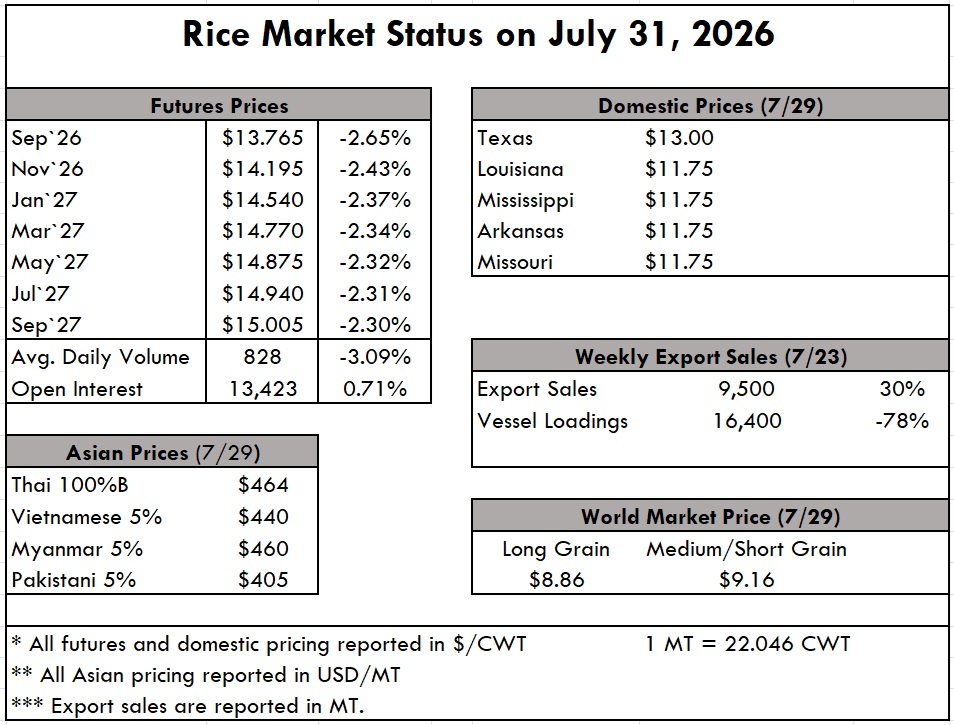
All eyes on Arkansas, where harvest is expected to get underway in mid-August. While this is the big-ticket item, the potential fallout from Hurricane Bertha on the Louisiana rice harvest is still up in the air, but to date there have been no real negative reports. What we all know is that we don’t need any additional complications for the harvest season; the hot weather in Arkansas is enough to cause worries on quality, so we don’t need difficult weather patterns to augment problems in Louisiana. Harvest is also underway in Texas, where it is otherwise 89% headed and 68% in the good/excellent categories.
Louisiana is just ahead of Texas with 93% headed and 78% in the good/excellent categories. Arkansas is 63% headed and 65% good/excellent. Overall, all six states are reporting 67% headed, and 77% good to excellent. 30% is fair, and 3% is poor. It is still too early to have any solid idea of milling qualities out of Louisiana and Texas. The few reports out of Southwest Louisiana have been positive, where new crop paddy was loaded this week for Honduras. Prices on the ground haven’t changed much as old crop inventory is being burned off in the face of the lighter harvest. Overall outlook is price trending upward due to low acreage, while apparently still plenty of low milling old crop hovers over the market.
A recent USDA GAIN report from Argentina shows that their MY 2026/27 rice production is forecast at 1.12 million MT rough (729,000 MT milled), with area expanding modestly. However, our sources in the 4 Mercosur countries indicate significant reductions in planted acres. Planting in Paraguay and northern Argentina will be underway this weekend if they have not already. Profitability versus cost of production, much like the U.S., is the current environment. Conditions are also being tempered by forecasts for a strong El Niño, which has producers selectively choosing fields to limit risk; above-average rains expected in southern Brazil and northeastern Argentina could swell irrigation-supplying rivers but also push weather-related area losses above recent norms. Producer prices have climbed from roughly $165/MT rough at harvest in March to near $200/MT on held stocks. Exports are forecast unchanged at 280,000 MT milled, with Chile, Spain, Turkey, Brazil, and Puerto Rico remaining the leading destinations in that order. Several paddy sales to Central America and Mexico out of Brazil and Uruguay have been reported this week.
The most recent USDA Export Sales report shows net sales of 9,500 MT this week, up 31 % from the previous week, but down 45% from the prior 4-week average. Increases primarily for Mexico (6,700 MT), Jordan (1,700 MT), Saudi Arabia (800 MT), Canada (100 MT, including decreases of 700 MT), and Guatemala (100 MT) were offset by reductions for Haiti (100 MT). Exports of 16,400 MT were down 78% from the previous week and 63% from the prior 4-week average. The destinations were primarily to Haiti (7,100 MT), Canada (2,900 MT), Mexico (2,700 MT), Jordan (1,700 MT), and Saudi Arabia (900 MT).
| |
|
|
Senate Ag Committee Eyes Farm Bill Markup Next Week: Reports earlier this week indicated that Senate Agriculture Committee Chairman John Boozman (R-AR) still hopes to mark up the majority’s farm bill before the Senate adjourns for the August recess. Boozman is tentatively targeting Thursday, August 6, though the timing remains uncertain, largely because Committee member Sen. Mitch McConnell (R-KY) is still absent from the Senate for health-related reasons. On Monday, McConnell’s office released an update stating the Senator had been discharged from the hospital but remained in a rehabilitation facility, with no return date specified. Without McConnell’s attendance and full GOP participation, the Committee will likely struggle to advance the proposed Agricultural Adjustment Act of 2026 in its current form. Senate Agriculture Democrats continue to push for inclusion of a delayed cost-share provision for the Supplemental Nutrition Assistance Program (SNAP). Boozman and Ranking Member Amy Klobuchar (D-MN) have been negotiating a path toward a bipartisan bill, but no compromises have been made public at this point in time. Additionally, it has been reported that new language regarding year-round E15 is expected to now be included. On Thursday, Senate Ag Committee majority staff organized a call to brief agricultural stakeholders on the upcoming markup, but the meeting was ultimately pulled down at the last minute with little explanation. As of now, the Senate is scheduled to remain in session until August 7 unless Republican leadership adjourns early for the five-week recess. You can find a link to the Senate’s farm bill text and supporting materials below:
· Click HERE for legislative text
· Click HERE for a title-by-title summary
· Click HERE for a section-by-section
· Click HERE for an overview
Trump Administration replaces Section 122 tariffs with new Section 301 forced labor duties and proposes Section 338 tariff on Canada: At 12:01 a.m. on July 24, 2026, the 10 percent global reciprocal import surcharges promulgated under Section 122 of the Trade Act of 1974 officially expired upon reaching their statutory 150-day time limit. To replace these expiring duties, the Office of the United States Trade Representative (USTR) issued a Notice of Final Action under Section 301 of the Trade Act of 1974 imposing new tariffs on 60 national economies due to failures to enforce prohibitions on goods produced with forced labor. From a sheep industry perspective, the new Section 301 action applies 12.5 percent tariffs to Australia and New Zealand. Almost simultaneously, the Executive Branch announced a separate proposal under Section 338 of the Tariff Act of 1930 to levy an additional 50 percent ad valorem tariff on certain Canadian goods, including dairy, beginning on August 19, 2026. Importantly for agricultural and food clients, products originating under the United States-Mexico-Canada Agreement (USMCA) receive distinct treatment under these two regulatory actions.
SECTION 301 FORCED LABOR TARIFFS
Effective July 24, 2026, USTR Modified Subchapter III of the Harmonized Tariff Schedule of the United States (HTSUS), Establishing Four Duty Categories to be Applied to 60 Investigated Economies:
- 10 Percent Baseline Duty Rate: Applies to 17 economies that have enacted forced-labor import prohibitions or entered into Agreements on Reciprocal Trade (ART) with the United States, including Argentina, Bangladesh, Cambodia, Canada, Ecuador, El Salvador, Guatemala, Honduras, India, Indonesia, Jordan, Malaysia, Mexico, Pakistan, Sri Lanka, Trinidad and Tobago, and the United Kingdom.
- 12.5 Percent Baseline Duty Rate: Applies to 38 remaining investigated economies, including: Algeria, Angola, Australia, the Bahamas, Bahrain, Brazil, Chile, China, Colombia, Costa Rica, the Dominican Republic, Egypt, Guyana, Hong Kong, Iraq, Israel, Kazakhstan, Kuwait, Libya, Morocco, New Zealand, Nicaragua, Nigeria, Norway, Oman, Peru, the Philippines, Qatar, Russia, Saudi Arabia, Singapore, South Africa, Thailand, Türkeye, the United Arab Emirates, Uruguay, Venezuela, and Vietnam. (See HTSUS Chapter 99, Subchapter III, Headings 9903.05.20–9903.05.84.)
- 10 Percent Net-MFN Additive Rate: Applies to Most-Favored-Nation (MFN) trading partners, specifically: the European Union member states and Taiwan. If an imported product’s standard MFN duty rate is less than 10 percent, a Section 301 duty is added to achieve a combined 10 percent rate. If the applicable MFN rate is 10 percent or higher, the additional Section 301 duty is zero.
- 12.5 Percent Net-MFN Additive Rate: Applies to Japan, South Korea, and Switzerland under the same additive formula up to a combined 12.5 percent cap.
EXEMPTIONS FOR USMCA GOODS AND AG INPUTS
Products qualifying for preferential tariff treatment under USMCA are exempted from the new Section 301 forced labor duties:
- USMCA Duty-Free Exemption: Additional Section 301 duties do not apply to originating products of Canada or Mexico that enter free of duty under USMCA (codified under HTSUS Chapter 99, U.S. Notes 52(g) and 52(h)).
- Specific Product Exceptions: Annexes I and II of USTR’s Notice exempt certain product categories to prevent domestic supply chain disruptions. These include raw agricultural inputs, fertilizer ingredients, and pesticide ingredients (codified under HTSUS Chapter 99, U.S. Note 52).
- Goods in transit. Products loaded onto a vessel and in transit before 12:01 a.m. on July 24, 2026, and entered in the U.S before July 28, 2026 are exempt from Section 301 duties.
(See Notice of Actions in Section 301 Investigations, Docket Nos. USTR-2026-0265, USTR-2026-0266, Doc. No. 2026-15181 (Off. U.S. Trade Rep. July 23, 2026))
PROPOSED SECTION 338 TARIFFS ON CANADIAN IMPORTS
In addition to the Section 301 Notice, the Executive Branch announced its intent to invoke Section 338 of the Tariff Act of 1930 to impose an extraordinary 50 percent ad valorem tariff on Canadian goods, including dairy products, beginning on August 19, 2026. This is in response to alleged Canadian trade discrimination against the United States. Unlike the Section 301 duties, the Section 338 announcement does not contain an exemption for USMCA goods. However, the Executive Branch indicated that certain energy products, potash, fish, and other products will be excluded. You can find the White House’s fact sheet on the proposed Section 338 tariffs on Canadian goods here.
| | Connecting the Next Generation to Texas Agriculture | |
|
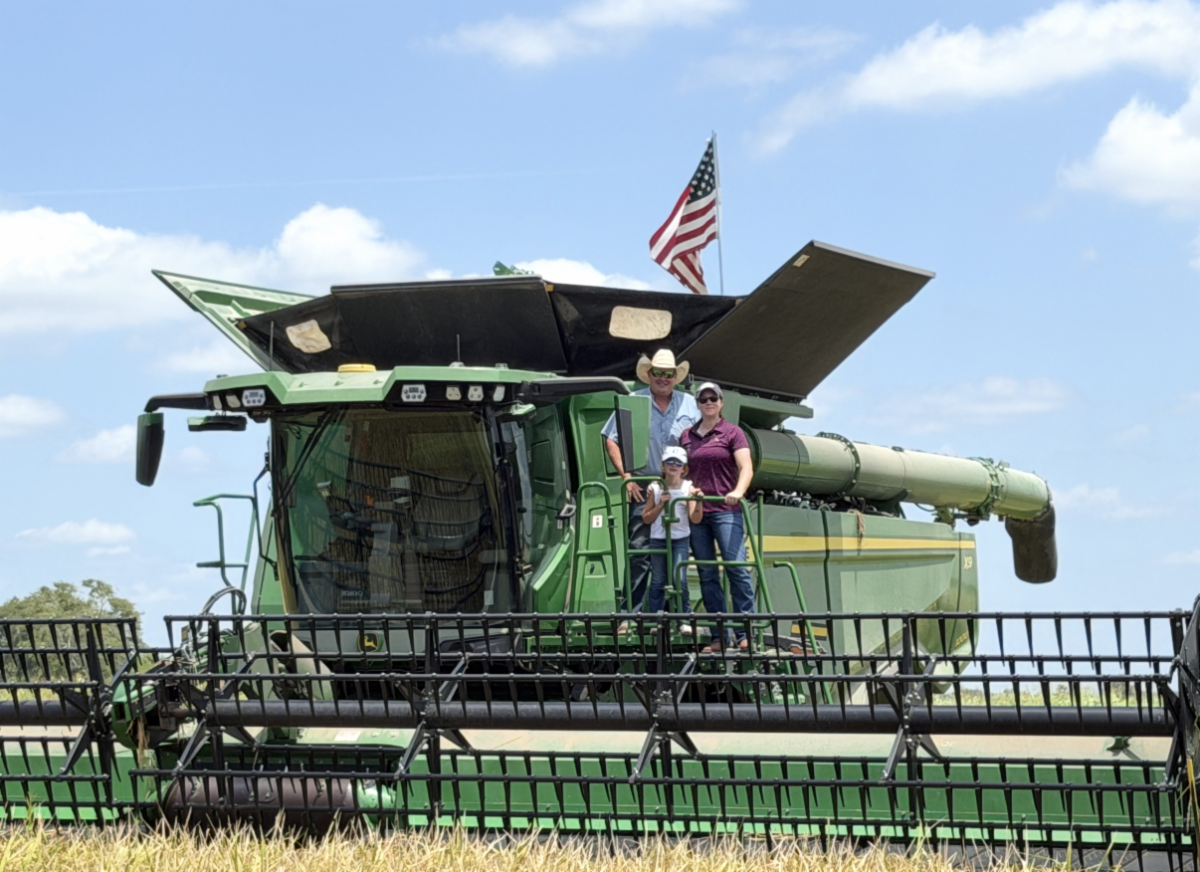
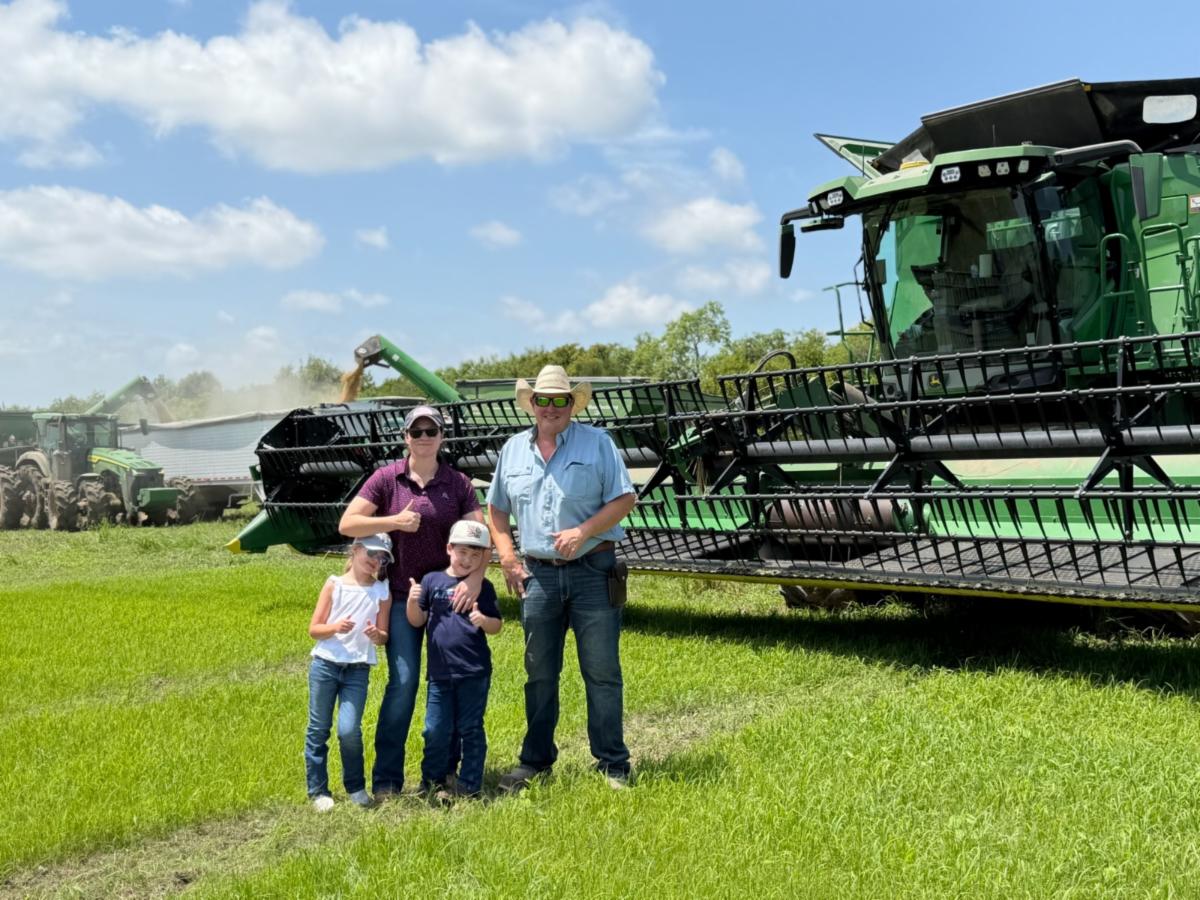
For Texas rice farmer Neal Stoesser, a recent visit from Alex Mealer, Republican nominee for the U.S. House in Texas’ 9th Congressional District, was about more than a farm tour. It was an opportunity to have a candid conversation about the realities facing Texas farmers and to give the next generation a firsthand look at where their food comes from.
Mealer brought her children along for the visit, allowing them to experience agriculture firsthand, see how rice is grown, and meet the farmers who work to put food on American tables. The visit also provided an opportunity for Stoesser to share the challenges facing producers and discuss the importance of having policymakers and candidates understand agriculture from the farmer’s perspective.
“As a Texas rice farmer, I appreciated that Mealer didn’t just stop by for a photo opportunity, she brought her children so they could see firsthand where their food comes from and meet the people who grow it,” Stoesser said. “We had a real conversation about the challenges farmers are facing every day, from soaring input costs and uncertain markets to government policies that too often make it harder to stay in business.
“It meant a lot to see someone willing to listen, ask thoughtful questions, and recognize that protecting American agriculture is about more than farming, it’s about food security, rural communities, and preserving a way of life.”
The conversation highlighted the many challenges facing American farmers today. Rising costs for seed, fertilizer, fuel, equipment, and other inputs, combined with market uncertainty and changing government policies, continue to put pressure on producers. For farmers, decisions made at the state and federal levels can have a direct impact on their ability to remain competitive and continue operating.
For Stoesser, having the opportunity to speak directly with a congressional candidate was particularly important because agriculture is about much more than the production of a commodity.
Farmers are responsible for producing the food that feeds families across the country, while also supporting rural economies and communities. Maintaining a strong domestic agricultural sector is closely tied to food security and the long-term sustainability of American farming.
The visit also emphasized the importance of introducing children and young people to agriculture. By bringing her children to the farm, Mealer allowed them to see the work behind the food they eat and to meet the people who dedicate their lives to producing it.
For many consumers, the journey from the farm to the grocery store or dinner table can seem distant. Farm visits help bridge that gap by providing a firsthand understanding of the people, land, equipment and expertise required to produce food.
As Texas farmers continue to navigate higher production costs, uncertain markets and an evolving policy environment, direct conversations with policymakers and candidates remain an important part of advocating for American agriculture.
For Stoesser, the visit was ultimately about making those connections, between farmers and policymakers, between consumers and the people who grow their food, and between today’s agricultural producers and the next generation.
“Protecting American agriculture is about more than farming,” Stoesser said. “It’s about food security, rural communities, and preserving a way of life.”
| |
First New-Crop Rough Rice Shipment Heads to Honduras from SLRF | |
|
SLRF is loading the first shipment of new-crop U.S. rough rice bound for Honduras. Pictured here is Mark Pousson, General Manager at SLRF and Justin Walker, Senior Chartering Manager with Oslo Caribbean Carrier, as he observes the loading operation.
Honduras is an important and consistent buyer of U.S. rice, particularly rough rice, with local millers relying on imported paddy rice to keep processing facilities supplied. The United States has historically been Honduras’ primary source of rice imports, and the country remains one of the key markets for U.S. rough rice in Central America. In 2025, the United States exported approximately $78 million in rice to Honduras, underscoring the importance of this market to the U.S. rice industry.
The movement of the first new-crop shipment signals the start of another season of U.S. rice moving into this important Central American market.
| Bringing the Benefits of U.S. Rice to Guatemala’s School Children | |
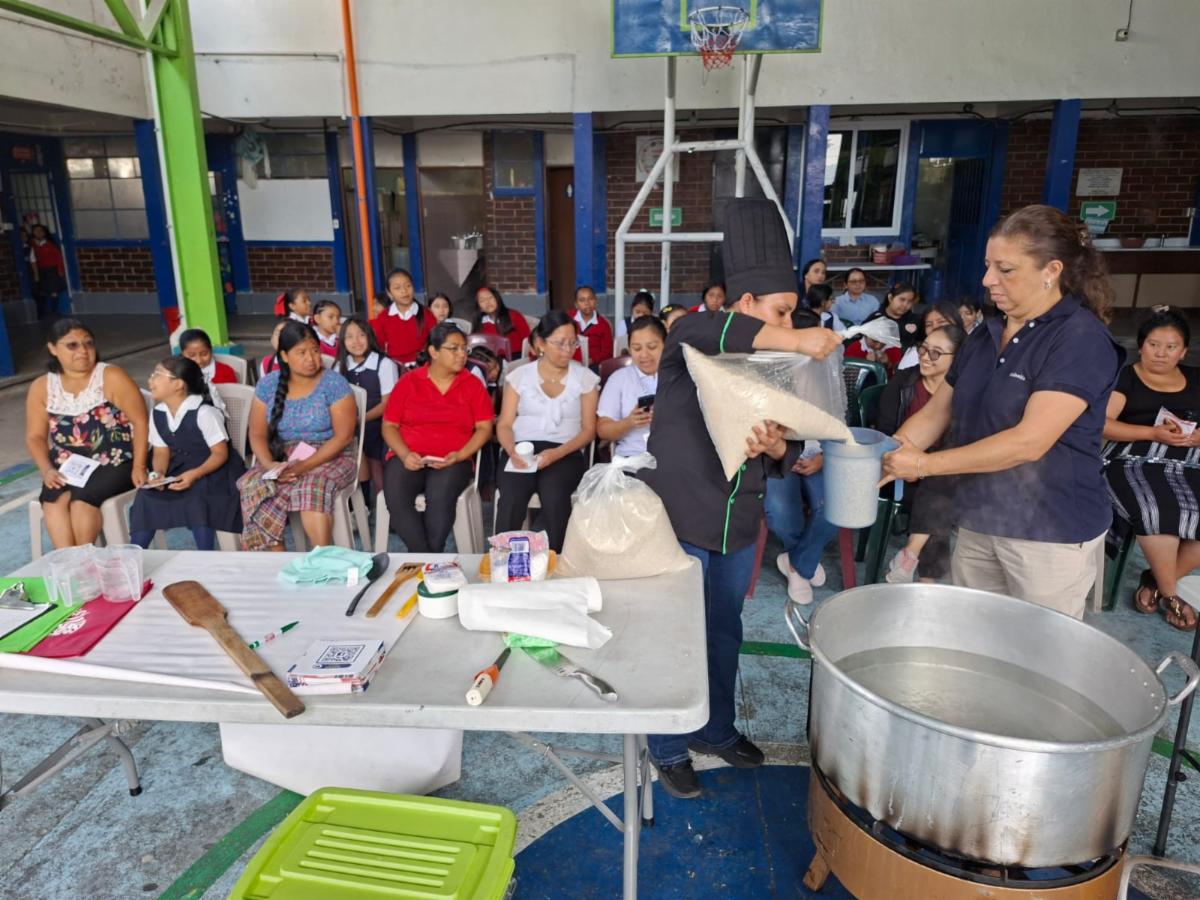
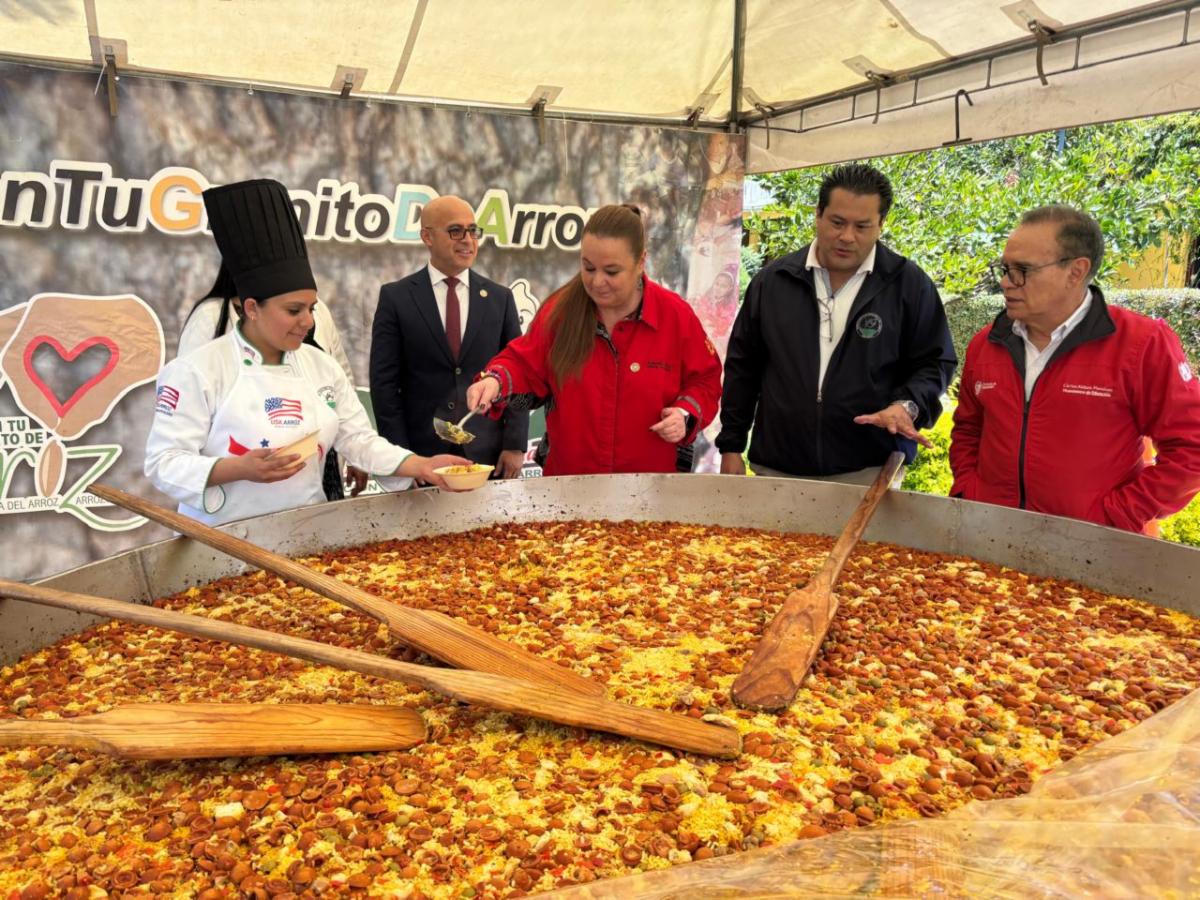
The School Nutrition Program in Guatemala was developed several years ago with the goal of strengthening the quality and nutritional value of meals provided to school-aged children in public schools. In coordination with the Ministry of Education, USRPA and ARROZGUA conducted a cooking course demonstration for Minister of Education Anabella Giracca. The Minister also had the opportunity to learn about the BIG POT cooking concept, which can be used to prepare meals for large-scale events and schools with high student attendance. | | On July 17, USRPA and ARROZGUA participated in activities celebrating the anniversary of the Ministry of Education. As of 2025, the program has benefited more than 3 million children and provided free cooking classes to approximately 250,000 mothers and other household caregivers of participating students. | | From the fields to the harvest and everything in between, we want to see what rice country looks like to you! Share your favorite rice country photos or videos and help us celebrate the people, places, and stories that make our industry special. | | |
Click on the picture to see the video and ride "Deep in the Heart of Texas!" Sent by Casey Smith.
Send us your rice country photos by email, or via Facebook or Instagram!
| |
| |
FAO Rice Price
Update
| |  |
Food & Agriculture
Regulatory & Policy Roundup
| | | |
World Markets & Trade: Grain
| | | World Agricultural Production | | | | | | Inter-Rice World Rice Market Report | | |
|
August 6, 2026
2026 Stuttgart Rice Field Day
Stuttgart, AR
More Information
| |
August 18, 2026
Missouri Rice Research & Merchandising Council Field Day
Glennonville, MO
More Information
| |
September 10 - 11, 2026
Katy Rice Festival
Katy, TX
More Information
| |
September 30, 2026
Texas Rice Festival
Winnie, TX
More Information
| |
February 18 & 19, 2027
30th Annual Cotton & Rice Conference
Jonesboro, AR
More Information
| | |
June 8 - 10, 2027
Rice Market & Technology Convention
Sheraton Puerto Rico Resort & Casino
San Juan, Puerto Rico
More details to come
| | |
USRPA does not discriminate in its programs on the basis of race, color, national origin, gender identity, sexual orientation, religion, age, disability, political beliefs, or marital/family status. Persons who require alternative means for communication of information (such as Braille, large print, sign language interpreter or translation) should contact USRPA at 713-974-7423. |
| | | |