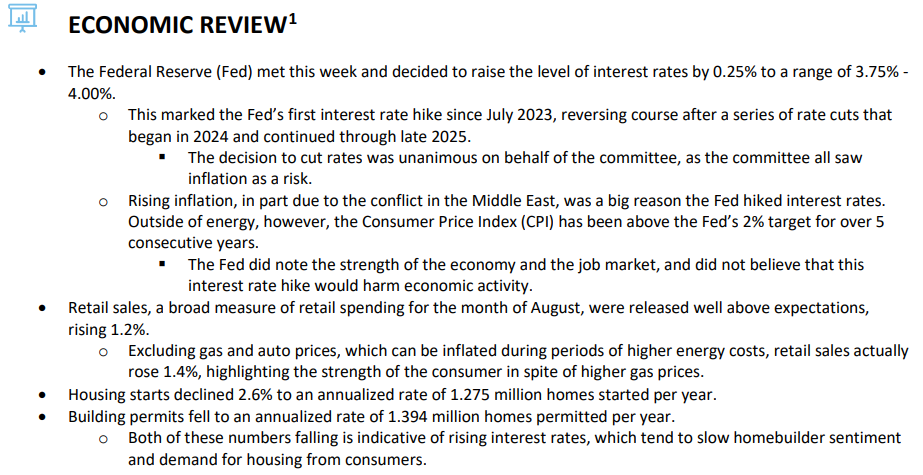
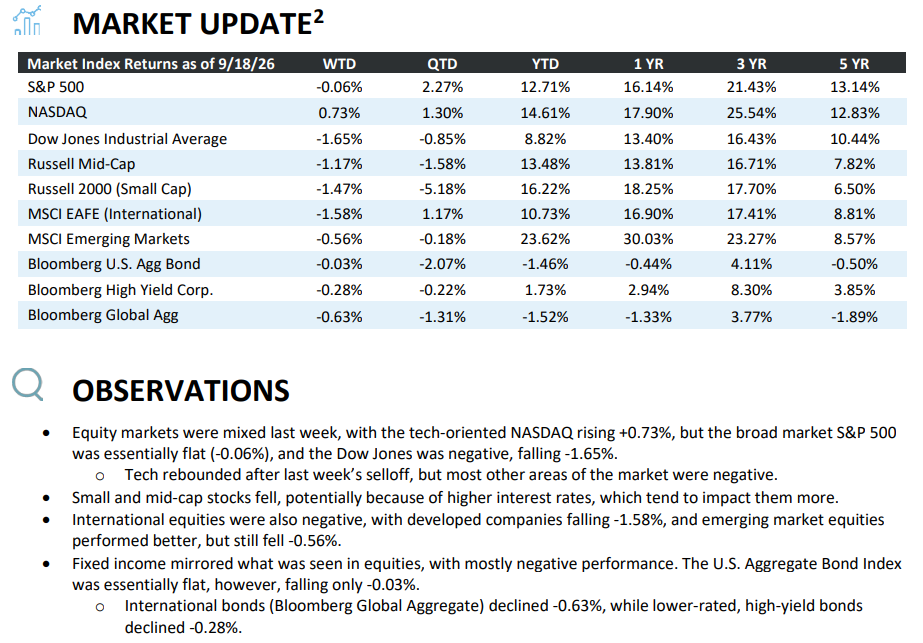
How does the most recent economic data impact you?


  •  The Fed raising interest rates will have an immediate effect on things like credit card interest rates and borrowing costs, but for consumers who have net assets instead of net liabilities, they will benefit from higher interest rates on things like high-yield savings accounts and money market funds, which should move higher.
  • Retail sales increasing suggests that despite higher prices and an uptick in inflation this year, consumers are still spending on a variety of things, from staples like food and gas to discretionary and hobby items.
  • This report was a strong reading ahead of the holiday spending season, but it could have been higher as back-toschool spending kicked into gear.


A LOOK FORWARD1


  • Investors will be looking forward to the University of Michigan Consumer Sentiment report, which is released on Friday and should show how consumers are feeling.


How does this week’s slate of economic data impact you?


  • Despite consumers continuing to spend, it is important to also monitor how the broad consumer base is feeling about the economy and the path of inflation moving forward.
  • Consumer sentiment is only slightly off the lowest reading ever hit in May of 2026.


BY THE NUMBERS


Warren Buffett Steps Down as Chairman of Berkshire Hathaway: Warren Buffett will step down as the chairman of Berkshire Hathaway effective immediately, the company announced Friday. His son, Howard—a Berkshire director since 1993—will replace him as chairman. Warren Buffett will now serve as chairman emeritus of the company and remain a member of the board. The move came a little more than nine months after Buffett retired as CEO of Berkshire and was replaced by Greg Abel. Buffett wrote in a letter to shareholders Friday that the timing to step down as chairman was right, as Abel had been “making the decisions that matter for some time” and had exceeded his expectations as head of the company. 3


LSU’s College Football Playoff Odds Plummet After Ole Miss Loss: Lane Kiffin, in his much-anticipated return to Oxford, fell to his former team, the Ole Miss Rebels. Kiffin's LSU Tigers, a team he spent more than $40 million to build into a national championship contender, got outplayed by the Rebels, falling 32-24. Safe to say this isn't the start Kiffin was hoping for after the university signed him to a record seven-year, $91 million contract. This loss to his former team comes amid a months-long dramatized exit which included in Lane Kiffin not coaching Ole Miss in their playoff berth last year, and leaving Ole Miss with a handful of its players and coaching staff coming with him to LSU. That doesn't leave much room for error for Kiffin's team, and anything more than two losses over that stretch would likely end their season.4

    Matthew J. Lawler, Financial Advisor

matt.lawler@osaicwealth.com  402-412-5008


Securities offered through Osaic Wealth, Inc. Member FINRA/SIPC Advisory Services offered through Osaic Wealth, Inc. Matthew J. Lawler Representative  F&M Wealth Management and F&M Bank are not affiliated with Osaic Wealth, Inc.

 May Lose Value - Not FDIC-Insured - No Bank Guarantee - Not a Deposit - Not Insured by any Government Agency

Economic Definitions


Building Permits: This concept tracks the number of permits that have been issued for new construction, additions to preexisting structures or major renovations. These statistics are based on the number of construction permits approved.

CPI (headline and core): Consumer prices (CPI) are a measure of prices paid by consumers for a market basket of consumer goods and services. The yearly (or monthly) growth rates represent the inflation rate.

Federal Reserve (Fed): The Federal Reserve System is the central banking system of the United States of America.

Housing Starts: Housing (or building) starts track the number of new housing units (or buildings) that have been started during the reference period.

Producer Prices - PPI (headline and core): Producer prices (output) are a measure of the change in the price of goods as they leave their place of production (i.e. prices received by domestic producers for their outputs either on the domestic or foreign market).

University of Michigan Consumer Sentiment Index: Consumer confidence tracks sentiment among households or consumers. The results are based on surveys conducted among a random sample of households. Target Audience: representative sample of US households (excluding Alaska and Hawaii). Surveys of Consumers collects data on consumer attitudes and expectations summarized in the Consumer Sentiment, in order to determine the changes in consumers' willingness to buy and to predict their subsequent discretionary expenditures. This Index is comprised of measures of attitudes toward personal finances, general business conditions, and market conditions or prices. Components of the Index of Consumer Sentiment are included in the Leading Indicator Composite Index. Unit: Index (Q1 1966=100).

Retail Sales: Retail sales (also referred to as retail trade) tracks the resale of new and used goods to the general public, for personal or household consumption. This concept is based on the value of goods sold. 


Index Definitions


S&P 500: The S&P 500® is widely regarded as the best single gauge of large-cap U.S. equities and serves as the foundation for a wide range of investment products. The index includes 500 leading companies and captures approximately 80% coverage of available market capitalization.

NASDAQ: The NASDAQ Composite Index is a broad-based capitalization-weighted index of stocks in all three NASDAQ tiers: Global Select, Global Market and Capital Market. The index was developed with a base level of 100 as of February 5, 1971.

Dow Jones Industrial Average: The Dow Jones Industrial Average is a price-weighted average of 30 blue-chip stocks that are generally the leaders in their industry. It has been a widely followed indicator of the stock market since October 1, 1928.

Russell Mid-Cap: Russell Midcap Index measures the performance of the 800 smallest companies in the Russell 1000 Index, which represent approximately 25% of the total market capitalization of the Russell 1000 Index.

Russell 2000: The Russell 2000 Index is comprised of the smallest 2000 companies in the Russell 3000 Index, representing approximately 8% of the Russell 3000 total market capitalization. The real-time value is calculated with a base value of 135.00 as of December 31, 1986. The end-of-day value is calculated with a base value of 100.00 as of December 29, 1978.

MSCI EAFE: The MSCI EAFE Index is a free-float weighted equity index. The index was developed with a base value of 100 as of December 31, 1969. The MSCI EAFE region covers DM countries in Europe, Australasia, Israel, and the Far East.

MSCI EM: The MSCI EM (Emerging Markets) Index is a free-float weighted equity index that captures large and mid-cap representation across Emerging Markets (EM) countries. The index covers approximately 85% of the free float-adjusted market capitalization in each country.

Bloomberg Barclays US Agg Bond: The Bloomberg Barclays US Aggregate Bond Index is a broad-based flagship benchmark that measures the investment grade, US dollar-denominated, fixed-rate taxable bond market. The index includes Treasuries, government-related and corporate securities, MBS (agency fixed-rate pass-throughs), ABS and CMBS (agency and non-agency).

Bloomberg Barclays High Yield Corp: The Bloomberg Barclays US Corporate High Yield Bond Index measures the USD-denominated, high yield, fixed-rate corporate bond market. Securities are classified as high yield if the middle rating of Moody's, Fitch and S&P is Ba1/BB+/BB+ or below. Bonds from issuers with an emerging markets country of risk, based on Barclays EM country definition, are excluded.

Moody's, Fitch and S&P is Ba1/BB+/BB+ or below. Bonds from issuers with an emerging markets country of risk, based on Barclays EM country definition,

are excluded.

Bloomberg Barclays Global Agg: The Bloomberg Barclays Global Aggregate Index is a flagship measure of global investment grade debt from twenty-four local currency markets. This multi-currency benchmark includes treasury, government-related, corporate and securitized fixed-rate bonds from both developed and emerging markets issuers.

Bloomberg Barclays Municipal Bond Index: The Bloomberg Barclays U.S. Municipal Index covers the USD-denominated long-term tax-exempt bond market. The index has four main sectors: state and local general obligation bonds, revenue bonds, insured bonds and prerefunded bonds.

Disclosures


The statements provided herein are based solely on the opinions of the Osaic Research Team and are being provided for general information purposes only. Neither the information nor any opinion expressed constitutes an offer or a solicitation to buy or sell any securities or other financial instruments. Any opinions provided herein should not be relied upon for investment decisions and may differ from those of other departments or divisions of Osaic Wealth, Inc. (“Osaic”) or its affiliates.


Certain information may be based on information received from sources the Osaic Research Team considers reliable; however, the accuracy and completeness of such information cannot be guaranteed. Certain statements contained herein may constitute “projections,” “forecasts” and other “forward-looking statements” which do not reflect actual results and are based primarily upon applying retroactively a hypothetical set of assumptions to certain historical financial information. Any opinions, projections, forecasts and forward-looking statements presented herein reflect the judgment of the Osaic Research Team only as of the date of this document and are subject to change without notice. Osaic has no obligation to provide updates or changes to these opinions, projections, forecasts and forward-looking statements. Osaic is not soliciting or recommending any action based on any information in this document.


Investing involves risk, including the potential loss of principal. No investment strategy can guarantee a profit or protect against loss. In general, the bond market is volatile; bond prices rise when interest rates fall and vice versa. This effect is usually pronounced for longer-term securities. Any fixed-income security sold or redeemed prior to maturity may be subject to a substantial gain or loss. Vehicles that invest in lower-rated debt securities (commonly referred to as junk bonds or high-yield bonds) involve additional risks because of the lower credit quality of the securities in the portfolio. International investing involves special risks not present with U.S. investments due to factors such as increased volatility, currency fluctuation, and differences in auditing and other financial standards. These risks can be accentuated in emerging markets.


Index performance does not reflect the deduction of any fees and expenses, and if deducted, performance would be reduced. Indexes are unmanaged and investors are not able to invest directly into any index. Past performance cannot guarantee future results.


Securities and investment advisory services are offered through the firms: Osaic Wealth, Inc. and Osaic Institutions, Inc., brokerdealers, registered investment advisers, and members of FINRA and SIPC. Securities are offered through Osaic Services, Inc. and Ladenburg Thalmann & Co., broker-dealers and members of FINRA and SIPC. Advisory services are offered through Ladenburg Thalmann Asset Management, Inc., Osaic Advisory Services, LLC. and CW Advisors, LLC., registered investment advisers. Advisory programs offered by Osaic Wealth, Inc. are sponsored by VISION2020 Wealth Management Corp., an affiliated registered investment adviser. 9136363

1 Data Obtained from Bloomberg as of 9/18/26.

2 Data Obtained from Morningstar as of 9/18/26

3 Warren Buffett steps down as Berkshire Hathaway chairman. Here’s his final message.

4 LSU’s College Football Playoff Odds Plummet After Ole Miss Loss - Newsweek