|
|
Increasing Organizational Capacity by Hiring Prevention Certified Professionals |
|
Several advantages exist to hiring and sustaining credentialed prevention professionals with the skills and expertise to perform prevention activities that are beneficial to the organization and the community. Effective prevention practice requires a competent, skilled workforce. Certification is one way to ensure that prevention staff achieve a minimum or core level of competence in key professional domains. It can also help to increase staff retention, employability, and the ability to meet the challenges of current and future public health challenges.1 These, and many other advantages to the organization/community exist.
Read more about the benefits of credentialing to organizations and view additional tools for employers.
|
|
A Closer Look at Opioid-Related Mortality:
A Focus on American Indians
and Alaskan Natives
By Iris Smith, Ph.D.
Indigenous groups are often marginalized and face discrimination, and struggle to protect their rights at both the collective and individual level. While indigenous populations represent a relatively small percent of the population in a region, they are more likely to experience significant disparities in access to services and disparities in physical and behavioral health outcomes. As such, it is important to gather accurate data on the severity and scope of culture-specific risk and protective factors for these groups (Wyatt et al., 2015; Lauricella et al, 2016).
|
|
What's Happening Around the Region |
|
What is the Building Our Leadership and Diversity
(BOLD) Prevention Fellowship Program (PFP)?
The Building Our Leadership and Diversity (BOLD) Prevention Fellowship Program’s (PFP) focus is increasing the number of prevention scientists working in Black/African American communities and building their capacity to identify and chronicle programs, practices, and policies proven effective in reducing substance misuse risk factors and consequences and promoting mental health in Black/African American communities. The South Southwest PTTC Fellow, Jalyn Stubbs receives mentorship from prevention staff at the Louisiana Office of Behavioral Health and is exposed to the day-to-day workings there.
We extend a special thank you to the following individuals for their support of this meaningful work:
Dr. Leslie Brougham-Freeman, Director of Prevention, Wellness and Workplace Development
Amber Slater, Prevention, Wellness, and Workplace Development Program Manager
Shelley Lee, Prevention, Wellness, and Workplace Development Program Manager
|
|
Please Help us Welcome the South Southwest PTTC
BOLD Fellow, Jalynn Stubbs
Jalynn Stubbs is a native of Chicago, IL. After graduating from high school, she went on to pursue a Bachelor of Arts degree in Psychology at the illustrious Clark Atlanta University. During her matriculation, she developed an interest in mental health disparities in the Black/African American communities. Clark Atlanta University afforded her the opportunity to study abroad in Ghana, West Africa, where she conducted research on family dynamics. She presented this research at various symposiums, and it was published in 2016. After her many successes at her beloved institution, Jalynn was accepted into Louisiana State University’s graduate school to pursue a Master of Social Work degree (MSW) with a specialization in Policy/Macro. She is also a member of the Association of Black Social Workers (ABSW), where she serves as President.
Jalynn is currently working as a BOLD Fellow in the Office of Behavioral Health under the supervision of Amber Slater and Shelley Lee. Jalynn’s focus as a BOLD fellow is providing prevention and mental health resources to Black/African American communities by curating a resource inventory that will assist this community in locating services that they need. Being a BOLD fellow, to Jalynn, is not only about developing skills to become a prevention scientist, but it is also for brilliant Black minds with a heart for service to come together to help OUR people receive the resources they deserve.
|
|
A Data Story:
Visualizing with Purpose in Excel
|
Thursday, January 26, 2023
9:30- 11:00 MT / 10:30-12:00 CT / 11:30-1:00 ET
Excel is a practical and accessible tool for creating data visualizations for prevention professionals who may not have access to expensive software packages.
In this webinar, we will explore the power of Excel to create meaningful data visualizations for prevention professionals. Participants will be guided through real-life examples of applying the 4-step visualization process using Excel to create a meaningful data story for a prevention audience.
This will be a beginner's guide to using Excel for visualization. To help prepare for this training, please watch Part 5 of Ditching the Discomfort with Data: Communicating and Visualizing Data.
|
Happy Holidays from the
South Southwest PTTC!
|
SAMHSA's 19th Prevention Day!
SAMHSA's Prevention Day is happening Monday, January 30, 2023, in conjunction with CADCA National Leadership Forum. The event will take place at the Gaylord National Resort & Convention Center in Oxon Hill, Maryland. Whether you are a prevention...
Read more
www.samhsa.gov
|
|
|
|
|
|
New! The Final Video in the
Coalition Affinity Group Short Booster Videos
Goal Directedness
One of the biggest challenges that coalitions face is staying focused so they can effectively achieve their goals. In this last video of our coalition video series, Derrick Newby, SSW PTTC T/TA Specialist and Sarah Davis, SSW PTTC Associate dive into practical steps coalition leaders can take to set their coalitions up for success.
Using the Six Elements of Effective Coalitions framework developed by the Community Coalitions and Collaborators PTTC working group, this video series outlines each of the six elements discussed in the Six Elements of Effective Coalitions Resource Toolkit.
These short videos supplement the learning for attendees of the Coalition Affinity Group series that took place January-March 2022. Each video highlights one of the six elements in the Six Elements of Effective Coalitions framework. Every other month, beginning May 2022 and ending in December 2022 you will be able to access a new video with strategies to develop the six elements of effective coalitions.
|
Community Engagement: An Essential Component of an...
Community engagement is often cited as a tool to improve the health of the community and its members. This guide will review evidence related to leveraging community engagement to support the implementation and scale-up of evidence-based programs ...
Read more
store.samhsa.gov
|
|
|
|
|
|
Watch our website for
future events
|
|
Download resources
from our website
|
|
Subscribe and view past training from
our YouTube channel
|
|
Results From Last Month's Poll Question
About Credentialing Barriers
|
|
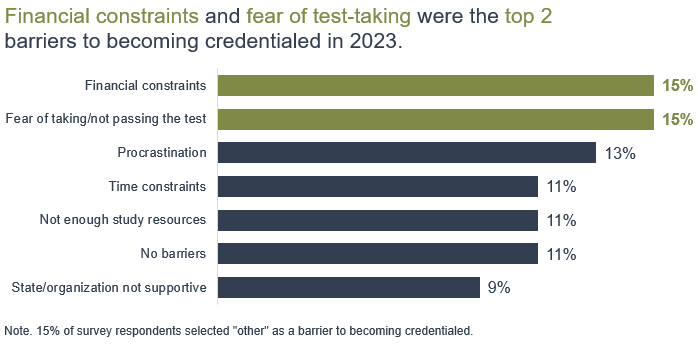
Last month we invited our readers to complete a poll question about the barriers they have to becoming credentialed in 2023. Of the 46 individuals who participated, 15% of them stated that financial constraints and fear of taking/not passing the test were the biggest barriers to becoming credentialed. 15% of participants also selected other barriers but were not required to comment on the nature of those barriers. Procrastination was rated by 13% of the participants as a barrier to becoming credentialed whereas, time constraints, not enough study resources, and no barriers were selected by 11%. The lowest percentage (9%) of participants felt that the state/organization in which they work is not supportive of credentialing.
Thank you for participating. The South Southwest PTTC will use this informal poll to continue to provide you with supportive tools and resources to help you get credentialed in the new year. Let us know how we can help! pttc6@ou.edu
|
|
Additional Opportunities From Our Partners |
|
HHS Launches New Maternal Health Resources for American Indian and Alaska Native Communities
|
|
National Hispanic and Latino PTTC and ATTC Training |
Understanding Risk and Cultural Factors Contributing to Substance Use in Hispanic and Latino Immigrant Youth
Session 2
A Migration Informed Context for Delivering SBIRT with Hispanic/Latino Immigrant Youth.
January 12, 2023
12:00 p.m. MT / 1:00 p.m. CT / 2:00 p.m. ET
|
An Announcement from the African American Behavioral Health Center of Excellence |
The African American Behavioral Health Diversity Leadership Fellows Academy
Now accepting applications until December 29
|
|
|
|
|
|
|
|