e-Newsletter | September 16, 2022
|
|
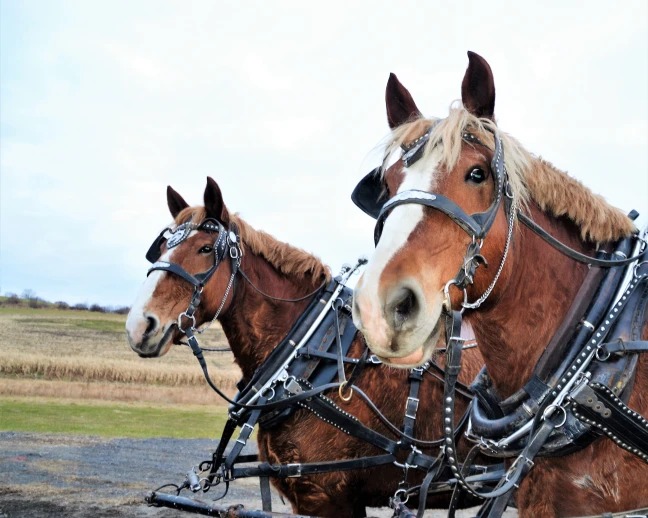
The Kimball Farm draft team will be ready to take you through Oak Hill Cemetery. Photo courtesy of Alison Colby-Campbell. |
|
Trot Trot through the Tombstones
Sunday, October 16 - afternoon horse-drawn wagon tours
Grab a warm drink and a cider donut and hop in a horse-drawn wagon for a 40-minute horse-powered ride through the fall beauty of Newburyport’s historic Oak Hill Cemetery. Kimball Farm draft horses will bring us through the 36 acres of ancient trees and winding trails with the guidance of noted author and historian Ghlee Woodworth, a 12th generation Newburyport native.
Wagon rides will take place at 2pm, 3pm, 4pm and 5pm. Tickets for members are $25, non-members $35. Reservations are required.
Oak Hill Cemetery is still an active cemetery, as well as the final resting place of shipwrecked sailors, sea captains and merchants, architects and photographers, writers and poets, silversmiths and newspaper editors, and adventurers who travelled to the Klondike gold rush.
|
|
Can't wait until October? Join us for a walking tour of Highland Cemetery this Sunday. (See below) |
|
Annual Meeting Highlights |
|
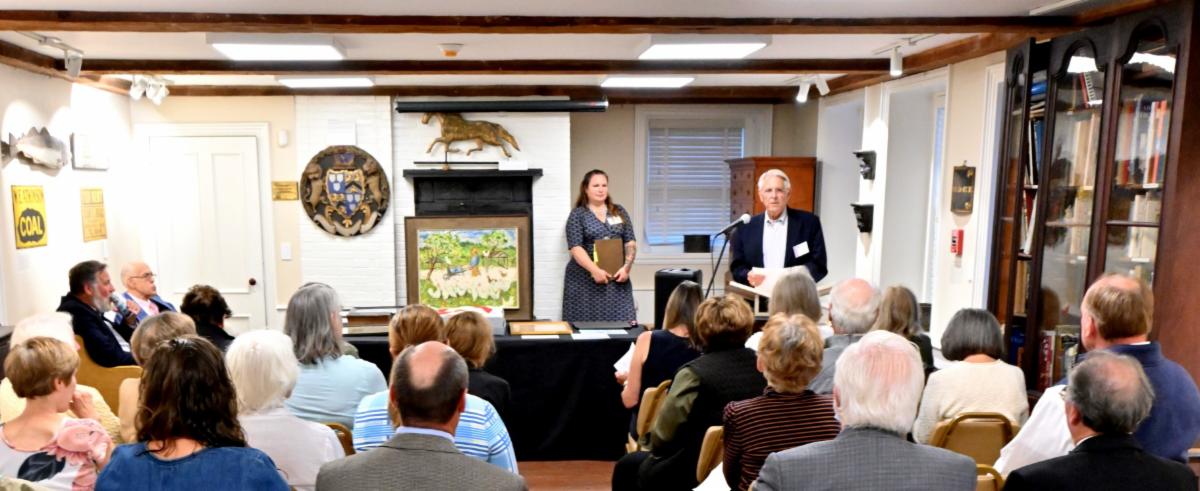
On Wednesday evening, the Historical Society of Old Newbury (our official name) held its 145th annual meeting. We thanked Co-Presidents Dave Mack and Cathy Strauss, who are stepping down after years of dedicated service. We'll introduce the new board members in an upcoming newsletter so for now, just a few highlights of a lovely evening. |
|
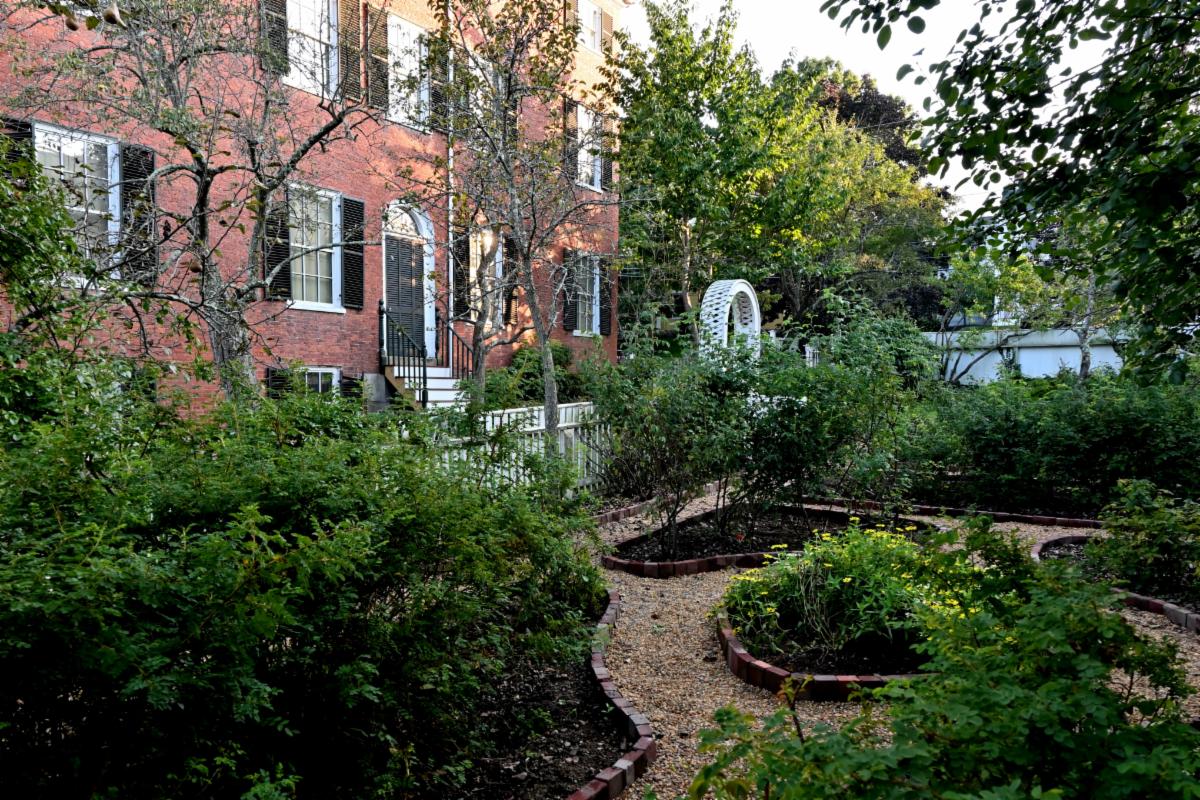
Members admired the rose garden, where pathways were renewed and brick borders re-laid with the help of a volunteer crew from New England BioLabs and support from the Historic Gardens of Newburyport and Environs. The work was done as part of the final phase of the Courtyard Restoration Project, funded in part by the citizens of Newburyport via the Community Preservation Fund. If you haven't visited the garden in a while, come on back. We're looking sharp! |
|
Treasurer Les Ferlazzo led the business meeting, reviewing the organization's annual financial statement. |
|
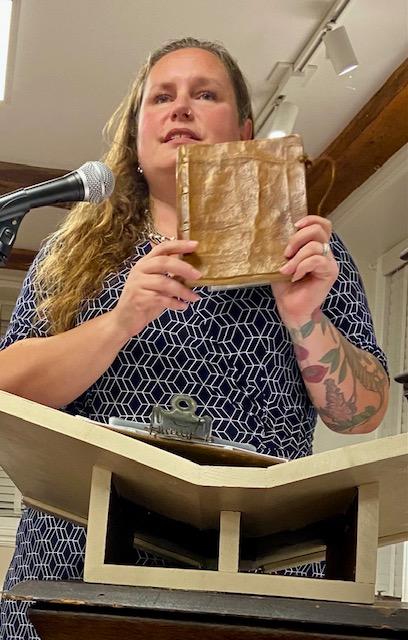
After the business meeting, a presentation on recent acquisitions (and how they came to the museum) was made. Executive Director Bethany Groff Dorau spoke about a rare early 18th century book describing the management of Newbury common land. There was even a quiz to see if the members could decipher one of its passages. |
|
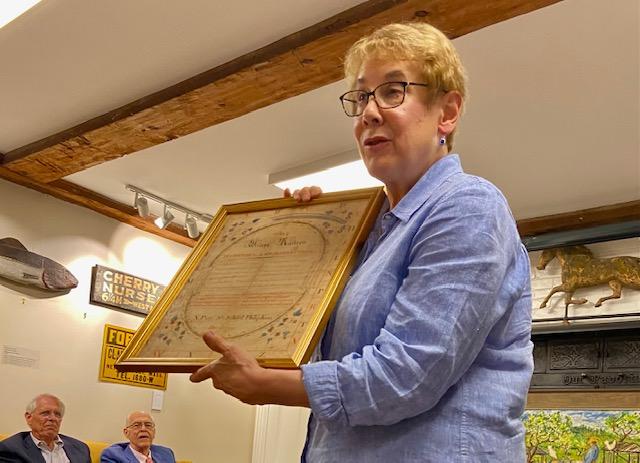
Dedicated archives volunteer Dr. Carrie Poirier shared her research on this 1799 advertisement by 12-year-old Philip Knap, demonstrating his talent as a writing instructor. |
|
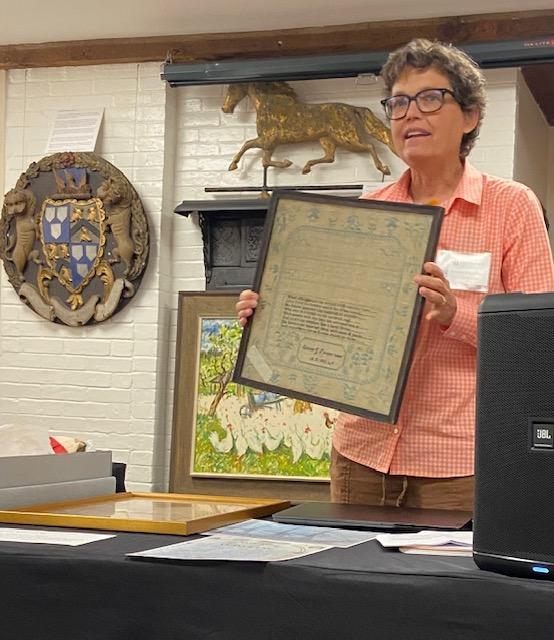
Assistant Director Kristen Fehlhaber spoke about this 1811 Eunice Greenleaf Sawyer sampler. She also highlighted a gift of documents relating to slavery that were donated to the museum with the understanding that we would work to find the best placement for them in another institution. The documents have found a new home at an archive in Kentucky. |
|
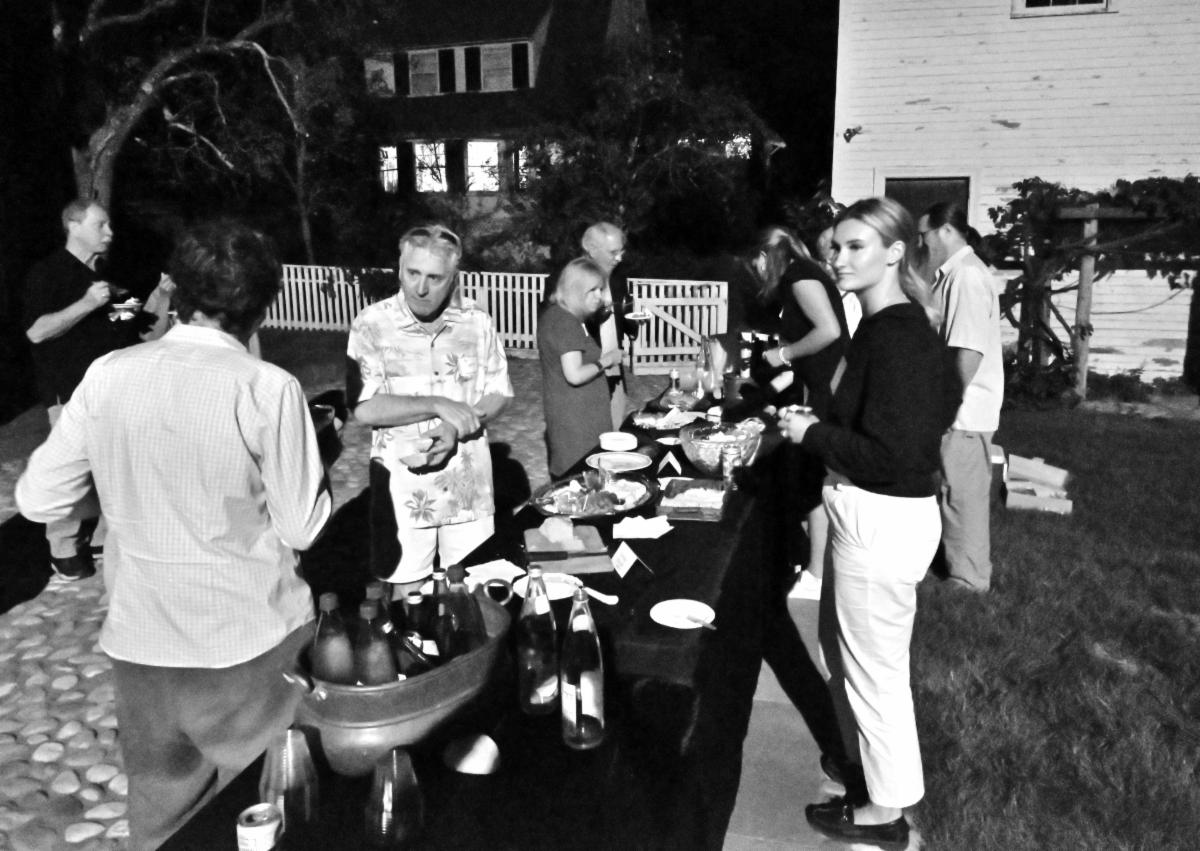
The night ended as it began - with snacks and beverages in the courtyard. Thank you to all members who attended, and to Ipswich Ale for providing the beverages! Want to make sure you're on the invitation list for this and many more fun events? Join here.
|
|
Tiptoe Through the Tombstones: Highland Cemetery
Sunday, September 18, 2022, 10am.
Directions: 21 Hill St, meet at Highland Cemetery sign
Wander through Newburyport’s historic Highland Cemetery with noted author and historian Ghlee Woodworth, a 12th generation Newburyport native. From the long-forgotten graves of Newburyport’s once-thriving Black community leaders to the mausoleums of captains of industry, sea-faring folk, artists, eccentrics, and ordinary Newburyporters, learn about people whose lives were recorded in stone. $15 adults /
$10 Museum of Old Newbury members.
|
|
The Best Ever! Parades in New England, 1788–1940 Thursday, October 13, 7pm.
Noted curator and author Jane Nylander will give a talk on her book, The Best Ever! Parades in New England, 1788-1940. She explores the parade tradition as enacted in the small cities and towns of New England. Meticulously documented and lavishly illustrated with nearly 300 photographs, The Best Ever! offers never-before-seen pictures of actual parades, including floats and banners that have mostly disappeared and ranging from the Federal Ship carried in the 1788 Ratification parade at New Haven, Connecticut, to 1940 when the parade tradition largely halted at the onset of WWII.
Free for all thanks to Mass Humanities
|
|
Woman on the MOON
...a blog by Bethany Groff Dorau
|
|
The Good, the Baud, and the Ugly
John Atkinson and the Merry Widow Stickney
If anyone haunts the dark halls of the Cushing House, I’m going to bet it’s Mae Atkinson. Mae, who spent thirty years of her life as a volunteer and board member of the Museum of Old Newbury, still appears in the oddest places here – she tucked little notes under chairs, made mildly draconian lists of tasks for the docents, and strictly forbade jeans or bare arms while on (unpaid) duty. She also worked incredibly hard for this organization, training docents, cataloguing objects, cleaning and organizing and researching. We owe her a great debt.
And she did not care for me one little bit.
Many years ago, when I was a fresh-faced twenty-something, my former employer, then known as SPNEA, made a decision about a property in Newbury and I blithely sallied forth into the community to spread the good news. Mae was adamantly opposed to this decision and came to see me, and I am sure I was wearing jeans and my arms were bare (as they are most days, truth be told). She excoriated me for the decision de jour, and then listed some 47 other reasons why she had a bone to pick with SPNEA.
The earliest of these complaints dated back to 1911. I kid you not. She was still angry that, sixteen years before she was born, SPNEA had swooped in and “stolen” the Swett-Ilsley House (I tried to interject that it had been purchased, actually, but to no avail). It was a pointed exchange which ended in my tearfully apologizing for my very existence and her throwing a look of such withering scorn as she exited that I shudder to recall it even today.
After this memorable scene, I sought my revenge in the only way I could – I set about to prove that I was an Atkinson heir which, in the reverse logic of old New England, would give me the right to disagree with her.
|
|
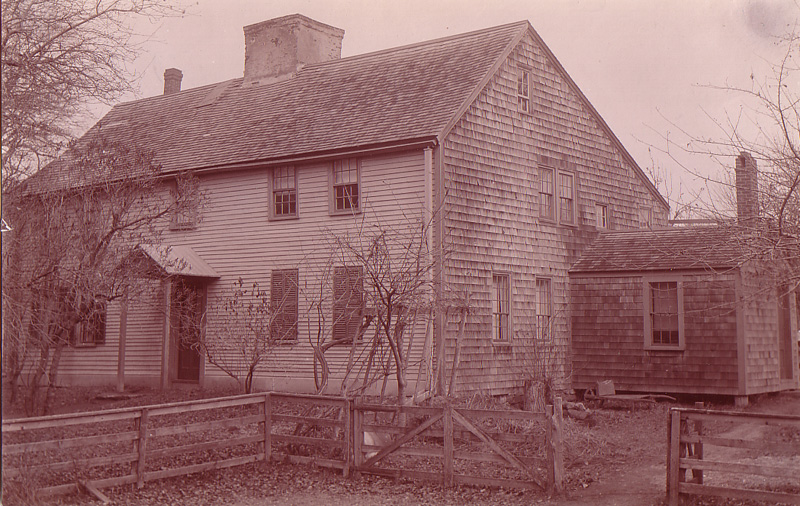
The c. 1664-1665 Atkinson House at 5 Hanover Street in Newbury was purchased by Mae and Bud Atkinson in 1985 and meticulously restored. Image courtesy of the Newbury Historical Commission.
Of course, here’s the tricky bit. Mae Atkinson, who lived in the Atkinson family homestead, and fiercely defended the rights of this ancient family, was not born an Atkinson. Still, I cracked my genealogy book open to the “A”’s, and there he was, John Atkinson (1636-1713), builder of Mae’s much-admired c. 1664 home. He is my 9th great-grandfather and the 8th great-grandfather of Mae’s husband Bud.
Recently, as I was answering a research inquiry, I ran into John Atkinson again, this time not in my tidy genealogy, but in the wonderful, bawdy scrum of the Essex County Quarterly Courts, which you may know is my favorite light reading.
|
|
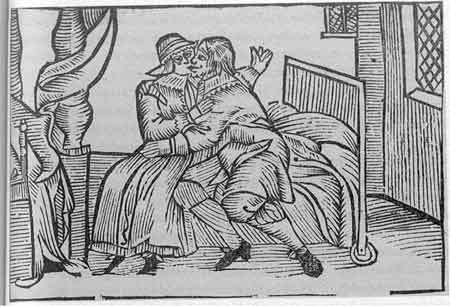
On December 15, 1681, Sarah (Morse) Stickney, a widow and already mother of nine, swore out a complaint that John Atkinson “is the father of my last child, a fact which I had concealed upon his promise to maintain the child which he now refuses to do.” I backed up a bit. There she was, Sarah Stickney, in March, 1681, presented by the town of Newbury for “having a child born January last.” Two women present at the birth appeared as witnesses. Sarah Stickney, then 39 years old, was sentenced to be whipped or pay a fine. She did not name the father, even in the throes of labor when she would have been interrogated by the midwives present. She thought she had a deal with John Atkinson, who had agreed to pay for the child if she kept their indiscretion(s) to herself.
Her first act, after paying her fine, was to slander the court, telling Sarah Haines and her husband Jonathan that “the court did not regard the sin (of fornication) so long as they could get the money.” But it was John Atkinson’s refusal to keep up with his secret child support that landed them both back in court.
|
|
Once Sarah Stickney had officially charged Atkinson with fathering her child, the whole town got involved. There was precious little to do in March, 1682, when her case was called, and every ambulatory citizen of Old Newbury seems to have shown up to the Ipswich court (held in a tavern, naturally) to have a drink and watch the show. Audience participation was encouraged, and dozens of people testified on one side or the other. Sarah Haines came to court to reveal that she was present at the birth of the child and that Sarah Stickney had never named John as the father. Oh, and she also mentioned that Stickney had insulted the court.
Witnesses come forward who had seen John Atkinson at Widow Stickney’s house before and after the birth of the child. Other witnesses overheard Sarah accuse another man, Samuel Lowell, of being her child’s father.
Sarah’s son testified that John Atkinson came to their house, gave him some money, and sent him out to get some wine for them, and the children were all sent to bed and their mother and John “drank freely”.
Sarah’s son, John Stickney, testified that John Atkinson hid his horse when he came to their house, and that shortly after the baby was born, Atkinson “came to see her, took the child in his arms and kiss’d it.”
Sarah thought they had a deal. As she left for Salem court to be sentenced for her daughter’s birth out of wedlock, Atkinson came to visit. Sarah said he “called her out of her house, told her that the court was near, and he was going to Boston. He gave her 30 shillings in money and asked her to be true to him.”
And then he stopped paying, and Sarah followed him and his wife to a neighbor’s house. “Sarah came into Jonathan Haines’ house when John Atkinson and his wife were there and asked John if he was going to deny his child, whereupon John's wife called her an impudent baud (promiscuous woman). Then Sarah Stickney used such opprobrious, reproachful and reviling speeches (including calling Mrs. Atkinson a baud as well), that Haines told her to go out of the house but she would not depart. Then Goody Atkinson stepped to Goody Stickney and clapt her hand in her face and said she would spit in the face of any such that would call her a baud: and spit at her."
What happened after the baud-shaming and the spitting? Well, you'll have to wait until the next newsletter. Let’s just say, it doesn’t end well for anyone. There’s attempted murder, slander, witchcraft accusations, at least three lovers for the Widow Stickney, and an ongoing ferocious custody battle that doesn’t end well for anyone…
If you find me unconscious at the bottom of the Cushing House stairs after spreading this family gossip, you’ll know who came back from beyond to give me a shove. But tonight, whether she likes it or not, I will toast Mae Atkinson for all she did for this organization and for this community.
|
|
Something is Always Cooking at the Museum |
|
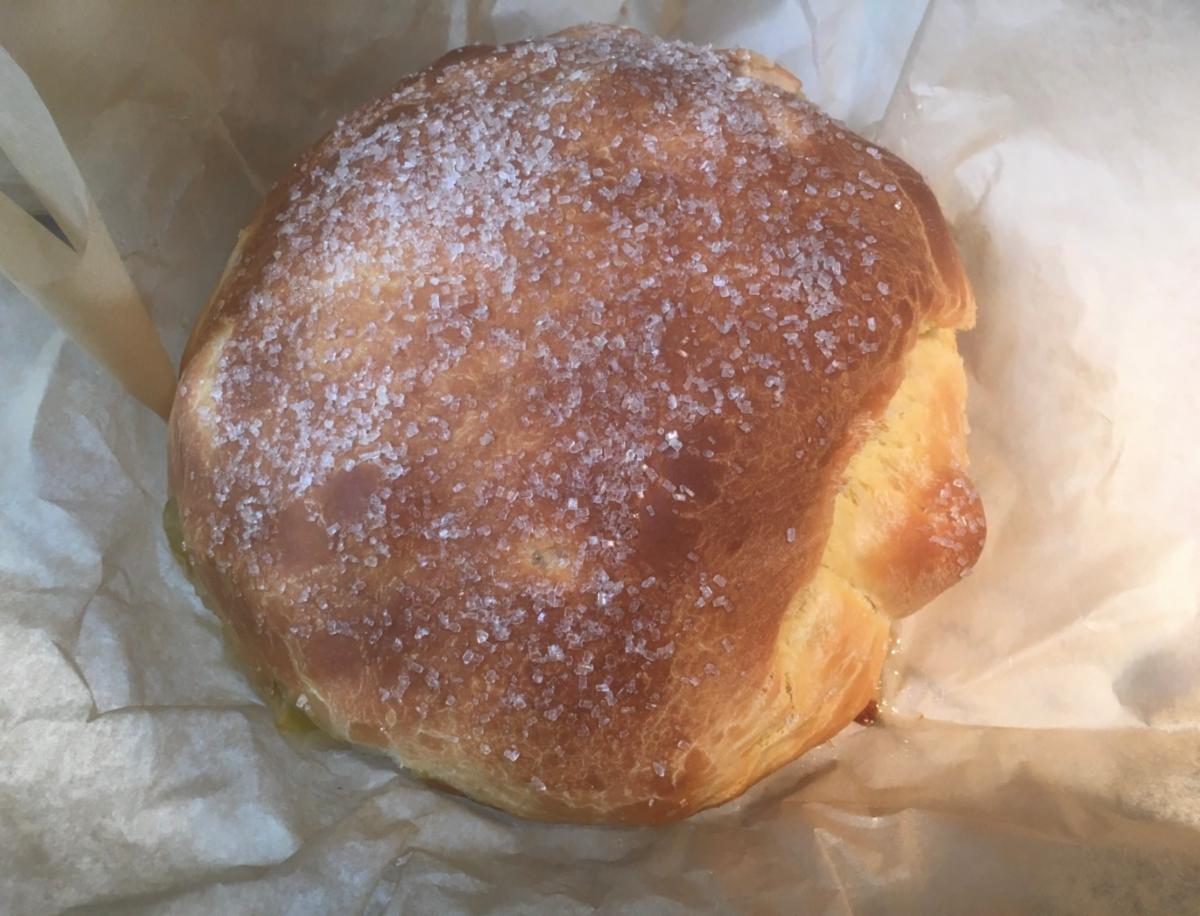
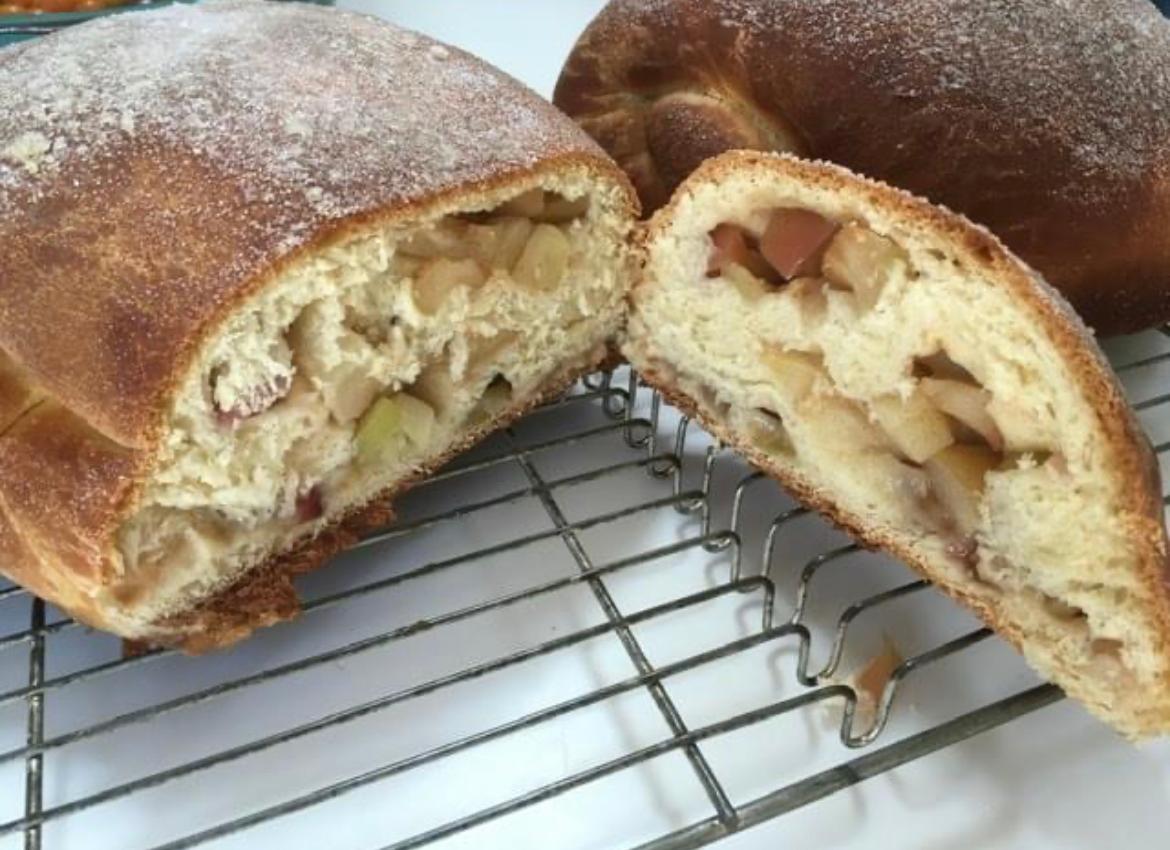
The Jewish New Year, celebrating the beginning of the year 5783, will begin at sundown on Sunday, Sept. 25. In the spirit of making "something sweet for the new year," we share this recipe for apple challah from Judy Matthews of Congregation Ahavas Achim in Newburyport. Her recipe was adapted from one by Maggie Glezer. The recipe is delicious and utilizes a clever technique to fold a lot of apples into a dough. (Kristen's note - I've made this with King Arthur all purpose flour, instead of bread flour, with great results). |
|
Dough:
2 envelopes active dry yeast or instant yeast (approximately 2 tablespoons)
5 cups bread flour
1 cup warm water
3 large eggs
1/3 cup vegetable oil, plus extra for oiling the pan and the topping
2-1/2 teaspoons table salt
½ cup sugar, plus extra for sprinkling
Apple filling:
4 good sized apples (for 4-1/2 cups cut-up baking apples)
1/4 cup sugar
1/2 teaspoon cinnamon
Mixing the yeast
In a large bowl, whisk together the yeast and 1 cup of the flour, then whisk in the warm water. Let this mixture stand uncovered for 10 to 20 minutes, or until it begins to ferment and puff up slightly.
Mixing the dough
Whisk the eggs, oil, salt, and sugar into the puffed yeast mixture until the eggs are well incorporated and the salt and sugar have dissolved. With a wooden spoon or your hands, stir in the remaining 4 cups flour all at once. When the mixture is a shaggy ball, scrape it out onto your work surface and knead it until it is smooth and firm, no more than 10 minutes. If the dough is too firm to knead easily, add a tablespoon or two of water to it; if it seems too wet, add a few tablespoons of flour. The dough should feel smooth, soft, and only slightly sticky.
Fermenting the dough for the first time
Place the dough in the bowl and cover it with plastic wrap. Let ferment for 1 hour, or until just slightly puffed. While the dough is finishing fermenting, prepare the apples.
Preparing the apples
Peel, quarter, and core the apples. Cut each quarter lengthwise in half, and then cut into squarish chunks. If the apples begin to brown, toss them with a few drops of lemon juice and cover.
Rolling out the dough and adding the apples
Sprinkle the dough and your work surface with flour and take the dough out of the bowl. Cut the dough in half and keep one piece covered while you work with the other. Roll out the dough into a 14 to 16 inch square (about 1/8 inch thick). Scatter one cup of the apples over the center third of the dough, then fold up the bottom third to cover them. Press the dough into the apples to try to seal it around them. Scatter another heaping cup over the folded over apple portion of the dough and fold the top of the dough over it to create a very stuffed letter fold. Press down on the dough to try to push out any air pockets and to seal it around the apples. Roll the dough up from a short side into a chunky cylinder, push the dough into the bowl with the smooth side up, and cover it with plastic wrap. Repeat with other piece of dough and put it in a second bowl and cover. Let the dough ferment for about another hour, or until slightly risen and very soft.
Shaping and proofing the dough
Oil two 9-inch round cake pans. Slip the dough into the pans smooth side up and cover well with plastic wrap. (The loaves can be refrigerated for up to 24 hours, which will only intensify their flavor). Let the loaves proof until they rise over the edges of the pans, about 30 minutes (or up to 1-1/2 hours if the loaves have been refrigerated).
Preheat the oven to 350 degrees.
Baking the loaves
When the loaves have risen and do not push back when gently pressed with your finger but remain indented, brush each one with a generous tablespoon of oil, then sprinkle them with a few tablespoons of sugar to form a sugary-oily crust. Bake in the lower third position for 45 to 55 minutes, until very well browned. Midway, switch the pans from front to back so that the breads bake evenly. When they are done, remove them from the oven, unmold them and let them cool on a rack.
|
|
Click on image above to play the puzzle |
|
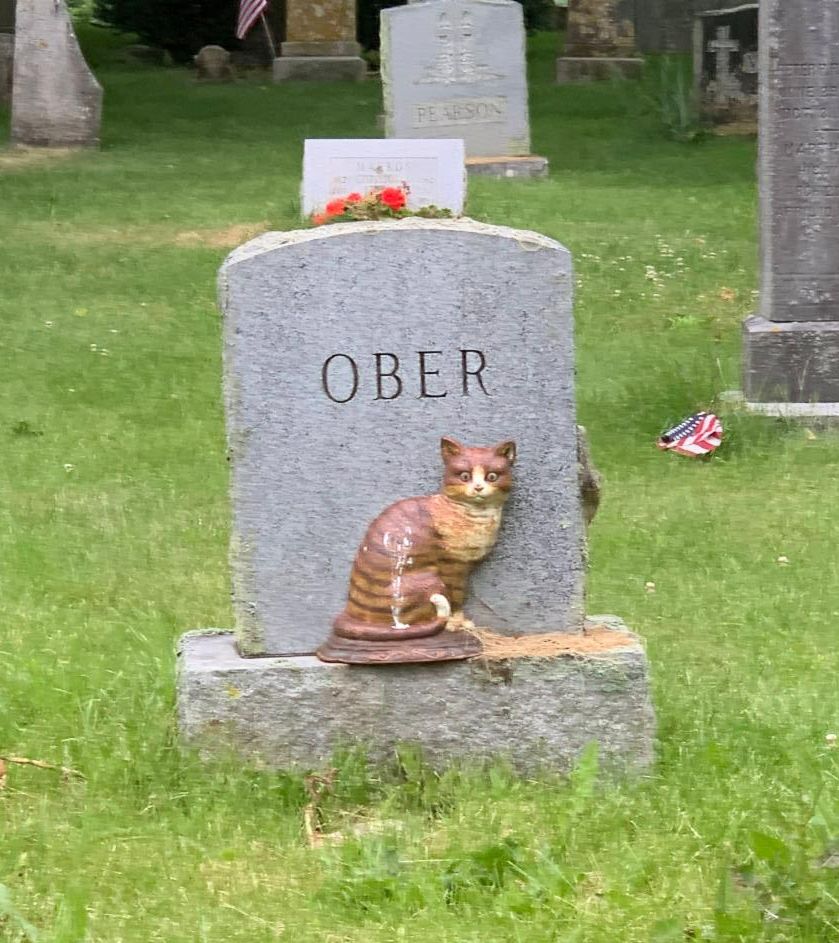
The Ober family headstone from Highland Cemetery is a memorial to Ella Ober (1873-1965) and her children and grandchildren and features an orange tabby cat on the front and a black cat on the back. See if you can spot these cat lovers at this Sunday's Tiptoe Through the Tombstones cemetery tour. |
|
Museum e-Newsletter made possible through the
generosity of our sponsors:
|
|
|
Museum of Old Newbury
98 High Street
Newburyport, MA 01950
978-462-2681
|
|
|
|
|
|
|
|