|
An alert from the US Section of the
Women's International League for Peace and Freedom
| | |
Dear WILPF US members,
When Fall arrives, I normally seek hot chocolate, hearty meals, and a sense of burrowing or nesting for warmth. This Fall, it’s the opposite. I seek change. In the country, in the world, in WILPF. The latter is guided by the re-envisioning process we have been experiencing at WILPF US these past few months. 80 of you shared your vision for the future of WILPF in focus groups. More than 230 of you responded to our re-envisioning survey. One respondent said: “WILPF US’s survey has helped me think about how I want to show up not only in WILPF but in my community right now.”
These conversations have been hard, meaningful, and necessary. Leaning into our history and looking to the future, we have asked ourselves: As an organization, as a feminist movement for peace, what are our core values? What do we want to do now, especially in the US? And how do we adapt so we continue to have impact in the future?
Please join me for my first monthly Executive Director Open House on Monday, September 15 at 4 PT / 6 CT / 7 ET. I will share insights from the focus groups and survey results as well as highlights of my annual work plan. I will also host an open discussion among members about WILPF’s re-envisioning and anything else on your mind in these times. One of the main themes that surfaced from the survey was a desire by WILPF members to come together in community more. I look forward to seeing you on September 15 – to connect as humans and to move WILPF US forward. Register to join my Open House in Zoom at this registration link.
80 years after Hiroshima and Nagasaki
| |
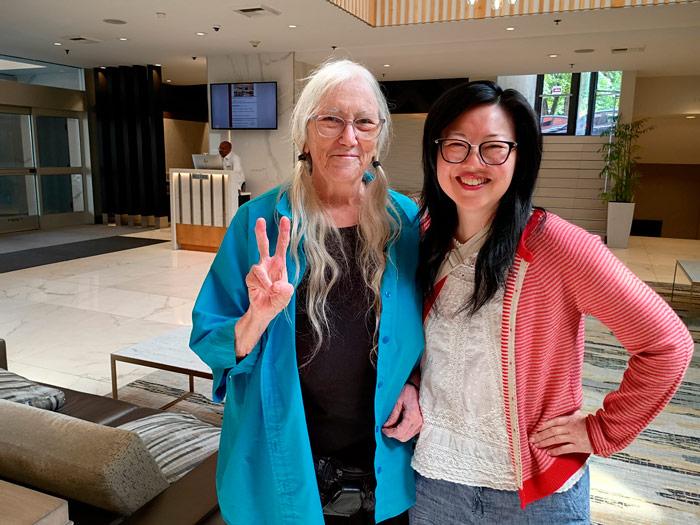
Last month, the world commemorated the 80th anniversary of the atomic bombings of Hiroshima and Nagasaki. WILPF US branches across the country mobilized to draw attention to this war tragedy and the nuclear dangers that persist today. With so much strife in the world, it feels like people have forgotten but WILPF remembers. I had the honor of meeting Ellen Thomas when she was on her way to Hiroshima last month (that’s Ellen and I pictured above). Ellen lived outside the White House for 18 years as part of the longest running anti-war and anti-nuclear vigil still active today.
Congressman Jeff Van Drew (R-New Jersey) recently called the vigil an eyesore and for its removal. WILPF US’s Disarm committee responded with wise words in a letter to the editor of The Washington Post which said: “…isn’t it in the interest of our common national heritage that we preserve and protect freedom of speech and important historical sites? The White House vigil site is considered to be the longest continuous act of political protest in US history, through which generations of people have peacefully exercised their First Amendment right to speak freely in public about the issue of humanity’s survival in the face of a growing risk of nuclear war.”
Even with WILPF’s powerful words, I fear that people don’t fully comprehend the dangers our increasingly nuclearized world poses. It’s understandable that the kind of harm this can inflict is beyond imagination. I only comprehended it when I stood in front of the skeletal dome in Hiroshima, and in more recent history, was deployed with the Red Cross to Fukushima after the nuclear power plant disaster. I shared my concerns with Ellen when we met in person. We continued the conversation last week in Zoom with Margaret Engel, a Young WILPF US graduate student working to abolish nuclear war. Together, we represented three generations. We compared strategies, then and now. And we will incorporate our learnings into actions we will take at WILPF US. That’s cross-generational power in action. That is the future of WILPF.
Demystifying AI
| | |
A common question I hear from WILPF US members is “What is AI?” and “Should WILPF US use it or not?” Many of my peers in the non-profit sector speak of the efficiencies that AI programs enable, but I admit I have been wary. So, over the summer, I started testing AI programs such as Chat GPT to see how it could help me – or not – as I tackle the unending lists of things I need to do at work and at home.
I am not an expert in AI. In fact, I consider myself a late adopter of new technology (I was the last of my friends to get an iPhone and even a Facebook page years ago!). However, I want to try to understand AI: how it works, and how I can work alongside it to enable my thought process to move faster but NOT have it do my thinking for me.
I have been surprised at the results. I have learned that the specificity of the prompts I use matters a lot. The more specific I am with my request to the AI program, the more useful the response I get. I also have a couple rules for myself in how I engage with AI. For example, when I use it to help me write a script or story, I make sure I am the original source of information. For example, I upload a background document I personally wrote to ensure no confidential information is shared, or I link to a website I trust. Then I ask AI to create the content I need such as a social media post. That way, I know the output will be factual and not based on potentially erroneous data on the internet. I also use it to format documents such as turning a word document into a PowerPoint, or vice versa. This saves me time, so that I can respond to your emails faster!
Overall, my net assessment is that we need to leverage this technology. As a small non-profit with too much to do and minimal resources, AI can help us move basic processes faster. And it has the power to do more. For example, my husband uses it to help him code. My stepson uses it for deep research. Yet we know AI has its downsides such as the amount of energy it uses and more. We all must move at our own comfort level with AI. Personally, I will remain vigilant about the source of the data when I run an AI query and to keep questioning and learning about its ethical implications. I also choose to use a personal AI account that I pay for ($20 per month) rather than a free account because it processes my queries faster, offers deeper analysis, and has more data security. If you’re curious about AI, see these examples of how people use it in everyday life and work, ways to get started with AI without feeling overwhelmed, and tips for the new AI user.
Moves for Palestine at the UN General Assembly
| | |
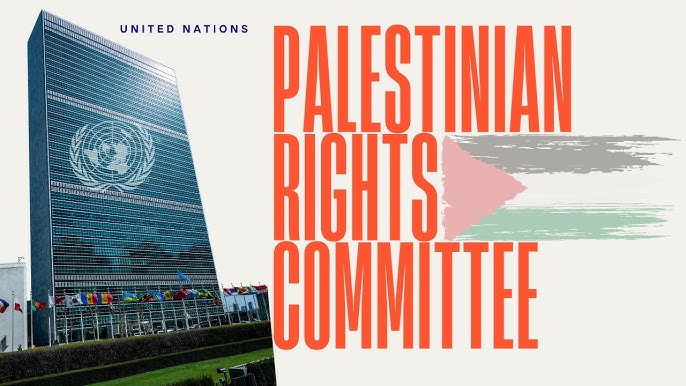
Last September, the UN General Assembly (UNGA) demanded that Israel end its ‘unlawful presence’ in Occupied Palestinian Territory, to no avail. This month, one year later, when the world convenes for UNGA in New York, the UN Committee on Palestinian Rights will urge world leaders to back a two-state solution at a high-level UN summit on September 22.
The US State Department has denied visas to this meeting for Palestinian officials, preventing them from attending and representing Palestine. But civil society will be mobilizing. The Palestinian NGO Network (PNGO) and Global Civil Society is calling for a Global Strike and Day of Action on September 18, 2025, to denounce Israel’s refusal to comply with this order, and to demand that UN member nations act immediately to end Israel’s genocide against the Palestinian people. WILPF US has endorsed PNGO’s call to action.
WILPF members have also been mobilizing for Palestine and Gaza year-round and will continue to do so this month as UNGA plays out. News on WILPF activities during UNGA week will be shared in future updates.
WILPF network news
| | |
🗓️ WILPF International invites sections worldwide to provide feedback on its 3-year International Program (IP) that is in the process of being updated. Our US section is hosting a discussion about the 3-year IP on September 10 at 4 PT / 6 CT / 7 ET. The feedback we collect will be shared with WILPF International by their September 15 deadline. To join the discussion, contact ED Linda Low at lindalow@wilpfus.org.
🗓️ Help lead WILPF US into the future! Are you interested in joining the WILPF US board of directors or leading a national committee? WILPF US seeks a board secretary, treasurer, program committee chair 1st and 2nd seat, personnel committee chair, and membership committee chair. Apply or nominate someone you know! Nomination forms are due September 13. Candidate applications are due September 20. For more information, contact nominations committee chair Julie Kabukanyi at nominatingchair@wilpfus.org.
🗓️ Tell us how you or your branch is responding to ICE activities in your community. We want to share what you’re seeing and doing with other WILPF US members, so that we can learn from each other and mobilize together where we can. By September 20, please submit a summary of how you and/or your branch is taking action (no more than 250 words) to WILPF US’s eNews editor, Emily Franko, at emily.wilpfeditor@gmail.com. She will include your essential work in an upcoming eNews story. Please coordinate with your branch members so that there is only one submission for each branch.
🗓️ The next WILPF US board meeting is October 30 at 4 PT / 6 CT / 7 ET. For more information, contact board secretary Dianne Blais at secretary@wilpfus.org.
Wise words from WILPF members and allies
| | |
I believe in the wisdom of the crowd, so I continue to seek insights from WILPF US members and allies. This month, I sought advice on mutual care and leadership. Here are some of the wise words I heard.
Code Pink Co-Founder Jodie Evans joined a WILPF US focus group in Zoom from a Gaza protest in LA. I asked her: What does activist care look like at Code Pink? Jodie said: “We are committed to a building a peace economy. We have clear boundaries and invitations for time outs. And we’re never attached to anyone being part of our community. If it doesn’t fit, it’s okay. On enabling mutual care: it happens in the smaller moments, the smaller gatherings. This is where we enable change. This is where we create sisterhood.”
In Seattle Chinatown, I met with Veterans for Peace Executive Director Michael MacPherson over tea. Earlier, during a WILPF US focus group, I asked: What comes to mind when you think of WILPF? Michael said: “Women’s voices and women’s leadership. WILPF cannot be small. You have an important role to play, because of your history, because of who you are today. Women are essential in countering the patriarchy. Women are essential in leading peace.”
Last week, I spoke with Margaret Engels, a Young WILPF US member in Syracuse about despair and hope. Margaret said: “I’m doing everything I can to resist the despair, the burnout. The people I’ve met in peace work are some of the funniest and most joyful people I know. My advice is this: No matter the crisis, it cannot take away joy. No policy can take joy away. Joy is inherently human.”
I agree with Margaret. Though times are hard, though we are tired, especially because we are tired: we must also make space for joy.
Take care of yourselves, fearless WILPF women and WILPF allies, and let’s continue to take care of each other.
Linda Low
WILPF US Executive Director
| | Your support helps WILPF reach farther and be more effective. Consider a donation to WILPF today to demonstrate your solidarity with our work. | | | | |