Quick, Timely Reads
On the Waterfront
|
|
Bay Rat Shortcuts: The American Alleyway |
|
Dr. David Frew, a prolific writer, author, and speaker grew up on Erie's lower west side as a proud "Bay Rat," joining neighborhood kids playing and marauding along the west bayfront. He has written for years about his beloved Presque Isle and his adventures on the Great Lakes. In this series, the JES Scholar-in-Residence takes note of life in and around the water.
|
|
“That cannot possibly be a shortcut!
You kids are stupid.”
– Typical parent’s response for why we walked
through alleys to and from school
|
|
Every weekday at about 8:30 a.m., thousands (or at least it seemed so) school kids departed their northwest Erie, Pennsylvania homes and trudged grudgingly toward daily educational destinies. Some headed toward St. Andrew, others either toward Emerson or Gridley. Most were dreading the loss of autonomy and freedom that was about to descend upon them. It was a time before yellow school buses and when we used feet to take us places. A few kids were driven by parents who wanted to be sure that their children arrived safely, although there were few actual dangers aside from some friendly jousting, exposure to rough language, and the odd pile of dog poo to be stepped in. For the first few years of these morning travels, we heeded the general instructions of parents. They started us out by identifying the “best” way to walk to school. For most of my St. Andrew colleagues, the recommended route was to head south on Cascade Street and then west on Sixth Street.
But there was an alternative. Some of us learned that we could continue west on Fourth Street to Raspberry and then make the southerly trek on that street. There were interesting things along that track, including Martucci’s Tavern (later to become Chuck & Ginny’s), especially the exciting stuff that seemed to grace the staging area near the rear entrance to the bar. Beer kegs were great fun, especially after we learned that they sometimes came with attached tax stamps that could be liberated and converted to collectable and tradable items that looked highly official. Even though they were clearly marked, “Do not remove under penalty of law.” We were renegades!
There was a unique corner store at Fourth and Raspberry that featured a delectable assortment of penny candy, including wax lips and candy cigarettes. Lucas Groceries became a regular pit stop for us as well as an incentive for using the western route to school. Parents did not seem to mind the occasional, creative use of the Raspberry Street alternative. It seemed sensible and safe, and except for our occasional stealth trips to remove tags and stamps from beer kegs, there were no obvious ways to get into trouble on Raspberry Street. It was much like a modern MapQuest alternative, and we were ahead of the times, technologically speaking.
But then we discovered the “dreaded alley route.” Halfway between West Fifth and West Sixth streets there was an alleyway running parallel to the numbered streets and connecting Cascade with Raspberry streets. No adult had ever suggested it as a viable school route. So why not? Sometime between first and second grade most of the neighborhood boys (never the girls) discovered the excitement and thrill of hanging a right turn just before Sixth Street and following the alley to Raspberry Street and school. We first noticed the bigger kids walking into the alley as they headed to school. When we asked why, they described the excitement of walking along the backs of houses and businesses instead of using regular streets. Eventually we tried it ourselves. The most adventuresome went first followed by the rest of us who did not want to seem like “wimps.” The alley changed our lives forever. Trips back and forth introduced us to a magical new world. Unlike the fronts of houses in the neighborhood, which were “managed” to look neat and proper, backyards that were visible from the alley exposed people’s real lives. Piles of random stuff, old cars, garbage, discarded wood, and other detritus stretched into the alley. And some of the discards that we found in the alley were useful. Old baseball bats, hockey sticks, lightly used bits of wood or wire, magazines, and books – all things that we were pleased to recycle. A trip through the alley was like a free Christmas shopping tour.
Eventually we were “busted.” Someone spotted us exiting or entering the mysterious alley, and as often happened during those days, our terrible transgressions were quickly broadcast among parents as well as teachers. When they chastised us for using the ally instead of a traditional sidewalk route we responded with a logical assertion. “It was a short cut and helped us to get to class sooner!” A few parents initially “bought” that explanation for a short time until they had consulted with each other. Shortly after that, however, a massive anvil of guilt was dropped on all of us. “Stay away from alleys,” we were told. “They are dirty, disease-ridden, rat-infested, and dangerous. Nothing good has ever happened in an alley.”
|
|
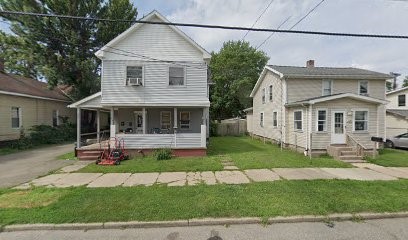
Our first alley, between West Fifth and Sixth Streets, still exists. Seemingly innocuous,
it is sandwiched between two homes on Cascade Street.
|
|
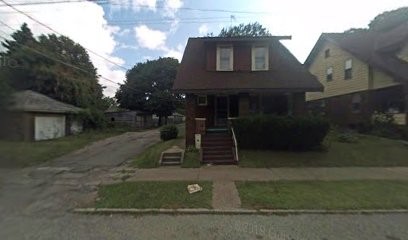
Our special “adventure alley,” seen from the west, reveals a network of garages. |
|
The history of the urban alley dates to Europe, where population density as well as narrow center-city streets made it imperative to create delivery corridors in crowded central areas so that businesses could be serviced by delivery wagons. The European experience eventually made its way to large cities in the United States, but by the time that American cities were developing, urban planners and developers were making alleys multifunctional. They provided space for delivery carts and horses, but also served as places to hide the most offensive aspects of big city building operations like garbage cans and work sheds. In some middle-sized cities like Erie, as well as a few of the big metropolises, there were few if any alleyways in the downtown core. An ongoing criticism of the early design of New York City was its failure to include alleys in its planning, unlike Boston, Chicago, Philadelphia, and Charleston. As cities expanded and grew, however, alleyways were incorporated into expansion plans. Chicago, for example, was known among city planners for including alleys in both its central core and then in many of its first outward expansions. |
|
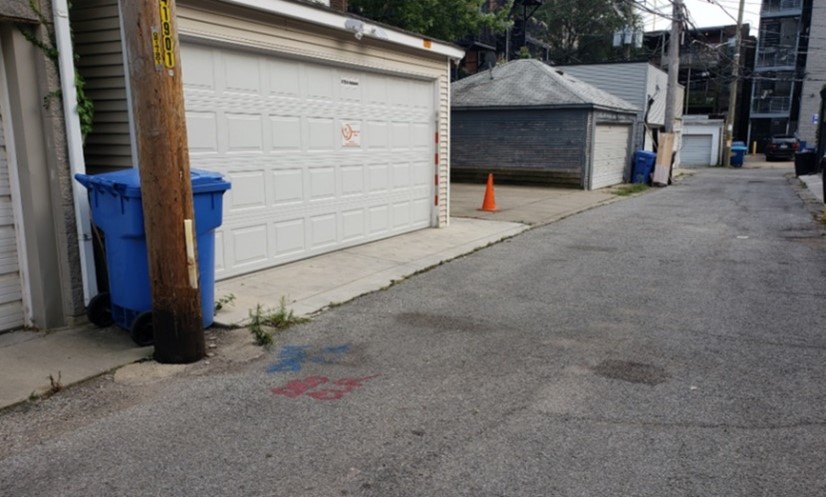
Here is a typical alley in a residential area of Wrigleyville, a northern Chicago suburb. |
|
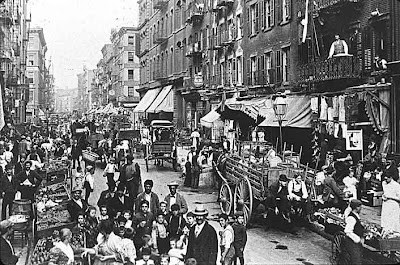
By the late 1800s, big city streets had become impassable. Streets were so clogged with horses and delivery wagons that commerce would have been impossible without alleyways. |
|
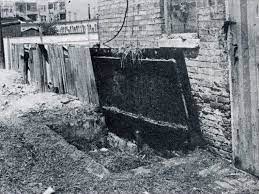
In mid-sized cities like Erie, the evolution of the automobile was closely linked with the development and use of alleys. Before the automobile, when horses were used for commercial deliveries, alleyways were essential for reducing the amount of horse droppings as well as other garbage from busy main streets. One of the fixtures in most city center alleyways during the 19th century was the traditional “horse manure vault.” Manure was swept or shoveled into these below-street-level chambers, where it was allowed to ferment. Periodically, the manure vaults were cleaned out by a “manure monger,” who gathered the material and took it to be made into fertilizer. The average horse produces about 45 pounds of manure each day, which is more than enough to present a major problem. It may have been the festering and odiferous horse manure that helped alleys earn the reputation for being disease-ridden. In the early days of automobiles, one of the justifications for allowing the noisy and dangerous new machines to use public streets was the promised reduction of the horse poop problem. Imagine thousands of horses multiplied by 45 pounds per day. |
|
Here are the remains of an old manure vault in a Chicago alley. |
|
Later, when automobiles began to appear, alleys were developed in the neighborhoods that were closest to the city core. These alleys allowed the few people who had automobiles to keep them off the main streets. By the 1920s, when automobiles became more common, new housing developments (away from the city center) included driveways for the relatively affluent people who had automobiles and wanted to keep them off the street. The final step in urban development came after World War II when the automobile became an integral part of the typical upper-middle class American family. The new emphasis on automobiles created a situation in which people were proud to have a showcase for their cars, especially if they owned a luxury brand. Having a Buick, Oldsmobile, or Cadillac in front of the house was a sign of success and status. During that period, garages began to become a structural component of modern homes. The very most desirable homes were built with wide driveways and attached multiple-car garages. That step in home\automobile ownership essentially ended the era of the American alley.
The 1950s era when we were growing up was a time when there were lots of allies between our northwest bayfront neighborhood and downtown, but newer and more affluent neighborhoods west of us (beyond the West Sixth Street Viaduct) were different. Those neighborhoods were designed with the assumption that people would own automobiles. The more affluent of the western developments had large driveways and connected garages while the less prestigious ones, especially worker homes built by Baldwin Brothers were either lacking driveways or featured small, detached garages with narrow driveways.
Our alley explorations were confined to neighborhoods to the east. And by the time we were in middle school, we had become obsessed with them. Telling a Bay Rat to stay away from alleys, as parents and teachers had, was a powerful reverse motivator. Not only did we begin to use the familiar alley between Fifth and Sixth Streets almost every day and in both directions (to school and back), we became obsessed with finding others. Our quest for new alleys was quickly rewarded. There were more to be discovered. There were alleys north of us between Fourth and Front streets on Plum Street. And we also discovered a great alleyway between Fifth and Sixth streets, spanning the block from Poplar to Cherry. That alley had a name, East Park Avenue, and was even more exciting than the alley that we used to walk to St Andrew School. The Poplar Street Alleyway had a commercial poultry operation halfway along the block. Fresh eggs could be purchased there as well as cooking chickens. More exciting than the poultry business was the fact that much of the alley was lined with garages that were so close to each other that we could climb to any of the roofs and jump from garage to garage, barely needing to step on the ground to move east or west. There was also a named alley (Rolling Ridge) that ran parallel with Seventh Street and between Cherry and Walnut.
|
|
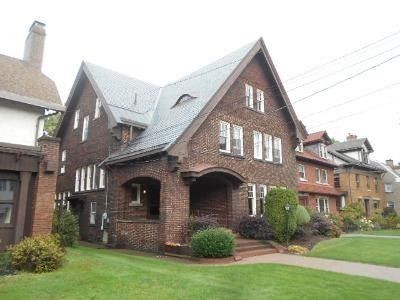
A typical Garden Court home is spacious and opulent but without a driveway. |
|
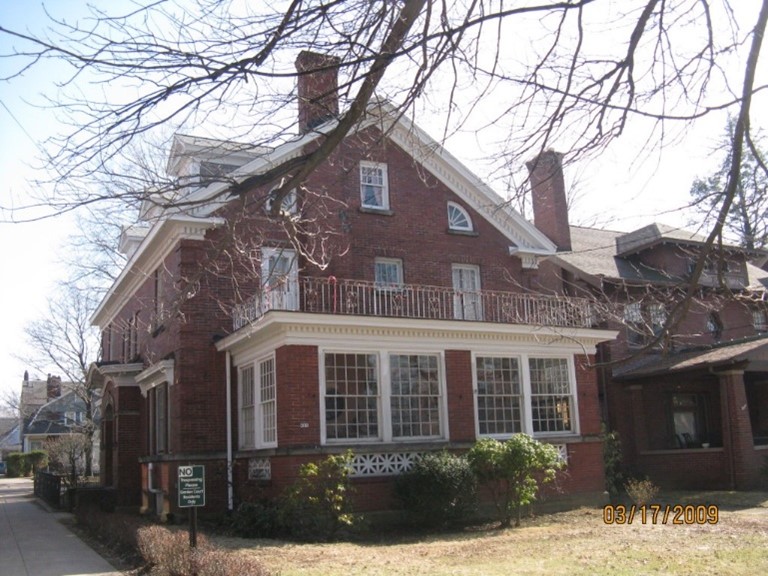
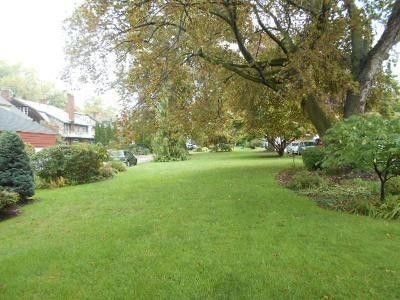
Eventually we discovered an amazing combination alley-shared backyard complex called Garden Court. Developed during the early 1920s, the space between West Sixth and West Seventh streets in the city block that stretched from Poplar to Cherry was (and still is) a wondrous place. Far more than a simple alley. Homes on the surrounding block were quite large and prestigious, almost as opulent as the houses just to the east on Erie’s historic Millionaires Row. Unlike the mansion district, which was built before automobiles, Garden Court was designed with the assumption that residents would own automobiles but with just a few exceptions there were no individual driveways or attached garages. Instead, backyards were melded into a common parklike greenspace, and alley entryways were created on both the west and east ends of the block. Residents could drive into the square behind the homes and its surrounding greenspace, where garages could be accessed from the rectangular lane that surrounded the park. |
|
One of four Garden Court entryways is shown adjacent to a West Sixth Street home. |
|
Unlike the mansions to the east or later homes west of the viaduct, Garden Court featured shared space for garages and parking. As automobiles began to appear, most of the mansions to the east had enough space that had previously been dedicated to horses, carriages, carriage houses, and outbuildings that it was a simple matter to create garages. The Garden Court development solved this problem communally. |
|
Garden Court’s shared greenspace and rectangular drive contains off-street parking and garages. |
|
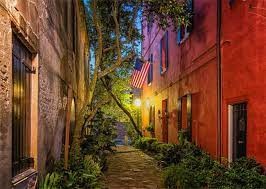
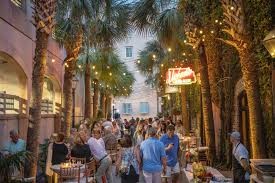
In recent years, as urban planners have reoriented their thinking about downtown designs and walkable cities, once-abandoned alleyways have been reborn. In Charleston, South Carolina, for example, several of the city’s most desirable downtown walking, shopping, and dining locations have been created within former alleyways. |
|
Charleston’s Philadelphia Alley |
|
One of Charleston’s popular dining alleys |
|
Accidental Paradise Available at TRECF!
Accidental Paradise
by Dr. David Frew and Jerry Skrypzak
|
|
The beautiful book on Presque Isle published by authors David Frew and Jerry Skrypzak – “Accidental Paradise: 13,000-Year History of Presque Isle” – is on sale at the Tom Ridge Environmental Center’s gift shop and through a special website, AccidentalParadise.com.
The book, priced at $35 plus tax and shipping, can be ordered now through the website sponsored by the TREC Foundation, AccidentalParadise.com.
Presque Isle Gallery and Gifts on the main floor of TREC, located at 301 Peninsula Drive, Suite #2, Erie, PA 16505 will also handle sales daily from 10 a.m. to 4 p.m.
For more information, send an email to aperino@TRECF.org.
To watch "Accidental Paradise: Stories Behind The Stories" click here.
|
|
ABOUT THE AUTHOR
Historian and author David Frew, Ph.D., is a Scholar-in-Residence at the JES. An emeritus professor at Gannon University, he held a variety of administrative positions during a 33-year career. He is also emeritus director of the Erie County Historical Society/Hagen History Center and is president of his own management consulting business. Frew has written or co-written 35 books and more than 100 articles, cases, and papers.
|
|
|
|
|
|
|