Weekly Digest Number 17 - April 27, 2021 |
|
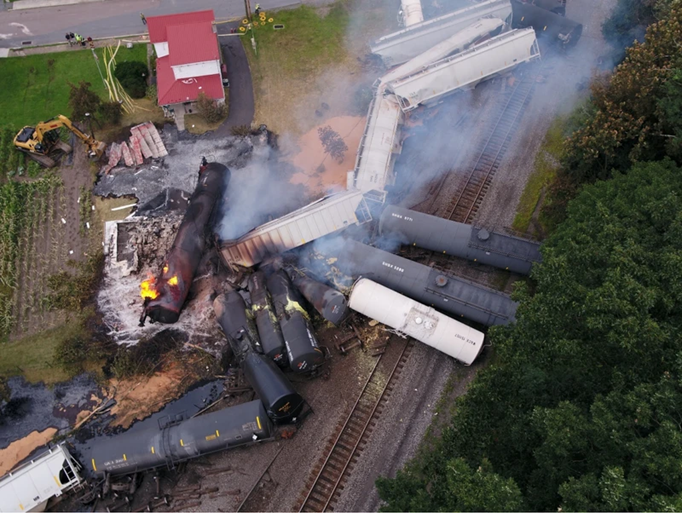
‘It’s Going to End Up Like Boeing’: How Freight Rail Is Courting Catastrophe
Workers are sounding the alarm that drastic cuts in employees and maintenance in order to increase profits are tempting fate.
|
|
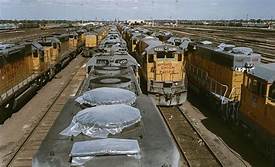
Like plane crashes, freight train derailments are rarely the result of a single failure. Many different things have to go wrong. Also like air travel, freight trains are a highly regulated form of transportation because of the potential for catastrophe. And yet, freight train derailments are surprisingly common. In 2019, railroads reported 341 derailments on main line track, meaning the parts of the rail system not in yards or other work areas. Of those 341 derailments, 24 were freight trains carrying 159 cars of hazardous material, according to data the railroads voluntarily submitted to the Federal Railroad Administration. Even local news reports provide an alarming window into how frequent derailments are that people actually notice. While reporting this article, freight trains derailed on February 15 in Illinois, February 23 in Pennsylvania, March 3 in California, March 7 in Alabama, and March 11 in both Wisconsin and Minnesota
|
|
UNION YES! PRO Act National Week of Action |
|
The Protecting the Right to Organize (PRO) Act is a significant piece of worker empowerment legislation that would change the power dynamics in America for generations. It gives power back to workers and holds corporations accountable for union-busting. The PRO Act passed in the House with bipartisan support. President Biden has urged Congress to send it to his desk. Before that can happen, we have to pass it through the Senate. We just need three more senators. So we’re having a national week of action, April 26–May 1, to show the Senate that working people want the PRO Act.
|
|
Lots of Action Planned for Earth Day to May Day |
|
Some people may be surprised to learn that a labor union played such a significant role in the emergence of the modern environmental movement. When they think of organized labor, they think of things like support for coal and nuclear power plants and opposition to auto emissions standards.
When it comes to the environment, organized labor has two hearts beating within a single breast. On the one hand, the millions of union members are people and citizens like everybody else, threatened by air and water pollution, dependent on fossil fuels, and threatened by the devastating consequences of climate change. On the other hand, unions are responsible for protecting the jobs of their members, and efforts to protect the environment sometimes may threaten workers’ jobs.”
|
|
Bose Nominee to Head Federal Railroad Administration |
|
As largely expected, President Joe Biden will nominate current Deputy Federal Railroad Administrator Amit Bose as FRA Administrator, the White House announced April 23.
“Amitabha Bose has spent nearly two decades in public service working to build a better, safer and more sustainable transportation system that provides opportunity to communities across the United States,” the White House said. “Bose’s leadership in senior-level roles at the U.S. Department of Transportation and the FRA under two Secretaries led to the passage of the FAST Act and MAP-21.”
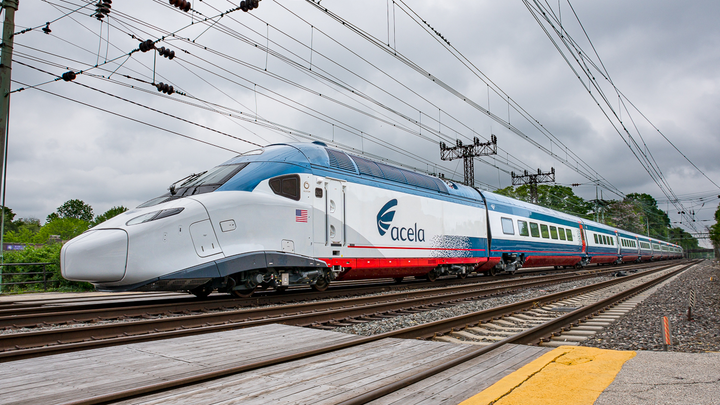
Currently, Bose serves as Deputy FRA Administrator, returning to the agency where he was also Chief Counsel and Senior Adviser. “He has been involved in some of the highest profile rail and transportation projects, including the Northeast Corridor Gateway Program, California High- Speed Rail, Acela 2021 trainsets and Liberty Corridor,” the White House noted.
|
|
STB Forms Passenger Rail Working Group |
|
The working group will develop plans that will allow STB to fulfill its oversight roll regarding on time performance of intercity rail service
The Surface Transportation Board (STB) has formed a passenger rail working group, which will be chaired by STB Office of Economics Deputy Director Frank O’Connor and made up of STB staff. STB will have additional oversight duties of intercity passenger rail metrics and on-time performance following publication last fall of a Federal Railroad Administration (FRA) final rule setting measures and minimum standards regarding the quality of service and performance of Amtrak operations. The rule went into effect in December 2020, but the metrics will begin to apply July 1, 2021. The final rule requires Amtrak and its host railroads to certify Amtrak schedules and sets an on-time performance minimum standard of 80 percent for any two consecutive calendar quarters. A train arriving within 15 minutes of its published arrival time is considered on time. Other metrics that FRA defines in the final rule include ridership, train delays, station performance and host running time.
|
|
Transportation Trades Department and Rail Unions Applaud Nomination to National Mediation Board
|
|
On April 20, union attorney Deirdre Hamilton was nominated by the president to serve on the National Mediation Board (NMB), the government body that facilitates labor-management relations in the aviation and rail industries. The 33-member union Transportation Trades Department, AFL-CIO (TTD), which represents millions of workers across the aviation, rail and broader transportation sectors and of which the SMART Transportation Division is a member, urges the U.S. Senate to quickly confirm her appointment to the board.
“Deirdre Hamilton’s qualifications are impeccable, and it is clear she will bring to the NMB professionalism, integrity, and a deep commitment to the mission of the agency,” said Greg Regan, president of TTD. “We applaud the Biden administration for nominating someone with Ms. Hamilton’s depth of knowledge and experience, and who understands the critical role that the NMB plays for aviation and rail workers. We look forward to her swift confirmation by the Senate.”
|
|
CP - KCS Merger Takes a New Twist
CN Counters CPKC with a ‘Superior Proposal’
|
|
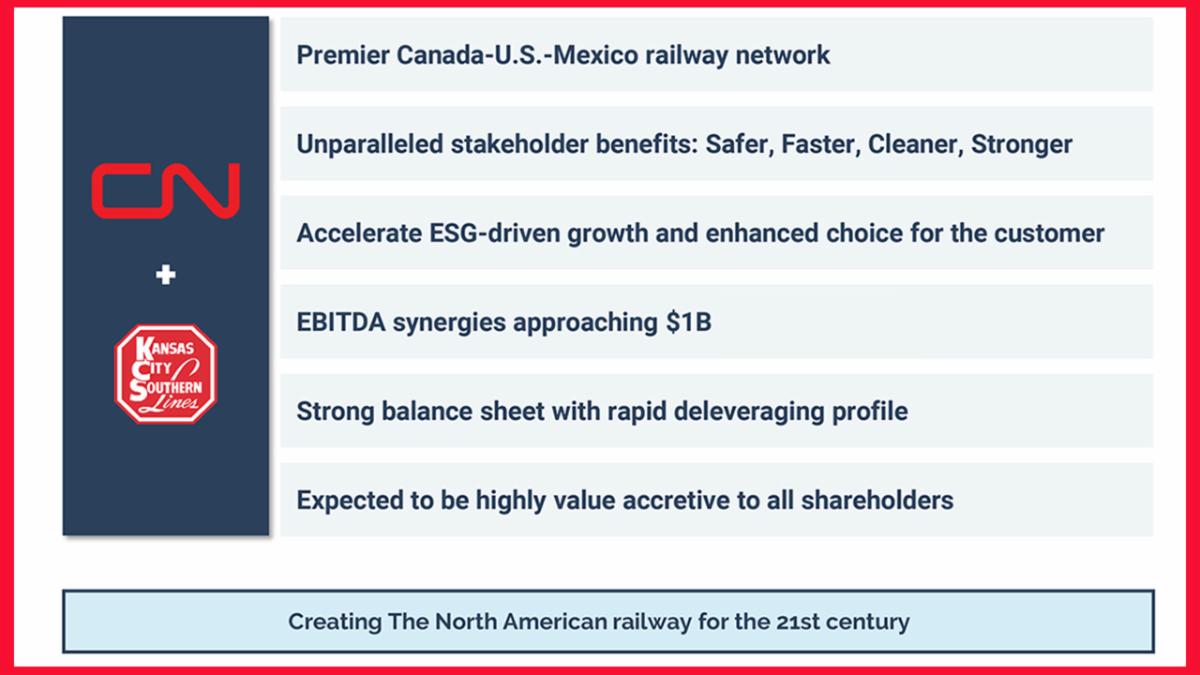
Perhaps not so surprisingly, almost exactly one month to the day after Canadian Pacific and Kansas City Southern announced their intent to merge into CPKC (Canadian Pacific Kansas City), CN made a counter-offer it said is a “superior proposal” that “will result in a safer, faster, cleaner and stronger railway.” CN’s proposal of $325 per KCS share “represents a 21% premium over the implied value of the CP transaction and values KCS at an enterprise value of $33.7 billion.”
Combining CN and KCS “will create the premier railway for the 21st century, connecting ports in the United States, Canada and Mexico to facilitate trade and economic prosperity across North America … providing superior service, enhanced competition and new market access to move goods across North America efficiently and safely,” CN said. “This rail and logistics network would reduce traffic congestion and prevent thousands of tons of greenhouse gas emissions from entering the atmosphere every day. This combination will also significantly expand the combined company’s total addressable market and provide growth opportunities across the rapidly growing USCMA network.”
|
|
Rail Industry Income Drops Precipitously |
|
Union Pacific Reports Lower Profit, Revenue
Union Pacific Corp. today reported first-quarter 2021 net income of $1.3 billion, or $2 per diluted share, compared with $1.5 billion, or $2.15 per diluted share, during the same period a year ago. The Class I’s operating revenue of $5 billion declined 4% during the quarter. Business volumes, as measured by total revenue carloads, fell 1% compared to Q1 2020 due to declines in industrial and bulk shipments, partially offset by strength in premium carloads. UP reported a Q1 operating ratio of 60.1%, up from 59% last year. The increase was attributed to weather and rising fuel prices. Quarterly freight revenue declined 5% ..
|
|
Class One Railroads Employed More People in March |
|
(Editor's Note: While this is good news, everything is relative. The rail Class One workforce has been decimated by PSR, the pandemic and economic downturn. A less than 1% uptick in employment levels hardly warrants mention when looked at in the context of the 10% drop in year-over-year figures.)
U.S. Class Is employed 115,003 people in mid-March, up 0.82% from mid-February but down 10.06% compared with employment during the same period a year ago, according to Surface Transportation Board data. Four of six employment categories logged employment increases in March compared with February’s level. They were: maintenance of way and structures, up 1.46% to 28,356 workers; transportation (train and engine), up 1.33% to 46,404; transportation (other than train and engine), up 0.36% to 4,767; and executives, officials and staff assistance, up 0.14% to 7,276. Categories that posted month-over-month decreases were maintenance of equipment and stores, down 0.52% to 18,021 workers, and professional and administration, down 0.16% to 10,179.
|
|
The U.S. Is Not Ready for High Speed Rail |
|
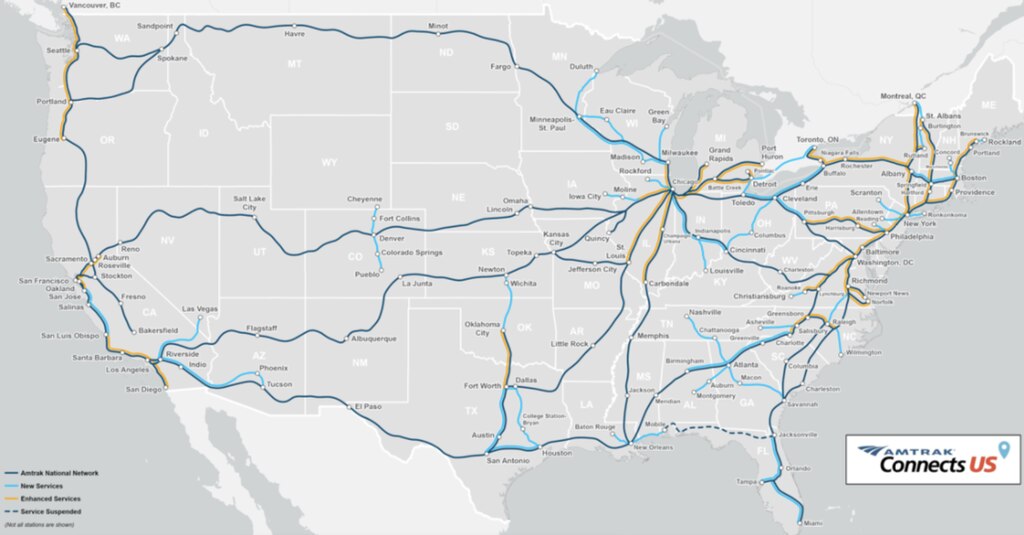
The U.S. already has an extensive 140,000-mile functional rail network owned and operated by freight rail companies that is also used by Amtrak. If we're going to have decent U.S. rail service in time to make a meaningful impact on emissions, this is our best shot. Amtrak even released a map (see above) of what this might look like should Biden's infrastructure plan get enacted.
|
|
Railroad Workers United Endorses the People's Party |
|
The People’s Party is proud to announce the endorsement of Railroad Workers United, a cross-craft organization of non-management railroad workers from all carriers and railroad unions. Founded in 2008, RWU works to build rank and file power and solidarity among all railroad workers in North America. “RWU has long proclaimed its discontent with the two established parties,” said General Secretary Ron Kaminkow. “Working people in the United States need a political party of their own that is not beholden to big money. We need a People’s Party.”
|
|
Nevada Governor Proclaims April 28th A Day in Honor of Railroad Workers |
|
JOINT STATEMENT FROM SMART-TD AND BLET NV STATE LEGISLATIVE BOARDS
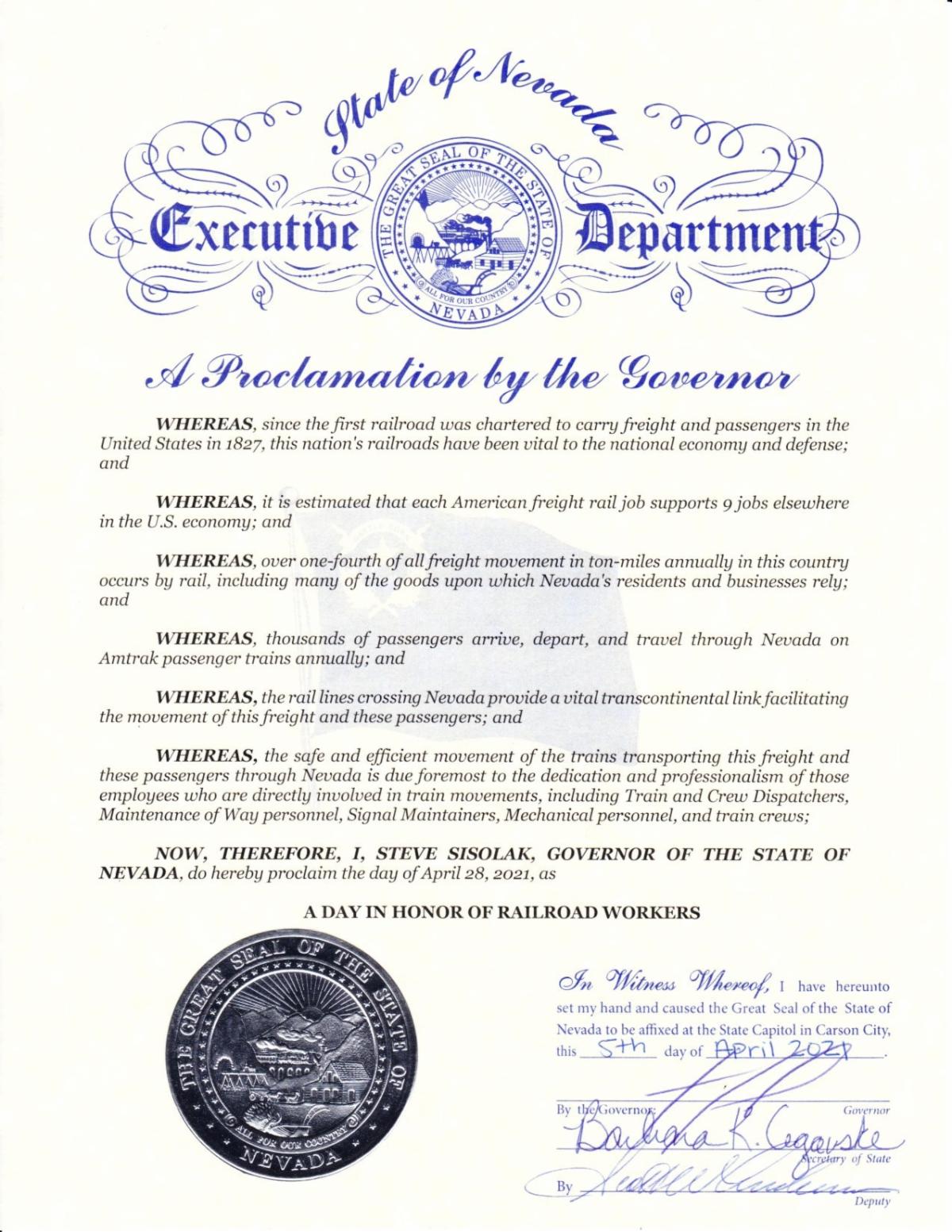
Every day, front-line railroad workers report for duty as required and perform the tasks of their jobs in a manner which ensures that the movement of freight and passengers by rail which is needed to keep this nation's economy functioning is accomplished. In spite of various objectives and circumstances which create hurdles to be crossed in providing this vital service, the work which you do continues to deliver for those counting on it. We are pleased on this April 28th, a date designated in this country as “Workers Memorial Day”, to join with Nevada Governor Steve Sisolak in honoring the railroad workers whose efforts every day ensure rail traffic into, out of, and through Nevada continues to move (see below for full statement)
|
|
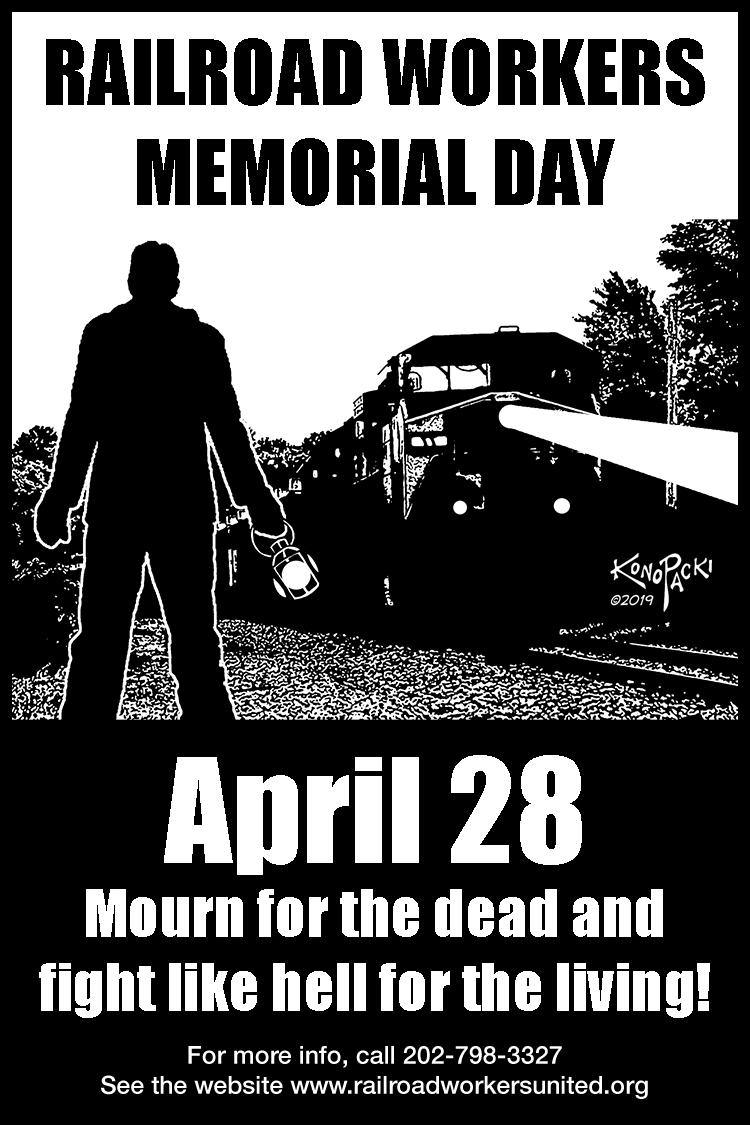
Railroad Workers Memorial Day is Wednesday 4/28/21 |
|
Every year on April 28th, workers across the United States honor and remember our Fellow Workers who have been killed, injured, and infected on the job. Far too many workers this past year have been subject to workplace hazards that can kill or maim them. We should be able to go to work, and know that we will come home safely to our family and loved ones.
And during this pandemic, working people are dying of preventable deaths. The "essential workers", including nurses and doctors, grocery store workers, and transportation workers like us, have been on the front lines the past year, and will continue to be there. The nation rightly considers such workers heroes. But heroes deserve to be treated as such, and that means provided with proper sanitary facilities, adequate social distancing space, personal protective equipment, and the elimination of hazards from the workplace environment that might injure, infect, or kill them. This Workers Memorial Day, we remember those who have sacrificed their lives and health while in the performance of their duties. In the midst of this global pandemic, we will keep on fighting for a healthy and safe workplace environment. In the words of the famous labor union organizer, "Mother" Mary Harris Jones, we must always remember to "Mourn for the dead, and fight like hell for the living!"
|
|
Transformative Power of Electric Trains |
|
Electric cars are generating a lot of buzz. ...
But if the goal is to radically reduce greenhouse gas emissions in the next decade, electric trains are the true EVs we’ve all been waiting for. The technology is already mature. And electric trains are the only tool powerful enough to move the needle quickly on a challenge of this magnitude. Electric cars are still cars. They add to highway congestion and incentivize more car culture—which means more spending on new roads and lanes, more sprawl into greenfields, more hollowed out urban centers, more crashes and lives shattered or lost. Like electric cars, electric trains produce low or zero emissions. But unlike electric cars, they actually shift us toward a paradigm of sustainable growth. They incentivize more density in urban areas; fewer parking lots; more walking and biking; and a sharp reduction in resource consumption devoted to building, storing, and disposing of cars. That’s in addition to being much safer than driving.
|
|
|
|
|
|
|