The Annapolis Observer is IRO’s weekly update on happenings in Annapolis and highlights the progress of key bills of interest to WSSC Water, as well as provide timely updates and calendar of important dates.

A Note from WSSC Water's Intergovernmental Relations Office


Crossover Day has come and gone, marking the annual push to move priority bills out of their originating chambers. The week leading up to the March 23 deadline brought long committee sessions and rapid‑fire floor action as lawmakers positioned major budget, energy, housing, and policy measures for the final stretch of session.


Crossover at a Glance

The crossover deadline reshaped the final phase of session, with leadership focused on advancing top‑tier bills and consolidating others into broader packages. The Senate passed its FY 2027 budget (closes deficit without tax increases), setting up the House to begin adjustments this week.


Energy policy dominated much of the activity. Lawmakers rallied behind the Utility RELIEF Act (ratepayer savings; reforms to data centers, solar, and transmission). Several standalone proposals were folded into the package, while others are unlikely to advance.


Environmental and immigration measures saw mixed progress. The Senate advanced a PFAS sludge bill (limits PFAS in biosolids), while other environmental justice proposals stalled. The House passed the Data Privacy Act (limits information‑sharing with federal immigration authorities), though the Community Trust Act (restricts local‑federal cooperation) remains in committee.


Governor Wes Moore’s housing agenda advanced in part, with vesting rights legislation (regulatory predictability for developers) and TOD incentives (parking and zoning flexibility near transit) clearing the deadline.


School Cell Phone Restrictions

Both chambers advanced legislation to significantly limit student cell phone use during the school day. The Senate passed SB 928 and the House approved HB 525 (statewide “bell‑to‑bell” restrictions beginning in 2027–28).


The bills prohibit student use of personal electronic devices during instructional time, lunch, recess, and transitions. Local school boards would determine storage methods and discipline protocols, with final policies due by September 1, 2027.


Supporters, including educators, parents, and child‑development specialists argue the restrictions will reduce distractions and improve academic focus. Disability advocates have raised concerns about compliance with the Americans with Disabilities Act, particularly for students who rely on devices for health or accessibility needs.


The Senate bill will be heard in the House Ways and Means Committee on April 1, while the House version awaits action in the Senate Education, Energy, and the Environment Committee.


Environmental Justice

The CHERISH Act (cumulative‑impacts review for new industrial permits) stalled before the crossover deadline after advocates withdrew support over late amendments. Those changes narrowed the definition of “overburdened communities,” raising concerns that many industrial parcels, including sites in the Voluntary Clean‑Up Program, would be exempt from heightened review.


The bill would have required the Maryland Department of the Environment to conduct deeper analyses for new facilities in heavily impacted areas and, in some cases, deny permits unless compelling public interest could be demonstrated. Supporters viewed the proposal as a needed step toward addressing cumulative pollution burdens, while opponents questioned the scope of MDE’s authority and potential economic impacts.


With the bill no longer moving, funding included in the Senate budget to implement the measure will likely be redirected. Sen. Benjamin Brooks has acknowledged the effort will need to be revisited next year, and advocates say they plan to push for a clearer, more enforceable cumulative‑impacts framework in 2027.


IRO will continue tracking developments as these debates move into their next phase.

Legislative Updates


HB 1230 (PG/MC 102-26): Washington Suburban Sanitary Commission – Procurement – Alterations

  • The bill passed the House of Delegates on March 19 (124-7). The bill will be heard before the Senate’s Education, Energy, and the Environment Committee on March 31 at 1:00pm.


HB 204/SB 264: Drinking Water – Regulation – Control and Prevention of Waterborne Disease

  • No updates.


HB 328 (PG/MC 105-26): Bicounty Commissions – Public Ethics – Financial Disclosure Statements

  • The bill will be heard before the Senate’s Education, Energy, and the Environment Committee on April 2 at 1:00pm.


HB 721/SB 243: Uniformed Services Spouses Act

  • HB 721 awaits a hearing in the Senate’s Education, Energy, and the Environment Committee.
  • SB 243 bill will be heard before the House’s Appropriations committee on April 2 at 1:00pm. 


HB 925/SB 719: Sewage Sludge – Per– and Polyfluoroalkyl Substances – Regulation

  • HB 925 awaits a hearing in the Senate’s Education, Energy, and the Environment Committee.
  • SB 719 will be heard before the House’s Environment and Transportation Committee on April 2 at 1:00pm.


HB 1022/SB 686: PFAS Chemicals – Product Phase Outs and Registration Requirements

  • HB 1022 has no updates
  • SB 686 has no updates.


HB 1185 (PG/MC 104-26): Washington Suburban Sanitary Commission – Personnel Management – Disciplinary Actions

  • The bill passed the House of Delegates on March 19 (121-6). The bill will be heard before the Senate’s Education, Energy, and the Environment Committee on March 31 at 1:00pm.


IRO will continue to monitor legislation and provide updates. Please find the status and position on WSSC Water-related bills in our Legislative Update.

Around WSSC Water


WSSC Water Collaborates on $150,000 Research Grant to Advance Artificial Intelligence (AI) for Water Resource Recovery Operations  


On March 26, 2026, a project team that includes WSSC Water has been awarded a $150,000 research grant from the Water Research Foundation (WRF) to develop and test new artificial intelligence (AI) tools designed to optimize operations at water resource recovery facilities (WRRFs).  


The research is focused on addressing growing operational challenges, including: 


  • Stricter environmental regulations to protect local waterways 
  • Rising energy and chemical costs 
  • Complex treatment processes requiring real-time decision-making 
  • Numerous data systems that do not always work together 
  • Training and support for the next generation of plant operators 


To help address these challenges, the research team will develop AI tools that turn plant data into clear, easy-to-use information for operators. 


The project will be piloted at WSSC Water’s Piscataway WRRF in Accokeek, Maryland, where the technology will help forecast treatment impacts and identify opportunities to optimize operations through reduced energy and chemical use. More information on can be found here.


WSSC Water’s Patuxent Watershed 2026 Season


Our Patuxent Watershed recreational areas are open! After a long, cold winter, come on out to enjoy fishing, boating, hiking, horseback riding, and playground and picnic areas! The watershed spans over 6,000 acres along its two reservoirs, Triadelphia and T. Howard Duckett, in Montgomery, Prince George’s and Howard counties.


The Visitor Center is open daily from 7 a.m. to sundown, including weekends. Get all the details about obtaining permits, including who’s eligible for a complimentary permit, and how to reach recreation staff at wsscwater.com/watershed, or in person at the Brighton Dam Visitor Center, 2 Brighton Dam Road, Brookville, Maryland 20833.   

Customer Notification System (CNS)


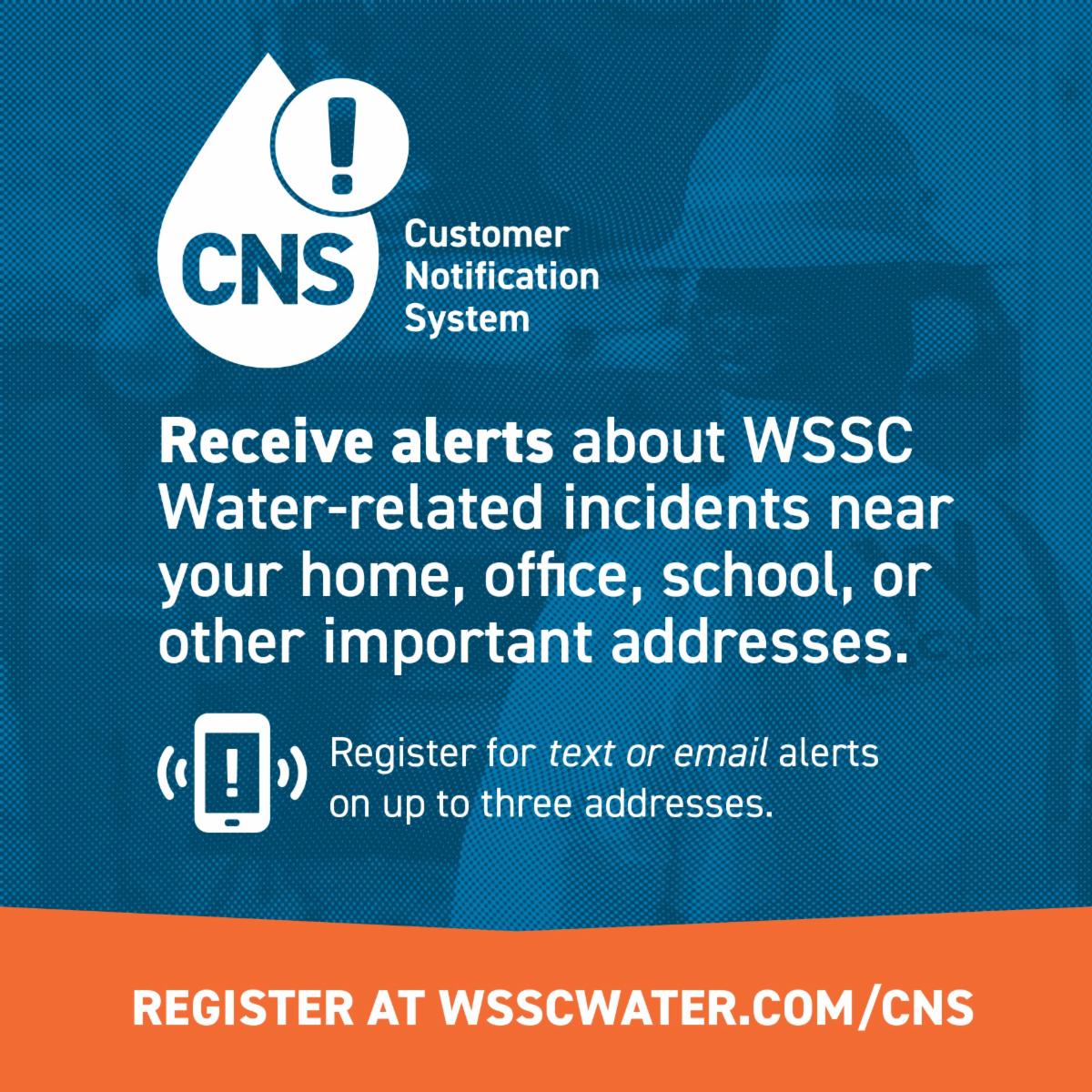
In our continuing effort to provide excellent customer service, WSSC Water offers a Customer Notification System (CNS) to alert you about our work in your area that may affect your service or daily routine.


Once you sign up, you will receive email or text alerts about water main breaks, sanitary sewer overflows, road or lane closures caused by WSSC Water work, boil water advisories and occasionally other important messages from us.


Sign up here for CNS and never be in the dark about water main repairs and water emergencies in your neighborhood.

Customer Assistance and the Water Fund


WSSC Water remains committed to making water/sewer bills more affordable. We want to do everything in our power to help you avoid a water service turnoff and ensure our safe, clean water continues to flow to your tap. Learn more at WSSC Water Financial Assistance Programs.

Customers may also help by making a tax-deductible donation to The Water Fund to help more neighbors have access to clean, safe water. The Water Fund is administered by The Salvation Army. Every dollar of your donation goes directly to local families who need financial assistance paying their water/sewer bills. Click here to donate online.


Customer Advocates


Our Customer Advocates are in your communities every day, carrying out their mission to serve as liaisons between you and WSSC Water, and ensuring that we are providing a high level of customer service.


Northern Prince George’s County (areas north of Central Avenue, MD 214)

David Wilkins

David.Wilkins@wsscwater.com

301-648-6953


Southern Prince George’s County (areas south of Central Avenue, MD 214)

Walter Guzman

Walter.Guzman@wsscwater.com

240-444-5803


Southern Montgomery County (areas south of Randolph Road)

Brandon Stewart

Brandon.Stewart@wsscwater.com

301-642-1712


Northern Montgomery County (areas north of Randolph Road)

Phil Callahan

Philip.Callahan@wsscwater.com

240-204-2123


Find your Customer Advocate here.

Key Dates

  • Apr. 6 – Budget bill to be passed by both Chambers
  • Apr. 13 – Sine Die 


Related Links


Maryland General Assembly

Montgomery County Delegation

Prince George's County Delegation

Maryland Association of Counties

Maryland Municipal League

About IRO


WSSC Water’s Intergovernmental Relations Office (IRO) team works to promote the value of water and the value of WSSC Water; engage federal, state, county and local government and elected stakeholders and advocate for WSSC Water’s strategic interests and priorities; and foster relationships with organizations and promote collaborative interests.


In Annapolis, the IRO team works with members to support administratively and fiscally responsible legislation, in addition to championing policy that benefits all water utilities throughout Maryland. WSSC Water is committed to increased statewide investment in water and wastewater infrastructure and sound regulatory initiatives.

Meet the IRO Team


Monica Marquina – Government Affairs Director

Monica.Marquina@wsscwater.com


Kenneth Simons – Government Affairs Manager

Kenneth.Simons@wsscwater.com


Contact Us

(301) 206-8228

iro@wsscwater.com


Please click here for a printable sheet of our key contacts.

Facebook  X  Linkedin  Pinterest  Youtube  
For over 100 years, WSSC Water has proudly served the citizens of Prince George’s and Montgomery counties – providing drinking water that has always met strict Safe Drinking Water Act standards and protecting the environment through vital water resource recovery services. Our vision is to be THE world-class water utility, where excellent products and services are always on tap. www.wsscwater.com