Strategic Planning Corporation
Weekly Economic Update
| | |
There are almost an innumerable number of ways to invest your money. But the key is TO INVEST YOUR MONEY! The ever-present temptation for all of mankind is to spend everything that comes into your possession. Now, granted, there are some people who have mastered the art of forgoing immediate gratification and who actually save their money. There are some of those who have not always acted in that manner, but have learned over time through various experiences to put aside some of what they earn or come into.
So once you have decided that it is important to put aside some money from what you gain, where should you put it? Now some of you are going to be thinking, "oh, here comes the spoil sport and he's going to tell me that I shouldn't be buying gold or other precious metals or investing in cryptocurrency or other exotic things." He wants me to just plug it away into a boring old brokerage account along with my 401k mutual funds and my Traditional and Roth IRA accounts.
Same ole, same ole!
Well, that is not the case. At least not when you are starting out. When you first begin putting money aside, I think it is a good idea to put money into a high-yielding money market account to have funds on hand in the event of an emergency or an expense that could lead toward borrowing money.
And speaking of borrowing money, if you have and you carry a balance over each month, the first money you should save after getting an initial start on a money market account is the money you put toward accelerating the payoff of that debt. If your interest rate on that debt is 12% or higher, that is what you are making on that money in that you are eliminating that drain, keeping the additional interest charges for yourself rather than the banker.
So how much should you pay off? ALL OF IT! I know, that sounds harsh, but it brings dramatic freedom to your life. So DO IT! And then you will be saving more money and investing more money than you ever have before.
Then you can save up enough in that money market account to take care of the extraordinary expenses that come up. How much? Save up somewhere between 3 and 6 months of your monthly expenses. If your monthly nut is $5,000 that means you should get $15,000 to $30,000 in that savings.
Then you are ready to really knock out some big bucks into your long-term investment account. Now if you have a 401k opportunity through your employer and the employer matches a portion of what you invest in your 401k, while you are saving up that 3-6 months of expenses in your money market, also investing what is needed to get the maximum employer matching contribution into your account. And consider whether that investment should be in a "pre-tax" or an "after-tax" account. You should talk to us about that!
If you are able to save more than the amount needed to get the employer match, open a Traditional or Roth IRA account. Talk to us about which!
Got more to save? After having us put together a financial analysis for you, it may be that you will want to continue to put more money into an individual or joint brokerage account to have exposure to the stock and bond markets.
So now you've heard me tell you to do the boring thing with stock and bond accounts in your 401k, IRA, Roth IRA and personal accounts. When do you get to go wild and lose some money!!??
Seriously, buying into things like precious metals, crypto, real estate, and other non-financial market items, doesn't guarantee a loss. It is just riskier than the liquidity and extraordinary diversification of a measured stock and bond portfolio which is what you should consider as the core of your long-term investment plan to take care of you as you age and want to slow down or retire from the monthly paycheck routine.
If you get that long-term income settled with a globally diversified portfolio then you may want to take some fliers! I don't mean that you have to wait until you are 64 or 66 or 69 and ready to retire in a year and you KNOW you will have the money in that diversified pocket. If you routinely check up to see if you are on track and doing what is necessary to arrive at your goal with reasonable assumptions, and you have additional funds to invest.... feel free!
But until you know you are on the right track and you have adequate insurance to take care of the possibility of incapacity or premature death or even need for extended care in old age, then don't blow your plan to reach that retirement goal by investing more than you should in the latest cool idea.
Get a plan in place. Get motivated to do what you need to in order to succeed. Then get going with that boring plan so you actually have the opportunity to do something crazier later on. Or better yet, you have the wherewithal to benefit others with your prudent path that allows you to do good along the way and once you arrive at your goal. I hope this encourages you, or is helpful if you are at the point in life where you are encouraging others that may be younger than you and still on the path. It is a good thing!
Enjoy the rest of this week's read.
| | Want to access our Podcast for current and past episodes? You can use this QR Code to go to the website where you can find the full archive of all podcasts beginning with the most recent to oldest. Enjoy! | | |
Weekly Economic Update
for the Week of
September 7, 2026
Quote of the Week:
"Do you ever wonder why it is that many of history's titanic intellects managed to come to radically different conclusions? The answer is simple: If you begin your system of thought by refusing to acknowledge what you know to be true - if you start with a lie - the more brilliant and consistent you are in following that premise, the further from truth you will go."
~ Tim Challies
| | |
The Week in Brief
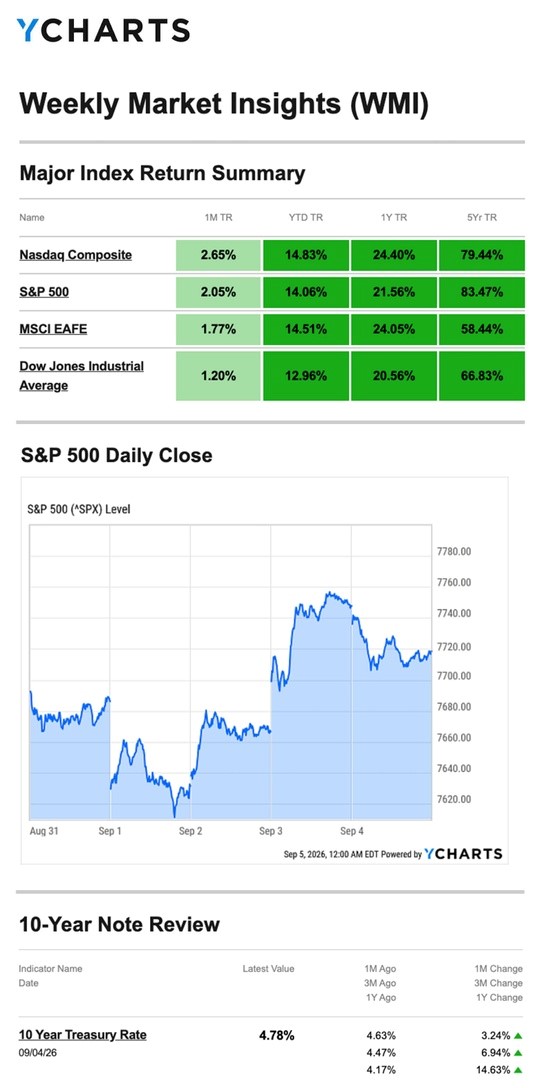
Stocks were mixed last week as markets continued to navigate geopolitical concerns and new signals about short-term interest rates.
The Standard & Poor’s 500 Index edged up 0.09 percent, while the Nasdaq Composite Index rose 0.40 percent. The Dow Jones Industrial Average slipped 0.27 percent. The MSCI EAFE Index, which tracks developed overseas stock markets, skidded 0.25 percent.1,2
Summer’s Final Act
Stocks fell modestly, and oil prices rose at the start of the week after renewed tensions in the Middle East put investors on edge. Longer-maturity Treasury bond yields also rose, adding pressure on stocks.3
Stocks remained under pressure as global bond yields rose, with traders fretting that higher oil prices would stoke broader inflation. Benchmark government bond yields for the U.S., Germany, and Japan hit 20-month, 15-year, and 30-year highs, respectively.3
But midweek, stocks rebounded after Fed Governor Christopher Waller suggested that the Fed might leave interest rates unchanged at its meeting later this month. Each major average gained 1 percent or more.4,5
Before Friday’s opening, the Labor Department's nonfarm payrolls report showed job growth was stronger than expected in August. Stocks were under pressure all day as traders saw the job report as a reason that the Fed might consider adjusting rates later this month.6
| | Source: YCharts.com, September 5, 2026. Weekly performance is measured from Monday, August 31 to Friday, September 4. TR = total return for the index, which includes any dividends as well as any other cash distributions during the period. Treasury note yield is expressed in basis points. | | |
Jobs Update
Wednesday’s ADP National Employment Report showed private-sector hiring slowed in August, as companies added only 38,000 jobs.7
That was one of the reasons why Friday’s nonfarm payrolls report surprised investors. The entire U.S. economy added 162,000 jobs in August. That was triple the 53,000 job gain economists expected and the biggest jump in 5 months. The unemployment rate also remained unchanged at a historically low 4.1 percent.8
This Week: Key Economic Data
Tuesday: NFIB Small Business Optimism Index. Consumer Credit.
Thursday: Weekly Jobless Claims. Producer Price Index (PPI). Monthly Wholesale Trade. Existing Home Sales.
Friday: Consumer Price Index (CPI). University of Michigan Consumer Survey. Monthly Treasury Balance.
Source: Investors Business Daily - Econoday economic calendar; September 4, 2026. The Econoday economic calendar lists upcoming U.S. economic data releases (including key economic indicators), Federal Reserve policy meetings, and speaking engagements of Federal Reserve officials. The content is developed from sources believed to provide accurate information. The forecasts or forward-looking statements are based on assumptions and may not materialize. The forecasts are also subject to revision.
This Week: Companies Reporting Earnings
Tuesday: Oracle Corporation (ORCL)
Thursday: Adobe Inc. (ADBE)
Source: Zacks, September 4, 2026. Companies mentioned are for informational purposes only. It should not be considered a solicitation for the purchase or sale of the securities. Investing involves risks, and investment decisions should be based on your goals, time horizon, and risk tolerance. The return and principal value of investments will fluctuate as market conditions change. When sold, investments may be worth more or less than their original cost. Companies may reschedule their earnings reports without notice.
| | |
FEATURE ARTICLE
Why You're More Likely to Succeed in Self-Improvement in the Fall
AssetMark - Efficient Advisors/Investor Minute
| | |
It's not hard to think up ways we could improve ourselves. What's tough is actually taking the steps necessary to achieve that personal growth.
Wanting to expand your abilities is a healthy impulse worth pursuing. Not only does giving ourselves this kind of challenge support better cognitive health, but gaining a new skill can have a crossover effect where it results in positive benefits in seemingly unrelated areas of your life.
For example, people who are able to stick to a new exercise routine find that they are also more disciplined in other areas.1 And studies have shown that when children are taught how to play a musical instrument, their math and reading skills tend to go up.2
Scientists don't claim that picking up a violin will immediately make you good at geometry, but rather that learning how to turn the notes on a page into music prepares your brain for success in other areas.
The goal you want to achieve might be practical, like gaining a new career skill. Or it could be life-enriching, like learning another language or becoming a proficient gardener. Any area where you seek personal growth can be a positive.
So when would be a good time to start your new initiative? Right now, when the leaves are changing and the kids are heading back to school.3
Three Reasons Why Fall Is the Best Season for Personal Growth
- The change of season to more moderate weather makes it easier to concentrate. The distractions of summer are over, and cooler weather has been shown to enhance mental performance.
- There's still time to achieve your goal before the year ends. Start with a modest objective now and you can reach it by the end of December.
- You can use your built-in back-to-school energy. From age five through young adulthood you took on a big challenge each fall—starting a new grade. You still have the reflex that makes this time of year ideal for personal growth.
Be bold and start something new this month. Even if you just take the first baby steps toward learning a new skill or establishing a new routine, the important thing you can do is begin.
As always, your trusted financial advisor is a great sounding board for ways to plan for significant self-improvement. Often, gaining new skills comes with new expenses. For example, if you're literally going back to school, talk with your advisor about how to keep tuition and fees from derailing your progress toward financial health.
Sources:
1. https://pmc.ncbi.nlm.nih.gov/articles/PMC6971834/
2. https://www.weforum.org/stories/education-and-skills/b-c-students-who-took-music-classes-scored-higher-than-peers-in-math-science-and-english-study/
3. https://amlotus.edu/%F0%9F%8D%82-why-fall-is-the-best-season-for-personal-growth/
| | |
Weekly Tip
A thought to consider!
Health Benefits of Garlic
Not only is garlic delicious, but it also confers many potential health benefits.
One of the most potent benefits of garlic is that it may bolster your immune system and help you combat sickness, including the common cold. One large 12-week study found that a daily garlic supplement reduced the number of colds by 63% compared to a placebo. The average length of cold symptoms was also reduced by 70%, from 5 days in the placebo group to 1.5 days in the garlic group.
Garlic may also improve cholesterol levels, thus lowering the risk of heart disease. Garlic may reduce both total and LDL cholesterol (otherwise known as the "bad" cholesterol).
Therefore, consider adding a few garlic cloves next time you make your favorite dish.
Tip adapted from Healthline.com10
| | |
Riddle of the Week:
How do you spell “hard water” using only three letters?
Last Week's Riddle:
A man bet his neighbor that his dog could jump higher than his neighbor’s hedge. The neighbor accepted the bet and lost. Why?
Last Week's Answer:
A hedge cannot jump.
| | |
Each year Strategic Planning Corporation updates it filing with the appropriate securities administrators by way of a form called the "ADV". Our ADV brochure is available to you at any time simply by making a request or clicking HERE to Download it. A hard copy is also available for the asking. Please let us know if we can provide you with this important disclosure document about how we conduct our business.
Thank you for reading this newsletter. We want to be the financial partner you need . . . the financial partner you can trust. Call on us at (336) 668.4338 for anything we can do to help you.
Please feel free to forward this article to family, friends, or colleagues. You may use the "Forward email" link at the bottom of this page. If you would like us to add them to the list, please reply to us with their address and we will contact them and ask for their permission to be added. Thank you.
Sincerely,
R. Michael Flanders, CLU, CFP®
Certified Financial Planner™professional
Strategic Planning Corporation
mike@SPCinvesting.com
www.SPCinvesting.com
(336) 706-2605
Investment Advisory Services offered through
Strategic Planning Corporation
| |
Some of this material was prepared by FMG Suite or Efficient Advisors LLC, and does not necessarily represent the views of the presenting party, nor their affiliates. The information presented herein should not be construed as investment advice. This information has been derived from sources believed to be accurate. Please note - investing involves risk, and past performance is no guarantee of future results. The publisher is not engaged herein in rendering legal, accounting or other professional services. If assistance is needed, the reader is advised to engage the services of a competent professional.
This information should not be construed as investment, tax or legal advice and may not be relied on for the purpose of avoiding any Federal tax penalty. This is neither a solicitation nor recommendation to purchase or sell any investment or insurance product or service, and should not be relied upon as such. All indices are unmanaged and are not illustrative of any particular investment. The Dow Jones Industrial Average is a price-weighted index of 30 actively traded blue-chip stocks. The NASDAQ Composite Index is an unmanaged, market-weighted index of all over-the-counter common stocks traded on the National Association of Securities Dealers Automated Quotation System. The Standard & Poor's 500 (S&P 500) is an unmanaged group of securities considered to be representative of the stock market in general. It is not possible to invest directly in an index. NYSE Group, Inc. (NYSE:NYX) operates two securities exchanges: the New York Stock Exchange (the "NYSE") and NYSE Arca (formerly known as the Archipelago Exchange, or ArcaEx®, and the Pacific Exchange). NYSE Group is a leading provider of securities listing, trading and market data products and services. The New York Mercantile Exchange, Inc. (NYMEX) is the world's largest physical commodity futures exchange and the preeminent trading forum for energy and precious metals, with trading conducted through two divisions - the NYMEX Division, home to the energy, platinum, and palladium markets, and the COMEX Division, on which all other metals trade. The MSCI EAFE Index was created by Morgan Stanley Capital International ("MSCI") and serves as a benchmark of the performance of major international equity markets, as represented by 21 major MSCI indexes from Europe, Australia and Southeast Asia. Additional risks are associated with international investing, such as currency fluctuations, political and economic instability and differences in accounting standards. U.S. Treasury Notes are guaranteed by the federal government as to the timely payment of principal and interest. However, if you sell a Treasury Note prior to maturity, it may be worth more or less than the original price paid. Fixed income investments are subject to various risks including changes in interest rates, credit quality, inflation risk, market valuations, prepayments, corporate events, tax ramifications and other factors.
This material represents an assessment of the market environment at a specific point in time and is not intended to be a forecast of future events, or a guarantee of future results. Past performance is no guarantee of future results. Investments will fluctuate and when redeemed may be worth more or less than when originally invested. All economic and performance data is historical and not indicative of future results. Market indices discussed are unmanaged. Investors cannot invest in unmanaged indices.
Investing involves risks, and investment decisions should be based on your own goals, time horizon, and tolerance for risk. The return and principal value of investments will fluctuate as market conditions change. When sold, investments may be worth more or less than their original cost.
Forecasts or forward-looking statements are based on assumptions, may not materialize, and are subject to revision without notice.
| | |
CITATIONS:
1. WSJ.com, September 4, 2026
2. Investing.com, September 4, 2026
3. CNBC.com, September 1, 2026
4. CNBC.com, September 2, 2026
5. CNBC.com, September 3, 2026
6. WSJ.com, September 2, 2026
7. WSJ.com, September 4, 2026
8. WSJ.com, September 4, 2026
9.Healthline.com, November 18, 2025
| | | | |