December 2020
In this issue:
- SOFIA at AAS Meeting in January
- New IRSA Release
- Featured Public Archival Data: The Multi-phase Envelope of NGC 7538 IRS1
- Funding Available for Archival Research
- SOFIA and Occultations
- Join Science Talks Remotely
|
|
SOFIA at AAS Meeting, January 2021
SOFIA science will be all over the 237th AAS Virtual Meeting January 11-15, 2021. Be sure to visit our virtual exhibit booth for a chance to win some swag!
Special Session: Assessing the Impact of Stellar Feedback
Tuesday January 12, 4:10-5:40 pm ET
Speakers include:
- Xander Tielens (U. Leiden) - PI of SOFIA Legacy program FEEDBACK
- Laura Lopez (OSU)
- Mélanie Chevance (U. Heidelberg)
- Hector Arce (Yale)
- Susanna Widicus Weaver (U. Wisconsin-Madison)
- Crystal Martin (UCSB)
SOFIA Town Hall
Friday, January 15, 1:40-2:40pm ET
Webinar: Exploring the Mid-IR Galactic Center with SOFIA Legacy Maps
Tuesday, January 12, 12:30-1:00 pm ET
Webinar: SOFIA: Science from the Stratosphere
Tuesday, January 12, 2:30-3:00 pm ET
Webinar: SOFIA Archive Opportunities: Science- Ready Data and Funding
Wednesday, January 13, 1-1:30 pm ET
Community Zoom chat with Margaret Meixner (SMO director)
Wednesday, January 13, 2:40-3:10 pm ET
|
|
New IRSA Release
- Display of preview images. PNG files associated with HAWC+ and GREAT Level 4 files are now displayed in the "preview" tab in the search results. This should help users have a better understanding of what is in the data files.
- Enhanced visualization of data (FITS) files. Users can now visualize data cubes for FIFI-LS and GREAT, and plot spectra for GREAT, FORCAST, FLITECAM, and EXES.
- Publication information, including DOI links.
- Inclusion of SOFIA data in "Precovery" searches. Users can search for a moving target, and the search engine will use the ephemeris of the object to see if it is included in any SOFIA data product. For example, if a new comet is discovered, a precovery search can be run to see if the source happened to be included in any past FORCAST data.
|
|
The Multi-phase Envelope of NGC 7538 IRS1
NGC 7538 IRS 1 is one of the many IR-bright, young stellar objects (YSO) within the HII region NGC 7538, in the Perseus’ arm of the Milky Way. IRS 1 is still actively accreting mass, offering one of the best perspectives into the very first stages of star formation. The composition of the protostar’s envelope can be used to retrace the early processing of gas, dust and PAHs by the UV radiation field, which should be strongly absorbed during this young phase. SOFIA extensively observed IRS 1 in the mid and far-IR, providing:
- photometric images at 7.7, 19.7, 25.3, 31.5 and 37.1 µm, which can be used to distinguish the infrared contributions from dust and PAHs, the latter being mainly constrained by the emission level at 7.7 µm (FORCAST, project 01_0034)
-
spectrally-resolved images (R~600 and R~1000) covering 75-95 µm and 135-155 µm. The derived far-IR photometry can refine the source’s SED and constrain the temperature, emissivity and size distribution of the colder dust component, as shown by Sandell et al., 2020 with mid-IR data. Gas-phase transitions for atomic, ionized and molecular species may also be detectable (FIFI-LS, project 03_0151)
-
high-resolution spectra from 5.5 to 27 µm, covering ro-vibrational transitions of several gas-phase components - H2O, HCN, C2H2, CS, SO2, CH4, CH3, NH3. the availability of low and high-J transitions (across P, Q- R-branches) for CH4, HCN, H2O and SO2 can allow one to derive the abundance of these molecules in a comprehensive way, tracing both cold and warm gas components (EXES, projects 02_0104, 03_0080, 04_0120, 75_0024). Indriolo et al. 2015, 2020, demonstrate the analysis of similar EXES H2O data in protostars.
|
|
Funding Available for Archival Research
SOFIA is pleased to invite proposals for the SOFIA Archival Research Programs (SARP), aimed at encouraging the use of SOFIA archival observations for impactful science.
This program will fund archival research projects primarily using SOFIA data in the Infrared Science Archive (IRSA). and is open to all astronomers affiliated with a U.S. institution.
|
|
SOFIA and Occultations
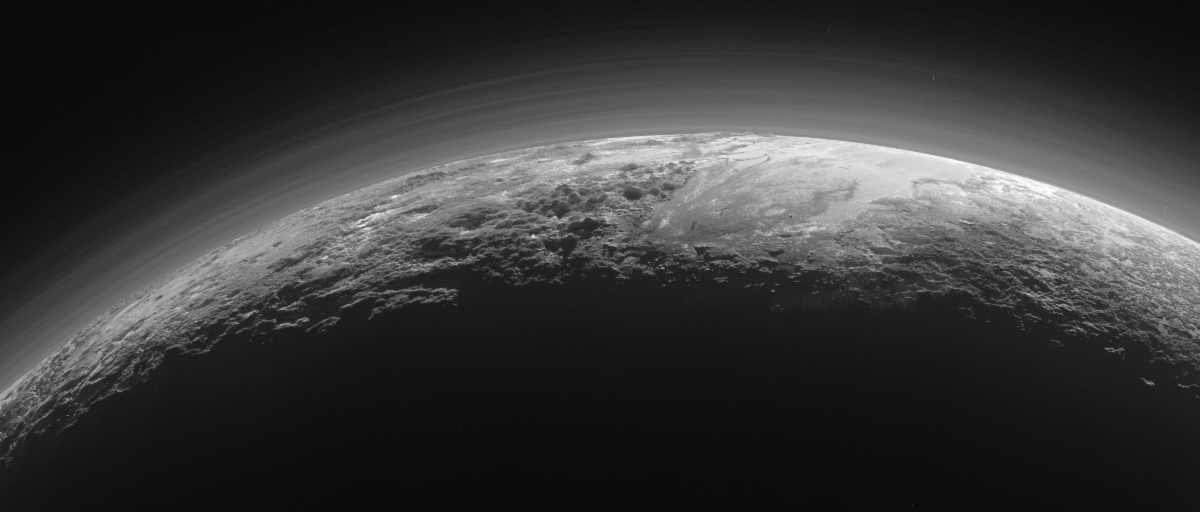
Occultations occur when a relatively near object (like Pluto) passes in front and blocks light from a more distant object. This techniques allows one to retrieve unique information about the size, shape and atmospheric structure of the occultator. SOFIA is an effective platform from which to observe occultations, as it can be deployed with extreme precision to locations where ground-based observations are impossible. Read about SOFIA occultation observations confirming haze in Pluto's atmosphere.
|
|
Just 15 minutes after its closest approach to Pluto on July 14, 2015, NASA’s New Horizons spacecraft looked back toward the sun. The backlighting highlights over a dozen layers of haze in Pluto’s atmosphere, which were further characterized by SOFIA occultation observations. Credit: NASA/JHUAPL/SwRI |
|
Join Science Talks Remotely: Colloquia & Tele-Talks
Upcoming Colloquia
- March 10: Irene Shivaei (University of Arizona)
- March 24: Viviana Guzman (UPC)
- April 7: Melodie Kao (University of Arizona)
- May 5: Laura Perez (Universidad de Chile)
Tele-Talks are scientific presentations given via phone, with slides distributed ahead of time. The talks are held approximately twice a month on Wednesdays at 9:00 a.m. Pacific, noon Eastern. For information on how to participate, check SOFIA Tele-Talk webpage.
Upcoming Tele-Talks
- January 20: Star Formation in a Cold Quasar; Kevin Cooke (University of Kansas)
- January 27: [CII] in the Barred Galaxy NGC7479; Dario Fadda (SOFIA/USRA)
- February 3: Magnetic Fields in Galaxies as Seen by HAWC+; Terry Jones (University of Minnesota)
- February 24: [C II] Mapping and CO-Dark Molecular Gas across the Galaxy NGC 6946; Frank Bigiel (University of Bonn)
- March 10: Magnetized Filamentary Gas Flows; Thushara Pillai (Boston University)
- March 24: Water on the Sunlit Moon; Casey Honniball (NASA GSFC)
|
|
e-Newsletter Editors: Kassandra Bell and Arielle Moullet
|
|
|
|
|
|
|