e-Newsletter | September 27, 2025 | | |
Turning Back Time: The Hurdy Gurdy
By Edward F. Speck, introduction by Bethany Groff Dorau
| | |
We fear, from the present appearance of the sky...that our youth, instead of stepping off to the time of the hurdy gurdy, will be compelled to listen in agony to the pitter-patter of the rain...
Newburyport Herald, November 30, 1830
There is now a room where the hurdy gurdy rules mellifluous. The hurdy girls are almost without exception of German nationality and honest of deportment. They set themselves on a bench on one side of the room or all around it and are ready and willing to dance or waltz with any rough miner who applies, for the customary sum of $1.00, to which sum, however must be added the complement of a treat, so that he who would dance with a hurdy girl must needs expend at least $1.50.
-Newburyport Daily Herald, April 10, 1869, describing tavern entertainments in the White Pines mining camp.
Two years ago, Ipswich Ale Brewery, Theater in the Open and I teamed up to offer a tavern night at Lowell's Boat Shop as an auction item for their annual fundraiser. The idea was that I would provide the history, Ipswich Ale would provide the beer, Lowell's would provide the venue, and Edward Speck, artistic director of Theater in the Open, would provide the entertainment. Edward, who is a dear friend, is fascinated by the variety of entertainments in taverns of the 17th and 18th century. Performers walked on ropes stretched across the room, exhibited dancing dogs, talking parrots, and pick-pocket monkeys, performed monologues from popular plays, and, of course, performed musical numbers.
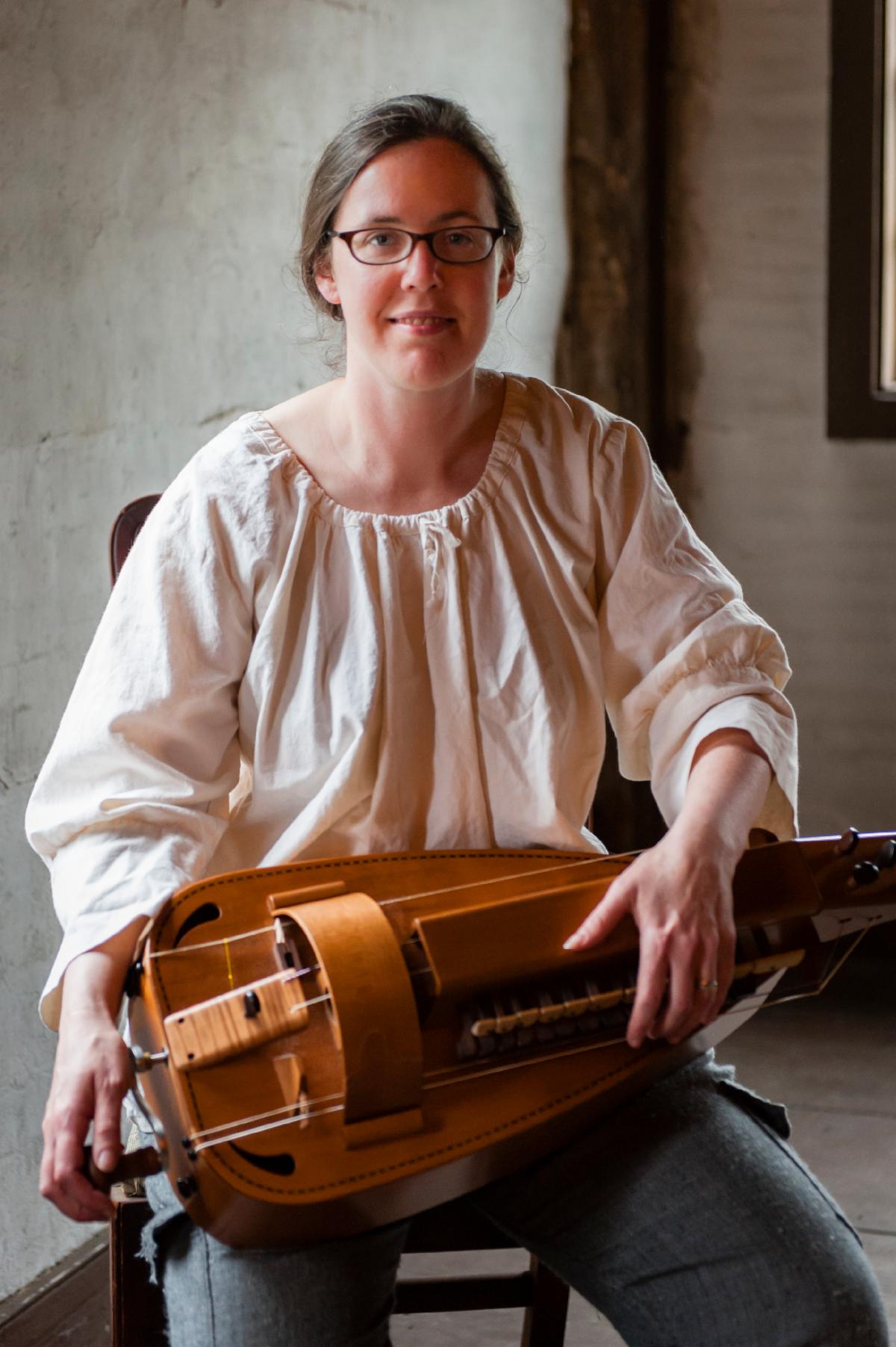
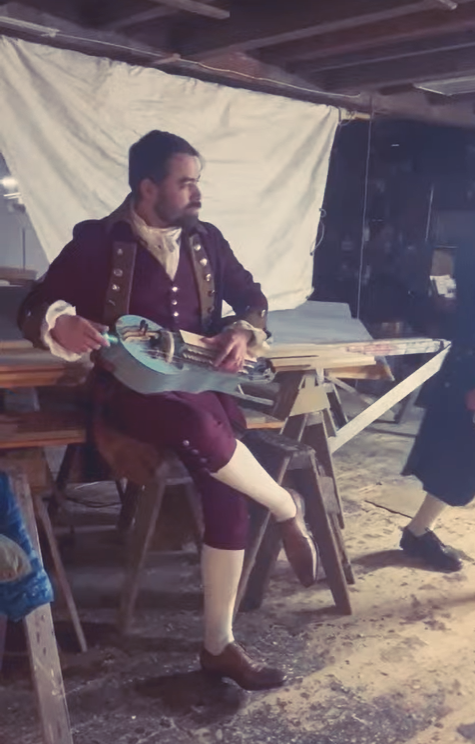
The first hurdy-gurdy I ever "met" was played by Adrienne Howard (above left), who brought it to tavern nights at the Swett-Ilsley House. It was like nothing else I had ever heard before, and so when Edward (above right) suggested that he would like to bring a hurdy gurdy to the Lowell's Boat Shop tavern night, I loved the idea. But first, because he never does anything the easy way, Edward was going to make it himself, after exhaustive research. This is the story of this process...
Want more hurdy-gurdy? Stay tuned for information about a series of Revolutionary Tavern Nights (with entertainments) that will take place over the next year.
Continued below Museum events...
| | Perkins Art & Research Center Now Open! | | More Upcoming Museum Events | |
| |
June to October, 2025
Thursday-Sunday
11:00 a.m. to 5:00 p.m.
Museum of Old Newbury Guided Tours
Take a tour through this 1808 Federal mansion, containing art and artifacts from the past four centuries. Hear the story of Old Newbury and the growth of Newburyport.
Tours on the hour, last tour at 4 p.m.
Tickets here
| | | |
| |
Sunday, October 12, 2025
10:00 a.m.
Architectural Walking Tours: Newburyport’s Fashionable Old Houses
Join us for a walking tour of Newburyport’s architectural styles from the 18th and 19th centuries as found along High Street and the neighborhood near the Museum of Old Newbury.
Tickets here
| | | |
| |
Mid-October to May, 2026
11:00 a.m. to 4:00 p.m.
Seasonal Saturday Tours!
Take a tour through this 1808 Federal mansion, containing art and artifacts from the past four centuries. Hear the story of Old Newbury and the growth of Newburyport.
New starting the fall of 2025, the Museum will be open most Saturdays (weather permitting). Tours on the hour, last tour at 3 p.m.
Tickets here
| | | |
| |
Saturday, November 1, 2025
11:00 a.m. , 1:00 p.m. & 3:00 p.m.
Memento Mori Tour: Oddities from Old Newbury on All Hallows Day
On All Hallows Day—a time set aside for remembering the dead—the Museum of Old Newbury invites you to a rare, behind-the-scenes experience. For this one-day-only event, the museum will offer three special guided tours of the Cushing House and Perkins Archive and Research Center.
Tickets Here
| | | |
| |
Saturday, November 1, 2025
7 p.m.
Secure the Shadow: Spirit & Post-mortem Photography in the 19th Century
This All Hallows Day, explore post-mortem & spirit photography in the 19th century and beyond —plus dark beer, wine & cider donut tasting.
Tickets Here
| | | | |
Turning Back Time: The Hurdy Gurdy
By Edward F. Speck
| | |
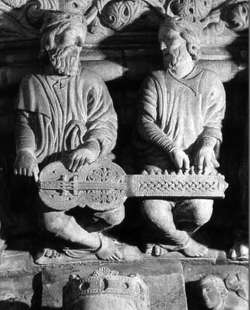
Top: Two men playing an organistrum. Santiago de Compostela, Spain.
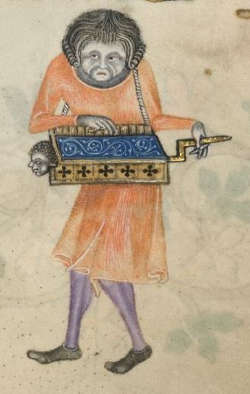
Bottom: Detail from the Luttrell Psalter, Psalm 99. c. 1340, England, showing a man playing a much smaller symphonia..
A reed or flute sounded will last as long as the breath of the player; a string plucked will vibrate loudly, then die out quickly and must be plucked again; a string bowed will vibrate for the length of one bowing movement, but the tone must break as the bow reverses. The singer too must pause for breath. The Arab scholar Ibn al-Akfani wrote a chapter on music in his encyclopedia of sciences in the fourteenth century. In it he describes what the human voice lacks: “Human tones have an effect upon the soul, take hold of it etc. Then they are interrupted by pauses, which destroy the pleasure.” To solve this problem, he says, we have invented instruments capable of continuous sound.
The first advance toward this ideal came in wind instruments through a combination of breathing technique and instrument design. A second pipe was added to the first, a drone that would continuously sound one note, while the player practiced circular breathing and fingered the traditional melody pipe. By puffing out their cheeks with stored air, the player could breathe in through their nose while forcing air out through both pipes with their cheek muscles.
This may put you in mind of Scottish bagpipes, which have precedents much earlier in Greece and Turkey. In each case, a bladder under the arm replaced the cheeks as the air reservoir and provided the continuous flow of air, sounding constant drone pipes and varied melody pipes.
How to solve the problem of continuous sound with string instruments? Stringed instruments have existed in the ancient world at least since the infant Hermes killed a tortoise and turned it into the first lyre. From such simple harps evolved instruments that were not simply plucked, but where the effective length and tone of each string changed by being pressed down against a surface and either plucked or strummed, as with a lute, or bowed as with a fiddle. The Arab rabab is accounted the earliest bowed instrument, which led to the Byzantine lira and thence through Muslim Spain to the European rebec, all predecessors of our violin. Along the same Persian and Arab trade routes eventually traveled a stringed instrument which replaced the linear bowing movement of the horse hair bow with the circular motion of that singular Mesopotamian blessing, the wheel.
By installing a wooden wheel into the stringed instrument and running a rod out to a hand crank, constant friction between the strings and playing surface could be achieved, and thus continuous sound, for as long as the player cranked. Rather than pressing the strings down against a surface to change their pitch, wooden paddles or bridges at regular intervals were turned on keys below the strings. When a key was parallel to the string, the bridge would lie flat in the key box, but when turned perpendicularly it would rise to create a point of contact with melody strings. Other strings were allowed to drone continuously.
The earliest depictions of these instruments survive as sculptures on church portals from the 12th century. These depict the instrument sitting on the laps of two figures, with one cranking and the other turning the keys with both hands to play the melody. Referred to as a symphonia or organistrum, these instruments found western favor in the liturgical music of the medieval Christian church, perhaps due to the solemnity which the church musicians knew drones could provide. The first step away from monophony, where many voices sang precisely the same notes, as in Gregorian chant, into polyphony, where different notes would be sung simultaneously by different voices, was the vocal drone. The drone voice would provide a sustained root note, from which the melodic voice would depart and eventually resolve back. The symphonia’s sound suited this development, and the cumbersome nature of keys which must be turned, such that the entire hand is required to sound one note, would have limited it to relatively slow melodies.
While the continuous sound provided by pipe organs, with air forced through pipes first by water pressure, and later by bellows, eventually won out in religious spaces, improvements in the symphonia’s design allowed it to move into the secular world. By replacing the rotating bridges with tangents that could contact the strings with a simple pushing motion, the body of the instrument could be shortened by more than half and played by one person. This allowed traveling minstrels to adopt the instrument and popularize it across Europe. As an instrument which could constantly sound several strings and be played with a simple one-handed keyboard, it could produce a maximal sound with minimal dexterity. Further, at some unknown point in the symphonia’s evolution it borrowed a buzzing bridge, apparently from the tromba marina, which added a percussive buzz to one of the drones, allowing it to mark time for a dance. Here was an instrument that anyone could use to provide a large and festive sound to any gathering; some believe that its modern name, the hurdy-gurdy, comes from the hurly-burly of rustic dancing. But these blessings eventually proved the instrument’s curse, as it became associated not with virtuoso musicianship, but with boisterous peasantry, and eventually beggars.
| | |
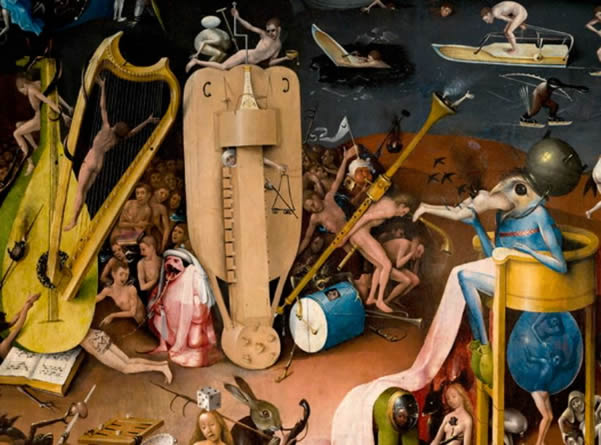
Hieronymus Bosch’s triptych, The Garden of Earthly Delights, painted early in the 16th century, provides the earliest known depiction of the buzzing bridge. It is not in the left panel, symbolizing Eden, nor the center panel symbolizing earthly delights, but, conspicuously, in the right panel, situating the hurdy-gurdy firmly in hell. For modesty’s sake I won’t describe the acts perpetrated by painted demons on the poor naked mortals in and around this diabolical instrument. Suffice to say, if you’ve ever had a flock of birds fly out of one end of your body, while a blue bird-headed demon devours you from the other end, you have some conception of what it is to repent your time with the “wheel instrument”.
Whatever the intentions of Bosch in this depiction (several other instruments are also there in hell) true it is that the symphonia’s star was setting by the end of the renaissance. In the early 18th century it was revived in France as the vielle à roue (wheel fiddle) or just “vielle”, as the aristocratic craze for the pastoral and romanticization of peasant life brought the instrument into vogue in the finest parlors. But once again its success would damn it, as its new association with the rich would make it a symbol of opulence to the architects of the French revolution. Many of the finest vielles ever made were destroyed in its aftermath, and once again this unique instrument found itself played by and associated with only the lowest strata of society, as evinced by Franz Shubert’s 1827 “Der Leiermann” (The Hurdy-Gurdy Man), where a derelict barefoot hurdy-gurdy player is shunned and left to die on the ice by an indifferent populace. (Listen HERE)
By the 20th century the hurdy-gurdy was of interest only to folklorists, or again a romanticized portrait of someone outside of society, as in Donovan’s psychedelic “The Hurdy-Gurdy Man” (Listen HERE).
The 21st century however, has thus far taken the hurdy-gurdy in novel directions. Whatever pockets of interest remained in the instrument were fanned by the internet’s ubiquitous reach, creating a renewed demand, as renaissance fair attendees looked for easy-to-play instruments authentic to the middle ages, or video game designers sought a sound evocative of an age of pirates. Newburyport is no exception: last year a hurdy-gurdy was employed along with other renaissance instruments by members of the Boston Camerata during a Newburyport Choral Society concert at the Belleville Church. And when my mother, a member of that society, called me this past December to ask whether or not I owned one, my interest was piqued. Surely if my mother thinks I might own one, then it’s something I need to acquire!
Coincidentally, I had recently been asked by Bethany Groff Dorau to provide her with a tavern entertainment. As part of a fundraiser for Lowell’s Boat Shop, on whose board she serves, she had promised a program on tavern life in Essex County. Tavern food would be served, tavern stories would be told, and, somehow, historically accurate tavern entertainment would be offered. I had initially thought of a crankie, a moving narrative panorama, firstly because I knew that crankies would theoretically have been available to the European settlers of Newburyport, even if I had no record of it, and secondly because hard experience has taught me never to say no to Bethany. A quick internet search told me that a hurdy-gurdy was exactly what I needed for our tavern entertainment.
It also told me that there is no industrial manufacturer of these instruments. Compared to a mass-produced entry-level guitar, which might be had for one hundred and fifty dollars, the hurdy-gurdy world has a monumental barrier to entry, as hand-made instruments need to be custom ordered from luthiers, most of whom are based in central Europe. I wasn’t going to be able to buy a quality hurdy-gurdy for less than three thousand euros. Unless I made my own.
Several years ago a man in the Netherlands named Jaap Brand set out to do just that:
A few years ago, I took up the idea of building my own Hurdy Gurdy. Now, I’m not much of a craftsman, so that might be a disadvantage. I am, however, a highly experienced mechanical engineer. My normal field is designing equipment for the high-tech industry, with customers around Europe, Japan and Silicon Valley in the US.
So, I thought: why not use the tools of the trade and create a Hurdy Gurdy using modern rapid prototyping technology; Laser Cutting and 3D printing? Would it be possible to create an instrument that is inexpensive to build, and still sounds well?
| | |
Almost a decade on, Jaap has over-delivered on that initial idea. The “Nerdy Gurdy,” as he dubbed it, has passed through many iterations, built and improved upon by thousands of players and builders. A kit containing all the laser-cut plywood, 3D printed plastic components and prefabricated metal hardware can be ordered for under four hundred euros. More importantly however, Jaap has made his designs available online, so that anyone with access to a laser cutter, a 3D printer and a hardware store can make their own, and even improve upon it. When I first came across it in December, the “Nerdy Gurdy Builders” group on facebook boasted four thousand and four hundred members. I am one of more than four hundred who have joined its ranks over the past three months. Some members are working on their first Nerdy Gurdy and looking for advice. Others have made hundreds to sell, paying a royalty to Jaap with each sale. The community is constantly pushing the designs forward, printing variations on existing parts and then making their new plans available to all, and Jaap has continued to update his designs with these crowd-sourced modifications while adding new instruments like the swedish nyckelharpa to his catalog.
Just as individuals, over centuries, helped the rabab birth the lira, and the organistrum evolve into the symphonia, and then into the vielle à roue, individuals across the globe have, in shockingly short order, helped Jaap evolve the hurdy gurdy into an instrument that is at last mass produced, one “nerd” at a time. Luckily for us, Amesbury is blessed with Code and Circuit, a computer science school for kids, and its founder Ken Aspeslagh is a friend of Theater in the Open. He and his laser-cutting friend Bill Schaller provided me with all the plywood and plastic parts I needed to build my own Nerdy Gurdy, and Scott Tatarczuk of Amesbury Industrial Supply patiently sourced all the necessary hardware. And so, some three hundred and fifty years after residents of the young settlement of Newbury gathered in a tavern to argue and drink and listen to the continuous tones of the hurdy-gurdy, current residents were able to hear the same music played on an instrument built right here in Newburyport. You never know what you’ll get when you bid on an auction item at the Lowell’s Boat Shop holiday party, or what fun you will have when you say YES to a request from Bethany.
I am looking forward to more research on tavern entertainments in the decades around the American Revolution, and am excited to share them with you. Stay tuned for more information as we cook up more nerdy tavern adventures this upcoming year!
| | |
"The first monkey that ever delighted my eyes was seen..."
Another Tale from the Joppa Boyhood of Andrew Lunt
by Bethany Groff Dorau
| | |
Note: The Museum of Old Newbury recently acquired a hand-written memoir by Andrew Lunt (1797-1870) in which he recalls his boyhood in the Joppa neighborhood of Newburyport (then part of Newbury). Because he went to sea as a teenager and never returned, this memoir is a remarkable record of life in Joppa in the first decade of the 19th century. Read the full story of this fascinating manuscript here.
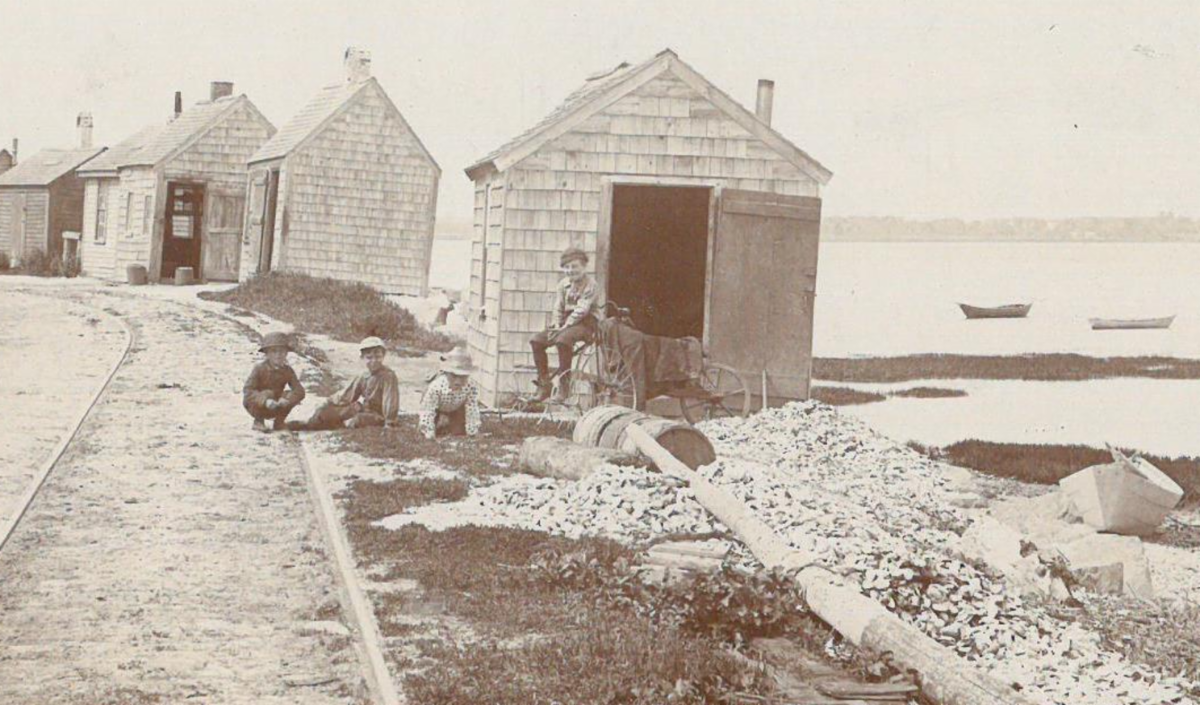
The Greenleaf House - 1798 to 1803.
"I have supposed that we went into Missus Greenleaf's chambers - for so my mother used to call this tenement - although, speaking after the manner of that day - "Old Tom Greenleaf" was living at that time. I remember him very little as a very short, unusually fat and big, and quite old man.
I have supposed we moved into this house at the very beginning of the year 1798 and remained there until January 1803. Five years - a longer term than we occupied any other house. I suppose so not from memory of course, but from facts more reliable, to wit (my siblings) John and Betsy were both born in this house, but as the latter was born in the fall of 1800, it would follow that this might have happened, that we (could have been) removed from here 2 years before the beginning of 1803, when Betsy was 27 months old. Therefore I should have other reasons for making this house our home so long, and so I have.
I remember many things connected with Missus Greenleaf's chambers, and I think I must have attained to something like the age of Belle, Freddie, or Nabby (his grandchildren, then between 3 and 6), before quitting this home, beyond which, my memory cannot reach, and about which, so much is so distinctly recollected. It was here that my impressions of life, that is all those which survived babyhood - were made.
It was here that the first monkey that ever delighted my eyes was seen. I remember as if a thing of yesterday that this fellow who exhibited this monkey, was induced by my mother to take him into the chamber and put him upon a common flag-bottom chair with wide slats going from post to post to form the back. Up and through those slats I saw with astonishment that red-jacketed monkey perform.
I remember too that while living here, I had my huckleberry box, of quite dark color, not painted, and very smooth. Its description I should say was length 1 foot, width 3 inches, depth 2 1/2 or 3 inches, and handsome, as I thought. I never used it as I can remember for any other purpose than to eat huckleberries from. And what I remember about those early berries is distinctly this: that they were the richest and most delicious luxury that the world had ever, up to that time, put within my reach, so as to give a polish and a beauty to the only box that contained them.
I remember so vividly too one day in the spring or summertime, for the grass was very green; I've always supposed it was spring, for as the farmers say, cows are apt to scour when first time out to grass, and the cow that had just passed that way had left sufficient evidence that she had recently been put upon green diet...
I remember one pleasant day that the three of us boys viz Thomas Disney, son of Captain Disney, who owned and occupied the next house, John, and myself, were playing in a shad boat which was lying by the side of the street just outside the sidewalk with her stem up to Disney's house and her stern reaching our house, and filling the entire space between our two houses. Thomas was on the forecuddy next his own premises, and John and myself were on the broad flat stern, where the seine of a shad boat is always carried when on duty.
A horse had been turned loose into the backyard, the only communication between which and the street was through the passageway between the houses now occupied by the boat, and which probably the owner of the horse considered a sufficient bar to prevent the horse from reaching the street. But if he did, he was quite mistaken. For after the animal by way of exercise had taken a turn or two about the yard, he came with a full gallop and a leap which took him entirely clear of the boat into the street, to the utter consternation of all of us, the others being only juveniles, who were still occupying the two ends of the boats as above stated, giving us an elevation, I suppose of about two or 2 1/2 feet from the ground. I being the only individual of the three of sufficient strength and stature to get down upon the ground, I made haste to do so, intent only on repairing to my mother, as in all cases of peril or danger, to give the alarm, and to cry for help when the danger was passed.
I've merely related this incident to aid in fixing its date.
I suppose that a boy, to be able to get down from a height of some 30 inches from the ground safely, away from what every such child would regard as a frightful danger (and if screams amount to anything, everyone within hearing of us must have been satisfied that we considered ourselves gone), to get down safely at such a time a boy must be about five and doubtless this was about my age at the time. Therefore I conclude that the little equestrian performance took place in the spring of 1802, the time at which I attained my 5th birthday, the other children being three and a half. I call it spring because that is the season when shad boats are brought into requisition, and besides, I have always remembered is as pleasant weather - not winter, and certainly the street would be an unlikely place to store a shad boat in the summer time, that is, if they were particular about avoiding sun cracks in the article in question.
In view of these facts, then, I find ourselves in possession of the Greenleaf premises as late as the spring of 1802, leaving but nine months to the end of our occupancy, according to the time I have assigned it, which of course includes another huckleberry season - and I feel quite certain that I must have feasted from the box before alluded to, of the crop of 1802; otherwise I should not remember so distinctly, as I always have, of these repeated treats, for I certainly remember more than one season in the Greenleaf house, from the panniers of the Dogtown women whose regular appearance on each market day used to greet and bless my eyes, laden not only with berries and fruit in their season, but also with legs of veal projecting from their panniers, to the very ridgepole of the beasts upon which these welcome old women with their freights used to come coursing into Joppa. Dismounting at Granny Tappan's shop, and from thence sailing up and down Water Street astride their Trusty steeds, furnishing their customers with their wares, consisting of within their respective seasons, veal, lamb, apples, pears, radishes, berries, and the last, not least, diet drinks (Lunt's use of this term could benefit from further research) in packages of a dozen materials each, etc. I loved all these good things, in those old days - but best of all were the berries. Huckleberries, at the time I was prepared to say, which Roger Williams said of strawberries, raised by the Indians nearly two hundred years before, "God could not have made, but God never did make, a better berry."
Again, I remember about this Greenleaf house that over the fireplace in our principal room, the finish was of wood from the mantle to the ceiling. Upon this plain wood, Master Greenleaf as he was always called - he was a schoolmaster and son of our landlord and landlady - a gentlemanly man whom I liked - I don't think he boarded with his parents - the master printed in large capitals with chalk all the letters of the alphabet for my benefit.
It was here, over these old hearthstones at home, that I first learned the names of those mysterious characters - the letters of the English alphabet.
I have no more recollection of going to school from the Greenleaf house except to Madame Stickney's, where I learnt nothing, but when I left the Greenleaf house, I had mastered all my letters, thanks to good Master Greenleaf..."
| | Something Is Always Cooking... | |
Whipped Feta and Charred Scallion Dip
This dip is a serious upgrade to my much-loved out-of-the-package onion dip, and is also a perfect appetizer for this in-between season. Cold but smoky, and served equally deliciously with a bowl of potato chips or a rustic bread, this is a quick but lovely addition to any gathering.
Enjoy!
Ingredients:
- 10-12 scallions
- 1 tablespoon kosher salt
- 5 oz crumbled feta
- 2 oz cream cheese, softened
- 1/2 cup sour cream
- 1/2 teaspoon black pepper
- 3/4 teaspoon smoked paprika
- zest and juice of one lemon
Directions:
- Toss scallions in olive oil and ½ tsp. kosher salt until they’re slicked all over, then spread them out on a half-sheet tray. Set your broiler to high and send the scallions into the oven until they’re blistered and charred (about 5 minutes).
- While the scallions cool, add crumbled feta, cream cheese, sour cream, another ¼ tsp. kosher salt, ½ tsp. black pepper, ¾ tsp. smoked paprika, and the zest and juice of 1 lemon to the bowl of your food processor.
- Chop ¾ of the charred scallions into ¼-inch-ish slices and discard the root ends. Add the chopped scallions to the food processor bowl and pulse until everything is just combined. Transfer the dip to a serving bowl; top with the remaining, not-chopped scallions; and serve.
| | |
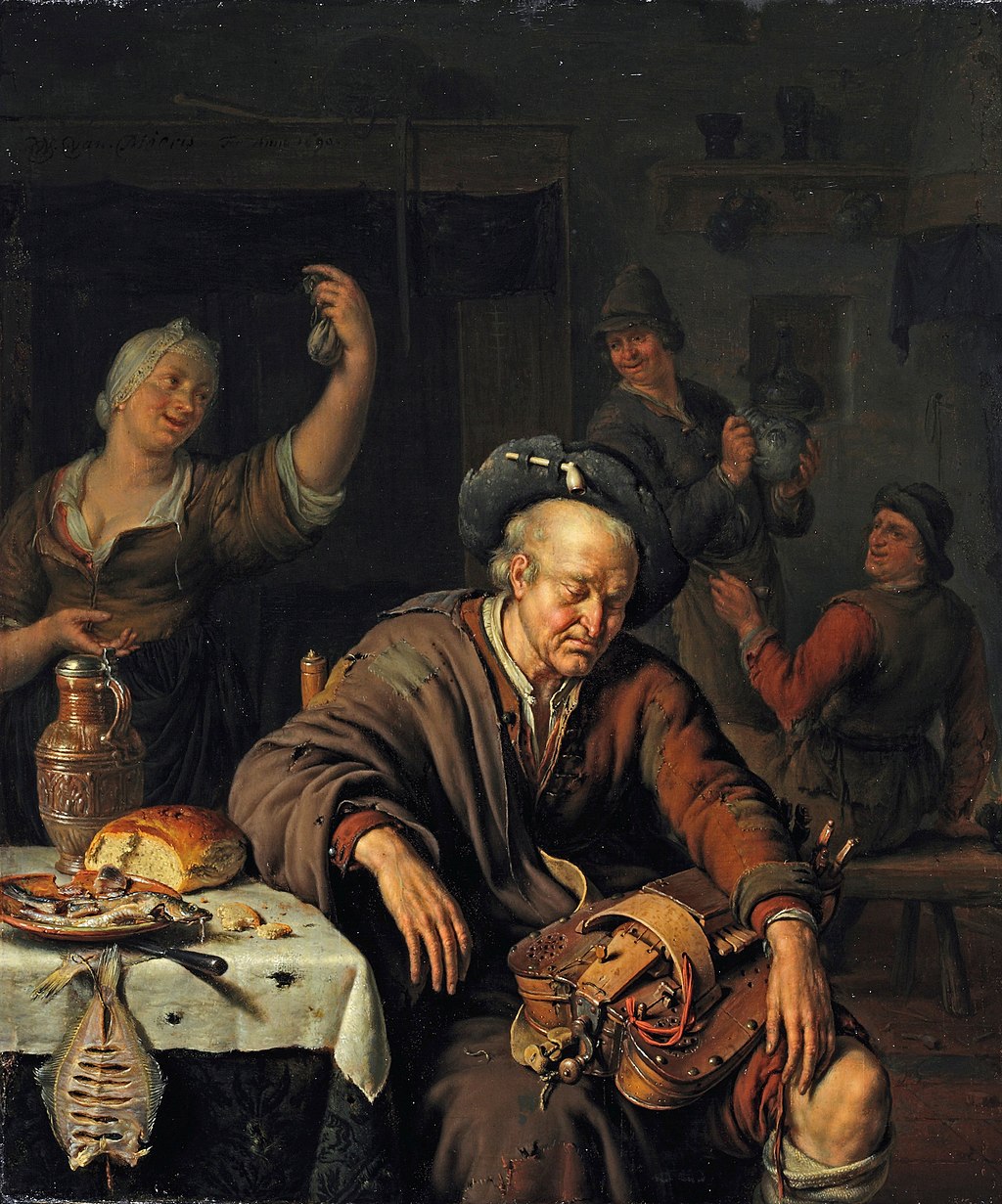
Click the image to do the puzzle
Willem van Mieris: Sleeping Hurdy-Gurdy Player, 1690
| | |
Museum e-Newsletter made possible through the
generosity of our sponsors:
| | | | | |