Rail & Labor News from RWU
| |
Weekly Digest Number 9 - February 25th, 2025 | |
Welcome to the RWU Rail & Labor News! This news bulletin is produced and emailed out each Tuesday morning. We hope you find each week's news and information useful. If so, please share with co-workers, friends, and colleagues. If you like, you can sign them up to get all the news from RWU HERE. Or forward them the link. Got a hot tip? Please forward the article and a link to raillabornews@gmail.com. Note: If you read over this news bulletin each week, you will be sure to never miss the important news of what is going on in the railroad world from a worker's perspective! | |
THIS WEEK'S RAIL AND LABOR NEWS | |
Editor's Note: While a 3% annual wage increase may appear steady on paper, it’s essential to ask: Does it truly keep pace with inflation, rising living costs, and the growing responsibilities these workers shoulder? In an era where railroads boast record profits, modest gains risk becoming hollow victories. True collective bargaining isn’t about settling for the bare minimum—it’s about ensuring workers see real, tangible improvements in their livelihoods. CN frames this as “mutually beneficial,” but one wonders if the scales tip heavier toward shareholders than the 750 workers who maintain the backbone of their network. | |
Railway Age / February 18
CN recently announced that on Feb. 14 it has formally ratified a new four-year tentative collective agreement with the International Brotherhood of Electrical Workers (IBEW), which represents approximately 750 Signals and Communications employees at the Class I in Canada.
The new four-year agreement, which includes 3% wage increases annually, expires on Dec. 31, 2028.
“The ratification of this agreement by our employees with the IBEW union represents a mutually beneficial outcome,” said CN Executive Vice-President and Chief Networking Officer Patrick Whitehead. “This is what we strive for in the collective bargaining process, allowing us to continue delivering safe, efficient, and reliable service to our customers and the communities where we operate.
| |
Editor's Note: CPKC touts “improved wages and benefits,” but the real question is: Do these gains match the increasing demands placed on Maintenance of Way employees or simply serve as window dressing for public relations? In a climate where corporate profits surge, workers often find themselves negotiating just to keep pace with inflation, let alone get ahead. Collective agreements should be more than check-the-box exercises—they should reflect the value of the labor that keeps the network running. The success of this deal isn’t measured by press releases but by whether workers see real improvements in their daily lives. | |
Editor's Note: The return of South Western Railway to public control marks a pivotal shift in Britain’s rail landscape—a reminder that profit-driven models often fall short when public service is on the line. Decades of privatization promised efficiency but frequently delivered delays, fare hikes, and fractured networks. As Britain inches toward reuniting infrastructure and operations under a national rail holding company, it raises a fundamental question: Should essential public services serve shareholders or the public? For rail labor, this move could signal a return to stability, but only if workers’ voices are central in shaping the system that follows. | |
Trains / February 18
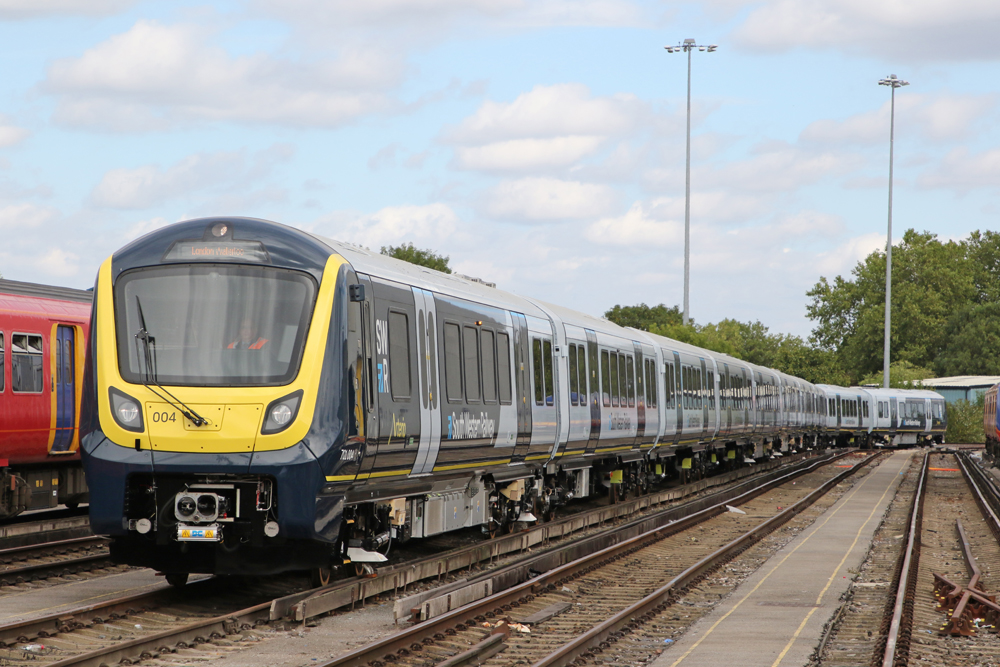
South Western Railway — a joint venture of First Group and Chinese firm MTR Corp. — will transition to public control in May 2025, becoming the first of three British private train operating companies to make that transfer this year. Others are C2C, owned by Italian state rail operator Trenitalia, and Greater Anglia, owned by Transport UK Group. One of South Western’s Alstom-built Class 701 electric multiple unit trainsets is shown at the Wimbledon shops in 2020. The first of these trains entered service in 2024 and many of the 90 ordered in 2017 have not yet begun regular operation. Keith Fender
Despite a few public setbacks, including the short-notice replacement of the previous Transport Secretary, the British government’s plans to restructure the passenger rail industry are moving ahead. Plans are to create a new national rail holding company, bringing together the railway network infrastructure and the operation of most passenger trains for the first time since rail privatization in the late 1990s.
|
|
Editor's Note: Canada’s long-promised high-speed rail network takes a cautious first step, but workers and taxpayers alike should ask: Who truly benefits from this multi-billion-dollar project? While slashing travel times sounds like progress, the reliance on an international consortium raises concerns about prioritizing corporate interests over public good. If history teaches us anything, it’s that ambitious infrastructure projects risk becoming profit machines for private firms unless labor rights, fair wages, and public accountability are baked into every phase. High-speed rail should be built not just for speed—but for the people who will ride it and those who build it. | |
Reuters / February 21
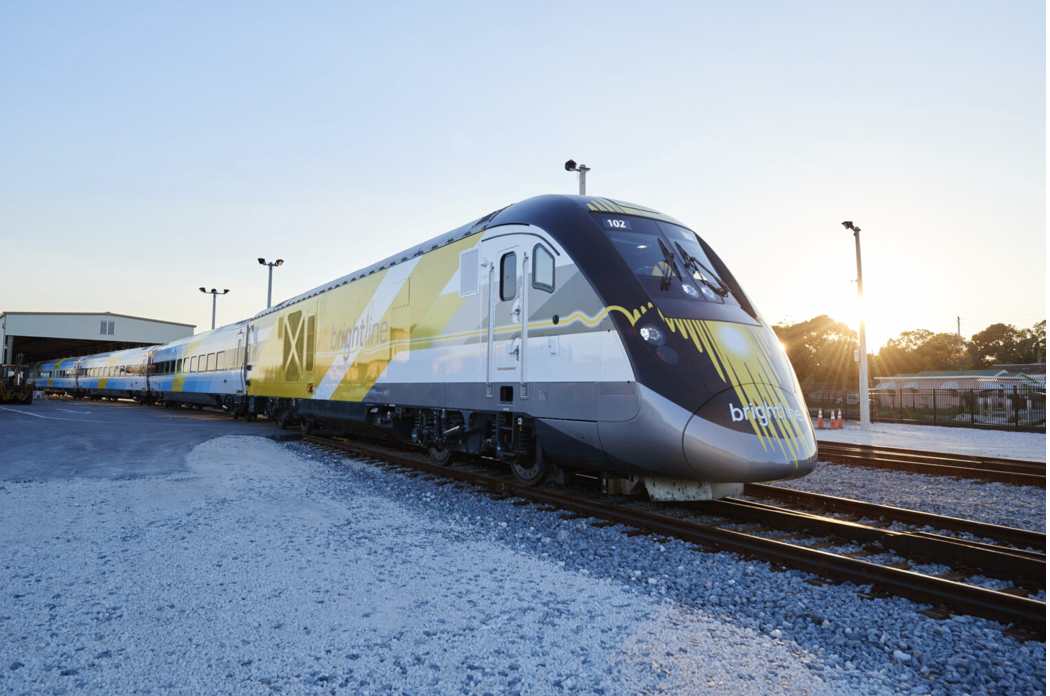
An international consortium including Air Canada, AtkinsRealis Group and France’s SNCF has won a C$3.9 billion six-year contract to help develop a high-speed passenger rail network in eastern Canada, Ottawa said on Wednesday.
The contract covers the first stage of planning the network, which would span approximately 1,000 km (620 miles) from Quebec City to Toronto and allow trains to reach speeds of up to 300 kph (186 mph). The government says current travel times would be halved, with a Montreal to Toronto trip taking three hours.
Ottawa did not say how long the network would take to build and how much it would cost. Governments have talked for decades about a dedicated line for passenger trains, which have to share the track with freight trains and often suffer delays.
| |
Editor's Note: Winning a union election should be the start of collective bargaining, not the beginning of a corporate stalling game. Yet here we are—workers who brave all weather, ensuring one of Amtrak’s most profitable routes runs smoothly, are left waiting for basic fairness at the table. Drummac’s delay tactics expose a system where profits roll in daily, but the people who make it possible are forced to fight for scraps. It’s a familiar playbook: celebrate the workers’ labor while sidelining their rights. The real question isn’t whether these workers deserve a fair contract—it’s why they’re still waiting for one. | |
IAM / February 19
More than a year after voting to organize into the Transportation Communications Union (TCU/IAM), the largest union on Amtrak, a group of Drummac employees who work on the Amtrak Auto Train Property in Lorton, Va., are holding an informational picket against Drummac management’s stall tactics during negotiations.
“These employees work tirelessly outside, in all weather conditions, to professionally load and unload cars and motorcycles from the trains,” said TCU/IAM Organizing Director Sal Rodriguez. “They fought and won a union in 2023 – it’s well-past time for the company to get serious.”
Amtrak contracts with a third-party company called Drummac to safely load and unload vehicles from their Auto Trains, which travel between Lorton, Va. and Sanford, Fla. The Amtrak Auto Train runs seven days a week, and is one of the highest revenue-producing routes for Amtrak nationwide.
| |
Editor's Note: The precarious future of Amtrak’s Pittsburgh-Harrisburg expansion highlights a brutal truth: public transit remains at the mercy of political tides, not public need. While $143 million hangs in the balance, workers, commuters, and entire communities are left in limbo—all while billions flow freely into highways and corporate subsidies. Rail isn’t just about tracks and timetables; it’s about connecting people, jobs, and regions. But when funding for essential services is treated as a political football, it’s always the working class that pays the price. If we can fund endless road expansions, why not invest in rail that actually serves the people? | |
Pittsburgh Post-Gazette / February 19
Federal funding uncertainty has hit the proposed expansion of Amtrak train service connecting Pittsburgh, Altoona, and Harrisburg, with state Transportation Secretary Mike Carroll saying on Wednesday $143 million in discretionary federal money for it is “sort of in question right now.”
Mr. Carroll spoke during a legislative hearing on his department’s share of Gov. Josh Shapiro’s proposed $51.5 billion budget for 2025-26. The session included an update on highway projects — including one on I-70 in Washington County — whose funding was tapped to help a big Philadelphia-area transit agency; and Mr. Carroll’s assertion that Mr. Shapiro’s heavy use of a state plane did not cross the line on rules concerning personal use of state assets.
Some of the questions from House members brought up the funding freezes put in place by the new federal administration of President Donald Trump.
| |
Editor's Note: The head of the largest rail advocacy organization in the U.S. - the Rail Passengers Association - speaks out against highway expansion, and in favor of expanded public passenger rail service, assisting to decongest our highways, reduce carbon emissions, provide safe and reliable transportation alternatives, and provide thousands of good paying union rail jobs. | |
Solutionary Rail / February 22
Meredith Richards is chair of the Rail Passengers Association—the country’s largest passenger rail advocacy organization—and president of the Virginia Rail Policy Institute.
Those who follow U.S. passenger rail closely know that Virginia has accomplished a lot in the last several years, and Mrs. Richards has been one of the figures at the center of it all.
In this clip, Mrs. Richards discusses how transportation officials in Virginia came to prioritize moving more people by rail as an antidote to rampant congestion on Virginia’s highways.
| |
Editor's Note: While a 15.9% wage increase and improved healthcare terms mark tangible wins for MARC engineers, the broader picture remains: Why do workers still have to fight tooth and nail for fair wages and basic protections, especially in public transit? A $1,500 signing bonus might feel like a quick win, but real gains come from sustainable, long-term improvements to pay, benefits, and working conditions. In an industry that keeps cities moving, engineers deserve more than incremental victories—they deserve contracts that reflect the true value of their labor. Here’s hoping this deal is a step forward, not a ceiling. | |
Progressive Railroading / February 18
The Brotherhood of Locomotive Engineers and Trainmen (BLET) has reached a tentative labor agreement with Alstom that if ratified would cover 20 locomotive engineers operating Maryland Area Rail Commuter (MARC) trains.
The five-year agreement calls for general wage increases of 15.9%, back paid to Jan. 1, 2024, compounded, BLET officials said in a press release. Ballots are due by Feb. 20.
Additionally, the contract calls for a $1,500 signing bonus for engineers; a $15 flat co-pay on occupation, physical and speech therapy in place of having to meet deductibles for coinsurance to apply; one-trip rate payment for lap-backs and side trips; and modification of the electronic bid system to allow for seven-day bids.
| |
Editor's Note: This is all smoke-and-mirrors, superficial PR in action. Does this CEO condemn what HH did to the railroad? Does he pledge to undo it? Of course not. HH made CSX stockholders billions of dollars. The same PR game that Shaw was playing at NS last year is now at play on CSX. “Corporate capitalist PSR with a human face.” So now CSX will be “kind” to its employees when it screws them. Remember, CSX is still attempting to cut costs and reduce its OR like the rest of them. This is its very nature. It can play nice if/when it serves its interests, but at the end of the day, it is still a corporation and its goal is to return the greatest possible profits to its owners. The niceness – as superficial as it is – will not last. | |
Trains / February 18
CSX CEO Joe Hinrichs is not one to shy away from a tall task. Since arriving at CSX in September 2022, he has been on a mission to repair the railroad’s damaged relationship with its employees.
His goal: Build a culture of respect and trust, where workers feel valued and appreciated. It’s the cornerstone of the ONE CSX strategy Hinrichs mentions everywhere he goes, from impromptu visits to terminals and shops to shipper and investor conferences. The idea is that high morale will motivate employees to provide better service, which will produce happy customers, which in turn will attract more freight and lead to higher revenue and profits.
To get to this promised land, Hinrichs will have to overcome three things.
| |
NEWS FROM AROUND THE LABOR MOVEMENT | |
Each week, RWU includes a few articles about advances and developments in the larger labor movement that are of interest to railroad workers. Got an artcile to submit for possible inclusion next week? Email it along to raillabornews@gmail.com. Thank you! | |
Editor's Note: Now that federal workers have organized to save their jobs and unions, it is up to the rest of the labor movement - including rail labor and especially public rail workers at Amtrak and commuter agencies - to come to their aid and assistance. An injury to one is an injury to all! | |
Labor Notes / February 20
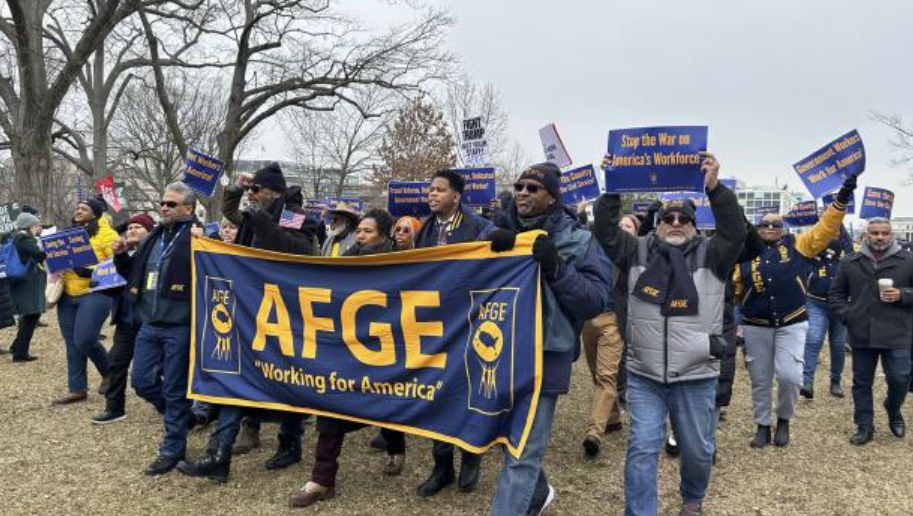
Federal employee union members have been speaking out, rallying, and suing, as agency after agency has been hit by Elon Musk’s “Department of Government Efficiency” (DOGE)—a private unaccountable entity which has been demanding access to all government records while spreading wild lies about waste and fraud.
Around 20,000 workers have been summarily fired so far.
Federal workers raised the alarm at over 30 “Save our Services” rallies around the country Wednesday, including in New York, Washington, D.C., Atlanta, Philadelphia, Denver, Boston, Boise, Chattanooga and Chicago.
| |
The Guardian / February 14
Can anybody stop Trumpism? Progressives are understandably worried. Though federal judges may temporarily pause some of the new administration’s most brazenly illegal executive orders, a hyper-conservative supreme court lies waiting in the wings. And looking ahead to 2028, it’s hard to feel hopeful about defeating Maga given that the Democratic party continues to hemorrhage working-class voters.
But there’s no need to despair. A powerful force in our society has the legitimacy, resources and leverage to turn things around: organized labor. Unions can beat back Donald Trump’s attacks, expose his sham populism, and – by uniting workers around their shared economic interests – help isolate his xenophobic scapegoating.
| |
Editor's Note: Railroad workers take notice! Especially Amtrak and commuter workers, all of whom are public workers. But just as private sector workers learned more than a decade ago in Wisconsin, first they came for the public sector workers, and once they were destroyed, they came after the private industry sector of the working class. Now is the time to fight back. United we stand, divided we fall! | |
|
Portside / February 19
I’m a federal worker, and I feel like a canary in the coal mine right now—because what they’re doing to us is going to happen to the entire American public.” That’s how Chris Dols, who works for the US Army Corps of Engineers and is the president of a local chapter of the International Federation of Professional and Technical Engineers, began his video response to Elon Musk’s instantly infamous Oval Office press conference last week.
Dols is right: Musk’s attacks on federal employees and their unions aren’t just a threat to the specific workers in his current line of fire. They pose an unparalleled danger to every single American.
Trump’s mission is simple: to exert authoritarian control over all branches of the federal government. To do that, he can’t merely fire the people at the top of government agencies. He needs workers at all levels of government who will put his wishes ahead of everything else, including the law. And to do that, he has to break the back of the federal employee labor movement.
| |
WEEKLY DERAILMENT DEPARTMENT | |
Each Tuesday in this news bulletin, RWU does our best to present a picture of what has been happening over the course of the previous week in terms of derailments in North America, and investigation determinations of previous accidents. NOTE: This list is by no means comprehensive. Smaller and less consequential mishaps are generally not reported here. If the wreck results in injury or fatality, or is especially damaging/extreme, a full article will appear as a feature in the dozen or so rail articles above. Know of a train wreck? Please feel free to forward a link to raillabornews@gmail.com for possible inclusion next week. Thanks! |
| | | |