Since January 1, 2107, CMS requires uniform use of the JW modifier (Drug amount discarded/not administered to any patient) when processing Part B claims for drugs and biologicals from single-use vials or single-use packages (now referred to as single-dose container or single-use package). There are no changes regarding the use of the JW modifier.
To align with the JW modifier reporting policy, the 2023 Physician Fee Schedule (PFS) final rule established a requirement that providers and suppliers report the new JZ modifier (zero drug amount discarded/not administered to any patient) when there are no discarded amounts of such products.
Effective July 1, 2023, providers and suppliers are required to report the JZ modifier on all claims that bill for drugs separately payable under Medicare Part B when there are no discarded amounts from single-dose containers or single-use packages. For the amount you administer, the claim line should include the HCPCS code describing the given drug, the JZ modifier showing there were no discarded amounts, and the number of units administered in the units' field.
CMS stated the use of the JZ modifier will be implemented in phases:
- January 1. 2023: You may report the JZ modifier
- July 1, 2023: The JZ modifier is required on applicable claims
- October 2, 2023: Claims editing starts when JW or JZ modifiers aren't used correctly
Claims that don't report the JW or JZ modifier on or after July 1, 2023, may be subject to audits. Be sure to document the amount of discarded drugs in the medical record.
|
|
Based on the COVID-19 trends, the Department of Health and Human Services (HHS) announced the federal Public Health Emergency for COVID-19 (PHE) expired at the end of the day, May 11, 2023.
People with Medicare can access telehealth services through December 31, 2024.
Here are the links to post-PHE resources:
|
|
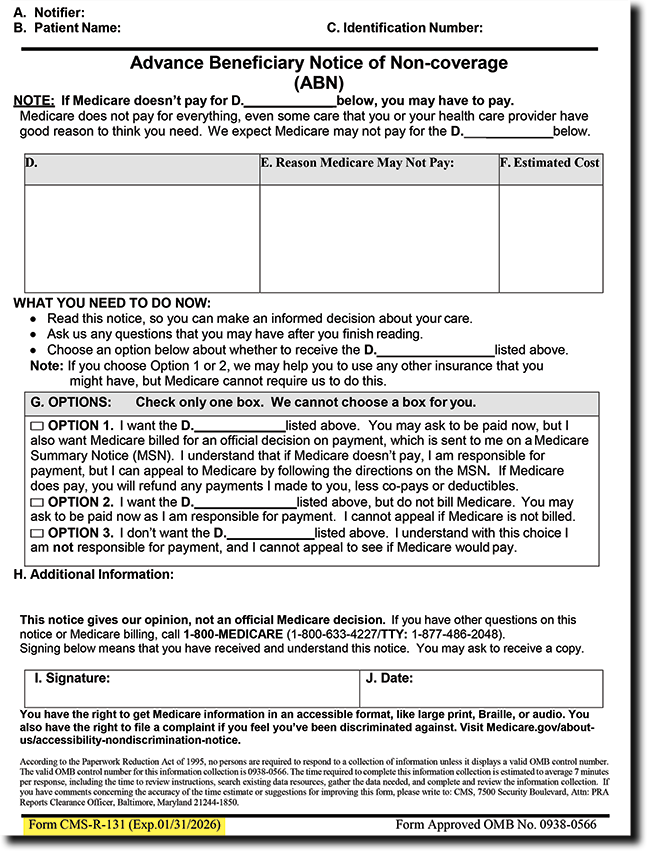
The ABN, Form CMS-R-131, and form instructions have been approved by the Office of Management and Budget (OMB) for renewal.
The renewed form has an expiration date of January 31, 2026. This updated form was mandatory beginning June 30, 2023.
Instructions remain the same.
- Used for medical necessity situations.
- May also be used as a reminder Medicare will not pay for statutorily excluded services.
ABN Resources:
|
|
Physicians play an irreplaceable role in preserving and enhancing the health and well-being of countless individuals. They are the trusted guardians of life, shouldering immense responsibilities and working tirelessly to deliver quality care. But beneath their white coats lies an epidemic that so many continue to struggle with: physician burnout.
And it reached an all-time high in 2021 with COVID-19 death rates up significantly from the year before, new SARS-CoV-2 variants emerging and large numbers of Americans who refused to get vaccinated or boosted. But with COVID-19 moving into a less deadly, endemic stage last year, it appears physicians across the country saw some relief in their stress levels, according to an exclusive survey from the AMA.
More than 13,000 responses from physicians and nonphysician providers across 30 states were received from more than 70 health systems who participated in the AMA’s Organizational Biopsy™ (PDF). The AMA benchmarking report—which is exclusive data to the AMA that is not published anywhere else—reflects 2022 trends in six key performance indicators—job satisfaction, job stress, burnout, intent to leave an organization, feeling valued by an organization and total hours spent per week on work-related activities (known as “time spend”).
|
|
COMPLIMENTARY ASIPP WEBINAR
for Residents and Fellows...
|
|
A brief assessment in primary care can help identify patients most at risk
The FDA is expected to grant full approval soon to the Alzheimer's therapy lecanemab (Leqembi). When that happens, physicians and their patients will have to navigate the path to access and reimbursement, and wrestle with concerns over side effects and cost.
But before those questions can be addressed, a baseline challenge awaits: who are the people who can benefit most from treatment, and how can they be identified? Similarly, who are the people most at risk of developing any form of dementia?
Clinical trials show that lecanemab can be highly effective in clearing the brain of amyloids, the plaque-like substance closely associated with Alzheimer's. Physicians must confirm the presence of amyloid beta pathology before starting treatment.
|
|
More information coming soon! |
|
In the UK, John Steele, an advanced nurse practitioner (ANP) at Glenfield Hospital, part of the University Hospitals of Leicester NHS Trust (UHL), was congratulated on Twitter as "the first nurse-ANP who has performed the whole TAVI procedure as the first operator true transformation addressing NHS needs...".
The now-deleted tweet from @GHCardiology is still visible in the Twitter thread of Mamas A. Mamas, a professor of interventional cardiology at Keele University, UK. "This is so inappropriate on so many levels," Mamas tweeted. "This is not safe for patients particularly given that there are numerous TAVI trained medically qualified operators in UK. You have also taken away training opportunities for medical / surgical trainees."
|
|
Virtual
ABIPP Part I; ABIPP Path - Combined DCCPM/CSM virtual exam; ABIPP Competency Exam in IPM; ABIPP Competency Exam in Regenerative Medicine
Memphis, TN
ABIPP Part II - Practical Portion; ABIPP Competency Exam - Practical Portion; ABIPP Regenerative Medicine Competency Exam - Practical Portion
|
|
More access to this life-saving medication is essential
You're dealing with a life-threatening illness that has an effective treatment. The only problem is the medication is only available at about 60% of pharmacies. What now?
This isn't a hypothetical for patients with opioid use disorder (OUD) in the U.S. And it's not limited to those living in care deserts -- areas where people lack nearby, convenient healthcare access. In fact, even in densely populated areas there may be multiple pharmacies that do not carry buprenorphine, one of three medications approved by the FDA to treat OUD and the only one that doesn't require frequent visits to a clinic (methadone) or an injection.
In recent research published in JAMA Network Open, it was uncovered that one of the reasons why medications for opioid use disorder (MOUD) are underutilized may be due to lack of access at pharmacies. Facing heavy scrutiny and reporting requirements from federal organizations like the Drug Enforcement Administration (DEA), pharmacies are hesitant or sometimes unable to stock MOUD. Less than two-thirds of pharmacies surveyed reported having the medication on their shelves, something which would be unthinkable for medications used to treat other chronic illnesses.
|
|
But experts disagree about what the findings actually mean
Some patients continually cancel their appointments, ignore your medical directions, treat your staff rudely, or send you harassing emails.
Do you have to tolerate their behavior?
No, these are all appropriate reasons to terminate patients, attorneys say. Patients also can be dismissed for misleading doctors about their past medical history, chronic drug-seeking, displaying threatening or seductive behavior toward staff members or physicians, or any criminal behavior in the office, experts say.
But even if a reason seems legitimate, that doesn't make it legal. Doctors should consider whether the reason is legal, said Chicago-area attorney Ericka Adler, JD, a partner at Roetzel & Andress, who advises doctors about terminating patients.
|
|
Only 16% of discharge doses were within 5 MME of inpatient daily consumption, study showed
More than 80% of patients undergoing head and neck surgery received mismatched opioid prescriptions at discharge, exceeding or falling short of their inpatient prescriptions, a review of 1,705 cases showed.
Almost two-thirds of patients received discharge prescriptions that exceeded their inpatient prescription by more than 5 morphine milligram equivalents (MMEs). An additional 19.2% left the hospital with prescriptions that were more than 5 MMEs lower than what they received during their hospital stay.
Patients with lower prescribed opioid doses at discharge had higher refill rates, suggesting the patients might have been undertreated, reported Zhonghui Guan, MD, of the University of California San Francisco, and co-authors in JAMA Otolaryngology - Head & Neck Surgery.
|
|
It turns out that some people really are tick magnets.
Researchers have discovered that ticks can defy gravity in their quest to latch onto people and animals. The key is static electricity, just like when someone rubs a balloon and things stick to it.
The study was published Friday in the journal Current Biology. In the first phase of the research, scientists exposed ticks to furry rabbit feet and to acrylic surfaces that each had electrostatic charges.
"Ticks were readily attracted across air gaps of up to several millimeters or centimeters onto these statically charged surfaces," the authors wrote. "This establishes that electrostatic attraction of ticks onto hosts can take place over large air gaps of many body lengths of a tick."
|
|
- ASIPP Members Only Site Information - |
|
-
To log in for the first time you will need to click “forgot password” at the bottom of the login window.
- Check your email and then log in as directed.
-
If you have problems logging into your account, click here.
|
|
Pain Medicine Case Reports (PMCR) and Editor-in-Chief Alaa Abd-Elsayed, MD, PhD would like to invite you to submit case reports and case series to the PMCR journal. Your article will be published free of charge.
Open access journals are freely available online for immediate worldwide open access to the full text of published articles. There is no subscription fee for open access journals. Open access journals are no different from traditional subscription-based journals: they undergo the same peer-review and quality control as any other scholarly journal.
Interested in becoming a member of the PMCR Editorial Board?
Editorial board members are asked to review 2-6 manuscripts per year. Please submit your most up-to-date CV to sgold@asipp.org for consideration.
For more information or to submit your articles, click here.
|
|
| CASE REPORT |
Mohammed Miniato, MD, and Krishna Shah, MD
Abstract
BACKGROUND: Common long-term complications for neuromodulation include lead migration, loss of efficacy of therapy, and lead malfunction. The following case describes pitfalls of lead migration and preventative steps to decrease risk of this complication.
CASE REPORT: This is an independent case study following the outcome of one patient diagnosed with complex regional pain syndrome that had failed conservative therapy. She underwent implantation of a spinal cord stimulator (SCS) with > 90% relief. Loss of relief was described on follow-up. On reimaging, the SCS had migrated cephalad and this was likely the cause of the malfunction.
CONCLUSIONS: Lead migration can occur at any time, even years after initial implantation. Recommendations from the literature and gained from this case include heightened vigilance and suspicion when a patient encounters sudden failure of pain relief, low threshold for new imaging to assess lead location, and use of mechanical anchoring devices.
KEY WORDS: Neuromodulation, spinal cord stimulator, CRPS, chronic regional pain syndrome, pain, chronic pain, case report
|
|
| RETROSPECTIVE STUDY |
Chen-Li Sun, MD, Xiu-Liang Li, MD, Cheng-Wen Li, MD, Nong He, MD, Jie Zhang, MD, and Fu-Shan Xue
Abstract
BACKGROUND: Postherpetic neuralgia (PHN) is pain persisting beyond 3 months from rash onset and is the most common complication of herpes zoster (HZ); it is commonly refractory to medication treatment. Available evidence indicates that high-voltage, long-duration pulsed radiofrequency (PRF) to the dorsal root ganglion (DRG) is a novel and effective treatment for this complication. Nevertheless, the effects of this intervention on refractory HZ neuralgia less than 3 months have not been evaluated.
OBJECTIVE: The objective of this study was to assess the therapeutic efficacy and safety of high-voltage, long-duration PRF to the DRG for patients with subacute HZ neuralgia compared with that of patients with PHN.
STUDY DESIGN: A retrospective comparative research.
SETTING: Hospital department in China.
METHODS: Sixty-four patients with HZ neuralgia in different stages receiving high-voltage, long-duration PRF to the DRG were included. According to the days from zoster onset to PRF implementation, they were divided into the subacute (one to 3 months) or PHN group (more than 3 months). The therapeutic effect was evaluated by pain relief using the Numeric Rating Scale at one day, one week, one month, 3 months, and 6 months post-PRF. The five-point Likert scale measured patient satisfaction. Post-PRF side effects were also recorded to determine the safety of the intervention.
RESULTS: The intervention significantly reduced pain in all patients, but pain relief at one month, 3 months, and 6 months post-PRF was better in the subacute group than in the PHN group. Furthermore, the success rate of PRF was significantly increased in the subacute group compared with the PHN group (81.3% vs 56.3%, P = 0.031). There was no significant difference in patient satisfaction at 6 months between groups.
LIMITATIONS: This is a single-center retrospective study with a small sample size.
CONCLUSIONS: High-voltage, long-duration PRF to the DRG is effective and safe for HZ neuralgia in different stages, and can provide an improved pain relief for HZ neuralgia in the subacute stage.
KEY WORDS: Pulsed radiofrequency, dorsal root ganglion, subacute herpes zoster neuralgia, postherpetic neuralgia
|
|
| OBSERVATIONAL STUDY |
Kyu-Lim Lee, PhD, Ji-Hyun Lee, PhD, Hye-Won Huh, MFA, and Hee-Jin Kim, DDS, PhD
Abstract
BACKGROUND: Despite the positive effect of botulinum neurotoxin (BoNT) injections in thoracic outlet syndrome (TOS) treatment, there is insufficient anatomical evidence of its use in the anterior scalene (AS) and middle scalene (MS) muscles.
OBJECTIVES: This study aimed to provide safer and more effective guidelines for the injection of botulinum neurotoxin into scalene muscles for the treatment of thoracic outlet syndrome.
STUDY DESIGN: The study was based on an anatomical study and ultrasound studies.
SETTING: This study was conducted at the Division in Anatomy and Developmental Biology, Department of Oral Biology, Human Identification Research Institute, BK21 FOUR Project, Yonsei University College of Dentistry (Seoul, Republic of Korea)
METHODS: Ten living volunteers underwent ultrasonography, and the depths of the anterior scalene (AS) and middle scalene (MS) muscles were calculated from the skin surface. In cadaveric specimens, fifteen AS and 13 MS muscles were stained using the Sihler staining procedure; the neural arborization pattern was identified, and localized dense portions were investigated.
RESULTS: The mean depth of the AS was 9.19 ± 1.56 mm, and that of the MS was 11.64 ± 2.73 mm at 1.5 cm above the clavicle. At 3 cm above the clavicle, the AS and MS were clearly located 8.12 ± 1.90 mm and 10.99 ± 2.52 mm deep, respectively. The nerve ending points were highest in the lower three-quarters of the AS (11/15 cases) and MS muscles (8/13 cases), followed by the lower quarter (AS muscle, 4/15 cases; MS muscle, 3/13 cases).
LIMITATIONS: There are many difficulties for clinics to directly perform ultrasound-guided injections in clinical practice. However, results of this study can be used as basic data.
CONCLUSION: According to anatomical features, the appropriate location for botulinum neurotoxin injection in the AS and MS muscles for the treatment of TOS is the lower portion of the scalene muscles. Therefore, it is recommended to inject at a depth of approximately 8 mm for AS and 11 mm for MS at a point 3 cm above the clavicle.
KEY WORDS: Thoracic outlet syndrome, ultrasound-guided injection, nerve arborization pattern, botulinum neurotoxin, noninvasive treatment, scalene muscles, anterior scalene, middle scalene
|
|
ASIPP is now in collaboration with Curi Medical Liability Program
Since this malpractice insurance program officially launched in November 2018, ASIPP has signed up hundreds of providers with an average savings of 30%. This is professional liability insurance tailored to our specialty and will stand up for us and defend our practices.
Curi is a full-service advisory firm that serves physicians and their practices. Their valued advice is grounded in your priorities and elevated in your outcomes. They are driven by a deep understanding of your specific circumstances in medicine, business, and life. To read a few important points to keep in mind about the program, including discounts, administrative defense, cyber coverage, aggressive claims handling, and complimentary risk management CME activities, visit our website.
|
|
ASIPP® has formed a partnership with Henry Schein and PedsPal, a national GPO that has a successful history of negotiating better prices on medical supplies and creating value-added services for independent physicians. Working with MedAssets, PedsPal provides excellent pricing on products like contrast media that alleviate some of the financial pressures you experience today.
|
|
ASIPP® is now offering our members the benefit of a unique revenue cycle management/ billing service.
We have received a tremendous amount of interest in the ASIPP® billing and coding program.
Click here to learn more about the negotiated rate for practices and more!
|
|
|
up-to-date news related to you, your practice, and your patients!
|
|
|
|
|
|
|