Book Notes #93
March 2022
By Jefferson Scholar-in-Residence
Dr. Andrew Roth
Today is St. Patrick’s Day! Whether or not you’re one of the 32 million Americans who claim some Irish ancestry (9.7 percent of the population), it’s the day everyone becomes Irish – at least for the length of the time it takes to “drown the shamrock” or down a pint of Guinness, about which, as they say in Ireland, “no beer comes near.”
 
Although not Irish, I have a special affection for the day because my wife Judy is Irish and, doubling down on that fact, she was born on St. Patrick’s Day! So, happy birthday “Bobs!” (it’s an inside joke)
 
I also grew to love Ireland and the Irish people through my experience establishing an Irish Scholars and student exchange program some 37 years ago. Working with Fr. Pat Moran of St. Augustine’s College in Dungarvan, County Waterford, Ireland, I met some tremendous young people, their parents, and families. People like Michael Kelly, John Deasey, John Melody, Orla Stevenson, Fiona McGettigan, Donnough Shaffrey, Yvonne Maher, Noreen Herlihy, Tracy Cross, Clare Scanlon, and dozens more. The program afforded me the opportunity to travel around Ireland on multiple occasions; I visited Ireland so often I joked I no longer needed road maps (this was long before GPS).
 
I soaked in Irish culture, history, and literature.
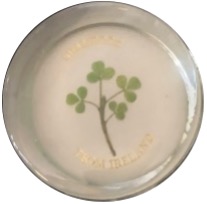
The experience, in a bit of an ironic twist, led me to a quintessential American experience. One March in the late 1980s or early 1990s, I was invited by Erie’s Irish Cultural Society to give a talk about the Irish Scholars program and Ireland in the late 20th century. As I began my talk, I recall I paused and said to the audience that I felt a bit discombobulated telling them about Ireland, for only in America could someone of German (actually Transylvania-Saxon), a dash of Romanian, and a dollop of Hungarian ancestry stand before a group of Irish-Americans and presume to tell them about their cultural heritage. For me, it was an example of the richness of American culture growing out of the fusion of many cultures. I still have the paperweight they gave me as a token of appreciation – a clear disk with a shamrock embedded in its center.
The fusion of cultures creating American culture is the culminating thread in my The American Tapestry Project, which can be heard on WQLN NPR1 and found on the web here. St. Patrick’s Day and all of America’s ethnic holidays also connect to other threads in The American Tapestry Project. They are “Freedom’s Faultlines: Tales of Race and Gender,” “The Immigrant’s Tale,” and “The Fusion Thread,” the ever-expanding inclusiveness of the “We” in We the People …
 
The first tells of the times America excluded people because of race, ethnicity, or gender from all of freedom’s benefits and the “excluded’s” fight for inclusion by appealing to America’s foundational values of freedom, equality, and opportunity. “The Immigrant’s Tale” overlaps with “Freedom’s Faultlines” at every turn as it explores America’s archetypal immigrant cycle of arrival, nativist anti-immigrant discrimination, the fight for inclusion, gradual inclusion, and, by the third generation, the immigrant’s descendants’ complete assimilation into American culture so that it is now they who sometimes oppose New Americans. And then, the cycle repeats itself. While the cycle repeats itself, it does not negate “The Fusion Thread” as immigrant wave after immigrant wave embeds itself in American culture.
 
Many in our current polarized culture want to permanently stop that cycle and freeze us all into some version of white Anglo-Christians, but America’s immigrant heritage enriches all of us. In an article in The New Yorker some years ago during one of our periodic squabbles about immigration policy, critic Calvin Trillin opined that he’d base immigration policy on national cuisine. He said he’d admit everyone except maybe the English. [1] America’s immigrant heritage makes its food fare among the world’s most bounteous with menu options ranging from curried chicken to spaghetti and meatballs (an Italian-American, not an Italian dish) to a hamburger (German in origin) and French fries (actually Belgian pomme frites) to hot dogs to bagels to stir fry anything (a variation on Chinese and southeast Asian cooking) to America’s favorite food – pizza! It’s a long way from colonial boiled beef!
 
Another example of America’s immigrant heritage enriching American culture is the ever growing number of ethnic holidays celebrating some group’s ancestral background. Just think of Erie’s feast of ethnic festivals with a different group celebrating its heritage on each weekend throughout the summer. They range from August’s Zabawa Polish Festival to July’s Greek Festival to the German Heritage Festival in September back to the Russian Festival in June, the Italian Festival in August, and multiple others. The national calendar is dotted with 74 (that’s a low number; I’m still counting) days or months designated this or that ethnicity’s day of honor. They range from April 6’s National Tartan Day honoring those of Scots ancestry to May 5’s Cinco de Mayo honoring Mexican heritage to March 1’s St. David’s Day honoring the Welsh to Happy Diwali Day to Asian Pacific Heritage and Jewish American Heritage month in May to the Chinese New Year in February to multiple other stops along the way.
 
Why ethnic holidays? Why ethnic festivals?
 
Several reasons come to mind from the most benign, in which the grandchildren or the great-grandchildren or the great to whatever “nth” applies to your particular lineage, to children fondly recalling their ancestor’s voyage to the New World and for a day dipping their toes in the old customs. In contrast to these benign motives, ethnic holidays also find their origin in older, darker assertions of ethnic dignity and solidarity in which the New Americans stood their ground against nativist bigotry. Just as today, earlier immigrants encountered vicious anti-immigrant sentiment in signs that said “Irish Need Not Apply,” “No Rum and Romanism,” or in politicians excoriating Italian immigrants as the “mongrel scum of southern Europe.”
 
Columbus Day and St. Patrick’s Day, America’s two most widely celebrated ethnic holidays, share these roots.
 
Columbus Day was first celebrated in 1792 when New York’s Columbian Order, better known as Tammany Hall, held an event to commemorate the 300th anniversary of Columbus’ historic landing. Forgotten for a hundred years, it was revived in 1892 when President Benjamin Harrison resurrected the day. Harrison yielded to pressure from Italian-American immigrant societies, the Knights of Columbus, and the government of Italy to do something about anti-Italian bigotry, which had culminated in a mob murdering 11 Italian immigrants in New Orleans. [2] Although ostensibly honoring Christopher Columbus’ discovery of the New World, it was really an expression of Italian pride and ethnic solidarity. Now, 130 years later, Columbus Day is attacked for honoring an exploiter of native peoples. In many communities it is morphing into Italian-American Heritage Day or, as in Akron, Ohio and elsewhere, Indigenous Peoples Day. [3] In many locales, it honors all three. October is already Italian-American Heritage Month.
 
St. Patrick’s Day, like Columbus Day, emerged earlier in American culture than many might suspect. The first recorded St Patrick’s Day celebration in America occurred in St. Augustine, Florida in 1600 and the first St. Patrick Day Parade marched in St. Augustine in 1601. [4] The Charitable Irish Society of Boston organized the first observance of Saint Patrick's Day in the Thirteen Colonies on March 16, 1737. [5] Surprisingly, the celebration was not Catholic in nature as Irish immigration to the colonies was dominated by Protestants. Similar to Boston’s, New York's first St. Patrick's Day was held on March 16,1762 in the home of John Marshall, an Irish Protestant. [6] Irish soldiers in the British Army held the first recorded St. Patrick’s Day parade in New York in 1766. [7]
 
But that all changed in the mid-19th century as Irish Catholic immigration soared. In the 19th century, confronted by those “No Irish Need Apply” signs and intense anti-Catholic bigotry, the newly arrived Irish-Americans, overwhelmingly Roman Catholic, formed Irish aid societies like the Friendly Sons of St. Patrick and the Hibernian Society. In a show of solidarity, they gradually co-opted New York’s St. Patrick’s Day parade and, by 1848, it became America’s largest parade. [8]
 
Today, although only a legal holiday in Suffolk County, Massachusetts and Savannah, Georgia, St. Patrick’s Day is celebrated everywhere in the United States. [9] Currently among the top ten American holidays for consumer holiday spending, St. Patrick’s Day grew into America’s favorite ethnic celebration. It is a celebration that transcended its Irish roots to become an essential American holiday. Although, in an example of reverse cultural sharing, the Irish in Ireland are adopting Irish-American customs and beginning to celebrate St. Patrick’s Day American style, it is a bigger holiday in America than in Ireland. In Ireland it remains mostly a religious observance honoring Ireland’s patron saint.
 
Which raises the question, who was St. Patrick? Was he real? The answer to which is “Yes.”
 
St. Patrick is credited with bringing Christianity to the Irish. [10] He flourished in the 5th century, that is the “400s.” He is only known because of two short writings. His Confessio and his Letter to Coroticus, an ancient Brit warrior known for brutalizing and selling into slavery his Irish conquests. The letter is a denunciation of British mistreatment of the Irish.
 
Some things are very, very old.
 
Interestingly, St. Patrick wasn’t Irish.
 
Born in Britain to wealthy parents, at 16 he was captured by Irish raiders – plunder went in both directions across the Irish Sea – and carried into slavery in Ireland. Enslaved for six years as a herdsman, his religious fervor increased. Having dreamt of escape, he managed to flee his master and find his way back to Britain. In his Confessio’s most famous passage, after his return to Britain, Patrick tells of a dream, in which he receives a letter titled “The Voice of the Irish.” Reading it, he heard the Irish plead for him to return. “Deeply moved,” he says, “I could read no more.” He says he felt unfit for the task. As is typical in the Church’s lives of the saints, the ones called are at first reluctant to answer because they believe themselves unworthy. Think of Moses telling God he is not the one.
 
For a long time, Patrick was reluctant to accept the call. Once back in Ireland, his qualms disappeared. Patrick roved all over Ireland zealously converting the pagans. An instinctive diplomat, he brought gifts to warrior chiefs and other powerful foes but accepted none for himself. On at least one occasion, he was cast into chains. He lived in constant danger of martyrdom. Humble, he thanked God for using him to bring flocks of pagan souls to forsake
worshipping “idols and unclean things” and to join “the people of God.”
 
By the end of the 7th century, he was a legend. The legends, certainly apocryphal and exaggerated, have continued to grow. One alleges he drove the snakes out of Ireland and into the sea. He himself wrote that he raised people from the dead. A 12th century saint’s life – some 700 years later – says the number was 33, some of whom had been dead for years.
 
Why shamrocks on St. Patrick’s Day?
 
If St. Patrick’s most famous legend involves snakes, his most popular legend involves the shamrock. Although the truth of the legend is now disputed, in a brilliant, one might say intuitively ingenious, if not inspired teaching metaphor, St. Patrick explained the Holy Trinity – three persons in one God – to bewildered Irish pagans by showing them the three-leaved plant with one stalk. [11]The only trinitarian metaphor, I think, that can compete with St. Patrick’s for simplicity and insight is Eldridge Cleaver’s explanation of the trinity in Soul On Ice as “three-in-one oil.” [12] Traditionally, Irishmen wear shamrocks, the national flower of Ireland, in their lapels on St. Patrick’s Day.
 
How is this brilliant teacher and evangelist’s day celebrated?
 
Well, it is true, some do manage to find their way to church, but most, if the weather cooperates even a little, put on their green, take in a parade, have a wee bit of a dram of uisce beatha (Irish for whiskey, it means “water of life”), or a glass of stout (or both), munch a plate of corned beef and cabbage and generally spend the day in a pleasant revel.
 
Why all the green clothing, green beer, and rivers dyed green?
Ireland really is green. I mean green in a rich, lush almost sensuous way. It’s a cliché, but if you’ve ever had the opportunity to fly over Ireland or to drive through its countryside, the ever-shifting shades of green are dazzling. As a result, the phrase "wearing of the green" was iconic in the Irish nationalist movement. When Ireland achieved its independence in 1922, the first act by the new Irish Free State was to paint all post boxes green under the slogan "Green paint for a green people.” [13] Green gradually became associated with St. Patrick and the defining color of the Irish people and Irish nationalism. On St. Patrick’s Day, green is everywhere, from clothing to street signs to beer to rivers. Seattle and other cities paint the traffic stripe of their parade routes green. Chicago dyes its river green and has done so since 1962 when sewer workers used green dye to check for sewer discharges and decided to turn the river green for Saint Patrick's Day. In nearby Jamestown, New York, the Chadakoin River is dyed green each year. [14]
 
What about those parades?
 
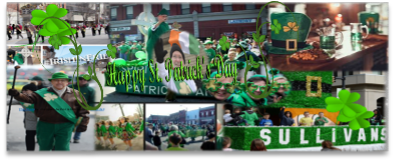
Although the custom began long ago, the largest is in New York City, but every, or almost every, American city has a St. Patrick’s Day Parade. If the weather is warm, Cleveland’s parade turns into a carnival in which Public Square becomes a veritable sea of people arrayed in green. Some of them might even be Irish. Erie has one every March, but usually the Saturday before or after (This year it was scheduled for March 12 but moved to March 19 on account of weather). Only the most extreme snow can deter the revelers. As the photo collage with which this Book Notes begins, one sees everyone from Mayor Joe Schember to Erie treasure Brady Louis and numerous others wearing-the-green, saluting with their shillelagh and heading to Sullivan’s Pub, the Tap House, Molly Brannigans or some other suitable venue to have that wee bit of a dram of uisce beatha.
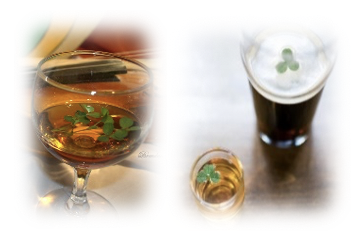
One of the leading days for the consumption of alcohol, St. Patrick’s Day also features drinking artificially colored green beer. In the carnival atmosphere surrounding many parades and other Paddy’s Day revels, drinking Irish whiskey or beer has become essential. I’ve already mentioned downing a pint of Guinness, but there is another custom Americans are beginning to adopt. Historically popular, especially in Ireland, it is the custom of “drowning the shamrock” or “wetting the shamrock.” At the end of the celebrations, a shamrock is put into the bottom of a cup, which is then filled with whiskey or beer. A toast is then made to St. Patrick, to Ireland, and to those present. Then the shamrock is either swallowed or taken out and tossed over one’s shoulder for good luck. [15]
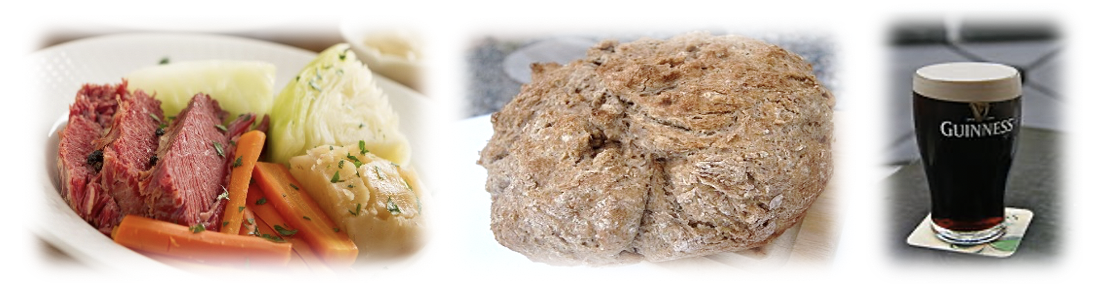
That plate of corned beef and cabbage accompanied by Irish soda bread and the beverage of your choice mentioned earlier, curiously enough, like many American “ethnic” foods, is not Irish in origin. While the soda bread is authentically Irish, the meal of corned beef and cabbage was created by Irish Americans in the 19th century. It is similar to what happened in other ethnic groups. They brought their customs and foods to America, but in America they were gradually transformed into something else. They became American foods, food for Americans. The classic example might be, but it is only one among literally dozens and dozens, the classic example might be spaghetti and meatballs. You will search in vain for anything like American spaghetti and meatballs in Italy. It is an American dish. The food is a metaphor for a New American’s assimilation into American culture. While the food’s roots, like the person’s, lie in the “old country,” in the soil of the new world they become something else – they become American. In becoming American, they change and enrich America. It is the essence of “The Immigrant’s Tale.”
 
A glimpse into Irish-American identity emerges in the changing character of St. Patrick's Day, its parade and how it was celebrated. St. Patrick’s Day evolved from an 18th century Protestant expression of Irish pride to a pushback against 19th century bigotry aimed against both Catholics and immigrant Irish. Over the next now almost 200 years, St. Patrick’s Day finally emerges in the 21st century as a profound expression of Irish-American assimilation and achievement. Tracing that achievement through Irish accomplishments in sports (Irish immigrants dominated early baseball), in politics (from Tammany Hall to South Boston to Alfred E. Smith to John F. Kennedy to Joe Biden), in arts and commerce (think Walt Disney) to Erie’s own Dr. Gertrude Barber would entail an entire other Book Note. As a result, every year since 1991, March has been proclaimed Irish-American Heritage Month.
 
It is the quintessential American story. As that story is told through the shifting character of St. Patrick's Day parades, the day’s rituals and traditions, it reflects how not only Irish immigrants, but all immigrants enriched American culture. On St. Patrick’s Day, if only for a moment, we need to stop and reflect how the experience of Irish-Americans becoming a people to be celebrated and admired exemplifies “The Immigrant’s Tale,” a major, maybe the major thread, in The American Tapestry Project’s “Fusion Thread” of the ever expanding “We” in We the People …
 
Although widely celebrated by Irish and non-Irish alike, today is the Irish’s day. So, let’s conclude this Book Notes with, if only figuratively, a wee bit of a dram of uisce beatha and say with our Irish neighbors – Erin Go Bragh (Ireland forever).

Happy St. Patrick’s Day!
-- Andrew Roth, Ph.D.
Scholar-in-Residence
The Jefferson Educational Society

This content is copyrighted by the Jefferson 2022.
Photo Credits
“Happy St. Patrick’s Day” from Free Clipart Library available here accessed February 28, 2022.
“Shamrock in Disk” author’s personal collection.
“Green Irish Post Box” from the Irish Post Office available here accessed March 2, 2022.
“Chicago River Green” from NBC News available here accessed March 2, 2022.
“Chadakoin River Green” from The Post-Journal available here accessed March 2, 2022.
(L) “Drowning the Shamrock” at Quora available here accessed March 2, 2022.
(R) “Drowning the Shamrock” at Quora available here accessed March 2, 2022.
“Corned Beef and Cabbage” at The Spruce Eats available here accessed March 2, 2022.
“Irish Soda Bread” at Wikicommons available here accessed March 2, 2022.
“Guinness Stout” at Wikicommons available here accessed March 2, 2022.
 
End Notes
  1. Although I couldn’t find the exact The New Yorker citation, I did find a confirmation at Quotetab.com, which quotes Trillin as saying “I'm in favor of liberalizing immigration because of the effect it would have on restaurants. I'd let just about everybody in except the English.” Available here accessed March 1, 2022.
  2. “Columbus Day” in Wikipedia, the free encyclopedia available here accessed March 2, 2022.
  3. Becka, Megan. “Akron to commemorate North American First People’s Day with art exhibit, Portage Path walks, panel discussions” at Cleveland.com available here accessed March 2, 2022.
  4. Miller, Michael E. “The incredible story of America’s first St. Patrick’s Day celebration” in The Washington Post (March 17, 2018) available here accessed March 2, 2022.
  5. Klein, Christopher. “How St. Patrick’s Day Was Made in America” at History.com available here accessed March 2, 2022.
  6. “History” at NYC Saint Patrick’s Day Parade available here accessed March 2, 2022.
  7. “Saint Patrick’s Day in the United States” in Wikipedia, the free encyclopedia available here.
  8. Ibid.
  9. See Langan, Sheila, “Why isn’t St. Patrick’s Day a public holiday in the U.S.?” at IrishCentral.com available here; “The History of St. Patrick’s Day in Savannah” at Savannah Lodging available here; and “Saint Patrick’s Day in the United States” in Wikipedia, the free encyclopedia available here. All accessed March 2, 2022.
  10. The following brief biographical sketch of St. Patrick draws from “St. Patrick” in the Encyclopedia Britannica available here; “The Life of St. Patrick” in Ireland-Information.com available here; Fischer, Franz, “St. Patrick’s ‘Confessio’” at Royal Irish Academy available here; and “St. Patrick’s Letter to the Soldiers of Coroticus” at Ancient Texts.org available here. All accessed March 2, 2022.
  11. For the traditional view of St. Patrick and the shamrock, see O’Connor, Rachael, “How did the shamrock become the symbol of Saint Patrick’s Day?” at The Irish Post (February 25, 2021) available here; for the counter view that the legend is a “sham” confer Cormac MacConnell “Everything you know about the St. Patrick’s Day shamrock is a lie” at IrishCentral.com (January 30, 2022) available here. Both accessed March 2, 2022.
  12. I long ago lost my copy of Soul on Ice, but Pastor Bob at “3-in-ONE Oil, a black panther, and God?” at Zion’s Liberty Bell Church available here accessed March 2, 2022 reassures me I didn’t imagine it.
  13. “Wearing Green” in “St. Patrick’s Day” in Wikipedia, the free encyclopedia available here accessed March 2, 2022.
  14. See McNertheney, Casey, “Irish paint Seattle street green for St. Patrick’s Day” at Seattlepi.com (March 17, 2013) available here; Bob Chiarito and Colin Boyle, “Surprise! Chicago’s River Dyed Green for St. Patrick’s Day After All” in Block Club Chicago.com available here; and Dennis Phillips, “Chadakoin River To Be Dyed Green for St. Patrick’s Day” in The Post-Journal, Jamestown, N.Y. (March 16, 2018) available here. All accessed March 2, 2022.
  15. “Drowning the Shamrock” at GoodFoodIreland.ie available here accessed March 2, 2022.
Upcoming JES Programs
with Dr. Roth

Tuesday, March 22
12-1:30 p.m.
Corry Higher Education Council
Corry, PA
Featuring Andrew Roth, Ph.D.


The American Tapestry Project continues its investigation of "Freedom's Faultlines: stories of race and gender;" "The American Dream: success stories, how-to stories, Horatio Alger and a nation of hustlers;" "The Immigrant's Tale: America's continuing experiment in building a diverse society;" and concludes with the "Fusion Story: America's fusing of Freedom's Story," the story of self-government and the ongoing struggle between exclusion and inclusion. The rich tapestry of American stories describes the contentious but ever-expanding understanding of America's founding documents – "We the People…"
Important to Note:

  • Location: Corry Higher Education Council-- 221 N. Center St. Corry, PA 16407.
  • Dates/Time: March 22 @ 12 p.m.
  • Admission: $5/person for a brown bag lunch. Prior registration must be made to receive a lunch.
  • Admission is free for Erie County students. Use coupon code "eriecountystudents" during registration, and make sure to bring proof of your enrollment in school with you to the event for check-in.
  • All program participants will be required to wear masks so long as Erie County is in the “substantial” or “high” transmission rate of community spread on the day of an event. Participants must also provide proof of full Covid-19 vaccination, including a booster shot, or a negative Covid-19 test within the last 72 hours. Please see our FULL Covid-19 policy here.
In Case You Missed It
Book Notes #92: Sarah Josepha Hale: Someone You Need to Know written by Jefferson Scholar-in-Residence Dr. Andrew Roth

Crooning: Music We Were Supposed to Like written by Jefferson Scholar-in-Residence Dr. David Frew

Washington, Lincoln, and the Power of Providential Deism written by Director of the Brock Institute for Mega Issues Education Rev. Charles Brock

Wakin' Us Up: The Story of Amadou Diallo written by author and historian Tanya Teglo
JES Mission: The Jefferson was founded to stimulate community progress through education, research, and publications. Its mission also includes a commitment to operate in a nonpartisan, nondenominational manner without a political or philosophical bias. As such, the Jefferson intends to follow the examined truth wherever it leads and is neither liberal nor conservative, Democratic nor Republican in philosophy or action. Our writers’ work reflects their own views.
Jefferson Educational Society | jeserie.org