|
Passing through Galatia and Phrygia
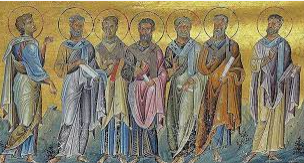
“Now a Jew named Apollos, a native of Alexandria, came to Ephesus.
He was an eloquent man, competent in the Scriptures.
He had been instructed in the way of the Lord, and being fervent in spirit,
he spoke and taught accurately the things concerning Jesus,
though he knew only the baptism of John.” (Acts 18:24–25)
Through the first missionary journey (Acts 13–14) and the second missionary journey (Acts 15:36–18:22), Paul and his companions expanded the scope of their mission. The third missionary journey is generally defined as Acts 18:23–19:20. It can be confirmed that the first and second missionary journeys focused on securing missionary bases, whereas the third missionary journey had a strong purpose of visiting churches that had already been established. In that sense, the term “missionary journey” is somewhat awkward.
Traveling through Galatia and Phrygia
If Paul’s missionary journeys that began from Antioch up to the passage prior to this text were for establishing missionary bases, then from the third missionary journey onward they can be defined as missionary journeys of a different dimension. They can be seen as pastoral journeys to visit already planted churches, encourage them, and strengthen them. Paul recognized that once a church is established, it cannot be sustained fully on its own, and he repeatedly emphasized and sought to confirm that they must stand firmly theologically. This was because he had already experienced that frequently hearing differing and opposing theological positions could distort God’s gospel toward the Gentiles and throw the church into confusion.
In addition, he emphasized that God’s church is not made up of churches established in various regions that struggle independently for survival, but that all are one body connected with Christ at the center. He frequently mentioned that all churches are connected churches centered on Jerusalem. To emphasize this point, when the Jerusalem church was in difficulty, he had relief funds collected and delivered, and he also appealed for churches in other regions to help one another when they were struggling.
Ephesus
Paul and his companions headed again to Ephesus. Ephesus was the capital of the Roman province of Asia. From Acts 16:6, we can infer that Paul had tried to carry out missionary work in Ephesus. As he concluded the second missionary journey, just before leaving for Jerusalem, Paul established a base in Ephesus and left Priscilla and Aquila there (18:19–21). It is thought that Paul intended later to focus his missionary activities centered on Ephesus. If Jerusalem, Antioch, and Corinth had been important missionary bases up to that point, Ephesus now joined that line.
Apollos
The third missionary journey began with strengthening the disciples by traveling in order through the regions of Galatia and Phrygia. And before they arrived in Ephesus, an important event took place there. The figure named Apollos was confirmed to be preaching the gospel in the synagogue, which drew the church’s attention.
Apollos was from Alexandria. Alexandria was the second-largest city in the Roman Empire and a center of Hellenistic-Jewish biblical interpretation and philosophy at that time. Apollos was a scholar of the Scriptures who was skilled in rhetoric and outstanding in speech (v. 24). It is not reported where he received Christian instruction, or when and how he came to have an experience of the Holy Spirit. Nor is it explained how such a person knew only the baptism of John and did not know about baptism received in the name of Jesus. These facts provide even more mystery, as similar statements are heard from certain disciples in Ephesus as well (Acts 19:1–3).
The believers in Ephesus had not yet formed an independent church and were in a situation where they attended synagogue worship. Aquila and Priscilla urged Apollos to receive baptism. They assured Apollos that the gospel could be proclaimed to the Gentiles (helping him realize that this was God’s will) and that it must be proclaimed. Apollos already had a letter of recommendation from the Ephesian church and went to Corinth, where he helped the church there through apologetic argumentation at the level of a biblical scholar.
The situation in Corinth was not easy. It was difficult to respond theologically to the Jews in their confrontations. Apollos had a special gift and was a great help to the Corinthian church. The Jews could not overcome Apollos’s arguments, through the Scriptures, that Jesus is the Christ. As a result, the Jews prohibited Apollos from preaching in the synagogue, and debates took place in the streets. After this, Apollos became an important coworker of Paul and participated in Paul’s missionary journeys. According to Paul’s letter sent to Corinth (1 Cor. 16:12), Paul mentions that because there was so much work to be done, he could not go to Corinth together with Timothy.
Points for Reflection
Mission consists of laying a foundation by proclaiming the Word and the ongoing process of nurturing and training. Through the first and second missionary journeys, Paul laid the foundation, and through the third missionary journey he sought to firmly establish the churches. The center of mission is expanding from Jerusalem to Antioch, from Antioch to Corinth, and from Corinth to Ephesus. It is time for us to examine whether our own missionary bases are also expanding.
Through Apollos, the Ephesian church gained great strength, especially because he had abundant knowledge of the Scriptures and was eloquent. Even today, various heretical teachings confuse the church and believers. Not all of us have received outstanding gifts like Apollos, but at the very least we must stand clearly on the Word ourselves and be able to convey it to our neighbors. By doing so, I am convinced that the church will grow and become strong.
President Sung Jin Lim
|