Weekly Digest Number 2 - January 10, 2023 |
|
Welcome to the RWU Rail & Labor News! This news bulletin is produced and emailed out each Tuesday morning. We hope you find each week's news and information useful. If so, please share with co-workers, friends, and colleagues. If you like, you can sign them up to get all the news from RWU HERE. Or forward them the link. Note: If you read over this news bulletin each week, you will be sure to never miss the important news of what is going on in the railroad world from a worker's perspective!
|
|
(Editor's Note: A breakthrough? How much longer can this farce continue? How many more years can the American economy, the American people and the U.S. government tolerate the gigantic swindle that is right under their nose? As the famous rail labor organizer Eugene V. Debs once quipped, "I would rather have a rail industry owned by the government, than a government owned by the rail industry." Well folks, what is it gonna be? RWU has made our choice. Click HERE.)
|
|
Is it Time for New Railroad Rules? Critics Say U.S. Train Industry is in Crisis |
|
Just before he retired, Matthew Rose offered a warning to his peers running the nation’s large freight railroads. Rose, then the CEO of BNSF, one of the largest American railroads, told an industry conference in early 2019 that railroads were shirking their responsibilities to serve all customers by adopting new business models that focused on only the commodities and routes that delivered the most profits. Recent industry trends — aimed at pleasing Wall Street investors — would invite more scrutiny from government regulators, Rose warned.
“I really do believe we’re going to get in a lot of trouble by doing that,” Rose said, according to an account in the trade publication Trains.com. It was a prophetic message.
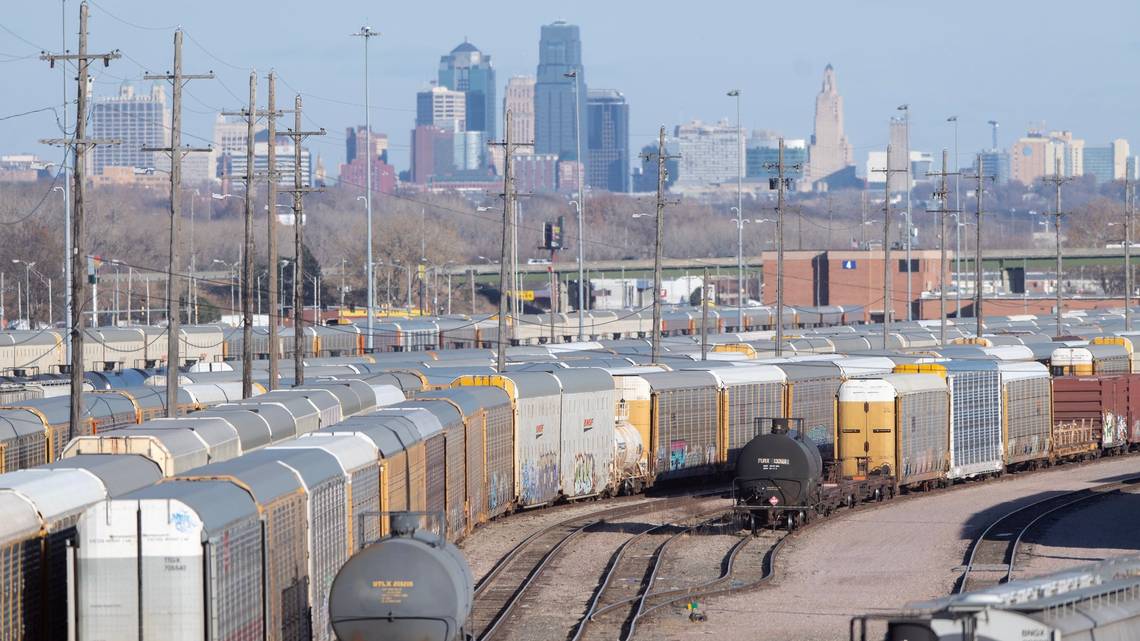
The business transformation of freight railroads in the last few years has raised the ire of top government leaders who have grown frustrated over the industry’s growing focus on short-term profits. New business tactics have pushed railroads to build longer trains, which can now block off emergency responders’ access to entire communities. They’ve also slashed work forces, leading to mounting frustration among workers, who narrowly averted a national strike earlier this month. Industry changes have also led to widespread complaints about poor service from the myriad businesses that rely on rail to move supplies across the country. U.S. Rep. Peter DeFazio, a Democrat from Oregon, characterized the freight railroads as being at a “point of crisis” during congressional hearings in May. DeFazio, who chairs the House Committee on Transportation and Infrastructure, said railroad executives had grown addicted to “watching the ticker on Wall Street.” Poor railroad service has caused factories to close, customers to move commodities to less efficient trucks and pushed up costs for consumers, he said.
|
|
(Editor's Note: RWU would add this: Expect to hear more about internal union battles for leadership and change of direction; the movement for public ownership of the railroads; and the broadening of a generalized revolt against PSR.) |
|
Expect to Hear More About Rail Service Issues in 2023
Merger conditions, rail workers’ quality of life among other hot topics
|
|
The Surface Transportation Board’s regulatory to-do list, train crew sizes and merger conditions related to Canadian Pacific’s acquisition of Kansas City Southern are just some of the big issues that rail industry stakeholders will be watching in 2023.
One of the biggest issues that the U.S. freight industry will tackle is how to improve rail service. Closely related to that are the potential actions that STB could take to address that issue.
“After being dormant for much of the last decade, the board has several large cases before it, including private railcar demurrage, reciprocal switching, [as well as] the carriers’ use of embargoes to meter traffic and essentially skirt the common carrier obligation,” said Todd Tranausky, vice president of rail and intermodal for consulting firm FTR Transportation Intelligence. “This board really likes the idea of fairness and that will lead them to be active.”
STB’s proceeding on reciprocal switching, Ex Parte 711, could be decided and resolved in 2023, Tranausky added. Reciprocal switching occurs when a shipper has access to one freight railroad but seeks access to a nearby competing freight railroad to cultivate a competitive pricing environment. A shipper gains that access at an interchange between the two railroads.
Meanwhile, the railroads will be eager to show how they’ve improved service metrics since last spring’s service meltdown. That could be a theme discussed during the Class I railroads’ fourth-quarter 2022 earnings calls starting in mid to late January.
“As an industry, we’ve been talking about service for two years now and it is unlikely to stop anytime soon. We’ve gotten back to historical average levels recently, but that is not going to be enough to impress shippers to bring volume back to the rails,” Tranausky said.
“Service has certainly been in the crosshairs of the STB and taken some of the momentum out of their other priorities while they try to sort out the service issue. The service issues also allow the board to see a reason for needing to get involved in some of the other areas they are looking at,” he said.
Another issue that could arise in 2023 involves STB itself as a regulatory body. Both shippers and some unions are pressing Congress to pass legislation that would give the board more regulatory authority.
Shippers and unions also want Congress to revise the common carrier obligation, which is the federal mandate requiring the railroads to carry freight at reasonable terms. Advocates for revising the definition argue that it would better define what service metrics the railroads need to meet. Legislation to revise the definition could come through part of STB’s reauthorization and/or as an independent bill.
|
|
(Editor's Note: This article points out the numerous obstacles and pitfalls that beset rail workers. But he shows that these can be overcome, that we can build upon what has been accomplished this past year, and that there is optimism for us to consolidate and keep the momentum going forward.) |
|
Railroad Workers Can Build on Seeds of Change |
|
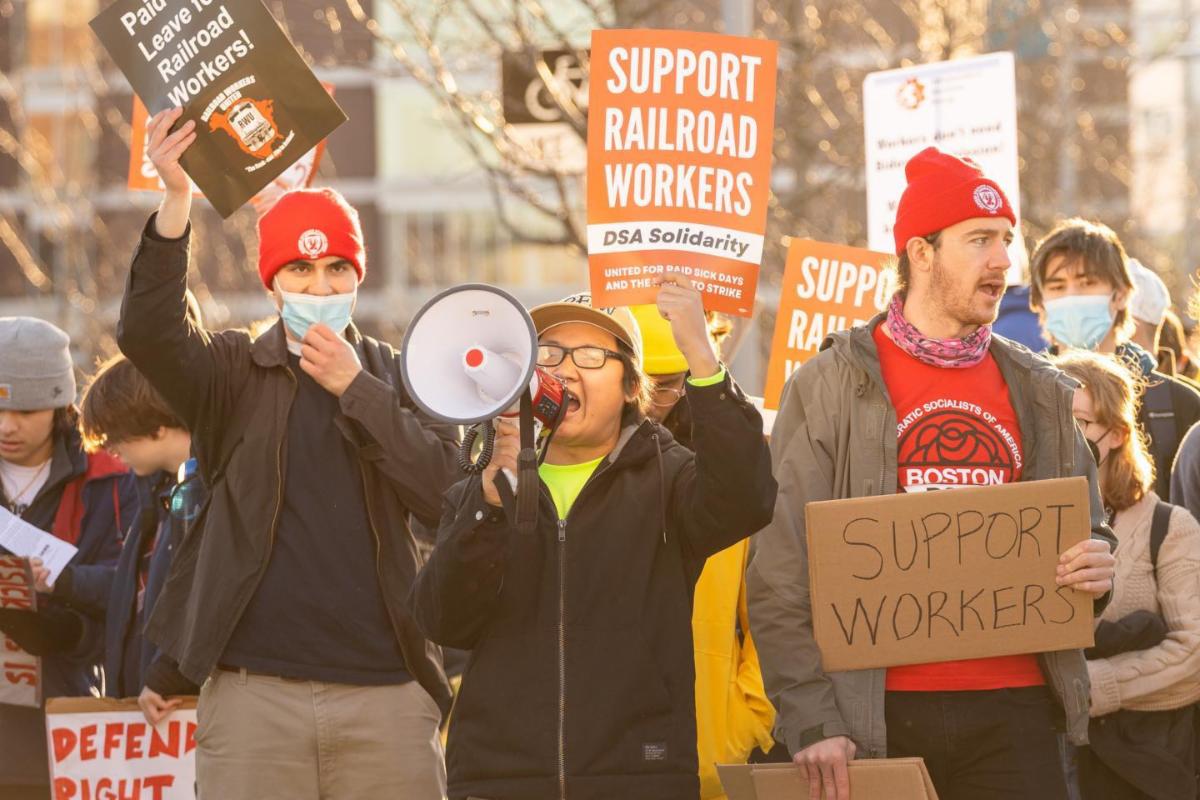
On December 2, 2022, as Joe Biden admired the view of Boston Harbor alongside William, Prince of Wales, the Boston DSA labor working group helped organize a protest rally against Biden’s having signed the imposition of the Railway Labor Act on the railroad workers earlier in the day. The protest received wide and favorable media attention in Boston, and at this writing at the end of December, remains the largest single demonstration in support of the demands of the railroad workers.
Twelve railroad unions were involved in the negotiations leading up to government intervention, and although the imposed settlement gave them some of what their leaders bargained for, the lack of paid sick days was a major defeat and disappointment. At the time, Biden said that he would push for the sick days by other means. The workers remain without the sick days, and the imposition of the Railway Labor Act has led to fractious debates on the Left and revolt in the ranks of some of the unions involved.
The debates within the Left threaten to derail (pun intended) the serious work of supporting the beleaguered workers. What is a left-wing labor activist or supporter to do?
Rank-and-file caucuses of railroad workers show the way forward
Two caucuses of rank-and-file rail workers are still organizing to win specific demands for paid sick leave, scheduling, and staffing relief, and also to remold their unions into a more coherent structure covering all railroad workers. They are Railroad Workers United (RWU) and the BMWED (Brotherhood of Maintenance of Way Employes Division) Rank and File United.
Railroad Workers United [RWU] is a cross-union caucus of reform-minded members from most of the 12 rail unions. Its positions include nationalization of the rail industry and the creation of a single industrial union to include all railroad workers. It meets at the national level and has a steering committee and an organizer.
|
|
(Editor's Note: With this initiative, we have a real chance of expanding the National Network of long distance trains. All rail workers and their unions - especially those at Amtrak - are encouraged to get involved and assist to make this happen. NOTE: RWU is a dues paying member of Rail Users Network and Rail Passengers Association, and we are allied with Solutionary Rail. We encourage every rail to join as well. See below.) |
|
Federal Railroad Administration Promotes Amtrak Daily Long-Distance Service Study |
|
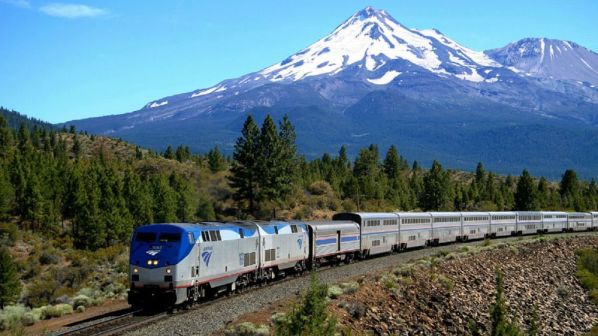
The Federal Railroad Administration (FRA) is conducting an Amtrak Daily Long-Distance Service Study to evaluate the restoration of daily long-distance intercity rail passenger service and the potential for new Amtrak long-distance routes. This study will ultimately create a long-term vision for long-distance passenger rail service and identify capital projects and funding needed to implement that vision.
Amtrak was established by the Rail Passenger Act of 1970, which removed the requirement for U.S. railroads to provide intercity passenger rail service and created Amtrak to fulfill that role instead. In 1971, the US Department of Transportation (US DOT) designated 21 city pairs between which intercity passenger trains should operate, and Amtrak began service between those cities later that year.
The new passenger rail system was about half the size (by route miles) of the pre-1971 U.S. passenger rail system, which had been operated by multiple railroads. At the request of Congress, several long-distance routes were added to Amtrak’s system in the 1970s, but long-distance service contracted in the following decades – especially after a 1978 US DOT report that recommended significant service reductions. Long-distance network service reductions over the past 50 years have resulted in some communities losing common carrier transportation options, as well as the economic and social benefits of those connections.
|
|
(Editor's Note: More and more activists, academics, professors and others are weighing in on the rail labor question in the US. Our struggle is on the map finally! This short clip - 5 mins - is well worth having a look at. These guys know their stuff.) |
|
Biden Blocks Rail Strike Despite Rank & File Pressure - Economic Update with Richard Wolff |
|
Labor reporter Bob Hennelly speaks about the growing militancy of the labor movement, especially in regards to the modern robber barons of the railroads. You can find Bob's book on activism and capitalism in America “Stuck Nation” published by Democracy at Work last year http://www.lulu.com/spotlight/democra...
"The labor movement and professional labor unions (large scale institutions) are equally upended by this. Do not think that they're somehow not caught up in it. In fact, they're struggling to keep up with the militancy of the masses" - Bob Hennelly
|
|
(Editor's Note: This under reported event took the life of a new hire trainman last month on NS in Alabama. Apparently, because he was not yet paying dues to a union, there was no report of his death while on duty. NOTE: The RWU Rail and Labor News weekly bulleting did cover the event shortly after it occurred, as we do for ALL rail worker fatalities) |
|
FRA Issues Safety Bulletin on Pre-Departure Inspections |
|
The Federal Railroad Administration (FRA) has released a safety bulletin to remind employees to conduct visual inspections prior to pulling cars.
In Safety Bulletin 2022-01, issued Dec. 20, 2022, FRA reported that it is investigating “a recent fatal accident when a train operating on the main line struck a piece of angle iron protruding from a freight car on the adjacent main track. Based on FRA’s preliminary results from its ongoing investigation, the piece of angle iron appears to have been part of the freight car (not lading, but a repair to the carbody side top cord of a scrap metal gondola car) that was starting to dislodge from the carbody. It appears that the piece of angle iron was in this state when the car was pulled from the customer, moved to a yard, and then added to a different train on the main track. The angle iron, which was protruding into the foul of the adjacent track, pierced a locomotive cab window and fatally injured a member of the crew.”
The goal of the safety bulletin is to provide the industry “almost-immediate awareness” of the incident/accident as well as “key information with which to brief or (re)train employees,” according to FRA. The agency noted that as it completes its investigation, it “may take additional actions with respect to this incident/accident.”
Specifically, FRA is requesting railroads to review the safety bulletin with employees “to increase awareness of this hazardous condition that led to a fatal injury.” FRA also wants to remind “train crew members that when at locations where a person designated under §215.11 is not on duty for the purpose of inspecting freight cars (such as in customer facilities), prior to pulling any cars and only when it is safe to do so, to perform a proper visual inspection of freight cars for any protruding objects that may foul an adjacent track from a railcar, and if observing such a condition to immediately report it.”
|
|
(Editor's Note: Railroad workers are blazing a trail and taking a lead role in the industrial disputes in the UK. Is it possible that their counterparts in the U.S. can assume such a role?) |
|
Only One in Five British Trains to Run on Final Day of Planned Strikes
Industrial action over pay and working conditions has caused almost four weeks of disruption
|
|
The last day in the latest stretch of railway strikes has begun, ending a run of almost four weeks of continuous disruption caused by industrial action over pay and working conditions.
Only about one in five trains across Great Britain will run on Saturday as a 48-hour walkout by members of the Rail, Maritime and Transport Workers union concludes, with no early morning or evening services and a pared-back schedule on main intercity and urban lines.
Much of Wales, Scotland and rural England will have no trains running, with thousands of signallers at Network Rail, as well as train crew, going on strike.
Passengers have been advised to avoid taking trains, and to continue to check for updates in case of further cancellations should they attempt to travel by rail.
Services should be restored by early afternoon on Sunday on most lines, although some operators have warned that it will take all weekend to fully return to normal. No trains will run from London King’s Cross until Monday due to engineering works.
Union leaders and rail bosses will meet the rail minister, Huw Merriman, on Monday to restart talks to resolve the long-running dispute.
The RMT rejected separate pay offers from Network Rail and train operators in December, heralding a period of 10 strike days and an ongoing overtime ban for train staff, which ended this week.
|
|
Rail Roundup: Union Pacific Ordered to Fix Service to Foster Farms |
|
The Surface Transportation Board wants Union Pacific to address the service issues raised by UP customer Foster Poultry Farms in California.
Foster Farms had filed a petition for emergency service before the board on Thursday, noting continued service deterioration, according to STB. STB’s response — an order issued Friday — calls for UP to deliver specific train sets of animal feed to Foster Farms on the time schedule specified by UP (NYSE: UNP).
The schedule will help prevent a potential significant loss of livestock in California, the board said in a new release. UP was also required to provide a status update to the board by Tuesday. If the railroad needs to deviate from its proposed schedule, it must inform Foster Farms.
The order relates to a decision the board rendered in June regarding Foster Farms, directing UP to adhere to specific service agreements and update STB on the railroad’s progress. STB’s oversight of UP’s progress was extended to July 20, 2022, and the board left the docket open through Jan. 20 in case further action is needed.
According to STB’s decision last week, Foster Farms said the service issues began in October.
“Extreme cold temperatures and blizzard conditions in late December have impacted 20 of the 23 states where we operate, with more severe weather continuing into the new year,” UP, in response to STB’s order, told FreightWaves. “Union Pacific remains committed to serving all of our customers as efficiently as possible, including Foster Farms, weather permitting. We continue to have open dialogue with our customers and the Surface Transportation Board as we work to recover from weather issues.”
|
|
(Editor's Note: A few days of bad weather is apparently now enough to result in weeks of traffic embargoes. What a convenient excuse for the Class One carriers to hide behind, when they cannot move freight for all sorts of reasons, the weather of course just one of them.) |
|
Union Pacific Continues to Embargo Traffic in Iowa, Minnesota, and Wisconsin |
|
OMAHA, Neb. – Union Pacific, citing ongoing harsh winter weather, is continuing an embargo it placed last week on all traffic to and from Iowa, Minnesota, and Wisconsin.
“A powerful storm system will swing through the Central U.S. early this week, bringing heavy snow, freezing rain and ice to Wyoming, Nebraska, Iowa, Minnesota, and Wisconsin. Weather embargo UP130022 is still in effect,” the railroad said in a customer advisory on Monday.
“In response to the recent severe weather events and arctic temperatures that have impacted our operations across Iowa, Minnesota, and Wisconsin, as well as the additional snow and ice accumulation forecast to hit the region over the next week, Union Pacific is implementing catastrophic embargo #UP130022 for all traffic in and out of the region,” UP said in its Dec. 29 customer advisory. “The embargo will allow us to maintain fluidity as this segment of the network works to move volumes impacted by the weather event.”
UP had to contend with snow drifts as high as 15 feet that blocked tracks in Iowa and Minnesota last month, as well as frozen switches, according to a customer advisory.
None of the other Class I railroads operating in Iowa, Minnesota, and Wisconsin – which include BNSF Railway, Canadian National, and Canadian Pacific – have issued similar blanket embargoes in the area, according to the Association of American Railroads embargo system.
|
|
(Editor's Note: The rate of inflation in Canada for 2022 was 6.8%. Let's hope it drop to less than half of that in the coming years, or else these wage increases are decreases. It is a dangerous game in these times to gamble on the the future rate of inflation. Unions should consider bargaining to include a COLA - Cost-of-Living Adjustment - to take the risk out of the equation.) |
|
TCRC Ratifies New CN Agreement |
|
The agreement, which came into effect on Jan. 1, includes adjustments to wages of 3% in 2023, 3% in 2024 and 2.5% in 2025, as well as other benefits. The agreement is in effect until Dec. 31, 2025.
“We are pleased to have negotiated a new collective agreement before the expiry of the previous one,” said CN President and CEO Tracy Robinson. “We are committed to working with our railroaders and their union representatives to create a workplace where employees thrive and together, we deliver better and safer service to our valued customers.”
|
|
(Editor's Note: Our apologies for the technical wording in this trucking article. The reason we run it is to show that the trucking industry's prices are dramatically falling, while the rail freight pricing does not. Perhaps this is part of what is behind the dramatic decline year-over-year shipments in rail freight (see final article). With the Class Ones hellbent on lowering the OR and boosting stock prices, customers are fleeing to the highways. Bad for the rail industry, bad for the highways, the environment and the country. Sadly, look for further rail freight declines in face of this phenomenon, since we do not expect the rail carriers to likewise lower prices.) |
|
Transportation Prices Fall at Fastest-ever Pace in December, LMI says |
|
Supply chain data released Tuesday showed a new “sharpest rate of contraction” for transportation pricing during December.
The Logistics Managers’ Index (LMI), a monthly survey of supply chain executives, displayed a 36.9 reading for transportation prices during the month. The rate of decline was the fastest recorded in the six-year history of the data set.
A reading above 50 indicates expansion while one below that indicates contraction.
Transportation utilization (48.1) fell into contraction territory for the first time since April 2020, while transportation capacity (69.5) expanded at a historically high but more tepid pace.
“With warehouses largely full of product before the start of the holiday season, less transportation than usual was needed to push goods forward at the last minute,” the report said.
The loosening in trucking markets has been evident in FreightWaves’ tender rejection data. The Outbound Tender Reject Index remained in the sub-5% range for the bulk of the fourth quarter. By comparison, carriers were rejecting roughly one out of every four loads in the same period of 2021.
|
|
(Editor's Note: Here we see that it is not just the Class One railroads that have the American people up against the wall, but thousands of corporations that put the interests of stockholders above all else - customers, performance, investment, safety, workers, the economy, the nation. But some of you may say, "That is business, that is what they are supposed to do." Exactly. Perhaps it is time to run our economy and our world in the interest of working people who create the wealth rather than the stock holders who simply happen to own it!) |
|
Demand Southwest Airlines Invest in Workers and Passengers, not Wealthy Shareholders |
|
Union members have been raising the red flag for years that the cancellation crisis this holiday season was inevitable due to Southwest’s severely outdated technology. The lack of investment in infrastructure for its own workers made the airline unable to match flight crews with flights -- forcing flight cancellations on some of the busiest travel days of the year.
Meanwhile, Southwest has announced that it plans to shower its wealthy shareholders with $428 million in stock dividends -- money it should instead be using to keep its planes, crews, and passengers in the air. This is an airline that received a $7 billion taxpayer bailout during the pandemic and whose CEO Bob Jordan receives $9 million in compensation annually. Talk about having the wrong priorities! Jordan has one important job: Making sure that when a customer buys a ticket on Southwest, they arrive at the destination on their ticket safely and reliably. Due to this epic failure, Bob Jordan should be terminated from his job.
|
|
(Editor's Note: The U.S. Rail industry should be ashamed of these figures. Appears that they are. Industry mouthpiece Progressive Railroading made a glaring "typo" in the headline of this article. The drop in traffic in 2022 was 2.8%. That is nearly 3%, not 2% as suggested in this headline.) |
|
North American Rail Volumes Fell Nearly 2 Percent in 2022 |
|
Total U.S. freight-rail traffic in 2022 fell 2.8% to 25,428,763 carloads and intermodal units compared with volume in 2021, according to Association of American Railroads data.
U.S. carloads dipped 0.3% to 11,976,283 last year, while the number of carloads and containers dropped 4.9% to 13,452,480 year over year.
"Rail markets are always evolving, and 2022 was no exception,” said AAR Senior Vice President John Gray in a press release.
Coal carloads rose "solidly" in 2022 largely because of higher natural gas prices, he said. However, those high prices — along with other market disruptors — hurt chemical volumes, since natural gas is a raw material for chemical manufacturing.
"Grain carloads in 2022 were slightly higher than the annual average over the past decade, but they were down year-over-year because 2021 was the best year for grain carloads since 2008," Gray said. "Intermodal volume in 2022 was the sixth-best ever, but down from an even stronger 2021."
|
|
|
|
|
|
|