LWVUS New open logo only


"The Voter" Newsletter

February, 2026

League of Women Voters of

Berrien & Cass Counties


President's Corner

We are proud to announce our newest community partner: The NAACP!


The LWVBCC and the NAACP of Niles-Buchanan are officially announcing our partnership! This supportive collaboration is geared towards our shared work of increasing voter participation, voter education, and protecting civil and political rights for all in our democracy! Stay tuned for more information on our projects and outreach together, including town halls, training, and educational sessions.


The NAACP and the League of Women Voters:

A Brief History and Their Work to Protect Democracy

The NAACP and the League of Women Voters are two longstanding American organizations committed to expanding democratic participation and advancing equal rights. Although founded in different historical contexts, they have often worked in coalition to protect voting rights and strengthen democratic institutions.


The NAACP

Founded in 1909 in New York City, the NAACP was created in response to widespread anti-Black violence, including the 1908 race riot in Springfield, Illinois. Its founders included an interracial group of reformers and civil rights leaders, among them Mary White Ovington, Oswald Garrison Villard, W. E. B. Du Bois, and Ida B. Wells.


In its early decades, the NAACP led anti-lynching campaigns and worked to enforce the constitutional protections of the 13th, 14th, and 15th Amendments. Through strategic litigation, it played a central role in dismantling legalized segregation. One of the most significant victories came in Brown v. Board of Education (1954), when the U.S. Supreme Court ruled that racial segregation in public schools was unconstitutional.


Today, the NAACP focuses on:

  • Protecting voting rights
  • Advancing racial equity
  • Criminal justice reform
  • Economic opportunity
  • Environmental and health equity

Its work combines litigation, public policy advocacy, and grassroots organizing.


The League of Women Voters

The League of Women Voters was founded in 1920, emerging from the National American Woman Suffrage Association shortly before ratification of the Nineteenth Amendment to the United States Constitution. Suffrage leader Carrie Chapman Catt described the League as a “mighty political experiment” designed to help newly enfranchised women become informed and active voters.


The League is strictly nonpartisan and does not endorse candidates or political parties. However, it actively engages in research, advocacy, and litigation on issues related to voting access and democratic governance.


Historically, the League has supported major public policy reforms, including Social Security legislation, consumer protections, the Equal Rights Amendment, and contemporary voting rights proposals such as the John Lewis Voting Rights Advancement Act.


The League has been criticized for failing to support Black women and advocate for full racial inclusion during it’s early work around suffrage. The League has publicly acknowledged aspects of this history and adopted formal diversity, equity, and inclusion commitments that it works to actively engage with and support.


Working Together to Protect Voting Rights

Although independent organizations, the NAACP and the League of Women Voters frequently work in coalition—especially on voting rights.


Both organizations have supported enforcement of the National Voter Registration Act of 1993 (NVRA), sometimes called the “Motor Voter Act,” which expanded voter registration opportunities at public agencies. They have also banded together along with other NGO’s focused on civil and political rights to challenge executive orders threatening voting rights and birthright citizenship.


Their collaboration has included:

  • Filing or joining amicus briefs in voting rights cases
  • Participating in litigation challenging restrictive voting laws
  • Supporting fair redistricting
  • Conducting voter registration and voter education efforts


For example, in Alexander v. South Carolina State Conference of the NAACP, the League joined an amicus brief supporting the South Carolina NAACP’s challenge to a congressional redistricting plan alleged to dilute Black voting strength. Both organizations are actively litigating and campaigning against actions they identify as stemming from the Project 2025 ideology, including the 2025 Executive Order on voter registration, which the LWV and NAACP (via its Legal Defense Fund) are challenging in court. 


At the state and local levels, NAACP and League chapters often partner in voter education initiatives, public forums, and get-out-the-vote efforts, joining together in work, public comment, and litigation.


Shared Advocacy Beyond Voting

In addition to voting rights, both organizations have advocated—sometimes jointly, often in broader coalitions—for reforms addressing:


Criminal Justice Reform

  • Sentencing reform
  • Police accountability
  • Juvenile justice reform
  • Voting rights restoration for formerly incarcerated individuals


Environmental and Climate Justice

  • Stronger environmental protections
  • Opposition to regulatory rollbacks
  • Equitable access to clean air, water, and energy¹⁰


Health Equity

  • Expanding access to healthcare
  • Addressing racial health disparities
  • Supporting policies aimed at improving maternal and public health outcomes¹¹


While not every initiative is jointly led, the two organizations frequently align in coalition-based efforts to advance policies they argue strengthen democratic participation and equal protection under the law.


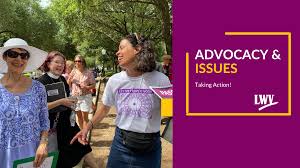
Take a look at the criminal justice , health justice, and environmental justice programs and issues focus for the NAACP and LWV Here and Here.


Why This Partnership Matters

The NAACP and the League of Women Voters were founded for different but related purposes—one to secure civil rights and combat racial injustice, the other to promote informed and active participation in democracy. Over time, their missions have intersected around a shared commitment to:


  • Equal access to the ballot
  • Constitutional protections
  • Transparent and accountable government
  • Inclusion in democratic decision-making


Through litigation, public education, and policy advocacy, both our organizations continue to play influential roles in American civic life. We can make a greater difference here in our communities when we work together!


Yours In League,

S. Warner, President

lwvbccpresident@gmail.com

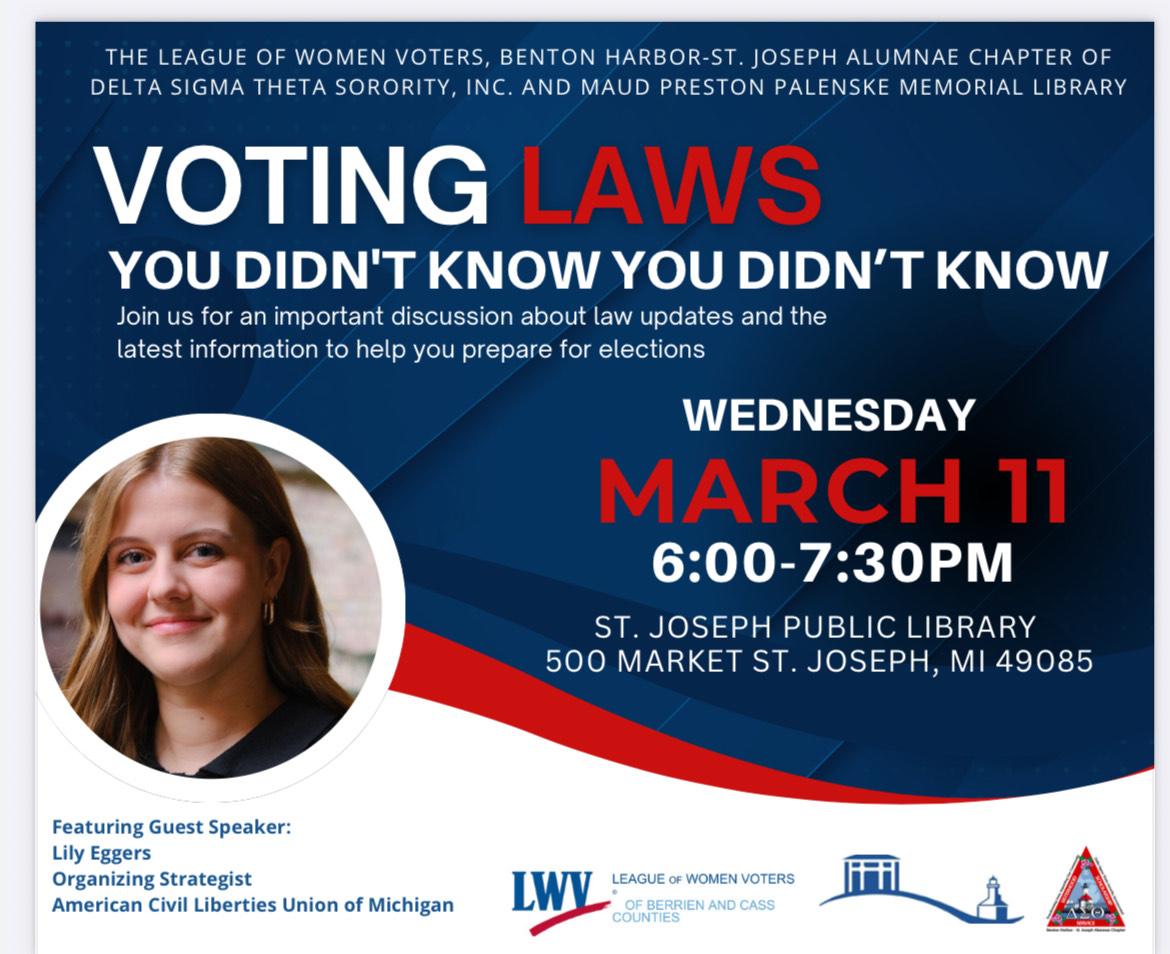
LWVBCC is Co-Hosting an Event


The Nitty Gritty: Voting Laws You Didn't Know You Didn't Know


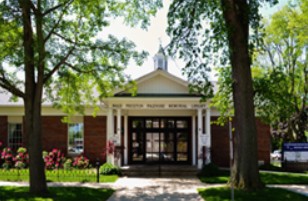
The League of Women Voters of Berrien & Cass Counties, Benton Harbor-St Joseph Alumnae Chapter Delta Sigma Theta Sorority, Inc. and Maud Preston Palenski Memorial Library are hosting "Voting Laws You Didn't Know You Didn't Know" featuring guest speaker: Lilly Eggers, Organizing Strategist for the American Civil Liberties Union of Michigan.


The presentation will be on voter rights law with a focus on rights at the booth and at registration. It will be designed to discuss the basics as well as lesser known laws affecting voting rights that affect individuals.


This is an in-person event. No RSVP is required.


Please join us on March 11, 2026 at 6:00 at the St. Joseph / Maud Preston Palenske Memorial Library for an important discussion about election law.


For more information contact:

or

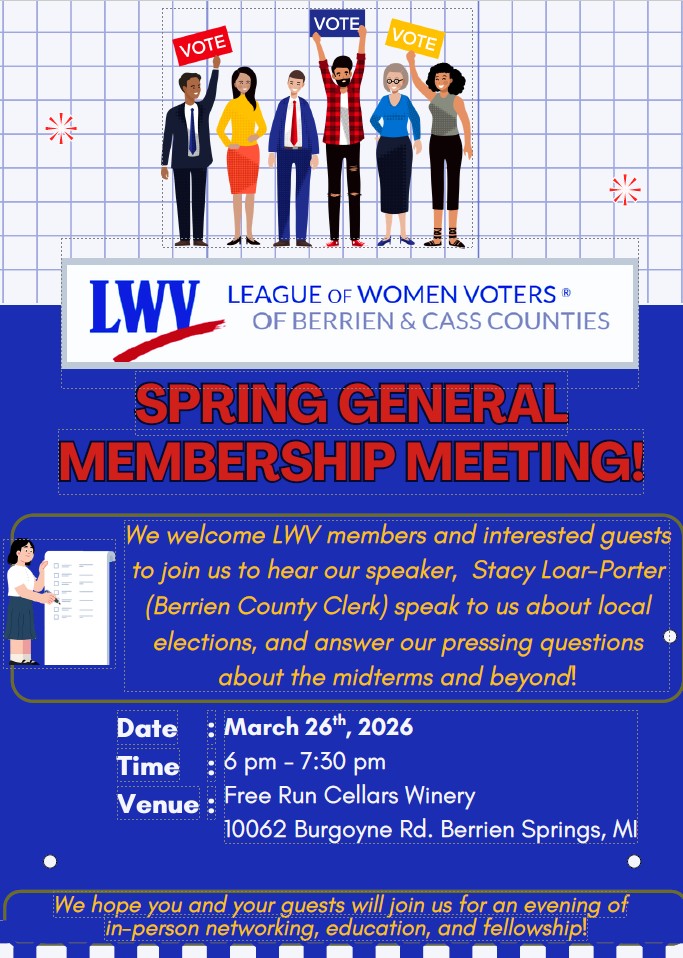
LWVBCC General Membership Meeting


Our first General Membership Meeting will be on

March 26th, at 6 pm at Free Run Winery, 10062 Burgoyne Rd., Berrien Springs, MI.


Stacy Loar-Porter, our Berrien County Clerk will speak to us about local elections, how to get involved in elections, and voter rights! There will also be time for questions.


FAQs:

  • There is NO cost to attend, drinks and food may be purchased.


  • This is an in-person event only and will not be recorded or streamed.


  • RSVP's are not required.


  • This event is open to all members and their quests.


For more information contact:

S. Warner, President

lwvbccpresident@gmail.com

Membership


We welcomed three new members in the last month and look forward to meeting them at our upcoming meetings March 11th, and March 26th. This brings the LWVBCC membership up to 115 members. I would like to encourage current members to invite neighbors, friends, and relatives to these events as well.  


I am pleased to acknowledge Karen Roth and Patricia Warner who have joined the membership committee, and I look forward to a team effort to recruit new members. There is a lot of work to do this year to protect our vote, so if anyone else is interested in working on membership activities, please let me know.


I made phone calls and left messages, but there are 33 current members whose membership expired on or before January 31, 2026 that will drop off our membership roster soon. Please don't let your membership expire. Logon to the lwvbcc.org website, and follow the instructions on how to renew your membership explained in the “Trying to Renew Your Dues?” article below.


This is where you can see your membership status and expiration date. There is also an option to automatically renew your membership each year. If you are having difficulty, please contact Val at lwvbccmembership@gmail.com or Mike at lwvbccwebmaster@gmail.com for assistance.


Val Schnable, Membership Chair

lwvbccmembership@gmail.com

Democracy Matters!


Welcome to Democracy Matters! where we cover matters of democracy and discuss why democracy matters. In this pivotal midterm election year, we will present snippets of information in this column to hopefully help you cast an informed ballot. As this election year unfolds, never forget that your voice and your vote matter!  


Improving Election Security Or Creating Roadblocks To The Polls?


According to the Michigan Department of State (MDOS) Bureau of Elections, actual voter fraud in Michigan is extremely rare and isolated: “The many security checks in our system prevent it, and when it does happen, the perpetrators are caught and prosecuted.” Michiganders cast more than 5.7 million votes in the 2024 general election. In December 2024, MDOS compared Michigan motor vehicle records to the State’s Qualified Voter File and found only 15 credible instances of purported non-citizen voting, which represented a mere 0.00028% of the greater than 5.7 million votes cast. Despite these data, federal voter security bills are in the news again.  


On Feb. 11, 2026, the U.S. House of Representatives passed (218-213) a suite of bills (Safeguard American Voter Eligibility (“SAVE Act”) and Make Elections Great Again (“MEGA Act”) relating to documentary proof of citizenship requirements to vote in federal elections. Provisions in the House bill include presentation of REAL ID-compliant citizenship documents, such as a certified birth certificate or valid passport (among others) to register and vote. 


Additionally, under these proposed bills, voters would have to present a copy of an eligible form of ID in person to request an absentee ballot. Finally, the Act would require states to send the names of all individuals on official voter rolls to the Department of Homeland Security’s Systematic Alien Verification for Entitlements system ostensibly to identify non-citizens and remove them from voter rolls. DHS could also share a voter’s name with other federal agencies to further investigate citizenship.


These proposals create suspect, burdensome, and costly requirements for voter registration and casting a ballot. First, the State of Michigan already has a robust citizenship verification system in place and prosecutes those who try to circumvent it. Second, a substantial number of eligible voters do not have an unexpired U.S. passport or access to a certified birth certificate that reflects their current name. Third, the financial costs and time burdens of obtaining such documentary proof of citizenship are not insignificant. The obvious consequence of these requirements is to disenfranchise otherwise eligible citizens of their right to vote.


Another alarming provision would subject election officials to criminal penalties for registering an individual without valid documentary proof of citizenship as defined in the Act. The burden of verifying the authenticity of the citizenship documents apparently would now be on the election official. Due to the threat of criminal penalties, these proposed bills would create a chilling effect on the willingness of people to act as election officials.  


Despite passage in the House, the U.S. Senate currently lacks sufficient votes to pass the suite of SAVE Act bills. However, legislators’ positions and/or political promises may change. Given the real risk of disenfranchisement of citizens’ ability to vote, the documentary proof of citizenship issue deserves an urgent call or email to your Senators. Click on this link for more information and how to Tell Congress to oppose the SAVE Act suite of bills.


For a more in-depth discussion of voting security and why these voter ID bills are unnecessary, take a look at the League of Women Voters-Michigan’s webinar available at this link: Let Voters Vote!  This informative presentation explains how voter rolls are maintained in Michigan and what checks exist to prevent non-eligible people from voting.  


Don Lenderman, Advocacy & Education Chair

lwvbccae@gmail.com

Book Club


As I watched the PBS News Hour tonight, I realized that many of the reporters were women, and the co-anchor of the program has been a woman for many years. Listening to NPR this morning, I heard many familiar female voices on Morning Edition and local WVPE programming. 


According to Lisa Napoli, the author of Susan, Linda, Nina & Cokie the founding mothers of NPR, would approve and would be proud of the professional integrity of each of the reporters featured every day on public broadcasting, especially the women. Her story of the four pioneering public broadcasting women reporters focuses not only on the backgrounds of the women but also on their experiences breaking into one of the most staunchly guarded male realms of journalism. Napoli included lots of stories about how each of the founding mothers encountered discrimination in their search for jobs in journalism.


In the late 60’s, there were only a few women writing reports on serious news events and very few on camera. W omen weren’t considered to be smart enough or emotionally stable enough to do serious news. And horrors, what if they got pregnant? 


The discussion around the table included some stories of book club members facing some of the same chauvinism that the founding mothers faced. The consensus of the group was that the book was mostly successful in telling a good story even though it was choppy in a few places and sent the reader paging back to sort out timelines and events.


The history of the Corporation for Public Broadcasting and NPR was well told. We discovered that the current administration isn’t the only one that has been upset by the reporting on NPR. Nixon wanted to pull their funding and was advised that he would be seen as the enemy of Big Bird and Mr. Rogers if he did. 


The next book up for the LWVBCC Book club is The Correspondent by Virginia Evans. We will be meeting at the home of Faith Schoon on March 30.


Faith Schoon, Publicity Chair

lwvbccpublicity@gmail.com

Environmental News


My folder of articles on stories about butterfly research and fighting invasive species will have to wait until next time. The administration “trumped” my original plan for this article. 


Here is the dictionary definition of “hoax” – deception, fraud, swindle, trick, flam or flimflam. That’s what the EPA now has to think about the concept of climate change. The New York Times reported on February 12 that the president said, “he was erasing the scientific finding that climate change endangers human health and the environment, ending the federal government’s legal authority to control the pollution that is dangerously heating the planet.” 


The Trump administration is saying that the vast majority of scientists around the world are wrong and they are perpetrating a hoax on the economies and energy businesses of the world. The administration argues that by rolling back the endangerment finding that guides EPA regulations, Americans will save a lot of money on transportation and energy costs. 


Supposedly auto manufacturers and businesses will save an estimated $1 trillion, but they did not specify how they arrived at that figure. The NYT states, “The repeal of the endangerment finding is expected to increase the country’s greenhouse gas emissions by 10 percent over the next 30 years, according to the Environmental Defense Fund, an advocacy group. The added pollution could lead to as many as 58,000 premature deaths and an increase of 37 million asthma attacks between now and 2055, the group said.” That’s just the tip of the iceberg. This will cause melting seas to rise and further disrupt weather patterns. 


If humans are going to be adversely affected by climate change, what about other living things, plants and animals. This week, The Bridge picked up on the story and reported,” The Trump administration announced Thursday it will no longer police climate pollution, the latest in a series of regulatory rollbacks with significant implications for Michigan’s economy, environment, and public health.” The auto industry has been reading its tea leaves and knows that consumers want a choice in vehicles and care about protecting the environment. It’s hard for an auto plant to tool up for one type of model and then retool for something else when ill-advised regulations are made or withdrawn. American car makers are watching their competition especially China.


Michigan’s power companies are in the midst of becoming more sustainable by phasing out coal and relying on wind, solar, and batteries. The Bridge reports,” While the Trump administration also aims to stop regulating greenhouse gas emissions from power plants, Michigan’s electric utilities are bound to a 2023 state law that requires them to achieve 100% clean energy by 2040.” 


Not all big business is happy with the roll back of the endangerment finding and its list of climate friendly regulations. The economist Paul Krugman writes, “So America’s hard turn against renewables and climate action won’t be decisive enough for the climate future as long as other countries continue to move ahead on green energy, which they are.


For the most part, (the administration’s denial of climate change) will help make the United States backward, poorer, sicker, and irrelevant.” There are many lawsuits planned. Hopefully, they will succeed and the EPA will again be able to fulfill its mission of protecting the environment and the planet.  


Faith Schoon, Publicity Chair

lwvbccpublicity@gmail.com

Going 'Plastic-Free'


My focus last month was “why” the consumption of nano-plastics and microplastics is bad for our bodies. Unfortunately, plastics are everywhere, and it’s impossible to eliminate the consumption and breathing of plastics. They’re in our food, air, water, car tires, packing materials, synthetic clothing, and beauty products.


But I have suggestions from the New York Times and the Food and Water Watch websites on “how” to avoid nano-plastics and microplastics from entering your body as much as possible.

  1. Don’t microwave anything in plastic. Heat allows plastics to release harmful chemicals like BPA.
  2. Filter water using a NSF certified water filter. It’s ironic that the filters are made of plastic, but microplastic shedding is likely to be minimal. Avoid using hot water through the filter and store the water in the refrigerator. Use glass or steel water bottles.
  3. Store food in metal or glass containers. Bring your own metal or plastic take-home containers when dining out.
  4. Avoid plastic cutting boards, kitchen tools, utensils, and nonstick pans.
  5. Avoid buying food packaged in plastic. Personal note: I used to buy Panera Salad Dressing because I liked the choice of flavors, and it was packaged in a glass bottle. The last time I was going to purchase this dressing, it was packaged in plastic. I have found another brand packaged in glass, Lighthouse, which I will now purchase instead of Panera. I plan to let Panera know of my decision.
  6. Buy organic as much as possible to reduce exposure to pesticides.
  7. Reduce consumption of red meat. Chemicals like to hang out in fatty foods.
  8. Use natural cleaning materials like water, baking soda, and vinegar. There are many DIY formulas online.


Make sure you’re registered to vote, and make your voice heard. Find out where your representatives stand on reducing plastics. The fossil fuel industry pushes the manufacturing of plastic products because the main ingredient in plastics is derived from fossil fuels.


If you have any more suggestions and/or resources to share, please send them to me: lwvbcc@gmail.com. I will include them in future editions of the newsletter.

In upcoming newsletter editions, I plan to give more specific suggestions on how to avoid plastics and include resources for products which are plastic free.


Until then,


Carla Ripley, Co-Treasurer

lwvbcc@gmail.com 

Trying to Renew Your Dues?


LWVBCC members are encouraged to renew their membership online using the League’s new online system.


If your dues renewal date is approaching, you will receive reminder emails 60 days, 30 days and on your membership expiration date asking you to renew. Please check your spam folder. Forty-five days after your membership expiration date you will receive your final notice, and after 60 days you will be dropped from membership if you do not renew.


To renew your membership, click on the link provided in one of the emails you have received, and follow the prompts. If you have not received the renewal email from LWVUS or have misplaced it, logon to lwvbcc.org and click on the "LWV Member Portal" button and click on the "Renew" button on the next page then follow the prompts.


If you are having trouble with the online system, feel free to contact LWVBCC Webmaster Mike Schnable at LWVBCCWebmaster@gmail.com.


If you would like to avoid the online system, you can mail your dues check to our Treasurer (a minimum of $20; the standard is $75), payable to LWVBCC:

John Ripley, LWVBCC

PO Box 1032

Niles, MI 49120


You can also give us a donation at this time by sending us a separate check. Just make it out to LWVBCC and be sure to indicate which check is for dues and which check is for the donation.


Thank you for renewing your dues. We need every single voice to save our democracy!


Mike Schnable, Webmaster

lwvbccwebmaster@gmail.com

2026 MI Election News


Voters may register by mail or online if an election is 15 or more days away.


If the election is within 14 days, a voter must register in-person with their Local Clerk and present proof of residency.


Voters in line by 8pm on Election Day have the right to register to vote in person at their local clerk's office:


  • Monday, April 20, 2026 - is the deadline to register online or by mail to be eligible to vote in the May 5, 2026 Special Election
  • Monday, July 20, 2026 - is the deadline to register online or by mail to be eligible to vote in the August 4, 2026 Primary Election
  • Monday, October 19, 2026 - is the deadline to register online or by mail to be eligible to vote in the November 3, 2026 General Election


 ** Always verify your voter registration status with the Michigan Secretary of State - https://mvic.sos.state.mi.us/Voter/Index/

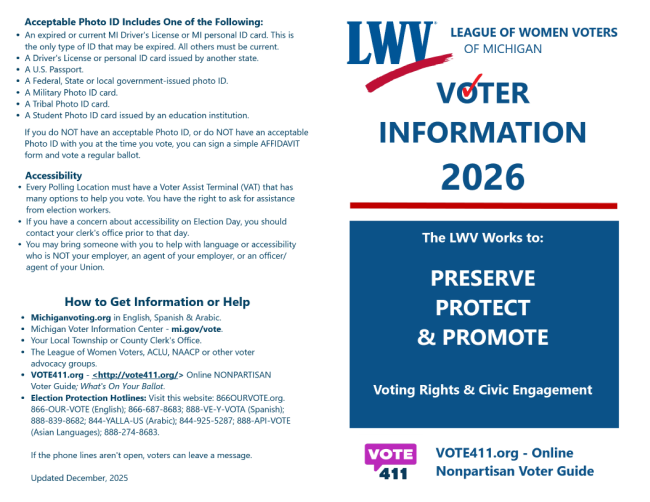
LWV MI Voter Information 2026!


Here is the link to the very information flyer. Please share!!


Topics include:

  • How do I register to vote?
  • Michigan has two options to vote early
  • What are the photo ID requirements to vote?
  • Accessibility

Attend your Local

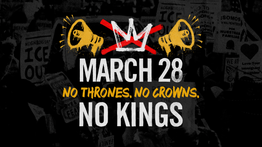
No Kings Protest March 28


LWVUS is joining No Kings as a national partner on Saturday, March 28. 


In response to the Trump administration’s escalated, violent attacks on everyday Americans in Minnesota and nationwide, The No Kings Coalition has activated an immediate and ongoing nationwide digital organizing effort leading up to their next mass mobilization on March 28.


Check the No Kings official website for specific local events in your area as the date approaches. 

Newsletter

Tech News

"The Voter" newsletter now has embedded links to take you to the additional information & websites referred to in the articles, or from sponsors, LWV or Vote411 logos.


Look for the text that is blue and underlined or when the "finger click image" icon appears when moving your cursor across an image or text.


Mike Schnable, Webmaster

lwvbccwebmaster@gmail.com

Looking for up-to-date LWVBCC information between newsletters? Check out the LWVBCC Facebook and website by clicking on the links in this Newsletter's footer.


Calendar of Events


February

Black History Month


February 14

LWV Turns 106


March 8

International Women's Day


March 9-13

Civic Learning Week


March 11

The Nitty Gritty: Voting Laws You Didn't Know You Didn't Know

at St Joseph/Maud Preston Palenski Memorial Library

6-7:30pm


March 26

General Membership Meeting

at Free Run Winery

6-7:30pm


March 28

No Kings Day

Book Club Calendar

All meetings are at 10am


March 30

The Correspondent

by Virginia Evans

Location: Home of Faith Schoon


May 11

Giving Up is Unforgivable

by Joyce Vance

Location: TBA

LWVBCC

Board of Directors


President - Sarah Warner

Vice President - Beverly Gray

Secretary - Dorothy Parker

Treasurers - John & Carla Ripley


Advocacy & Education

– Don Lenderman

Community Outreach

– Sarah Warner

Local & State Government Observation – Open

Membership – Val Schnable

Publicity – Faith Schoon

Voter Services – Beverly Gray 

Webmaster – Mike Schnable

Quick Links

LWVBCC SPONSORS


Please Tell Them You Saw Their Ad In The League Of Women Voters Newsletter!

Joe Jilek

Insurance Agency & Finance Services

(269) 695-2200

LWVBCC SUPPORTERS


We Appreciate Their Donations

LWVBCC PARTNERS


Collaborative Outreach Initiative

St Joseph / Maud Preston Palenske Memorial Library

NAACP Niles-Buchanan

Please Encourage 

Membership in LWVBCC


Non-Partisan Policy
The League as an organization does not support or oppose any political party, candidate for elected office, or any group that supports candidates. As individuals, though, but not as representatives of the League, members are encouraged to participate in political activity and to run for office. Our non-partisan policy does require two Board members--the President and the Voter Service Chair--to totally abstain from partisan political activity.