NSA Sunflower Survey and Drought
|
|
Ryan Buetow
Dickinson Research Extension Center
701 456-1106
|
|
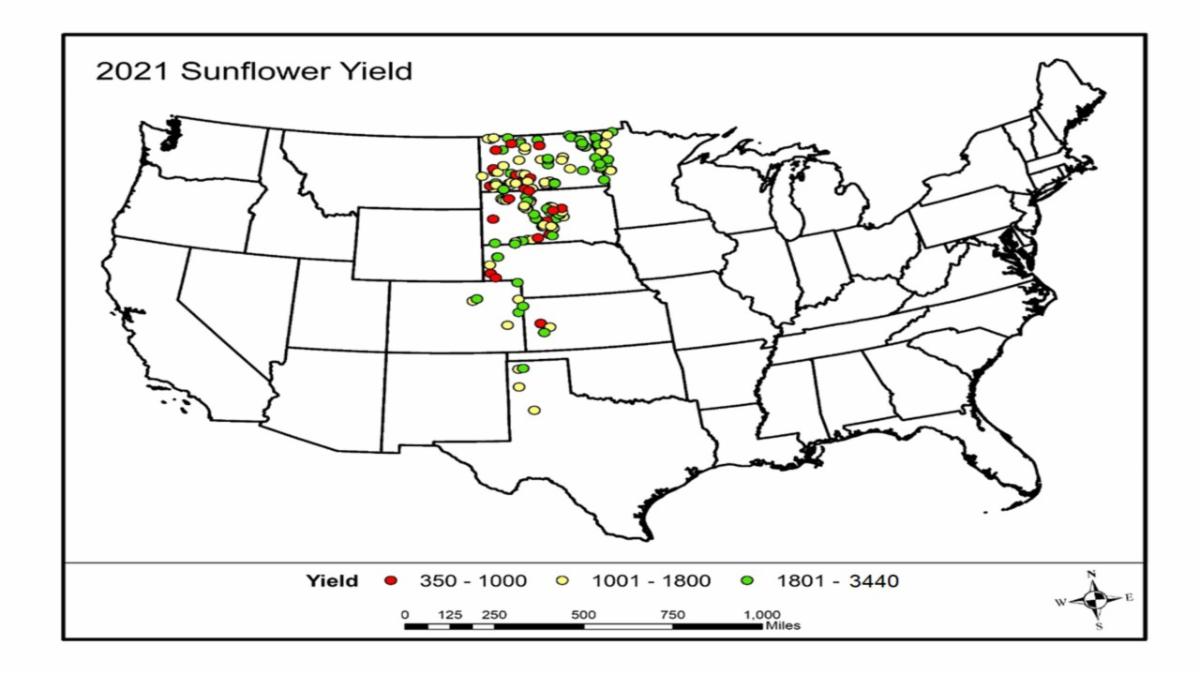
Since 2001 the National Sunflower Association has coordinated a field survey that estimates yield and tracks agronomic factors affecting yield. Factors that limited yield have been disease, insects, and weeds that occurred in each field. That survey has continued initially every year, and starting in 2013, every other year. During the 2021 sunflower growing season, trained teams of agronomists, entomologists, pathologists, and Extension agents, surveyed fields across North Dakota, South Dakota, Minnesota, Kansas, Colorado, Texas and Nebraska (figure 1). A majority of the fields surveyed were in North Dakota with 79 completed surveys. South Dakota had 52 completed surveys. A total of 164 fields were surveyed.
|
|
Management and yield factors
Each team evaluated plant stand, yield potential, disease, insect, and weed issues for each field. A yield estimate was calculated based on plant stand, head size, filling of the head, seed size, percent filled seeds, and percent loss due to bird feeding. North Dakota estimated yield for 2021 averaged 1,553 lbs/acre (Figure 2), lower than the 2019 average of 1,781 lbs/acre.
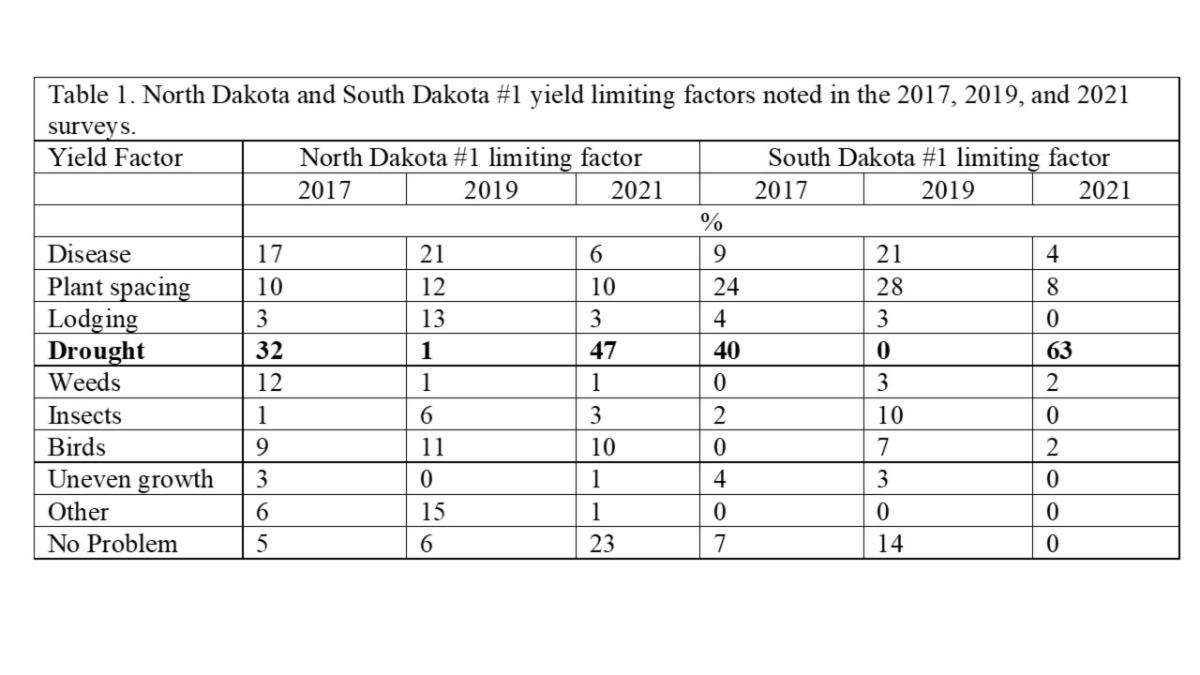
While 2017 and 2021 would be considered drought years with a majority of all fields surveyed claiming drought as the number 1 factor with 51%, the opposite was an issue in 2019. With excessive moisture in 2019 disease was a major issue across many surveyed fields with 25% of the 133 total fields considering it a number one factor (Table 1). Plant spacing within the row has been a consistent issue across survey years. Plant spacing issues could be caused by planting and equipment issues, environmental issues with germination and emergence, or insects and other pests early in plant growth. Across all surveyed fields 9% had plant spacing as the number one factor, 9% no problem, and 7% disease.
|
|
The sunflower disease Phomopsis has been growing as an issue over the years. Through this survey we were able to locate different species of the disease and where they are prevalent. This will assist in research towards resistant varieties. This sunflower survey helps track issues over time and allows for the National Sunflower Association to direct research and outreach dollars to priority areas. Not all issues impacting sunflower production can be directly fixed with management. Drought has consistently been an issue for southwestern North Dakota and although sunflower is one of the better crops at adapting to drought it still can have a major impact on yield. The US drought monitor (https://droughtmonitor.unl.edu/) utilizes weather data, models, and on the ground reports to influence drought intensity mapping. This map is often directly utilized to influence emergency relief funding. To assist in the accuracy of this map be sure to send photos of any drought issues such as soil cracking, reduced germination, crop stress, and low stock ponds to your local county extension agent. Hopefully this year we will receive adequate moisture, but when there is adequate moisture still take pictures to show as a comparison during future, more difficult times.
|
|
The NDSU Extension does not endorse commercial products or companies even though reference may be made to tradenames, trademarks or service names. NDSU encourages you to use and share this content, but please do so under the conditions of our Creative Commons license. You may copy, distribute, transmit and adapt this work as long as you give full attribution, don’t use the work for commercial purposes and share your resulting work similarly. For more information, visit www.ag.ndsu.edu/agcomm/creative-commons.
County commissions, North Dakota State University and U.S. Department of Agriculture cooperating. NDSU does not discriminate in its programs and activities on the basis of age, color, gender expression/identity, genetic information, marital status, national origin, participation in lawful off-campus activity, physical or mental disability, pregnancy, public assistance status, race, religion, sex, sexual orientation, spousal relationship to current employee, or veteran status, as applicable. Direct inquiries to Vice Provost for Title IX/ADA Coordinator, Old Main 201, NDSU Main Campus, 701-231-7708, ndsu.eoaa@ndsu.edu. This publication will be made available in alternative formats for people with disabilities upon request, 701-231-7881.
|
|
|
|
|
|
|