NATIONAL DAY OF PRAYER IN SOLIDARITY WITH
INDIGENOUS PEOPLES OF CANADA
|
|
Dear CLC Colleagues
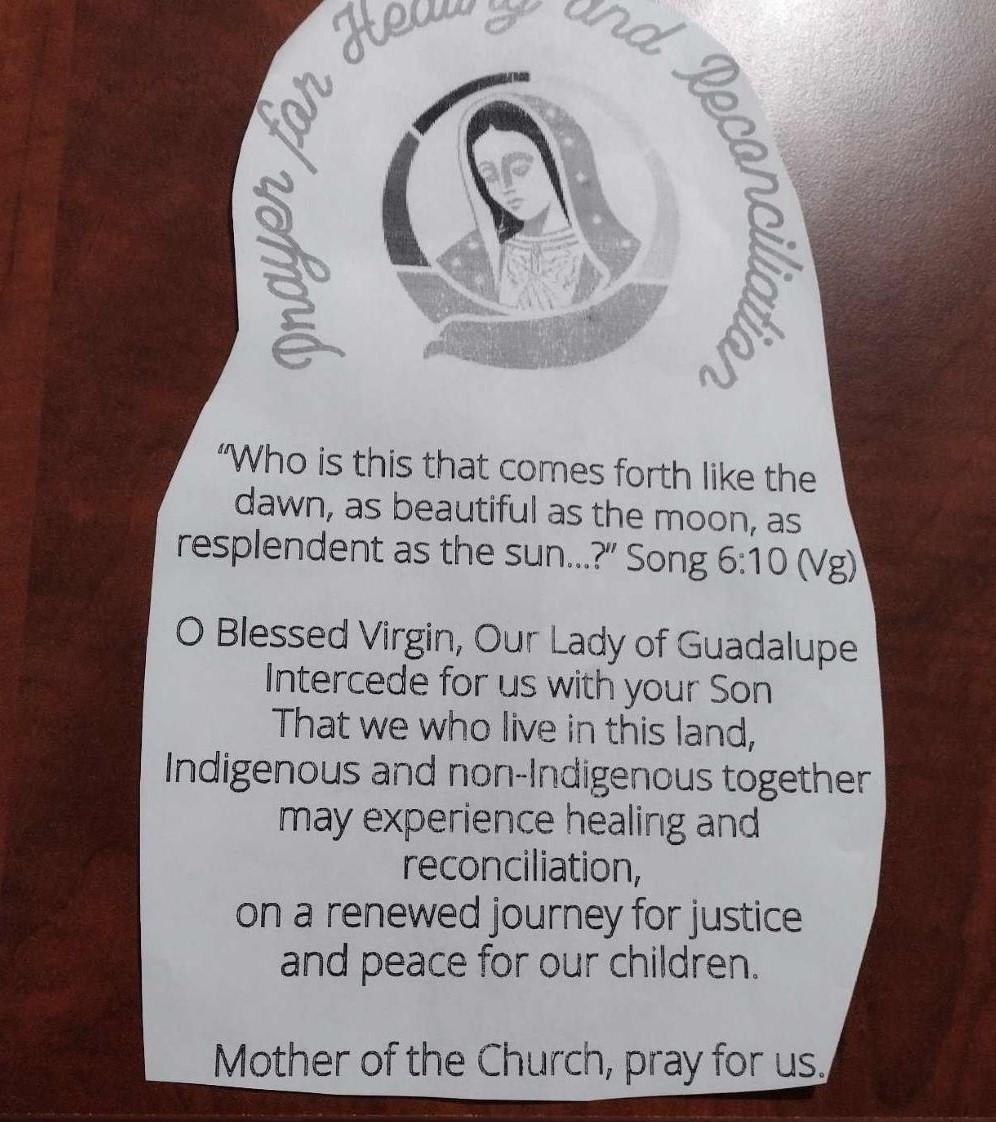
On December 12th, we will celebrate the National Day of Prayer in Solidarity with Indigenous Peoples of Canada. On this day we also celebrate the feast day of Our Lady of Guadalupe.
Below, you will find two submissions from, Graydon Nicholas, CLC Atlantic Region. The first was written in 2014. In it Graydon traces the history of this National Day and also, the appearences of Our Lady of Guadalupe to St.Juan Diego, an indigenous person, who lived under Spanish colonial rule in what is now Mexico. St Juan Diego was canonized on July 31st (St. Ignatius' feast day!) 2002, by Pope John Paul II. He is the first Indigenous Catholic saint for all the Americas. His feast day is December 9th.
(St. Kateri Tekakwitha is the first Indigenous North American saint. Her feast day is July 14th.)
The second submission (English and French versions) is a summary of 2022 events, including Pope Francis' visit to this land's Indigenous communities.
Graydon is a membrer of Our Lady of Guadalupe Circle, "a Catholic coalition of Indigenous people, bishops, clergy, lay movements and institutes of consecrated life, engaged in renewing and fostering relationships between the Catholic Church and Indigenous Peoples in Canada."
For more information, visit their website:
|
|
National Day of Prayer in Solidarity with Indigenous Peoples of Canada (2014)
The Catholic Aboriginal Council for Reconciliation was created by the Canadian Conference of Catholic Bishops (CCCB) in 1998 to provide resources to increase awareness of aboriginal issues, to support processes of healing and to foster aboriginal faith leadership in the Christian community. In 2002, this Council recommended that each year December 12 be a National Day of Prayer for Aboriginal People. This is a fitting date as it is the Feast Day of Our Lady of Guadalupe who is recognized as Our Lady of the Americas.
When the Blessed Mother appeared to Juan Diego between December 9, 10 and 12, 1531, she spoke to him in compassionate terms. She used the words my most abandoned son in her dialogue contained in the Nican Mophua. Juan Diego did not feel that he was worthy to be the messenger for her to make representations to Bishop Juan de Zumarraga. In fact, when the Bishop would not believe Juan Diego that he met Mary and gave him the message, Juan Diego felt very dejected. He asked Mary to send someone else more important and worthy. Again, Mary told him that she could send someone else. However, she told him that he was her choice to have him speak to the Bishop, so that her desire to have a chapel built where people could be comforted by her, would become a reality. Mary was very much aware of the abuse that Juan Diego and his people were receiving from the conquering Spaniards.
On the morning of December 12, 1531, the Blessed Mother asked Juan Diego to gather the flowers on Tepeyac Hill, to bring them to her, so that she could rearrange them in his cloak. She then asked Juan Diego to deliver these flowers, gathered in his tilma, as a sign for the Bishop. She called Juan Diego her ambassador in whom she had complete trust. Her words to him were with all of my strength, I command you that only in the presence of the bishop are you to open your mantle, and let him know and reveal to him what you are carrying. You will recount everything well; you will tell him how I sent you to climb to the top of the hill to cut flowers, and all you saw and admired. With this you will change the heart of the lord of the priests so that he will do his part to build and erect a temple that I have asked for. Through her miraculous Image and the acceptance of Mary’s message, in a short period of ten years [1531-1541], there were nine million conversions to the Catholic faith by the indigenous people of Mexico. Mary’s appearance succeeded where the missionaries and Spaniards failed in convincing the indigenous people to become followers of Jesus.
This is the eight year of this celebration. Now, this date has been renamed as the National Day of Prayer in Solidarity with Indigenous Peoples in Canada. Pope John Paul II visited Canada in 1984. In his speech in Huronia, Ontario, on September 15, 1984, he told the gathered aboriginal people that: Thus the one faith is expressed in different ways. There can be no question of adulterating the word of God or of emptying the Cross of its power, but rather of Christ animating the very centre of all culture. Thus, not only is Christianity relevant to the Indian peoples, but Christ, in the members of his Body, is himself Indian.
On this day of December 12, 2014, we are encouraged to gather in prayer and celebrate our indigenous identity with our Catholic faith and be grateful of those who minister to our spiritual needs and to prayer for all of our brothers and sisters.
|
|
National Day of Prayer in Solidarity with Indigenous Peoples (2022)
This year, we have been blessed to have had a delegation of Indigenous people visit Pope Francis in Rome in order to receive his apology on behalf of the Roman Catholic Church, and again to welcome the Holy Father to this land to hear his words of sorrow as he embarked on his, self described, “Pilgrimage of Penance”. Let us take this opportunity to build on the reflections offered by Pope Francis.
The Holy Father comments that he is struck by the Indigenous delegations’ wise and farsighted term “traditional wisdom” as it applies to the need to consider the impact of deliberations as far into the future as the seventh generation. Pope Francis’ understanding of the family bond over generations, and its importance in moving forward with reconciliation is instructive and it opens the door for all Catholics to learn about and apply understandings of the Indigenous world view towards reconciliation.
In Rome, Pope Francis remarked, “The ties that connect the elderly and the young are essential. They must be protected lest we lose our historical memory and very identity”. At the Mass in Edmonton, celebrating the feast day of Saints Anne and Joachim, the Holy Father recognized the gift that is family and how, “No one comes into this life detached from others. The love that awaited us and welcomed us into this world are part of a unique history that preceded us… we did not choose that history; we received it as a gift.” This is consistent with the insight from an Elder from Cold Lake, Alberta who responded to a question about why Indigenous parents were indulgent with their children, saying, “We must not injure the child’s spirit”. Children’s experiences of abuse at the hands of those who would shape their lives are contrary to this principle and that, in Indigenous settings, family ties are to be nurtured, protected, and cherished as the gift they are.
As Catholics, we share this value of strengthening nuclear and extended family ties, but we often do not see the many ways that colonization continues to impact the very thing we cherish. Indigenous voices have expressed that “residential school” continues in other forms. Child welfare authorities remove Indigenous children from nuclear and extended family settings. Canada’s justice system also removes parents from children which seriously affects opportunities for continuity of relationships, identity formation and indeed wholesome human development. As Catholics concerned about reconciliation, can we advocate for changes to these contributors to continued intergenerational trauma?
Maintenance and strengthening of family ties are very much in evidence in many Indigenous traditions from Powwows, which unite all generations in the gift of dance and feast, to the traditional wisdom demonstrated in the ‘pipe of peace’ smoking ceremony whose symbols teach the interdependence of all beings in creation.
These are but a couple of examples from many traditions that can be further explored to help us acquire an understanding of Indigenous peoples, as part of the reconciliation journey.
During his visit to Iqaluit, the last stop before his return to Rome, Pope Francis shared the words of an Elder who spoke of the beautiful spirit that reigned in Indigenous families before the advent of the Indian Residential School system. “He compared those days of grandparents, parents and children living harmoniously together as to springtime when the birds chirp happily around their mother. But then the singing stopped, families were broken up. Winter fell over everything”.
As we grow in our knowledge of one another and move away from stereotypes toward an increased understanding of our unique and shared beliefs and values, may our journey of reconciliation bring the springtime back once again and may our winter of shame be banished forever.
Canadian Catholic Indigenous Council
|
|
Journée nationale de prière en solidarité avec les peuples autochtones 2022
Cette année, nous avons eu la chance d’avoir une délégation d’Autochtones qui a rendu visite au pape François à Rome afin de recevoir ses excuses au nom de l’Église catholique, et d’accueillir le Saint-Père dans notre pays pour l’entendre exprimer sa douleur alors qu’il entreprenait ce qu’il a appelé un « pèlerinage de pénitence ». Profitons de cette occasion pour nous appuyer sur les réflexions du pape François.
Le Saint-Père dit avoir été frappé par la justesse et la clairvoyance de l’expression « sagesse traditionnelle » utilisée par les délégations autochtones, car cette dernière souligne la nécessité de tenir compte de l’impact de nos délibérations aussi loin dans l’avenir que la septième génération. La compréhension qu’a le pape François des liens familiaux entre les générations et de leur importance pour progresser sur la voie de la réconciliation est particulièrement éclairante et appelle tous les catholiques à apprendre et à mettre en pratique des perspectives du monde autochtone vers la réconciliation.
« Les liens qui unissent les aînés et les jeunes sont essentiels, a souligné le pape François à Rome. Il faut les protéger, car nous risquons autrement de perdre notre mémoire historique et jusqu’à notre identité. » Lors de la messe à Edmonton, en la fête de sainte Anne et saint Joachim, le Saint-Père a reconnu le don qu’est la famille et a souligné que « personne ne vient au monde détaché des autres. L’amour qui nous attendait et qui nous a accueillis dans la vie s’insère dans une histoire unique qui nous a précédés… nous n’avons pas choisi cette histoire; nous l’avons reçue en cadeau. » Cela correspond à la réponse d’un aîné de Cold Lake, en Alberta, à qui l’on avait demandé pourquoi les parents autochtones font preuve de tant d’indulgence envers leurs enfants : « il ne faut pas blesser l’esprit de l’enfant ». Les sévices subis par des enfants aux mains de personnes qui doivent façonner leur vie violent ce principe et qu’en milieu autochtone, les liens familiaux doivent être cultivés, protégés et chéris pour le cadeau qu’ils sont vraiment.
En tant que catholiques, nous reconnaissons, nous aussi, l’importance de renforcer les liens de la famille nucléaire et de la famille élargie, mais souvent, nous fermons les yeux sur les différentes façons dont la colonisation continue d’affecter ces valeurs que nous défendons. Des voix autochtones ont souligné que les « pensionnats » continuent d’exister aujourd’hui sous d’autres formes. Les services de protection de l’enfance arrachent des enfants autochtones de leur famille nucléaire et élargie. Le système judiciaire canadien sépare aussi les parents de leurs enfants, ce qui compromet gravement la continuité des liens entre eux, la formation de l’identité et, en fait, l’équilibre du développement humain. En tant que catholiques soucieux de réconciliation, pouvons-nous réclamer des changements aux actes qui contribuent à perpétuer le traumatisme intergénérationnel?
L’entretien et le renforcement des liens familiaux sont bien évidents dans plusieurs traditions autochtones, du pow-wow qui rassemble toutes les générations autour du don de la danse et de la fête, à la sagesse traditionnelle illustrée par la cérémonie du « calumet de la paix » qui démontre l’interdépendance de tous les êtres au sein de la création.
Ce ne sont là que deux exemples des nombreuses traditions qu’on peut approfondir pour mieux comprendre les peuples autochtones, dans le contexte du cheminement vers la réconciliation.
Lors de sa visite à Iqaluit, dernière étape avant son retour à Rome, le pape François a échangé avec un aîné qui évoquait l’esprit qui régnait dans les familles autochtones avant l’avènement du système des pensionnats pour autochtones. « Cette époque où les grands-parents, les parents et les enfants vivaient ensemble dans l’harmonie, il la comparait au printemps et au joyeux gazouillis des oisillons autour de leur mère. Mais le printemps s’est arrêté, les familles ont été brisées. L’hiver a tout enseveli. »
Au fur et à mesure que nous apprenons à nous connaître les uns les autres et que nous nous éloignons des stéréotypes pour mieux comprendre les croyances et les valeurs qui nous sont propres et celles que nous avons en commun, puisse notre cheminement vers la réconciliation ramener le printemps à nouveau et bannir à tout jamais l’hiver de la honte.
Conseil catholique autochtone du Canada
|
|
|
|
|
|
|