| |
| |
| |
Corpse Plant
Lane Parker, UC Master Gardener, Yolo County
If you’re searching the plant kingdom for a truly rare and dramatic specimen, then Titan arum (Amorphophallus titanum), a plant in the Araceae family dating back to the Early Cretaceous, will check most of the boxes.
Titan arum is the largest “inflorescence” - its structure is composed of individual flowers - in the plant kingdom, growing up to twelve feet tall in the wild, and about eight feet tall in cultivation. It doesn’t bloom until reaching maturity at seven to ten years, and after that only blooms again once every three to five years, the bloom lasting a mere couple of days. During that blooming period the odor it releases to attract pollinating insects, such as carrion beetles and flies, smells like rotting flesh, giving it the familiar name corpse flower, or corpse plant.
Native to the tropical rainforests of Sumatra, the scientific community discovered the corpse plant in 1878. It’s now considered endangered, with fewer than around a thousand plants estimated left in the wild. Logging and palm plantations have decimated the plant’s native habitat. Cultivated plants are currently sheltered in botanical gardens and conservatories around the world, beginning in 1889 with a specimen flowering at Kew Gardens, London. The first recorded flowering of Titan arum in California was at The Huntington in San Marino, Southern California, where two plants, Odora and Scentennial, have most recently bloomed on July 22, 2024, and July 30, 2024, respectively.
Yes, in addition to its common name, each corpse plant is usually given a nickname. In San Francisco, a corpse plant nicknamed Mirage last bloomed at the California Academy of Sciences in late February 2024. Just a few blocks away, the Conservatory of Flowers features Scarlet, which first bloomed there in 2019, and Chanel, which bloomed in June 2022.
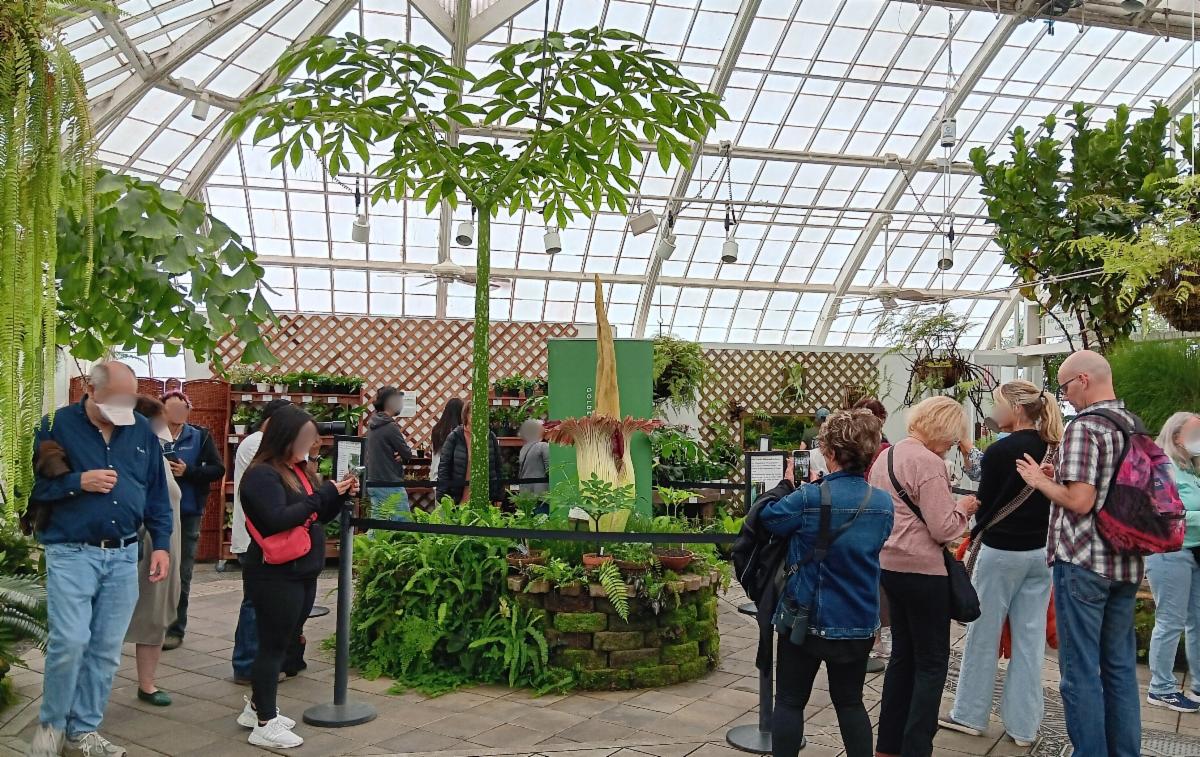
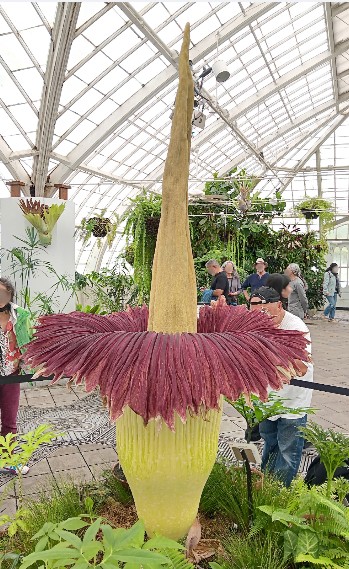
In early July 2023, I visited Scarlet during its latest bloom. Even taking the raised bed into account, Scarlet was definitely the most impressive flower I’d ever seen. Awesome even. Then I discovered that the “flower” I thought I was looking at, with its ruffled scarlet interior, was in fact a modified leaf called a spathe, which conceals and protects the numerous true flowers inside at the base of the towering spadix. As for the tree standing next to Scarlet: I thought the Conservatory had placed it there for aesthetic reasons. It turns out that the “tree” was in fact the corpse plant’s single compound leaf, the largest of any plant species, comprised of many leaflets. In the wild, those compound leaves can grow to twenty feet high.
The only disappointment was the smell, or in this case the lack of it. I’d heard that the corpse plant is notorious for exuding a strong stink of rotting flesh. I did smell a faint, sickly-sweet “meaty” odor, but it didn’t pack much of a punch. This could have been because the cordon surrounding Scarlet kept visitors at a slight distance, and because of the well-circulated cool air in the large space of the Conservatory’s Special Exhibits wing.
Still, the experience was unforgettable and worth the visit, and I plan on returning when Scarlet or Chanel bloom again. Unfortunately, not even the folks at the Conservatory can predict when that will be.
Besides Mirage, Chanel and Scarlet, the most recent documented blooms of a corpse plant happened earlier this year, at the Royal Botanic Garden in Sydney, Australia, when Putricia bloomed on January 23. At the Brooklyn Botanic Garden in New York City, an A. gigas corpse plant nicknamed Smelliot finished blooming on January 26.
Because of its unique climatic requirements and complex life cycle, cultivating the corpse plant is challenging for the hobbyist, though one plant reportedly flowered in 2011 at Roseville High School in Roseville, California.
Yet we corpse plant fans can always take advantage of the online sites that offer live coverage when a Titan arum is set to bloom. And there are many other videos and online images available, including at Corpse plants | United States Botanic Garden (usbg.gov) and Now Blooming: Corpse plant | The Huntington.
Also, though admittedly it’s not the same, we can always buy a pitcher plant or Venus flytrap and give it a clever nickname.
Photos: Scarlet in bloom at the Conservatory of Flowers in San Francisco by Lane Parker, adapted.
| | | | |
Notes From My Garden: The Balancing Act of a Gardener
Joy Sakai, UC Master Gardener, Yolo County
Our home in Visalia was in a rural housing development. That may sound like an oxymoron to some readers, but we lived in a small island of homes, outside of the city limits, and surrounded by orchards. No sidewalks, no street lights, oak trees everywhere, and you could easily walk to the St. John’s River about a half-mile away. To our family it was a little piece of heaven. We had owls, red-tailed hawks, bats, and toads, all of which are gardeners’ allies. We also had gophers, field mice, and opossums. I lost fig trees to gophers, and dozens of chicken eggs to predatory jays. For thirty-five years my life was a continuation of lessons gained from the many weekends spent in a family cabin in the mountains: a supportive environment nurtures an entire web of life, and a balancing act between human desires and nature’s needs.
Moving to our house in Woodland was a huge environmental change for us. I remember staying there one evening before we moved in permanently. We went to bed with all our windows open (it was hot) and in the morning I heard nothing but the sounds of traffic and not a bird, or toad, or any crickets the night before either. I decided we needed to start planting trees immediately.
Eight years later I can say that our behavior changed the microenvironment here, for the positive, I hope. By planting native plants and shrubs and at least a dozen different small to medium-sized trees we have invited the birds in. We hear birds throughout the seasons. Hummingbirds to jays, mockingbirds and mourning doves, the birds are here. But, so are the other critters that we think of as ‘pests’. My goal is to keep them in balance.
We built a chicken run when we moved here because there is nothing better than fresh eggs for cooking and baking. Lately, my husband has been working overtime to keep the wild birds out of our chicken coop. Some of them love to peck holes in eggs and suck up a snack. We are also concerned about the H5N1 avian influenza. The avian influenza virus is no laughing matter. Nationally and beyond, we are in a phase where this virus has spread to dairy cattle, cats and dogs, as well as a number of humans.1 You may see this influenza referred to as HPAI or highly pathogenic avian influenza. If you have chickens, there are steps to take to protect your flock.2
Beyond the very real concern about HPAI, the food that chickens eat draws rodents and the chickens themselves draw raccoons that the backyard gardener/farmer has to deal with. Two summers ago, rats got to eat more of our tomatoes than we did! Not a year has gone by that a raccoon hasn’t managed to drag a chicken out of the coop and kill it. Where rats are concerned, limiting the access to food, keeping vines and shrubs pruned, and using traps as needed are about the best a gardener can do to ensure humans get more out of the garden than the rodents.3 Good luck to anyone who thinks they can be eradicated.
There is quite a lot of discussion on how gardening is a positive activity for people. A connection to nature is thought to improve mood, cognition and health. Capaldi et al say it “would have been evolutionarily adaptive for our ancestors to be connected to nature in order to survive and thrive in their immediate environmental circumstances.” 4 In my opinion, breathing, seeing, and listening in a garden or other natural space helps us become better stewards and more appreciative of nature. Life in nature is a two-way street.
- CDC – Avian Influenza (Bird Flu) Past Reported Global Human Cases… by Country, 1997-2025
- The American Animal Hospital Association – H5N1 in backyard poultry: What you need to know
- UC IPM - Home and Landscape - Rats
- National Library of Medicine – PubMed Central – The relationship between nature connectedness and happiness: a meta-analysis
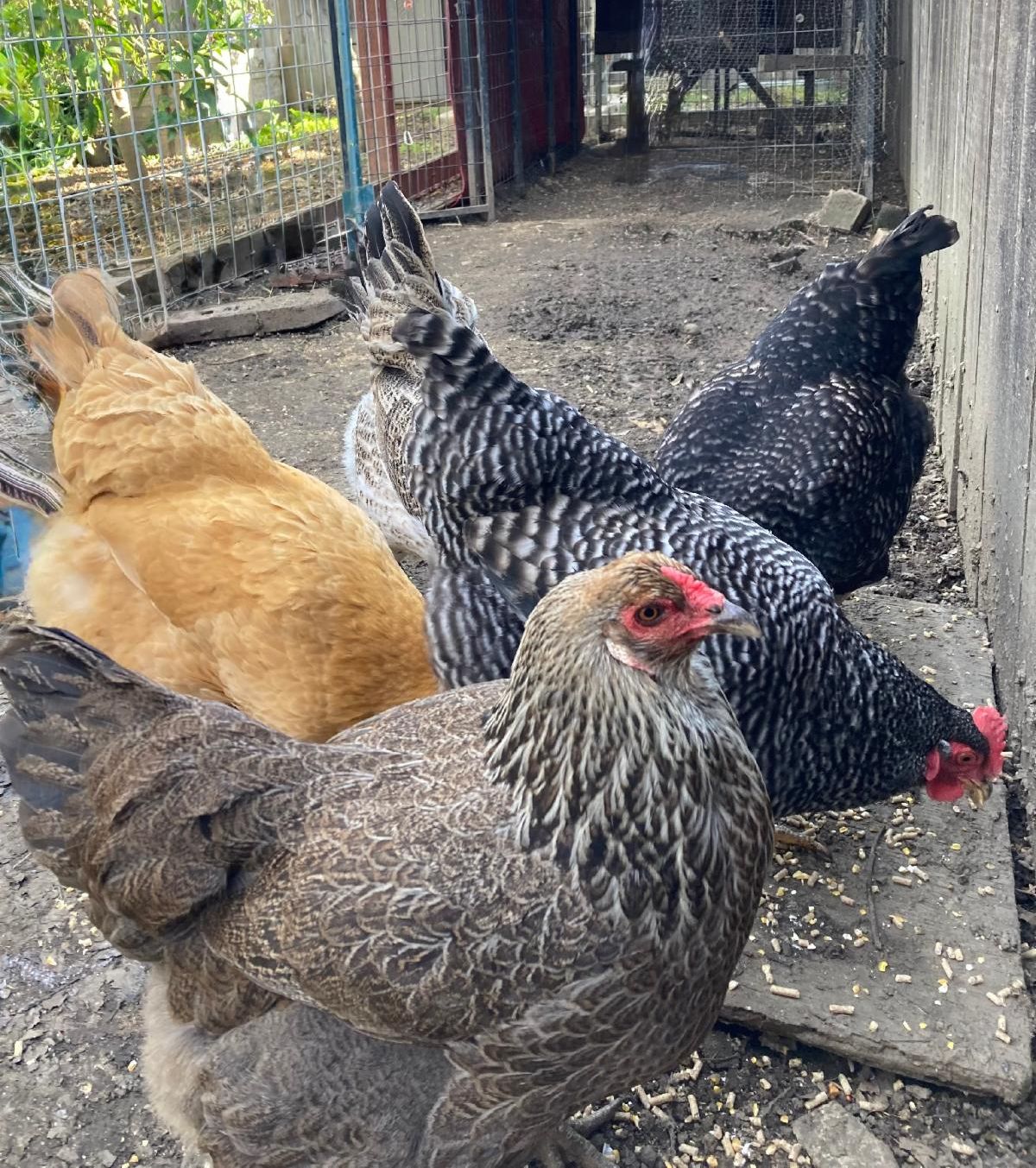
Photo: Backyard chickens by Joy Sakai, adapted
| | | | |
The Nature Cure
Tanya Kucak, UC Master Gardener, Yolo County
Spending time in gardens and parks can not only make you healthier and happier, it can also make you more resilient and “a better member of civilization,” Florence Williams said in a keynote talk at the 2023 Wild Wonder conference. Williams has traveled around the world to interview scientists studying the connections between nature and mental health. She wrote about this research in her book Nature Fix: Why Nature Makes Us Happier, Healthier, and More Creative.
For instance, in Japan, she learned that fifteen minutes of walking forest therapy trails resulted in reduced blood pressure, lower heart rate, and lower levels of stress hormones. In South Korea, “healing forests” are “managed for mental health and well-being.” Denmark has twelve-week horticultural therapy programs for people with severe depression, which are “the most successful return-to-work intervention” there.
On a larger scale, epidemiological studies have shown that living within one kilometer of green space is correlated with better health: lower incidence of fifteen stress-related diseases in a Netherlands study of four hundred thousand people; and lower mortality rates in a United Kingdom (UK) study of ten thousand people, after adjusting for income. In effect, Williams said, green space is a “social-leveling device”: the lower-income people in the UK study who lived near green spaces had a “gain in health equivalent to a much higher income.”
In the lab, cognitive neuroscientist David Strayer measured brain activity in people before and after a walk on a nature trail versus a walk along a busy street. The nature-walkers reported fewer negative thoughts after their walk. Strayer found the brain region associated with rumination -- self-referential, self-critical, and negative thinking -- had less activity in those who took the nature walk. What parts of the brain are activated instead? As a backpacker, Strayer noticed that his best ideas came after three days, so he gave people creativity tests and found almost a fifty percent improvement in creativity after three days of backpacking. Time outside and away from cognitive demands (including phones) increases activation in the parts of the brain associated with empathy and sensory perception. Instead of being consumed by inward dialogue, the brain becomes outwardly focused.
Simply showing people a photo of a whale or a waterfall, versus a mall or highway, induces people to give more to charity and “act in ways that are more pro-social and less self-interested,” Williams said. People who were asked to draw themselves in the landscape at Yosemite, versus Fisherman's Wharf, drew themselves as smaller. “This little bit of ego depreciation in the face of grandeur makes us feel more connected to everyone else, and that's incredibly good for mental health,” she said. “Big shifts can happen when you're outside in nature, open to awe.”
Researchers at the Human Connectome Project in Utah found that the people who had the most connections in the brain also rated themselves as most sensitive to beauty and to experiencing awe, and were most resilient to life stressors.
Awe is something mind-blowing (defined as “an emotional response to perceptually vast stimuli that transcend current frames of reference”). Williams observed that people can toggle between awe and self-referential thinking, but “the more time you spend in awe, the less time you're going to be spending on dramatizing your problems.” Awe is “a pathway to mental health,” she said.
And you don't have to travel far to experience awe and begin to transform your brain. To get what psychology professor Dacher Keltner calls microdoses of awe, just go outside, find something beautiful, and pay attention to it. “Take three breaths in the presence of this beautiful whatever it is,” Williams said. If you can't go outside, find something indoors that engages your senses -- a bowl of soup or a house plant, she suggested. Doing this at least once or twice a day for six weeks is linked to a reduction in symptoms of depression and anxiety, as well as significant reduction in physical pain symptoms. “Beauty is this secret weapon that people don't talk about,” she said. “You can become better at it.”
“Nature is a bridge,” Williams said. “There's beauty everywhere,” and the more we can learn to cultivate a sense of awe, “the closer we will feel to each other, the more we will feel like we can solve problems” and become a better citizen of the world. Because it enhances pro-social behaviors, experiencing awe can help us feel “more positive about our future and who we are.”
An earlier version of this article appeared in the Spring 2024 Total Wellness magazine, published by the Los Altos Town Crier on May 28, 2024.
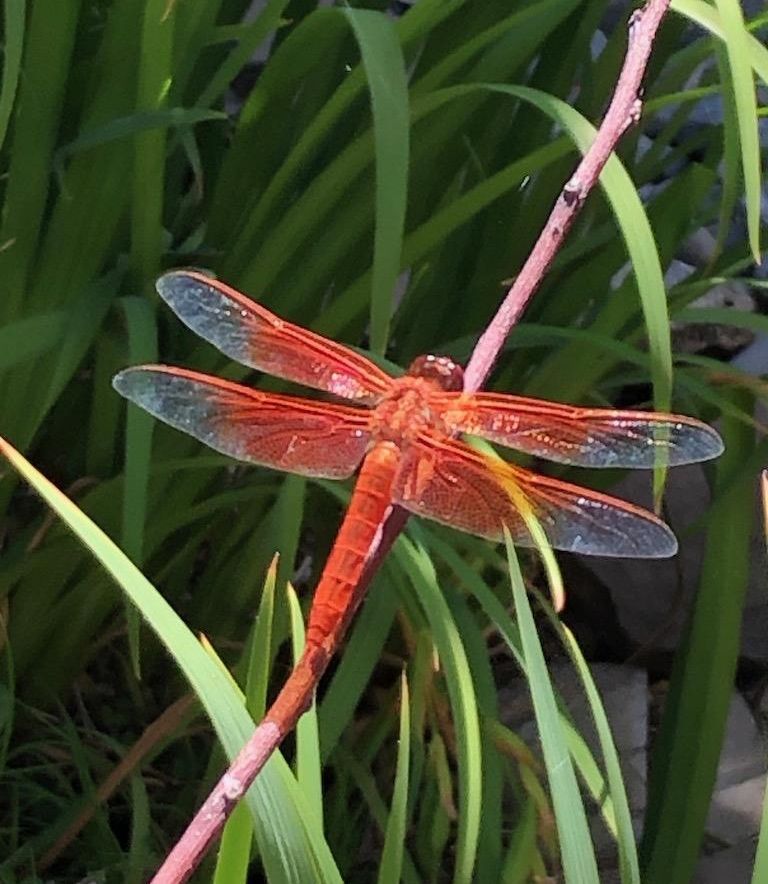
Photo - Flame skimmer dragonfly by Tanya Kucak, adapted.
| | | | |
| |
April Garden Tips 2025
Peg Smith, UC Master Gardener, Yolo County
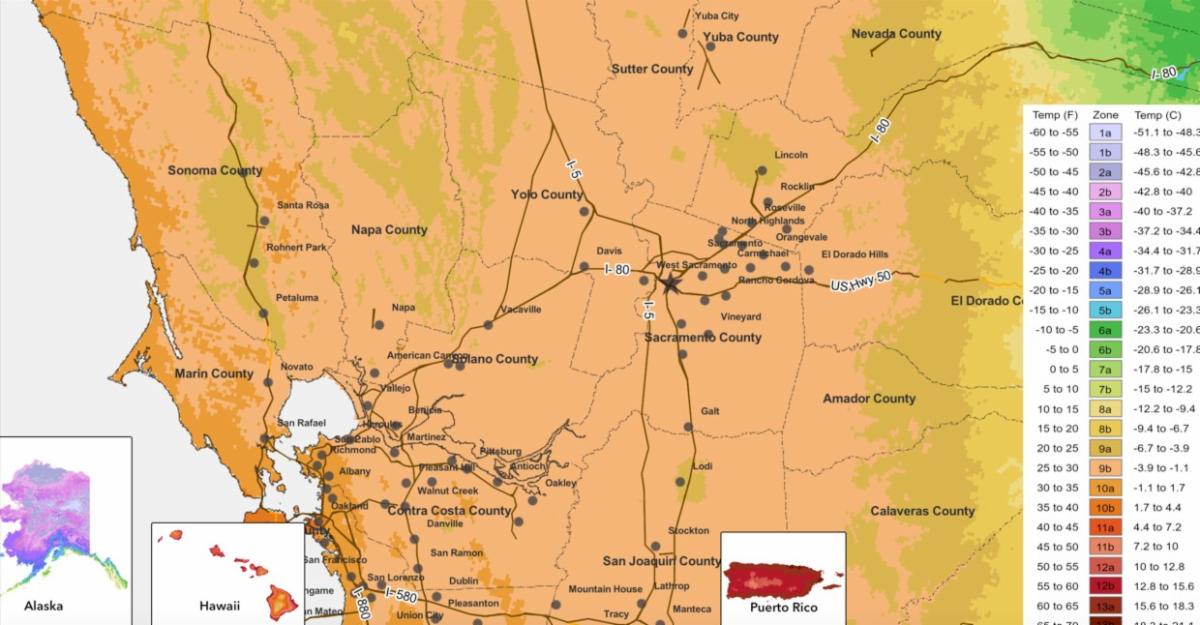
As gardeners, beginners or experienced, we have a strong spring urge to see what we can add to our collection of plants. Nurseries and plant sales are well stocked; seed racks are replenished; catalogues entice us. The million-dollar question is always will it thrive in our climate and do well in my garden?
What resources do we have to find out what is the ‘right plant, right place’ for our gardens?...
| | | | |
April Vegetable Planting Guide
Peg Smith, UC Master Gardener, Yolo County
Click the thumbnail for Peg's April Vegetable Planting Guide. This guide will tell you which Yolo County and Sacramento area vegetables are recommended for the month of March, along with how and when to plant them.
| | | | |
Spring Plant Sale - April 5th and 12th | | Spring 2025 Yolo County Master Gardeners Plant Sale | | | | |
General Information
Wilda Knoesen, UC Master Gardener, Yolo County
The Spring 2025 UC Master Gardeners-Yolo County Plant Sale will occur on Saturday, April 5th and Saturday, April 12th, 9am to 1pm, rain or shine.
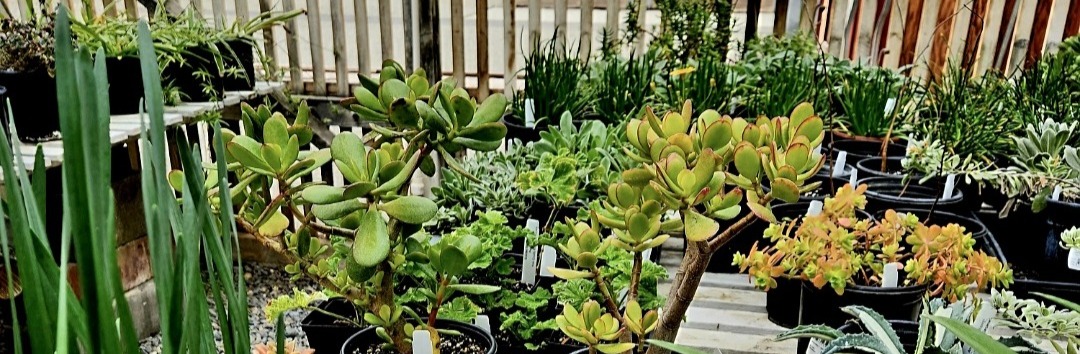
Drought-tolerant ornamental garden plants (bulbs, California native plants, perennials, and succulents) and more than 30 different varieties of tomato
plants (several heirloom tomato varieties) will be available. For tomato information, see Tanya Kucak's article. Shop early for the best selection!
Woodland Community College
2300 E Gibson Rd, Woodland
| |  |
Tomato Seedlings Sale - 15 New Varieties!
Tanya Kucak, UC Master Gardener, Yolo County
Every spring, UC Master Gardeners of Yolo County sell tomato seedlings the first two Saturday mornings in April. This year, the sale features thirty-five varieties, fifteen of which are new to the sale.
With rapid climate change, summers are getting hotter and heat waves longer. To get a satisfying tomato harvest, a good strategy is to choose your varieties based on how you will use them. If you have space for only three plants, you can hedge your bets by including an all-purpose variety, a cherry, and a luscious beefsteak.
All-purpose tomatoes can be used fresh or cooked...
| | | | |
| |
| |
|
April 5 - Lowe's Question and Answer Desk
10am - 12pm
The UC Yolo County Master Gardeners will be available to answer your gardening questions at their twice monthly gardening Questions and Answers Desk at Lowe's Home Improvement - 2250 Lake Washington Blvd., West Sacramento.
| | | | |
| |
|
April 7 - Flower Arranging
1pm to 2pm
Must pre-register - call 916-617-4620
Location: 1075 W.Capital Ave, West Sacramento
| | | | |
|
April 10 - Yolo County Library Zoom - UC Master Gardener Series
3pm - 4pm
Dr. Sang-Bin Lee, Assistant IPM Advisor will present The Beauty of Living Together: Social Insects. Check the UC Master Gardeners of Yolo County website or contact jmbaumbach@ucanr.edu for the Zoom link.
| | | | |
|
April 11 - Woodland Senior Center Class - Totally Tomatoes
1:30pm to 3pm
Must register at 530-661-2000
Location: Woodland Senior Center, 2001 East Street, Woodland.
| | | | |
| |
|
April 12 - Grace Garden Plant Sale
9am to11am
Grace Garden will sell a wide range of tomato varieties from Woodland Community College as part of a Grace Garden / Master Gardener fundraiser at Davis United Methodist Church. Located at 1620 Anderson Road, in the back patio area near the back parking lot. Click for Tomato Seedling List
| | | | |
|
April 12 - Grace Garden - Gardening for Year Round Meals - Microgreens
11am to12pm
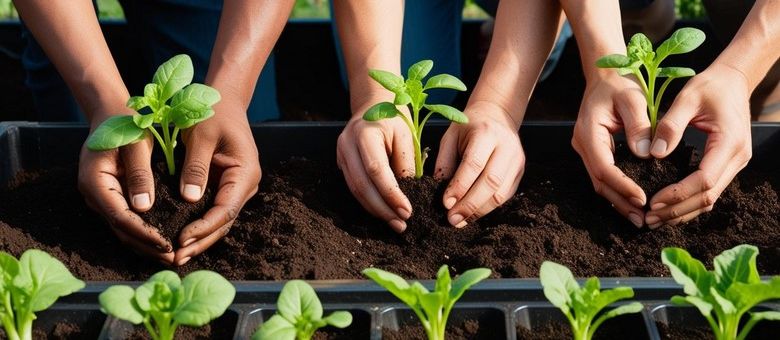
Microgreens provide quick growing nutrition. They are easy to grow in your kitchen. This class will provide information on why to grow microgreens, the easiest varieties to grow, tips for successful growing, and tips on harvesting, storage, and incorporating them into your meals.This is a Free UC Master Gardener presentation.
Location: Grace Garden, 1620 Anderson Rd, Davis
| | | | |
|
April 12 - Picnic Day - Master Gardener Information Table
9am to12pm
Location: UC Davis Campus, in front of Plant Sciences Building, North Quad
| | | | |
|
April 17 - Rose Maintenance
9am to11am
Hands on class, bring your favorite pruners, gloves, and kneeling pad.
Location: Quad Rose Garden at Woodland Community College - 2300 E. Gibson Road, Woodland
| | | | |
|
April 19 - Winters Spring Plant Sale
9am to 1pm
Choose from pollinator plants grown by garden volunteers and from Morningsun Herb Farm in Vacaville. Master Gardeners will be on hand to answer questions.
Location: Winters Community Library Teaching Garden, 708 Railroad Ave, Winters, CA
| | | | |
|
April 19 - Lowe's Question and Answer Desk
10am - 12pm
The UC Yolo County Master Gardeners will be available to answer your gardening questions at their twice monthly gardening Questions and Answers Desk at Lowe's Home Improvement - 2250 Lake Washington Blvd., West Sacramento.
| | | | |
| |
| |
The Yolo Gardener Newsletter is a monthly publication and the events posted here are based on information available at the time of publication. Be sure to check the UC Master Gardeners of Yolo County website for up to date events and information. | | | | |
Connect and Learn With Us | | | | |
| |
| |
| |
| |
University of California Agriculture & Natural Resources (UC ANR) is an equal opportunity provider. | | | UC Master Gardeners of Yolo County2780 East Gibson Road Woodland, CA 95776 US | | | | |
| |