| |  |
| |
“Diversification still remains paramount to risk management and long-term success.”
Greetings!
Welcome to October! In addition to celebrating multiple October birthdays of family members in my house, market participants can celebrate the 4th birthday of the cyclical bull market for stocks that began on October 13, 2022.[1] The third quarter of 2026 has been a microcosm of the hurdles that this bull market dealt with. In this case, the third quarter saw a historic climb in interest rates, elevated inflation, a new Federal Reserve rate hike cycle and oil prices rising back above $100 a barrel.[2] With those developments, one would assume that equity markets would struggle. Yet, the S&P 500 finished solidly positive for the quarter amidst continued strong corporate earnings.[3]
As we move into the final quarter of the year, clients have been asking about the implications of rising bond yields, how and why stocks continue to rise given the abundance of negative narratives out there and what, if any, impact midterm elections in November will have on markets.
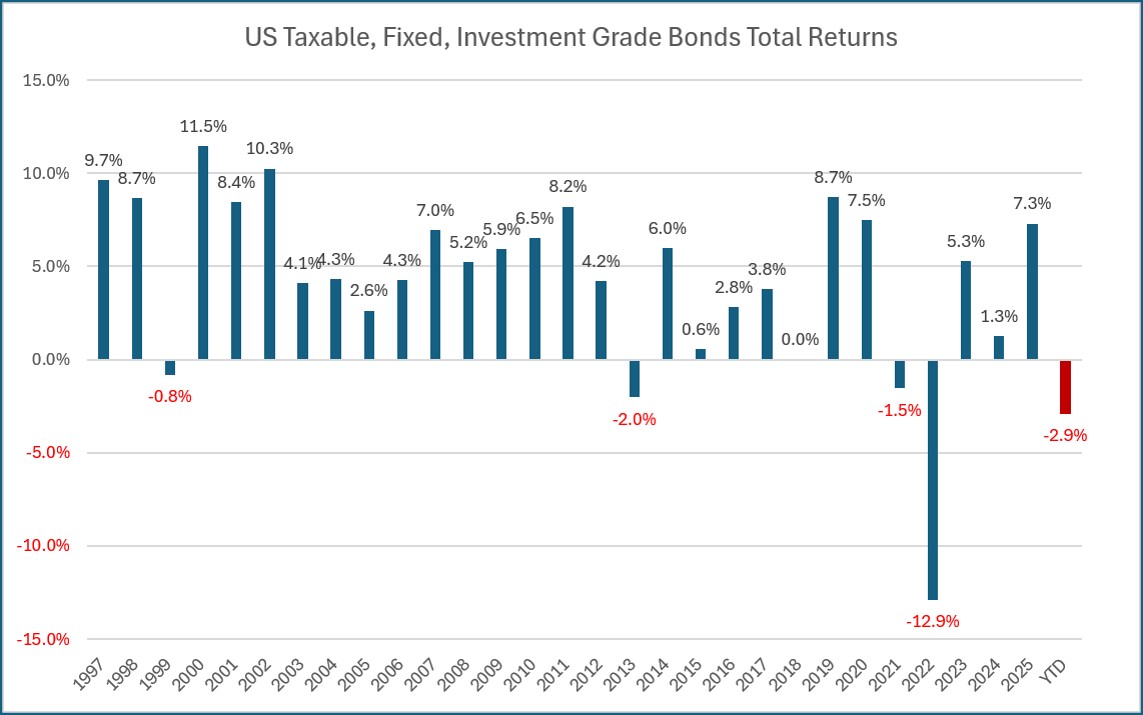
| | Why are Bond Yields Rising? | | YCharts, Bloomberg US Aggregate Index October 13, 2026 | | |
Through the end of the third quarter, the US bond market is experiencing its second worst returns in three decades.[4] While that sounds alarming, returns were down a modest -2.9% (relative to a long-term 30-year average return of +4.4%), underscoring the lower volatility of this asset class when compared to others, like stocks. In fact, there have only been four years in the last 30 where bond returns have been negative. It remains to be seen how bonds finish out this year. But to be fair, this year’s negative bond returns have been in stark contrast to US equities having been up a healthy +12.7% year to date.[5] So, what’s going on?
In our view, the negative performance is a result of the primary driver of future bond returns: starting yield. In a low interest rate environment, when fixed rate bonds are purchased, the associated lower yields provide less of a buffer for total returns when interest rates rise quickly. Those bonds still provide the same consistent income generating ability, but their prices will decline (since newer bonds will have better coupons and, thus, are more in demand). And total returns include both the income component and price movement.
The dramatic negative total return we saw in bonds in 2022 was a result of global central banks engineering a return to balance, following near-zero interest rates after COVID, by raising rates to combat rising inflation. Today, on a global scale, we are experiencing a lesser version of this rise in rates for a variety of reasons: Growing economies, deficits, inflation, central banks and a lot of competing debt supply, including AI-related debt. And it’s not just US-centric. Major central banks around the world are in tightening mode (rate hikes). The Fed only recently began to hike, while other major central banks, like the European Central Bank and the Bank of Japan, had already been executing.[6]
We believe the time to own bonds, or simply more of them, has improved markedly. There is much more of a buffer in yield should bonds be purchased today in case interest rates rise further. Moreover, should inflation subside via appropriate central bank action, total returns in bonds could be ripe for positive results soon.
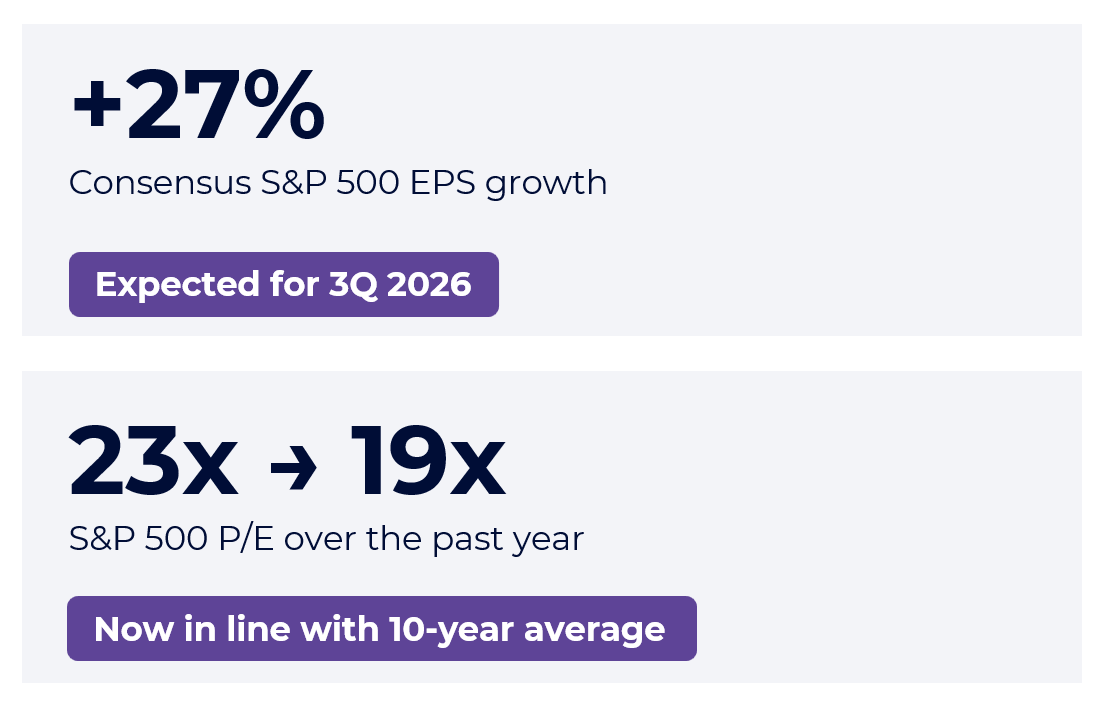
| | Many clients have been asking us, “if the stock market is up, are stocks getting more expensive?” That can sometimes be the case but so far in 2026, the overall market has actually become cheaper. Corporate earnings have been very strong with all 11 S&P 500 sectors reporting year-over year- earnings growth. Five sectors have seen double-digit earnings growth led by Energy, Technology, Communication Services and Materials.[7] | | Dynasty Financial Partners, Bloomberg, Goldman Sachs September 30, 2026 | | |
Forward earnings (a company’s projected or estimated profits for the next 12-month period) are up about 30% this year and price is up about 12%.[8] The P/E (Price to Earnings Ratio) on the S&P 500 has gone from 23 times to 19 times over the past year, which is right on the ten-year average. Stated simply, company profits have grown much faster than stock prices. Therefore, the market has gotten cheaper as it’s gone up.
It’s hard to discuss this bull market without mentioning the AI Boom, which has been billed as the biggest economic bet in US History in a Wall Street Journal article in late September.[9] Themes like the AI Boom are what market bulls dream of and company fundamentals have made them a reality: Nvidia’s quarterly revenue went from 57 billion to 96 billion. Hyperscaler capital expenditures doubled.[10] The value of the leading AI labs more than doubled. This is the market story of the year for 2026 and investors who follow earnings and revenue, as opposed to what they think could go wrong, have been rewarded.
With all of that being said, there are certainly plenty of risks to monitor on the AI front, such as the slowing of AI monetization, pricing pressure, massive capital requirements, data-center overbuild and concerns around circular financing. The market will continue to wrestle with whether revenues can eventually justify the trillions of dollars being invested in AI infrastructure. While we view this skepticism as healthy, the results being reported from companies appear to be trumping skepticism.
| | |
As citizens, there is nothing more important than participating in elections. However, when it comes to investing, politics and portfolios don’t mix. The midterm election in November is taking place amidst a dynamic backdrop of multiple wars, tariffs, the federal debt, inflation and AI concerns. It’s human nature to believe that politics should drive the economy and stock market, since elections can affect economic policies. It’s also easy to assume that election years can bring on more volatility. However, historically, this isn’t the case. Rather, markets have performed well under varying political leadership over the past century.
Since 1933, the S&P 500 has averaged an 8.6% total return during midterm election years and when it comes to which political party controls Congress, there have been no configurations that have consistently coincided with poor market returns.[11] Additionally, the market has seen positive returns when Republicans and Democrats are in the White House – regardless of a divided or controlled Congress.[12] The lesson from history is that politics rarely matters when it comes to your portfolio. Earnings, interest rates and other economic trends matter far more than a Congressional race.
| | |
Globally, bond yields are higher for both good (growth) and bad (inflation/deficits) reasons. However, starting points matter and bond investors are being offered the highest starting yields in a long time. On the stock side, we remain bullish, but not blind. There are four things that would make us rethink our view: 1) A Fed that goes from measured to aggressive, 2) oil if the Iran situation escalates, 3) whether the AI build can get the power it needs and 4) the consumer at the lower end, who is feeling energy prices the most. Diversification still remains paramount to risk management and long-term success.
As we close, we’d like to thank you, our clients, for your continued trust, confidence and partnership. As always, we’re here to answer any questions you may have. In the meantime, we wish you and your family a festive and peaceful holiday season.
Warmest regards,
| | |
Jack Piper
Founding Partner & Portfolio Manager
207.274.2504
| | |
[1] Fidelity October 12, 2026
[2] Kitces October 7, 2026
[3] Y-Charts October 15, 2026
[4] Y-Charts, Bloomberg US Aggregate Index October 13, 2026
[5] Y-Charts October 15, 2026
[6] Y-Charts, ECB Facility Interest Rate, BoJ Basic Discount Rate, Target Fed Funds Rate
[7] Kitces October 7, 2026
[8] Dynasty Financial Partners, Bloomberg, Goldman Sachs September 30, 2026
[9] WSJ https://www.wsj.com/economy/the-ai-build-out-is-becoming-the-biggest-economic-bet-in-u-s-history-c60716dd September 23, 2026
[10] Dynasty Financial Partners October 16, 2026. Hyperscaler definition: a large-scale cloud service provider that operates massive global data center infrastructure to deliver high-capacity computing, storage, and networking on demand
[11] Kitces October 7, 2026
[12] Kitces October 7, 2026
| | |
Great Diamond Partners, LLC is an investment adviser in Portland, Maine. Great Diamond Partners, LLC is registered with the Securities and Exchange Commission (SEC). Registration of an investment adviser does not imply any specific level of skill or training and does not constitute an endorsement of the firm by the Commission. Great Diamond Partners, LLC only transacts business in states in which it is properly registered or is excluded or exempted from registration. Great Diamond Partners, LLC’s current written disclosure brochure filed with the SEC which discusses among other things, Great Diamond Partners, LLC business practices, services, and fees, is available through the SEC’s website at: www.adviserinfo.sec.gov.
This information should not be considered investment advice. Opinions expressed reflect the judgment of the authors and are current opinions as of the date appearing in this material only. While every effort has been made to verify the information contained herein, we make no representation as to its accuracy and it should not be regarded as a complete analysis of the subjects discussed. All investing involves risk, including the loss of some or all of your investment.
Past performance does not predict future results.
Any indices and other financial benchmarks shown are provided for illustrative purposes only, are unmanaged, reflect reinvestment of income and dividends and do not reflect the impact of advisory fees. Investors cannot invest directly in an index. Comparisons to indexes have limitations because indexes have volatility and other material characteristics that may differ from a particular fund.
| | | |
Certain information contained herein constitutes “forward-looking statements,” which can be identified by the use of forward-looking terminology such as “may,” “will,” “should,” expect,” “anticipate,” “project,” “estimate,” “intend,” “continue,” or “believe,” or the negatives thereof or other variations thereon or comparable terminology. Due to various risks and uncertainties, actual events, results or actual performance may differ materially from those reflected or contemplated in such forward-looking statements. Nothing contained herein may be relied upon as a guarantee, promise, assurance or a representation as to the future.
Specific investments described herein do not represent all investment decisions made by Great Diamond Partners, LLC. The reader should not assume that investment decisions identified and discussed were or will be profitable. Specific investment advice references provided herein are for illustrative purposes only and are not necessarily representative of investments that will be made in the future.
Hyperlinks in this piece are provided as a convenience, as we disclaim any responsibility for information, services or products found on websites linked hereto.
All investment strategies have the potential for profit or loss. Changes in investment strategies, contributions or withdrawals, and economic conditions may materially alter the performance of your portfolio. There are no assurances that an investor’s portfolio will match or outperform any particular benchmark. Asset allocation and diversification do not ensure or guarantee better performance and cannot eliminate the risk of investment losses.
| | | | |