News and information to help journalists serve the public and stay safe.
May 12, 2020
Join Washington Post reporter Jessica Contrera  and Indiana University professor  Kelley Benham French  on May 19, 2020 from 11:30am-12pm for a discussion of how details tell the story of this pandemic.  Registration is open.

The conversation will describe how to consistently collect and select compelling details that evoke emotion and help convey the impact of coronavirus on people’s lives. Learn to identify the moments that compel readers toward a story’s purpose, and hear how to connect the reporting & writing process with our collective ability to understand what this pandemic means.
New York Times journalists Sarah Maslin Nir and Tim Herrera both tested positive for COVID-19 in mid-March. As journalists, it made them unique chroniclers of the disease as the nation awakened to the pandemic. It also made them aware of their privilege.
 
Nir, staff writer for the New York Times, and Herrera, who edits and writes for the New York Times Smarter Living section, discussed their personal experiences with the outbreak during a virtual conversation Tuesday hosted by the National Press Club Journalism Institute.
 
“Living the experience is the key, right? … This is sort of the ultimate shoe leather,” Nir said of her decision to use her bout with coronavirus as a reporting tool.  

“That said, we also have to recognize that Tim and my experience as gainfully employed, middle-class Americans is not the real experience of coronavirus. Black and brown people in New York City are dying at twice the rate of white people.”
 
Herrera said he works primarily with freelancers who have less financial security and who, thus, bring a different and needed point of view to their stories.
 
“Their writing and reporting and the way they’re framing stories is informed by being a person with a very precarious job situation,” he said. “So many of my freelancers have taken the stimulus checks and need them to survive, and I’m very grateful for them offering to share that perspective.”
 
Nir remembers realizing she might have the disease when a neighbor handed her a Clorox wipe and she didn’t detect the scent of bleach. “I remembered a sentence in a story that the Times had done from China about two Chinese healthcare workers, one lived and one who died,” she said. “The sentence was, ‘She lost her sense of taste and smell.’ ”

Read on to learn what compelled them to tell their stories and lessons in perseverance.

Advice from  Jill Geisler ,
Bill Plante Chair in Leadership & Media Integrity, Loyola University Chicago
Freedom Forum Fellow in Women’s Leadership

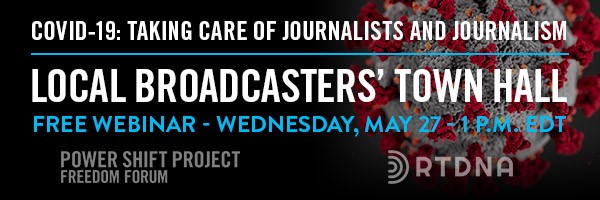
We gathered eight reporters to talk about how they took a Solutions Journalism approach to their COVID-19 stories. During our Power Shift “Taking Care of Journalists and Journalism” webinar , they explained how to dig deeper for systemic answers to problems like nursing shortages, lack of internet access, racial disparities in health care, and getting help to people who are isolated (video below). 

It was a great “how I did it” conversation.

But here’s what stays with me: Without any prompting, they talked about the “why” behind their reporting - the values that drive them.

One mentioned how she discovered, early in her career, that she wanted to be more than just the first reporter to get the names of victims after a fatal accident. Another mentioned how privileged his 10-year-old was to have a laptop, when so many people lack basics. Another described how important it is for him to cover stories in the community where he grew up. Another reflected on how he doesn’t want to be a national journalist who pays a short-term visit to a city and focuses only on the most outrageous or provocative things he sees.

I realized that what I was hearing was good old fashioned shop talk; the conversations journalists share face-to-face in break rooms, at after-work gatherings, in conferences and workshops - none of which are accessible today.

Shop talk lets us compare notes, let off steam, congratulate each other on wins of all sizes, reveal what we love about our jobs and what gets us down, dissect our own work and that of others - and remind ourselves what journalism means to us. It’s professional - but very personal, too, and that’s what makes it so valuable.

Shop talk is our vitamin.

I can’t help but wonder if we’re losing its benefits as so many teammates now work from their homes.

Zoom happy hours, Facebook groups and webinars help, no doubt. They’re the best we can do for now. But let’s make them better. Let’s leave space for those “why I do this work” moments. The personal insights. The “real me” revelations. Not forced - but not avoided. 

Let’s keep reaching out to each other - one-to-one or in small groups - whatever works best for each person. Let’s ensure that as we do the important and stressful work of chronicling the history of a pandemic, social distancing doesn’t silence the simple conversations that sustain us.

Journaling to process emotions isn’t new, but as the COVID-19 pandemic has worn on, some writers who rejected the practice in the past are reconsidering. 

Journaling can help manage stress and process emotion . 

Here are journaling tips from writers in the Journalism Institute’s Writing Through daily writing group : 

  • Your journal is yours: Release notions of what a journal is or needs to be. As the owner, you’ll define and redefine your journal’s purpose. 
  • Prompts can help: Not sure where to start? Search “writing prompts” online, and you’ll have an array to choose from. 
  • Journaling is simply documentation: Stray notes, lists or other writing counts. Thoughts don’t have to be complete to be valid.
  • Try photography: Tapped out after a day of writing? Document your day through photos, which can evoke memories you can reflect on later.
  • Collect artifacts: Receipts, menus, text messages, emails, birthday cards, Zoom screen grabs — all can reveal telling details about this period of time. 

Read on for more self-care tips, or share your own .
RESOURCES
This newsletter is written & edited by the National Press Club Journalism Institute staff: Beth Francesco, Holly Butcher Grant, Jim Kuhnhenn, and Julie Moos. Send us your questions and suggestions for topics to cover.

Get this from a friend? Subscribe , and view the archives .
SUPPORT THE INSTITUTE
The National Press Club Journalism Institute promotes an engaged global citizenry through an independent and free press, and equips journalists with skills and standards to inform the public in ways that inspire civic engagement. Support our important work with a tax-deductible contribution today.