International Foundation for Gastrointestinal Disorders
April 2021 eNewsletter
|
|
|
Greetings!
April is Irritable Bowel Syndrome (IBS) Awareness Month
Up to 45 million people living in the United States suffer from irritable bowel syndrome (IBS). Although IBS is common, patients are often stigmatized and misunderstood, and their symptoms have a significant impact on their quality of life.
During April, IFFGD will join patients, family members, and caregivers to increase public awareness about IBS and help to educate the public – the theme for IBS Awareness Month 2021 along with hashtags #IBSAwarenessMonth and #IBSEducation.
IFFGD invites everyone to join this year's campaign by visiting, www.aboutIBS.org, to learn about IBS. You can also join IFFGD's awareness campaign by downloading and sharing information in the IBS Awareness Month Media Toolkit, which provides key messaging and images.
|
|
|
|
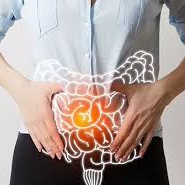
The key symptom of irritable bowel syndrome (IBS) is abdominal pain. The IBS pain can be felt anywhere in the abdomen. It may change over time.
Abdomen pain is different than stomach pain in terms of location. Abdominal pain is typically in the outer muscle wall.
People describe the pain of IBS as:
- Cramping or cramp-like
- Stabbing
- Sharp
- A ‘migraine’ in the stomach
|
|
IBS pain or discomfort is related to the way the bowels move.
- There may be less pain after having a bowel movement
- The pain may begin when the frequency of bowel movements change to more often or less often
- Or the pain may begin when bowel movement change and become harder or softer
|
|
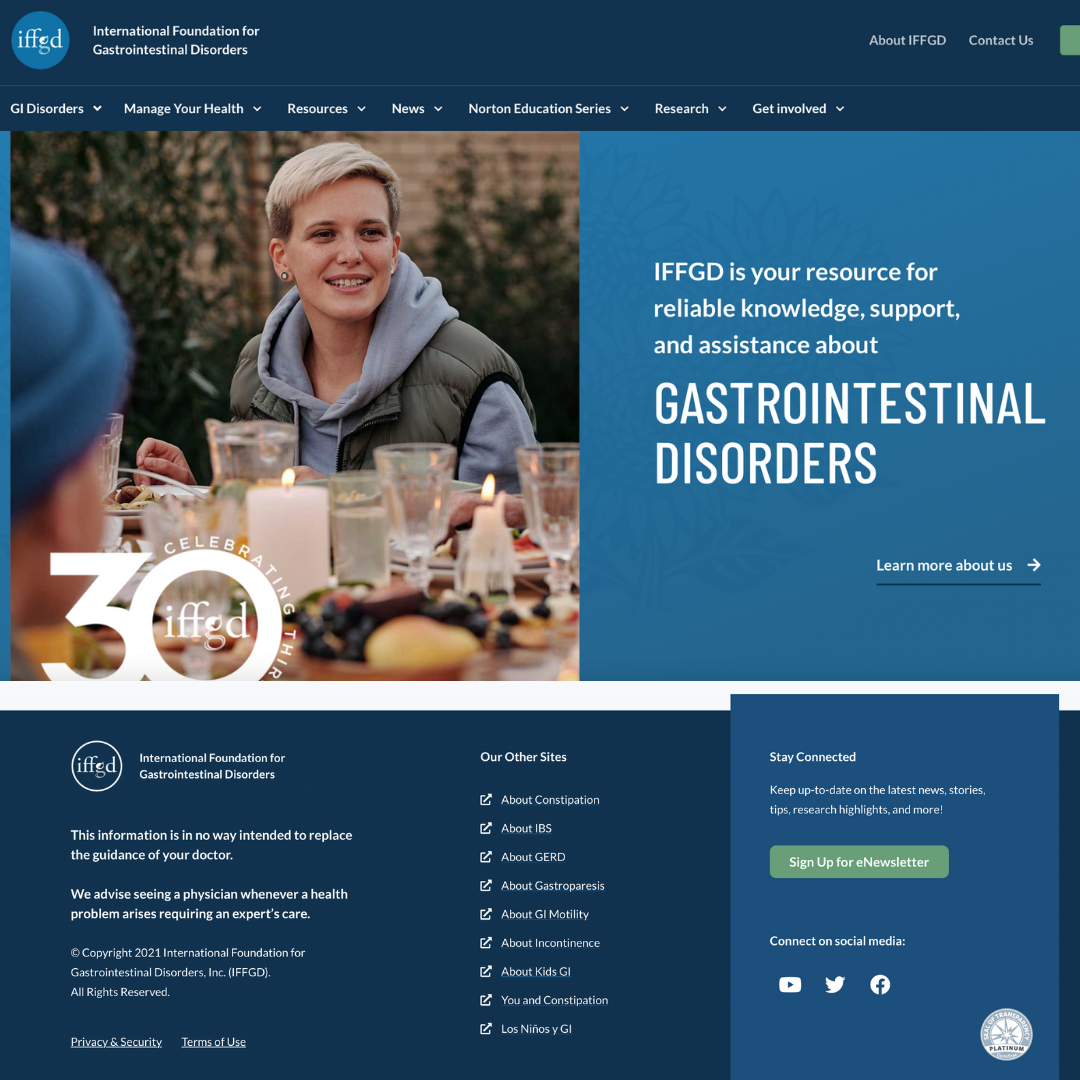
IFFGD is your resource for reliable knowledge, support, and assistance about gastrointestinal (GI) disorders. This year to celebrate our 30th Anniversary, we have redesigned our entire suite of 9 websites including iffgd.org.
Check our new website designs by visiting www.iffgd.org, and following the links at the bottom of the page to visit our other websites for more information on specific disease states.
|
|
Thank you to everyone who participated in our 2021 Virtual Advocacy Event. If you missed any of the educational program or the Congressional call-in, there is still an opportunity engage.
The educational portion included presentations from various non-profit organizations about the support they offer as well as government agencies discussing support programs and research related to Veterans with GI illness, and much more. The educational presentations from the 2021 Advocacy Event are now available online.
Advocates who were unable to participate throughout the week can view the advocate training materials and contact Congress. Please email advocacy@iffgd.org if you have any questions, and to inform us of any legislative offices you have be able to contact.
Click the button below for a complete recap of IFFGD's 2021 Virtual Advocacy Event
|
|
IBS is one of the most common GI disorders in the world. Within this large group of people affected, there is a small subgroup whose IBS symptoms begin suddenly.
It happens after what appears to be a bout of infection in the stomach and intestines (gastroenteritis), and is called post-infectious IBS (PI-IBS).
While most people recover completely after the initial illness, some people do not. Typically bacteria is the cause for PI-IBS
More recently, PI-IBS has been described following infections from a range of bacteria including Campylobacter, Salmonella, and Shigella. Bacterial infections are usually spread by consuming contaminated food or water, or by contact with infected people or animals.
Click the button below to learn more about PI-IBS.
|
|
|
|
To commemorate the 30th anniversary of IFFGD, we will be hosting a very special virtual edition of the Norton Education Series (NES).
The Nancy and Bill Norton Patient Education Series Event: IFFGD’s Thirtieth Anniversary Edition - This program will be a mix of pre-recorded videos and live feed that will take place Saturday, November 6th and Sunday, November 7th.
William Chey, MD will Chair the Program Committee and Lin Chang, MD and John Pandolfino, MD will serve as Co-Chairs. The Program Committee will join Ceciel Rooker, IFFGD President, in co-hosting the event.
Click here to learn more about the event and register!
|
|
|
If conventional medical therapies prove unsuccessful or have unwanted side effects, many people choose to pursue complementary or alternative therapies (CAM).
CAM is a group of diverse medical and health care systems, practices, and products that are not generally considered part of conventional medicine.
Complementary and alternative approaches to functional gastrointestinal disorders provide an exciting opportunity for both patients and healthcare provider faced with the difficulty of managing these chronic disorders.
Click the button below to learn about the different types of CAM treatments.
|
|
Constipation is one of the most common intestinal problems in children, accounting for 3% to 5% of all visits to pediatricians.
Fortunately, most constipation in infants and children is not caused by any serious medical disease.
The cause of most constipation is functional or idiopathic, meaning there is no sign of injury or infection, blood, or anatomic abnormality to explain the very real symptoms.
Click the button below to learn how to prevent or manage constipation in children.
|
|
Clinical trials and research studies help to improve our understanding of the underlying mechanisms of diseases and advance the development of new and better treatment options. By participating in a study, you can help further the advancement of research and learn more about your condition.
Here are 3 studies currently recruiting participants:
|
|
Participates Needed in the PRISM-CC Study |
|
Impact of a yoga intervention on chronic abdominal pain, and associations with the metagenome and metabolome in participants with IBS |
|
A Phase 2 Randomized, Double-Blind, Placebo-Controlled, Parallel-Group Study of the Safety and Efficacy of NG101 Administered Orally to Patients with Gastroparesis |
|
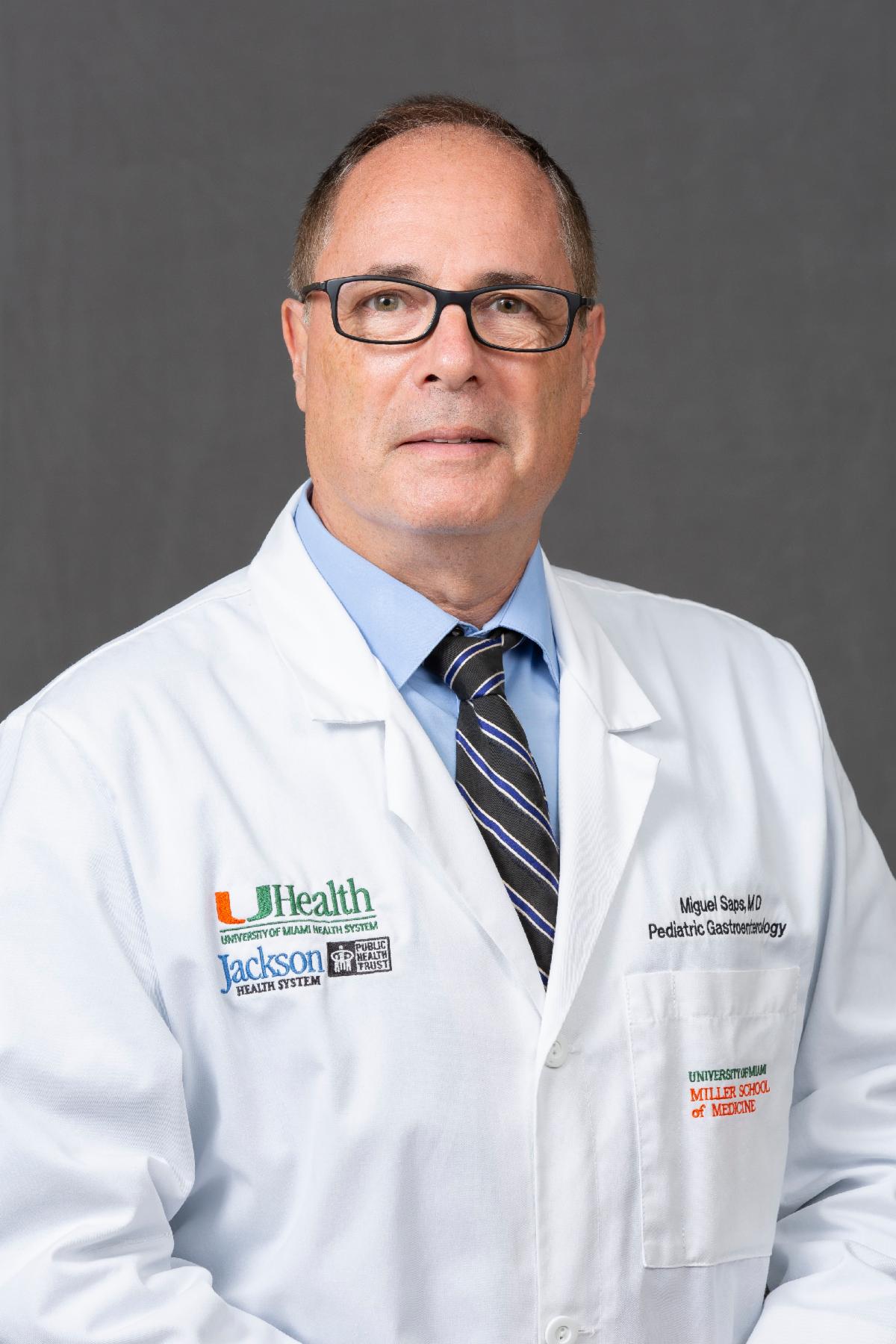
IFFGD has an Advisory Board that is made up of 60 medical professionals from various disciplines representing the USA and ten other countries. Many of these individuals are noted experts in the field of functional gastrointestinal disorders. This month we would like to recognize our new advisory board member, Dr. Miguel Saps.
Dr. Miguel Saps is a native of Uruguay. He has received his medical and pediatrics degree from the Universidad de La República Faculty of Medicine in Uruguay, a pediatric residency at Maimonides Medical Center, and a fellowship in pediatric gastroenterology at the Children’s Hospital of Pittsburgh.
Dr. Saps is the Chief of Division Pediatric Gastroenterology, Hepatology and Nutrition, Director of Pediatric Neurogastroenterology and Motility at Holtz Children’s Hospital of Miami, The George E. Bachelor Chair in Pediatrics and Professor of Pediatrics at the University of Miami.
|
|
|
Dr. Saps has lectured in more than 150 national and international meetings in North America, Europe, Asia and South America. He has authored more than 150 peer-reviewed articles, invited reviews, editorials and letters, presented more than 200 abstracts in national meetings and has written 30 book chapters. Dr. Saps has received multiple recognitions and awards in clinical care and research.
Dr. Saps is Member of the Advisory Board and Chairman of the International Ambassadors Program of the IFFGD, Member of the Gastrointestinal Advisory Drug Committee of the FDA. Dr. Saps also holds leadership on four Rome Foundation committees.
|
|
IFFGD is a nonprofit organization. We rely on donor support to fund research and to provide reliable information and support to those affected by chronic gastrointestinal disorders.
|
|
|
|
|
|
|