Rail & Labor News from RWU
| | Weekly Digest Number 38 - September 16, 2025 | | Welcome to the RWU Rail & Labor News! This news bulletin is produced and emailed out each Tuesday morning. We hope you find each week's news and information useful. If so, please share with co-workers, friends, and colleagues. If you like, you can sign them up to get all the news from RWU HERE. Or forward them the link. Got a hot tip? Please forward the article and a link to raillabornews@gmail.com. Note: If you read over this news bulletin each week, you will be sure to never miss the important news of what is going on in the railroad world from a worker's perspective! | | THIS WEEK'S RAIL AND LABOR NEWS | | Editor's Note: Eighty-five billion to weld two railroads into a monopoly, and not a penny for the workers who make them run. It is plunder.. jobs gutted, safety gutted, whole towns thrown under the wheels of greed. A railroad owned by one cartel is not a public trust, it is a private weapon. Every mile of track becomes a lever to squeeze more sweat, more time, more blood from fewer workers. If labor does not rise, this merger will not just steal our work, it will chain the nation to the barons who rule it. | |
Words about Work / September 12th
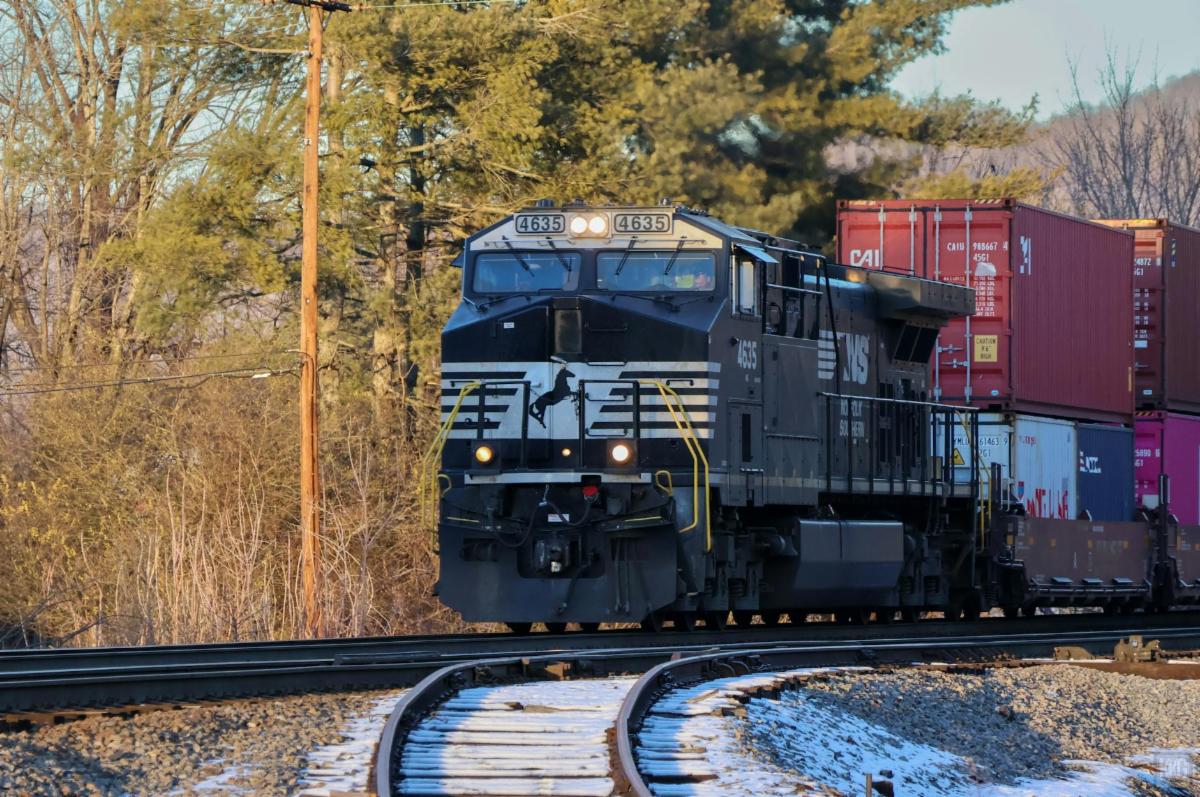
In late July, Union Pacific announced their plans to merge with Norfolk Southern in an $85 billion megadeal that would create the nation’s first transcontinental railroad. If successful, nearly half of United States rail freight would be transported by a single company, with the network spanning 43 states and nearly 50,000 miles.
Executives from both Union Pacific and Norfolk Southern have praised the deal, saying that the newly expanded company would bring efficiency and more jobs to America’s Class One rail network. In an interview with the New York Times at the end of July, Mark George, chief executive of Norfolk Southern, said “By coming together, we’re going to be able to get on a growth trajectory again, and that means more jobs.” The Surface Transportation Board, which will need to approve the merger, received notice of the companies’ intent to file on July 30.
The news of the merger has sent shockwaves through the railroading community, investment circles, and amongst shippers who use the rail lines to ship their freight across the United States. Activist investors like Ancora and Toms Capital have both separately increased pressure on CSX’s board to pursue potential merger plans with BNSF in response to the merger announcement.
| | Editor's Note: RWU's Ron Kaminkow was interviewed about the proposed merger by Bill Moyer of Solutionary Rail on his Reconnect America podcast. | |
Solutionary Rail / September 11th
In the coming year or so, the Surface Transportation Board will determine whether to approve or block Union Pacific’s $85-billion acquisition of Norfolk Southern. This signals an attempt by Wall Street to squeeze yet more from this critical infrastructure in order to maximize returns for shareholders.
Railroad workers, in particular, find themselves in a difficult situation. Being divided into several different unions, workers and their union leaders are often forced to choose between accepting concessions for their own particular craft and holding out in the name of industry-wide solidarity. A UP-NS merger involves even higher stakes, as it could very well result in significant cuts to the workforce resulting from the elimination of redundancies between the newly-combined railroads.
To better understand the dilemmas faced by workers in the fight ahead, and to help us pick apart the smokescreens that UP and NS are promulgating in an effort to charm workers into submission, we got in touch with Ron Kaminkow. Ron is a longtime ally and collaborator of Solutionary Rail’s. He is also a co-founder, former general secretary, and current trustee of Railroad Workers United (RWU), a cross-union caucus of railroad workers that aims to build industry-wide solidarity to more effectively stand up to Wall Street’s railroads.
| | Editor's Note: They send soldiers into our cities at the behest of a railroad tycoon.. while crime and suffering come from poverty and disinvestment, not a lack of military boots. When UP’s CEO whispers in the president’s ear about deploying the Guard, you see who pulls power in this country. The rail magnates don’t consult community leaders; they consult the highest bidder. Our streets and our safety are being treated like profit margins to be managed, not human lives to be protected. If the working class doesn’t rise to demand real safety, not martial spectacle, we’ll be living under guard while the rich stay inside their armor. | |
Trains Magazine / September 12th
President Donald Trump, in an appearance on Fox & Friends this morning, praised Union Pacific CEO Jim Vena and said the railroader offered suggestions on where the administration should call up the National Guard to fight urban crime.
Vena met with Trump and other administration officials at the White House on Tuesday regarding UP’s $85 billion proposed merger with Norfolk Southern. “He was a very impressive guy,” Trump said, noting Vena is a career railroader, “as opposed to a Wall Street guy that destroys the railroad.”
Trump sought Vena’s advice on what cities the administration should consider sending National Guard troops to as part of its strategy to reduce crime. Vena suggested Memphis, St. Louis, and Chicago.
|
| Editor's Note: They cast out the one man who stood in the way of the railroads, and in his place they set a consultant of the carriers. That is not regulation, it is surrender. Every seat filled by industry is a seat stolen from the people. The board is meant to guard the public, not shield the profits of a few. If labor does not rise against this, the corporations will sit in judgment over us all. | |
Freight Waves / September 11th
President Trump has nominated railroad industry consultant Richard Kloster for an initial five-year term as a member of the Surface Transportation Board, and re-nominated current member Michelle Schultz, FreightWaves has learned.
The nominations are critically important, as the board will soon consider the proposed $85-billion acquisition of Norfolk Southern (NYSE: NSC) by Union Pacific (NYSE: UNP), a deal that would create the first transcontinental railroad and transform the U.S. freight rail industry.
Kloster, a Republican, is president and founder of Integrity Rail Partners, Inc., a consultant on railroads and rail equipment based in Charles Town, W. Va. With more than three decades’ experience with railroads, rail supply chain and rail suppliers, Kloster started out as a car inspector and moved “inside” working for Chicago Northwestern, Chicago Central and Pacific, and the Indiana Railroad.
| | Editor's Note: Automation is the new gospel of the rail barons: fewer workers, longer trains, bigger dividends. They dress it in the language of innovation, but underneath it is the same old hunger to wring more from labor and give back less. A machine cannot strike, cannot bargain, cannot demand a fair share. Strip the human out of the cab and the carrier owns every lever, every second, every life. If this future is left to them, it will be built on the wreckage of both safety and solidarity. | |
Freight Waves / September 10th
Labor and industry are giving the Trump administration opposing takes on how technology and automation in freight railroading should be considered as a long-term economic strategy.
In comments filed with the U.S. Department of Transportation’s request for comments to help the department update its five-year strategic plan extending to 2030, the International Association of Sheet Metal, Air, Rail and Transportation Workers (SMART-TD) said the rail industry is at a point of critical mass.
“Under the guise of new and improved efficiencies, Class I railroads have hollowed out their workforce and pushed unsafe practices, including the operation of ever longer and heavier trains that infrastructure cannot safely accommodate,” wrote SMART-TD Legislative Director Jared Cassity. “These practices directly threaten the resilience of the rail network and, by extension, the nation’s supply chain.”
| | Editor's Note: They call it efficiency when they cut a crew in half, but what it really means is one worker left alone in the cab with the weight of a town on his shoulders. The carriers cheer, the politicians nod, and the lobbyists cash their checks, while the people who live along the tracks are handed nothing but risk. Every wreck, every fire, every poisoned river has already shown us what happens when greed outruns safety. Two in the cab is not a luxury.. it is the floor of decency. If those in power won’t protect life over profit, then rail labor must rise and make them. | |
Trains Magazine / September 8th
U.S. Rep. Eric Burlison (R-Mo.) on Friday introduced legislation to overturn the Federal Railroad Administration’s two-person crew rule adopted in 2024.
“This bill is about stopping union bosses from using Washington to get what they can’t win at the bargaining table,” Burlison said in a brief press release.” “Previously, in 2019, the FRA concluded that ‘accident/incident data does not support a train crew staffing regulation.’ Yet the Biden-Harris administration went ahead with this mandate, which burdens small railroads with increased costs with no benefit except inflating union membership. … Freight rail is one of the safest ways to move goods in America. We should be encouraging innovation, not imposing unnecessary regulations that benefit special interests.”
Text of the bill — dubbed the Train Crew Choice Act — has yet to be submitted to the Congress website.
The Association of American Railroads indicated its support for repeal of the rule.
| | Editor's Note: When a freight giant drags a commuter line into court, it’s not about justice.. it’s about power. Rail labor knows the score: the carriers guard their profits like treasure, but treat the public and their workers as expendable. Commuter crews, passengers, and taxpayers all get caught in the crossfire while lawyers bill the hours. The rails belong to the people who ride them and the workers who operate them, not the corporations that exploit them. If the industry won’t put the public first, labor must force the question. | |
Railway Age / September 10th
Just days after the Surface Transportation Board (STB) granted Metra’s application for terminal trackage rights to continue commuter rail service over three Union Pacific-owned lines in Chicagoland, UP has filed a lawsuit against Metra in federal court seeking compensation, according to media reports.
Regional/commuter rail operator Metra and host freight railroad UP have been negotiating the transfer of commuter rail service on the three lines—the Union Pacific North, Northwest, and West—for several years. UP has historically provided service for Metra under a PSA (Purchase of Service Agreement), which has been extended several times while the railroads negotiate a new agreement.
Approximately 39% of Metra’s annual ridership (13.7 million out of a total 35 million passengers) is associated with the three lines owned, used and dispatched by UP (see map, below). Those lines were once operated by the Chicago & North Western Railway: the West Line to Elburn, the Northwest Line to Harvard and McHenry, and the North Line to Waukegan, with limited service to Kenosha, Wis. Metra has eight other lines; one of which, the historic Chicago, Burlington & Quincy line to Aurora, runs on right-of-way owned by BNSF, which still operates it under contract with Metra.
| | Editor's Note: High-speed rail was sold as progress, but it has delivered more contracts than track. The people who move steel and swing hammers are sidelined while consultants feast and politicians hedge. Railroads are not built in hearing rooms.. they are built in sweat and solidarity. If capital can stall a vision this righteous, it will stall any hope that belongs to the people. Only when labor demands it, and demands it together, will this train run. | |
Grist / September 8th
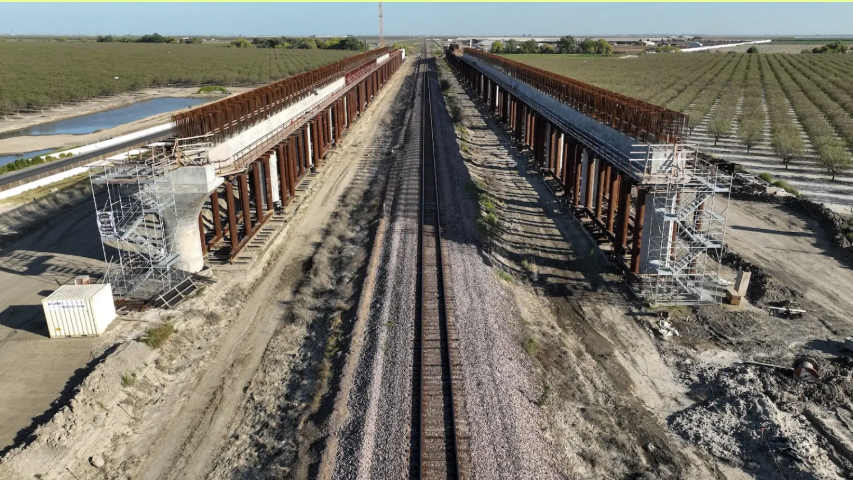
Seventeen years ago, Californians bet on a grand vision of the future. They narrowly approved a $10 billion bond issue to build a high-speed rail line that would zip between San Francisco and Los Angeles in under three hours. This technological marvel would slash emissions, revitalize the state’s Central Valley, and, with some financial help from the feds and private sector, provide the fast, efficient, and convenient travel Asia and Europe have long enjoyed.
State officials promised to deliver this transit utopia by 2020. Instead, costs have more than doubled, little track has been laid, and service isn’t expected to begin before 2030 — and only between Bakersfield and Merced, two cities far from the line’s ultimate destinations.
It’s little wonder the project finds itself in a precarious financial position, fighting political headwinds, and deemed a boondoggle by everyone from federal Transportation Secretary Sean Duffy to Abundance authors Ezra Klein and Derek Thompson. “In the time California has spent failing to complete its 500-mile high-speed rail system,” they wrote, “China has built more than 23,000 miles of high speed rail.”
| |
Progressive Railroading / September 9th
International Brotherhood of Electrical Workers members who work for Union Pacific Railroad on Sept. 3 ratified a new five-year labor agreement.
The contract includes the following for workers:
- annual general wage increases totaling 18.77% over the length of the contract;
- expanded paid bereavement leave to include grandparents and grandkids;
- the ability to carry over up to 32 hours paid sick time annually, with a maximum 160 hours with cash-out options at the end of each year;
- improvements to health and welfare benefits;
- paid vacation time for new hires and faster accrual of vacation time for tenured employees; and a new optional high-deductible health plan with lower monthly premiums.
"This agreement underscores the power of solidarity and the value of union labor in shaping a more secure and equitable workplace," said IBEW International President Kenneth Cooper in a press release.
| | NEWS FROM AROUND THE LABOR MOVEMENT | | Each week, RWU includes a few articles about advances and developments in the larger labor movement that are of interest to railroad workers. Got an artcile to submit for possible inclusion next week? Email it along to raillabornews@gmail.com. Thank you! | |
In These Times / September 10th
America did not get to the bad place it is in today by accident. We are here as a result of the combination of a political system that serves money, and a half-century long explosion of economic inequality that has produced an oligarchy. Donald Trump is the product of these factors, but he is not the underlying problem. The underlying problem is that too much power has flown into the hands of too few people, and they have used that power to arrange the entire economic and political system in their favor. Democracy, such as it was, is an inevitable casualty of this process.
Climbing out of the hole that we are in will require more than one or two favorable election cycles. It will require shifting that underlying balance of power away from the oligarchs and their allies, and back towards the rest of us. Power that has accumulated among the rich and ultra-rich will have to be wrested back into the hands of the working class majority. This pro-democratic shift in economic and political power can only be accomplished if the organized power of the working class gets stronger — strong enough to compete with the power of the rich. In other words, organized labor must get stronger if we are to turn around America’s descent into fascism. This is why you should care about what is happening with America’s labor unions even if you have been operating under the illusion that unions don’t mean much to you personally.
| |
The Guardian / September 8th
Add another growing split to the increasingly divided United States: union membership.
US states that protect unions’ collective bargaining rights have experienced an increase in new union members, while states with anti-union “right to work” laws are responsible for declines in union members, a new report reveals.
The report on the state of unions by the Illinois Economic Policy Institute and the Project for Middle Class Renewal at the University of Illinois at Urbana-Champaign found significant discrepancies between the 26 states in the US with “right to work” laws compared with the 24 states and Washington DC that protect collective bargaining rights.
The right-to-work states, concentrated in the south and central US, have a union density of 5.1%, compared with 14.2% for states with collective bargaining rights, concentrated on the coasts and in the north.
| | WEEKLY DERAILMENT DEPARTMENT | | Each Tuesday in this news bulletin, RWU does our best to present a picture of what has been happening over the course of the previous week in terms of derailments in North America, and investigation determinations of previous accidents. NOTE: This list is by no means comprehensive. Smaller and less consequential mishaps are generally not reported here. If the wreck results in injury or fatality, or is especially damaging/extreme, a full article will appear as a feature in the dozen or so rail articles above. Know of a train wreck? Please feel free to forward a link to raillabornews@gmail.com for possible inclusion next week. Thanks! |
| | | |