JUNE 2025 | VOLUME 1 ISSUE 12 | | | | |
Happy Family Unification Month!
Practice resources have launched on our new website! Join here! There is a guide to using our practice resources page at the end of today's newsletter.
Check out our Training and Events Calendar!
All current and active cases should be entered into LegalServer.
| | |
CIP dates and locations have been announced!
OKC Metro Area: October 15 and 16 at the Embassy Suites Norman
Tulsa: October 29 and 30 at the Southern Hills Marriot
| | |
Gwendolyn Clegg
June is National Family Reunification Month. Please enjoy the message below from the American Bar Association’s Center for Children and the Law on what is now called Unification Month.
“From Reunification to Family Unification: Centering Families and Preventing Harm Each June, the ABA Center on Children and the Law has celebrated Family Reunification Month as a time to recognize the tireless efforts of parents and families working toward reunification, as well as the professionals who support them. These celebrations have uplifted families navigating the trauma of separation and the long road toward being together again. Last year, we intentionally broadened our focus and recognized the month of June as Family Unification Month. This shift reflects a powerful truth: family unification is not just a case outcome or a permanency goal—it’s a lifelong journey. It is more than a system's response to a family’s struggles; it is a collective responsibility to ensure families are supported, protected, and kept whole whenever possible. This focus reflects a deeper understanding of the complex realities families face. Reunification events can risk becoming celebrations of a system that often causes the very harm it then attempts to repair. Reunification can indeed be a powerful milestone in a family’s journey, and those moments and system partners deserve recognition. But reunification should not obscure the truth that many separations could—and should—have been avoided altogether. Many parents, especially Black, Indigenous, and parents of color generally, have long voiced that had they received appropriate support, their families would never have been separated. Throughout this piece, we’ve included reflections from past unification heroes whose experiences help to illustrate why focusing solely on reunification—without a broader commitment to preserving family unity from the beginning—can miss the deeper needs of families and unintentionally affirm the system’s role in separating families in the first place, often under conditions rooted in poverty rather than actual safety risk. It is time we meet this moment to go farther in preventing the harm of system involvement.” (emphasis added).
“As Ambrosia shared, ‘It was extremely stressful not knowing where they are, how they're doing, or even if they're safe. The impact of family separation can be long-lasting and can lead to damaged relationships that can take years to heal.’ Family Unification Month seeks to recenter the conversation where it began: around families themselves. This means celebrating parents and youth’s strength and resilience not just after reunification, but throughout the continuum of family preservation. We will lift up families who have overcome separation and families who remained together despite the weight of systemic involvement. We will honor parents who continue to fight for their families, even as they navigate ongoing challenges because family unification, like life, is not linear. It is a journey—one that includes ups and downs, steps forward and setbacks, ultimately including hope and healing.”
“Jessica, a mother of seven and former foster youth whose family has been investigated, shares, ‘It weighs on you a bit, and if I didn’t have a good support system, I would probably be depressed. For example, my brother is a mental health specialist, and my best friend is a social worker. So I am surrounded by people who have insight and I reach out for help. If I feel like I’m struggling as a parent in an area, it means that there could be a bit of a transference, so I make sure to reach out.’ When families face challenges, they deserve to be supported by a compassionate community and a network that responds with care. As Alishia put it, ‘When I was at my lowest, I was met with hardened souls, and I needed to be met with love. … I needed someone to see my humanness. … The trauma response I had after contact with the Department lingered for months.’ We call on our communities, our systems, and ourselves to do more, to stand for family unity not just in rhetoric, but in action, investment, and support. As we expand our lens, we also remain grounded in the original purpose of June’s recognition efforts: to eliminate shame, honor parent and youth voices, and challenge the flawed assumptions that underlie family separation. Family Unification Month is a call to action: to celebrate parents, caregivers, and youth as heroes, to dismantle harmful narratives, and to recognize that family unification doesn’t happen in isolation. Families should not have to rely solely on government systems to fix what those systems often helped break. At the same time, families should not be expected to face challenges alone. Unification is made possible through community—the neighbors, kin, faith leaders, educators, community service providers, and mentors who stand alongside families and provide stability, guidance, and care.: (emphasis added).
“Unification is not a single moment—it is a lifelong commitment to family, community, and healing. This June, and moving forward, we celebrate the full spectrum of that journey with Family Unification Month.”
“This year, we are embracing this broader and more inclusive vision with the theme, Communities Supporting Family Unification. This year’s theme affirms the essential role of natural supports. It allows jurisdictions to define ‘community’ in locally grounded ways, whether through partnerships with parent-led advocacy groups, peer mentors, culturally responsive healing spaces, or place-based supports. True family unification is about creating a flow of care—across systems and beyond them—that honors family integrity and prioritizes early, affirming support. We owe it to families to invest in solutions that center wellness, not surveillance; healing, not punishment.” (emphasis added).
Written by: Cinney, Alexandria, & Schulterbrandt, Beverly (2025, May). www.americanbar.org. Retrieved May 28, 2025, from https://www.americanbar.org/content/dam/aba/administrative/child_law/from-reunification-to-family-unification.pdf
| | |
Shoutout to Stefanie Sinclair and Cheyenne Donatello!
Stefanie and Cheyenne were elected to OBA Juvenile Law Section leadership!
| | |
Shoutout to Leah Terrill-NesSmith and Monty Delluomo!
As they continue to fight a tough case for parents who are living outside of the United States to ensure that they are given proper notice and due process despite currently living outside the U.S.
| | | | |
Welcome to Tanya Dutko, new member of our appellate panel!
Tanya began her law career as a judicial clerk for the Honorable Justice Dana Kuehn at the Oklahoma Supreme Court, sharpening her legal analysis and drafting skills and learning the appellate process from the vantage point of the highest Court in the state. Tanya is a graduate of the University of Tulsa College of Law.
A Chicago native, prior to law school, Tanya received an MBA in general management from National-Louis University in Chicago and a Bachelor of Arts degree in political science and psychology from Roosevelt University Chicago. Tanya has guest lectured in Business Law at the University of Tulsa Collins College of Business.
At the University of Tulsa College of Law, Tanya graduated with highest honors and received CALI Awards for Excellence in State Constitutional Law and Advanced Legal Research. She was awarded Top Advocate in Appellate Oral Arguments in Research, Writing and Analysis II, and received Top Contract Draft in Contracts. Tanya was named to the Faculty Honor Roll for three consecutive semesters prior to graduation.
| | Welcome to Sheri Johnson, another new member of our appellate panel! | And congrats to Pat Madden, former contractor, for getting a decision reversed on appeal! | | Have you done something awesome? Do you have a good story? Share it here! | | |
Holly Iker, Managing Attorney
OPENING STATEMENTS—WHAT IS THE STORY?
Oftentimes, we are so focused on presenting our case, our witnesses, and our evidence that we neglect to devote enough time to preparing our opening statements. In bench trials, opening statements are often waived. Opening statements are a crucial piece to every trial.
Opening statements are our time to tell our client’s story. It is not an argument. It cannot be read from a prepared script. When we are young, we first learn by listening to stories and then reading stories. Opening statements should be a story that gives the listener a preview of what will develop during the trial. Tell the judge or jury what matters. Preview the key points they will hear from your witnesses. Preview the highlights of what your evidence will show. Avoid promising what you cannot deliver. This will undermine your and your client’s credibility.
You must be confident in your opening statement. You must start strong and end strong. Humanize your client. If necessary, deal with the “bad stuff” right from the start. Weave into the story the cast of characters. Using present tense can be very effective. Preview the ask. Tell the judge or jury the verdict you are seeking right from the beginning.
An opening statement should be like a movie trailer. Get the judge or jury interested in hearing the rest of the story. Every story has flawed characters. If you’ve ever watched ‘Breaking Bad’, Walter White is the bad guy. But, you find yourself cheering for him throughout that series. You will probably never have a perfect client. Give that judge or jury a reason to “cheer” for your client.
| | |
In the Matter of F.N., S.N., and M.N., Alleged Deprived Children
The State moved to terminate Mother's parental rights. Mother argued she was deprived of due process and a lack of notice as the Court found that the Children's medical issues were a factor in their ability to be safely returned home, yet there was never an adjudication for medical neglect nor was this concern noted as a condition to correct for which she could have received support services. Mother also claims the court erred in allowing irrelevant evidence when allowing DHS to testify that the Children should be adopted into their current foster homes. As this issue was not raised at trial, Mother waives appellate review. Issues at trial must be raised and preserved for appeal. Mother argues insufficient evidence presented to support the decision to terminate. COCA notes the testimony of DHS about conditions of DV, Mother providing the wrong kinds of food at visits, lack of progress on the ISP, and prior failures to correct were points of sufficient evidence. Mother further argues that the evidence does not support that termination was in the best interest of the children. COCA affirmed the termination of parental rights. See full opinion
| |
In the Matter of E.J.W. and J.N.R., adjudicated deprived children
Mother and Father appealed the termination of their parental rights. Each parent alleged: no active efforts, abuse of discretion by allowing prejudicial hearsay via admission of the affidavit in support of removal, the State's failure to introduce disposition orders, and failure to prove return of the children would result in severe emotional or physical harm. COCA declined to review any proposition of error other than the admission of unfairly prejudicial hearsay via the emergency custody affidavit because that was the only issue raised in the post-trial motion. For that reason, all other propositions of error were waived. COCA still looked at the sufficiency of the evidence under its duty to canvass the record, but it noted that this task was "formidable" because of the lack of citations to the record.
At trial, the parents tried to use a simultaneous Seminole County deprived case where the children were successfully returned home as evidence in their favor. But COCA held the trial court was not permitted to take judicial notice of a proceeding in another county that was not incorporated into its own. COCA also said it could not take notice of the case unless it was in the certified record on appeal.
COCA determined that there was not reversible error in admitting the affidavit in support of removal as the information was brought before the jury in other forms, and COCA could not determine that the outcome would have been different had the affidavit not been admitted. COCA determined that the parents did not demonstrate "plain error resulting in prejudice" in the failure to introduce dispositional orders. Finally, COCA determined that even with all of the other challenges raised, the parents do not dispute that the children had been in care for years longer than required by statute to terminate. COCA affirms the termination of parental rights. See full opinion
| | |
In the Matter of C.S., alleged deprived child
Mother raised five propositions on appeal: the petition to terminate was vague and inadequate, failure to prove she had not corrected conditions, that rights should not have been terminated based on Section 1-4-904(B)(7) (refusal to contribute to support of child), State failed to prove that child could not safely be returned home, and failure to prove termination was in child's best interest. Mother failed to raise the claim in proposition 1 "at trial", so COCA said it should have been waived (but still reviewed it as possible fundamental error). Issues at trial must be raised and preserved for appeal. COCA concedes proposition of error concerning Section 1-4-904(B)(7) - neglecting support. However, COCA determined that failure to submit UAs, failure to take DV classes, having moved to Missouri, and that CASA believed child to be thriving in her foster home all constituted sufficient evidence that the child could not be safely returned home. COCA determined that termination was in the best interest of the child. COCA affirms. See full opinion
| |
In the Matter of T.J.J., J.D.J., and P.J.J., alleged deprived children
The Court of Civil Appeals reversed the district court order terminating Mother's parental rights. Mother argued violation of due process when the State changed the characterization of the conditions she was required to correct. Mother completed her ISP and corrected the conditions initially required to be corrected. DHS sought trial reunification, but the court denied the request. Upon denial of TR, the State filed for termination for failure to correct conditions that were not in the deprived petition, adjudication order, or ISP. Further, the jury received conflicting instructions and the State failed to present any evidence that termination was in the children's best interest. COCA therefore reverses. See full opinion
| |
In the Matter of G.A., K.A., and M.P., Deprived Children
The Court of Civil Appeals affirmed the termination of parental rights. The children were first taken into emergency custody on allegations that Father held Mother and children hostage for four days. While both Mother and Father appealed, Mother did not file a brief. Father presented two propositions of error: that the State did not prove termination was in the children's best interest, and that the court erred in allowing testimony concerning the physical condition of his child at the time the children were removed from captivity. COCA found this testimony was relevant. Ultimately, COCA affirmed due to: length of time in care, conditions had not been corrected, and children could not safely be returned. See full opinion
| |
In the Matter of the L.L.-F., Alleged Deprived Child
Maternal grandmother appealed the trial court's order which denied her Motion to Intervene and sustained the Objection to Removal of child from his nonrelative kinship foster placement. Grandmother sought to obtain custody of her grandchild as she already had custody of his older siblings and hoped to adopt all three of her grandchildren. DHS approved Grandmother as a foster placement for the child, stating that keeping Child connected to family and biological siblings was in his best interest. The court raised concerns that the child's attorney was not included in DHS's conversations regarding the intended change of custody. COCA ultimately found no error in the trial court's denial of Grandmother's motion to intervene or in its sustaining of Foster Mother's Objection to Removal. See full opinion
| | How to use OFR's Practice Resources! | | |
Our practice resources page is growing nearly every day as we add more case law, example motions, and more!
We are working toward making it as easy and intuitive as possible to use. Below is a quick guide to all of the different ways to search and explore the resources available through our website.
Don't forget - you must register to use our practice resources page! If you do not have an account, you can register here: Registration page - Oklahoma Office of Family Representation
Search method 1: Tags
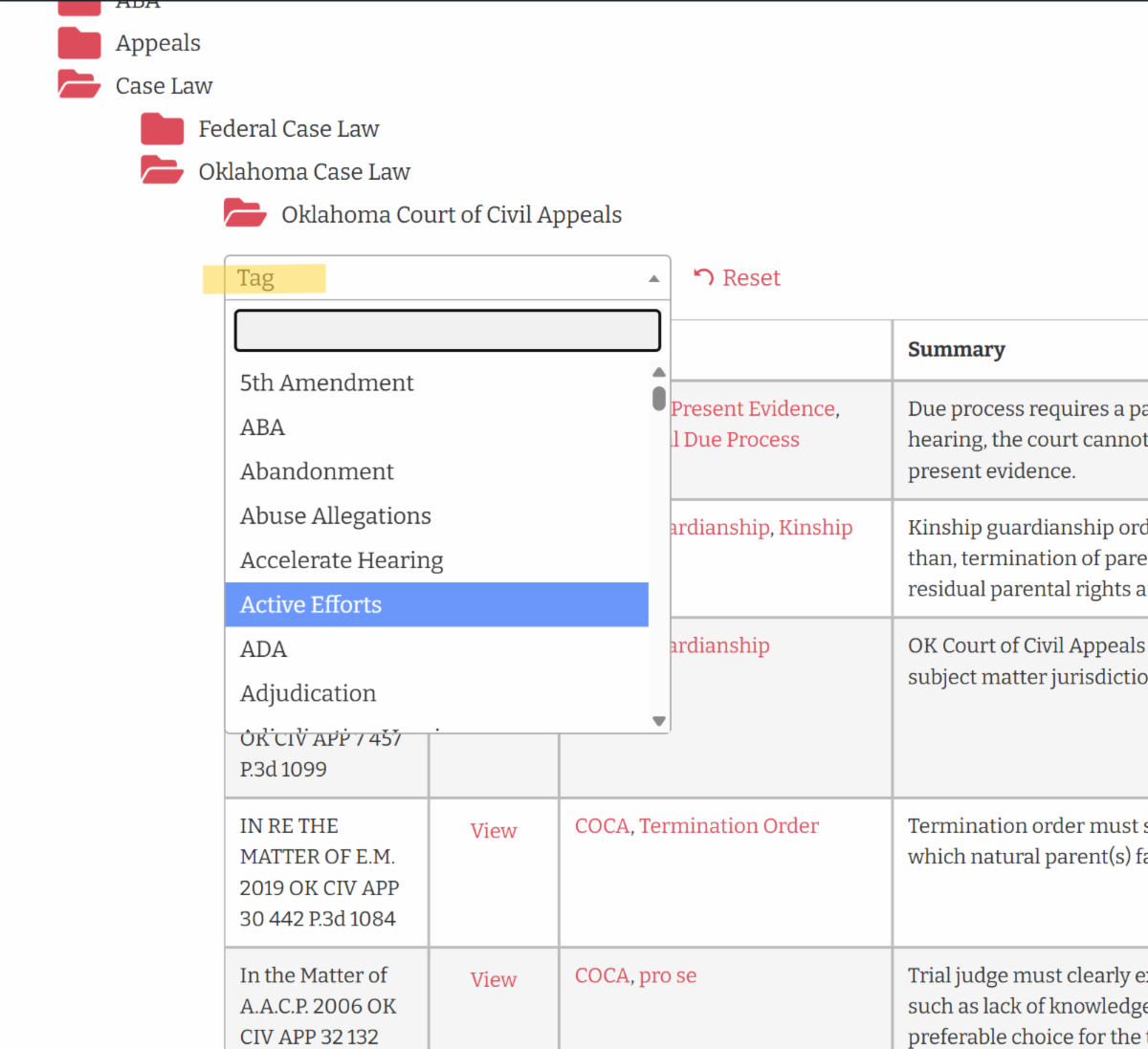
Every document on our practice resources page is tagged to identify its content. You can open any folder and see the "Tag" bar. Clicking this bar will open up every term used as a tag on our website! Here, if I clicked on "Active Efforts," it would filter to show all of the documents tagged as "Active Efforts."
| | |
Search method 2: Search bar
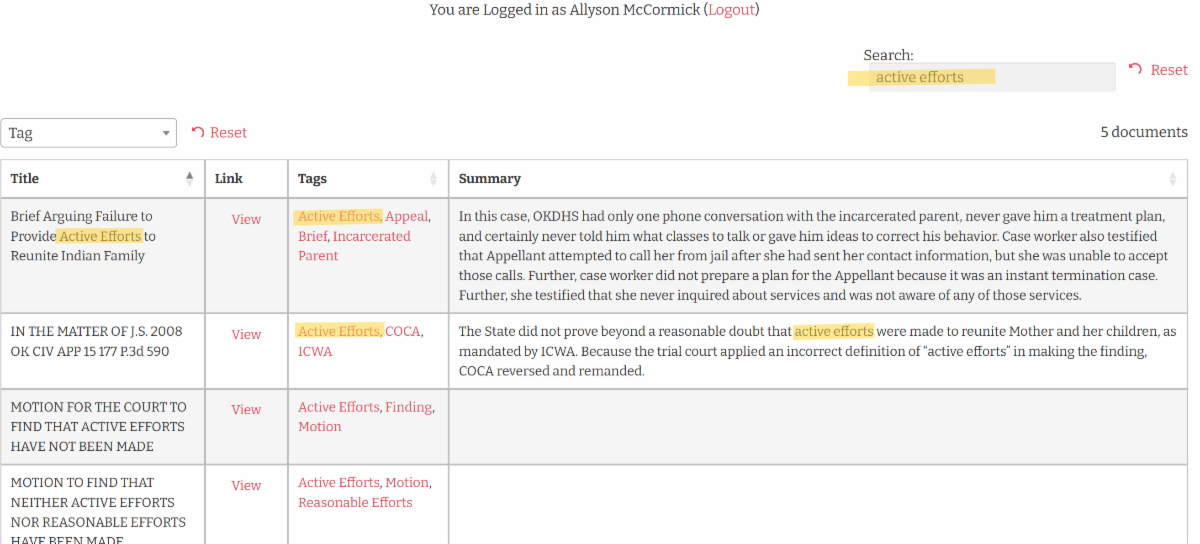
Maybe the tags section is a little too overwhelming. There are a lot of terms to scroll through to find what you want! Instead, you can use the "Search" bar. Here, I typed "active efforts" and it was able to pull any documents with the term "active efforts" in its title, tags, or summary.
| | |
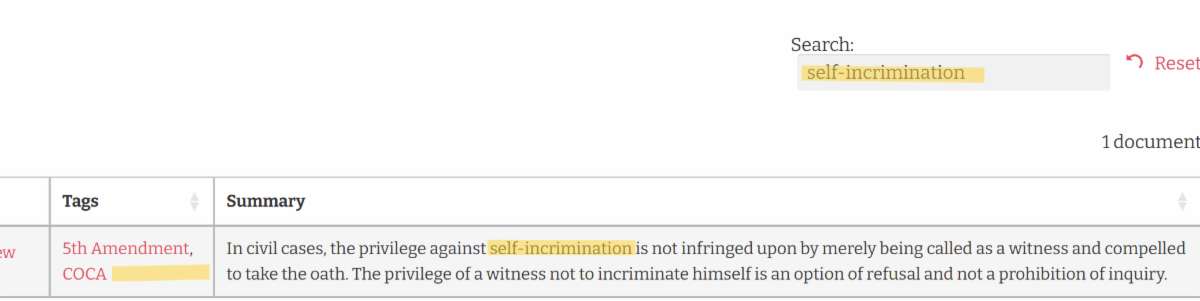
But, maybe I didn't tag the document with the exact term/subject matter you are searching for! Even if a word or term is not a tag, it will still show up in the summary of a document.
If you were not able to find your term in the list of tags, you can still search for it, and it will pull documents containing that term in the summary or title, EVEN if it is missing from the tags.
| | |
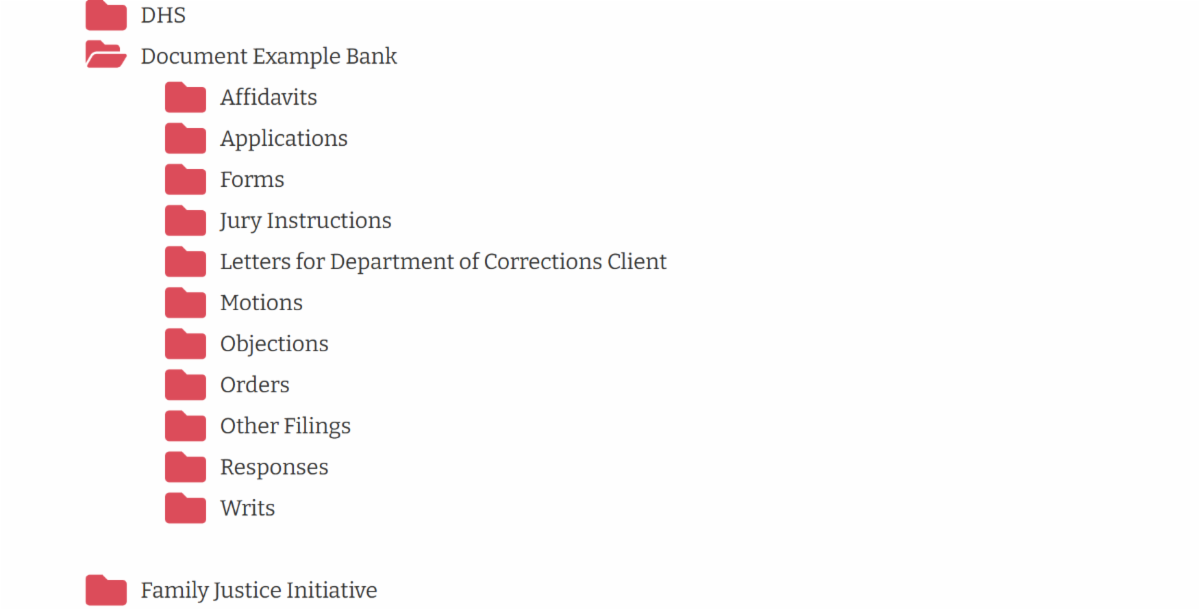
Search method 3: Exploring folders
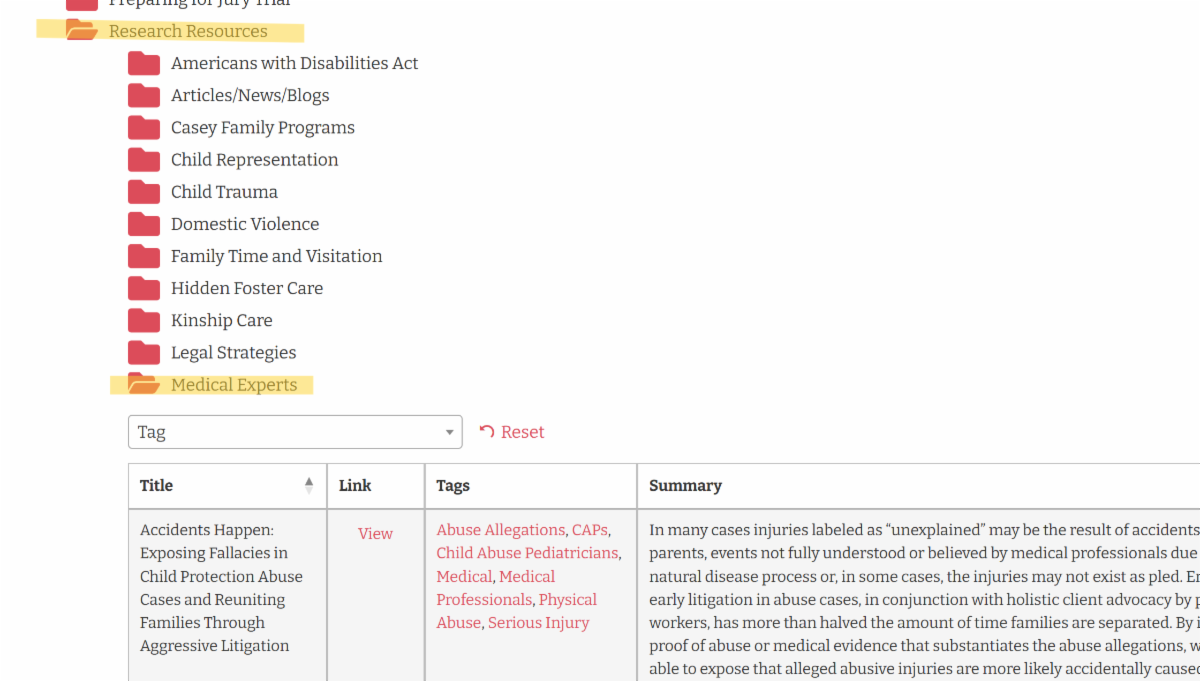
If you have explored our page, you know there are a LOT of folders. This can help guide more general research. For example, below I have gone into our "Research Resources" folder and popped open the "Medical Experts" folder. In here, you can find a variety of resources: journal articles, news articles, quick guides, and more.
| | This works the same way for our document bank. You can pop open the "Motions" folder and scan for what you may need, instead of searching for it by name. | | We want to provide you with as much support as possible. If you ever have any recommendations for resources to add, or have any questions about how to access or use the page, please email me: allyson.mccormick@laok.org! | |
| How did you like this newsletter? | | | | | | |