Weekly Newsletter:

December 31, 2025


Making Effective Resolutions

for the New Year... (AND BEYOND)


So it's that time of year again...New Year's! Oh my! "Out with the old, in with the new." Perhaps we ate too much, reveled too much, did too much, or did way too little. Now is a good time for new beginnings, a clean slate...an opportunity for the ultimate "do-over." Enter the concept of resolutions! Google defines resolutions as "a personal promise or goal people make at the start of a new year to change an undesired habit, improve their behavior, or achieve a personal goal." Good to know that the tradition of resolutions dates back over 4,000 years, with ancient Babylonians and Romans making similar promises...no wonder the custom seems so "old hat"! One wonders what their "success ratio" might have been!


Just as traditional as is the custom, the expectation that these resolutions will last has about the same shelf life as fresh flounder. And why is that?


Possible reasons for failure of desired success: 

  1. Many people fail to stick to their New Year's resolutions when outcomes don't meet their expectations.
  2. Impatience, it can take months for a new behavior to develop into a habit
  3. Due to an "all-or-nothing" mindset, perfectionists fail to appreciate that some progress is better than none.
  4. Healthy habits require some initial expenditure of effort, focus, and energy.

Here are tips to help you set and stick to your New Year's resolution:

I: Set the bar low.

Since most people who fail to stick to New Year's resolutions do so because they become discouraged by starting with an ambitious goal that doesn't meet their expectations. Begin with smaller goals that support the central resolution. Minor successes help to pave the way to ultimate success as progress is perceived. Success can serve to raise the bar to the next rung. Success serves to motivate you to the next level.


ll: Be patient with yourself. 

New Year's resolutions involve a new behavior that you may not be familiar with. Be patient with yourself; it can take time to fine-tune the new behavior. for optimal results. The key is to remain consistent and perform the behavior enough times in order to make it an automatic part of your life. Repetition creates habit. Habit changes behavior.


lll: Don't strive for perfection. 

According to perfectionists, if an outcome is not perfect, then it is a complete failure. It comes with a broad definition of failure but a narrow definition of success. An "All-or-nothing" mindset can cause one to give up entirely. Don't allow perfectionism to get in the way of showing up for yourself. Sometimes "good enough" is just that! Effort outdoes avoidance. 


lV: Give yourself grace. 

Be mindful of how your Inner Critic lashes out the first time you fail to stick to your New Year's resolution. A harsh Inner Critic makes it less likely that you will stick to your goals. Above all else, be kind to yourself. If toddlers had given up after falling down the first time, chances are we would all be going about on "all four legs," thereafter.


V: Have an accountability buddy. 

Having an accountability friend can help you stay on course even when you are lower on willpower because others can remind you of the progress you have made. It is also harder to slack off when someone is watching. Please note: This is an important source of support when establishing new habits and behaviors. Yet, like training wheels and other external support, the ultimate goal is to strengthen you sufficiently to integrate your own new habits and behaviors internally. As helpful and encouraging as having a buddy might be, the ultimate desired outcome must ultimately be intrinsic (from yourself) motivation, rather than extrinsic (from outside of you) motivation.


Vl: Daily journaling. 

Journaling regularly serves to keep you focused and committed to your resolutions and goals. It is an excellent practice that keeps you motivated and serves as a reliable record of your success and challenges. It can also serve as a testimony to the path and challenges on the way to achieving your goals.

Be specific in formulating your goals. When goals are concrete, clear, and measurable, it is easier to track progress, which provides motivation and a sense of accomplishment.


+ Make resolutions concrete, clear, and measurable. Instead of: "I will go running every day." Say: "I will run for 30 minutes 3 times a week at 7:30 in the morning, Monday, Wednesday, and Friday.


+ Focus on Process, not just outcomes. Instead of "I will lose 20 pounds by summer." Say, "I will eat more vegetables and consume fewer carbs with each meal." By focusing on behaviors, you will build systems that increase the likelihood of long-term success.


+ Make resolutions achievable and realistic. Begin by employing small, measurable steps. Instead of : I will read more each day," Say: "I will commit to reading 10 pages every day." By achieving smaller goals, you reinforce positive behaviors, which, in turn, increases motivation for the next challenge.


+ Consider the "why" behind your goals. Emphasis on intrinsic motivation fuels the drive to pursue goals because they align with your personal values and interests. (Intrinsic; from you, rather than extrinsic, another's wishes for you.) Therefore, reflect on why this goal or resolution is important to me.


Embrace flexibility and self-compassion.

“One of the most important psychological principles for resolution-setting is the ability to practice self-compassion. Research has shown that individuals who are kind to themselves when they make mistakes or encounter setbacks are more likely to stay motivated in the long run.


Instead of beating yourself up if you miss a workout or indulge in an unhealthy behavior that runs counter to your resolutions, approach yourself with the same kindness and understanding you would show a dear friend. Acknowledge the setback and then refocus on your goals without judgement or regret. Reaffirm your renewed intention." - Aspen Psychology Group


The new year offers a fresh opportunity for growth, but the key to lasting change lies in how you set your resolutions. By being specific, focusing on the process, setting realistic goals, and practicing self-compassion, you can create a path to success and self-mastery. 


  • "If you can conceive it and believe it, you can achieve it!"
  • "It isn't how many times we fall down, but how many times we get back up."

— Karen Kelleher, MA

Family Caregiver Support Coordinator at DayBreak


Meet Our New Team Member: Jayde Hart 🎉 


We’re excited to welcome Jayde to the DayBreak team as our Memory Care Cafe Program Coordinator!

With a diverse background in social services, public health, and mental health, Jayde sees the world through a lens of equity, justice, and compassion. She brings experience working with unhoused individuals, Veterans, those facing mental health challenges, individuals with disabilities, family caregivers, and more. She is passionate about doing her part to make the world a place where those facing both challenges and triumphs can find community and support.

  • Fun fact: She was a competitive swimmer for 13 years!
 

Upcoming Events & Workshops 📣


Spread the Love:

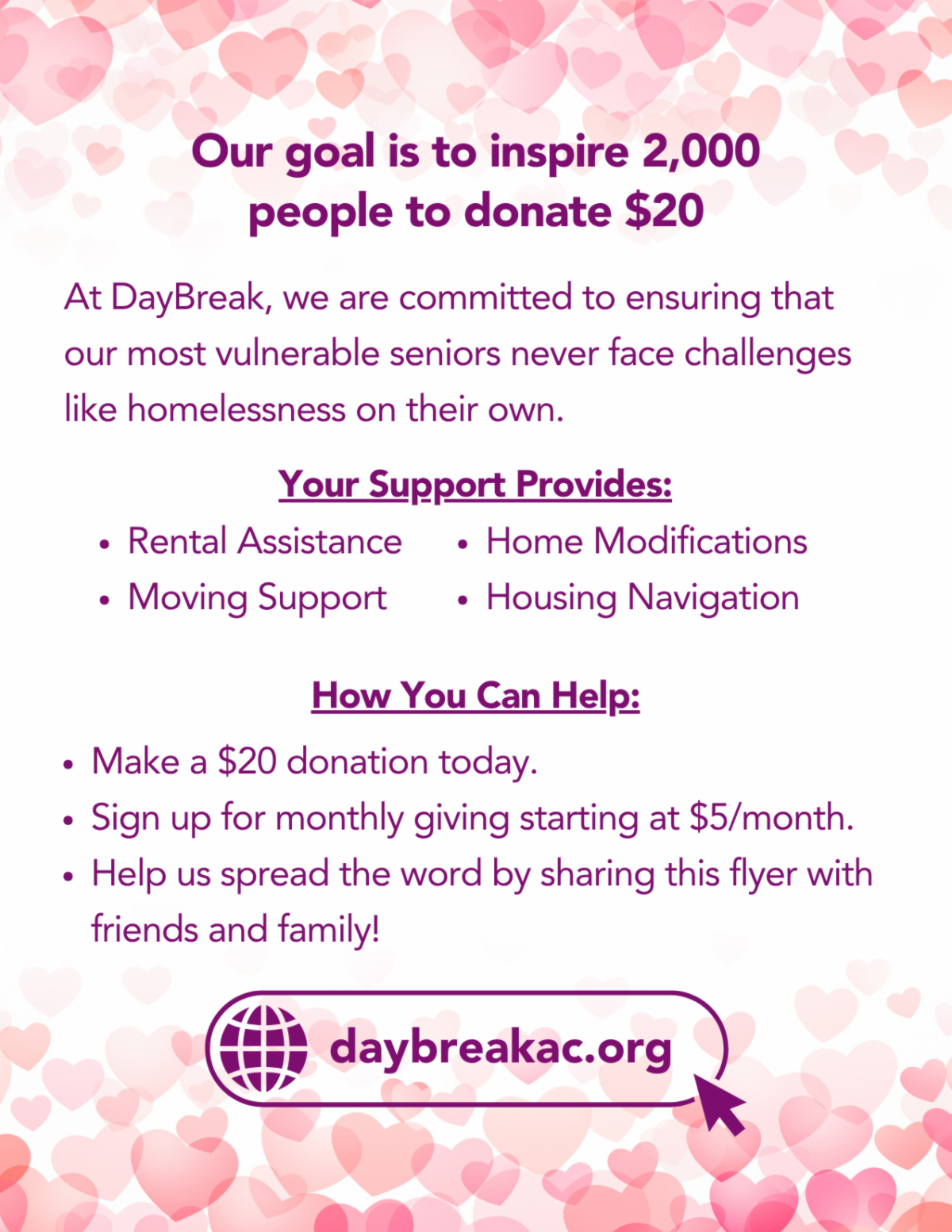
Help Us Reach Our Goal 💜


It truly takes a village to make this work possible. Because of your generosity, we’re able to continue serving seniors who are aging alone. Every donation, no matter the size, makes a real and lasting impact. Thank you for being part of our DayBreak community!

If you know an elder in need of our care and coordination services, or a caregiver seeking support, please encourage them to reach out to us at: 

510-834-8314

Web  LinkedIn  YouTube  Facebook  Instagram