NOTE: For those who are not NHC members, we have extended access to our Member Brief for a limited time. If you’re not a member and would like to continue receiving our Member Brief, as well as other NHC member benefits, please click here to join today. | | Weekly update from the National Housing Conference | | News from Washington | By Brittany Webb | | |
Insurance hearing reflects on NFIP challenges
The House Financial Services Subcommittee on Housing and Insurance held a hearing titled “Mitigation and Multiple Loss Properties: Factors Influencing the High Cost of Flooding,” examining the role of the National Flood Insurance Program (NFIP) in addressing rising disaster costs and repeated property losses. Lawmakers focused on the outsized impact of repetitive-loss properties on NFIP’s financial position and the need for stronger mitigation strategies to reduce long-term risk to homeowners and taxpayers. Conversation emphasized that the flood maps used for the NFIP program are decades outdated, leading to inaccurate reflections of risk.
Witnesses for the hearing included Dr. Alicia Puente Cackley, Director, Financial Markets and Community Investment at the U.S. Government Accountability Office; Dr. Diane Horn, Specialist in Flood Insurance and Emergency Management at the Congressional Research Service; Steve Ellis, President of Taxpayers for Common Sense; Joel Scata, Senior Attorney at the Natural Resources Defense Council; and Samantha Medlock, Founder and President of Climate Risk Advisors. Testimony addressed the drivers of NFIP costs and the role of mitigation strategies such as property acquisition, elevation, and relocation in reducing future losses.
Subcommittee Chairman Mike Flood (R-Neb.) emphasized that repeated-loss properties remain a key contributor to NFIP debt and the need to evaluate policy solutions to reduce risk and improve program sustainability.
"Multiple loss properties are properties that flood repeatedly, often costing the NFIP and taxpayers significant money. According to the GAO, as of 2021 unmitigated multiple loss properties made up about 2.5 percent of NFIP policies, but 48 percent of NFIP claims,” Flood stated in his opening remarks. “The mismatch between the number of these repetitive loss properties covered by the NFIP and the amount of claims paid out to those homes demonstrates a significant structural challenge for the program.”
| |
Time is running out to join
the premier housing communications event
On April 8, housing communicators from across the country will gather in Washington, DC, for NHC's Solutions for Housing Communications.
Panel discussions will spotlight strategies for clearly communicating complex and technical housing issues, working effectively with housing reporters, and understanding how technology and AI are reshaping public discourse. Sessions will also highlight the power of intergenerational storytelling, best practices for communicating before, during, and after natural disasters, and practical tools to help participants engage confidently across media platforms.
We’re proud to feature an outstanding lineup of speakers, including leading housing advocates, top journalists, communications strategists, and policy experts from across the country. Their insights and real-world experience will offer valuable perspectives you won’t find anywhere else—making this a must-attend event for anyone working at the intersection of housing and communications.
| | | |
Legislation introduced to expand homeownership
Sen. Lisa Blunt Rochester (D-Del.) introduced new legislation aimed at reducing barriers to homeownership and expanding access to generational wealth through grant pilots and research of shared equity programs. The bill, titled the Permanent Housing Affordability Act, focuses on addressing structural hurdles that limit access to credit and homebuying opportunities, particularly for first-time and underserved buyers, to ultimately broaden pathways for homeownership. Housing advocates supporting the bill emphasized that targeted federal action is necessary to close longstanding gaps in homeownership access.
“The housing affordability crisis affects every community in our nation, and we need innovative solutions to boost more affordable housing supply,” said David Dworkin, President and CEO of the National Housing Conference. “The Permanent Housing Affordability Act would empower communities to leverage public investment to develop long-term affordable housing, helping close the housing supply gap and putting the dream of homeownership in reach for hardworking families. We welcome this creative approach that builds on successful state and local models to help more households access the wealth-building opportunity of homeownership.”
The legislation comes amid continued bipartisan interest in addressing housing affordability through a combination of supply-side reforms and demand-side supports.
| |
GAO weighs in on institutional investors
A new report from the Government Accountability Office (GAO) finds that institutional investor ownership of single-family rental homes increased from 2018 through 2024 across six major metropolitan areas, with the largest growth occurring in markets such as Phoenix and Dallas. In these markets, investor-owned homes more than doubled over the period, while other metros, including Jacksonville and Nashville, also saw substantial increases.
Despite this growth, GAO found that institutional investors continue to represent a relatively small share of the overall housing market. In 2024, investor ownership ranged from less than 1-3% of all single-family homes across the six markets studied, though their presence was more significant within the single-family rental segment, reaching as high as 22% in Jacksonville. The report also notes that investor-owned homes tend to be geographically concentrated and that ownership levels declined across all six metro areas in 2024 following several years of rapid growth.
| | | |
Fannie Mae to accept crypto-backed down payment product
Fannie Mae will begin accepting cryptocurrency-backed assets as down payments under a new mortgage product, allowing borrowers to use crypto in place of cash for a Fannie Mae-backed mortgage. The product, offered by Better Home & Finance in partnership with Coinbase, marks the first time the government-sponsored enterprise has incorporated digital assets into its framework for evaluating borrower eligibility. Federal Housing Finance Agency (FHFA) Director Bill Pulte has previously indicated that both Fannie Mae and Freddie Mac should prepare to consider crypto as part of consumer reserves.
“Token-backed mortgages are a major first step to unlocking homeownership for the younger generations that have struggled with barriers to saving for a traditional down payment,” said Coinbase head of consumer and business products Max Branzburg in a press release.
The policy will apply to certain well-documented crypto assets held on regulated exchanges, with underwriting standards designed to account for the volatility and liquidity risks associated with digital currencies. The product is expected to allow borrowers to pledge their crypto holdings rather than liquidate them, enabling participation in the housing market without triggering taxable events or exiting digital asset positions.
Supporters argue the change could expand access to homeownership for borrowers with wealth held outside traditional financial systems, particularly younger households and technology-sector workers who have accumulated assets in crypto markets. However, the approach also raises questions about risk management and evolving regulatory oversight of cryptocurrency markets.
| | | |
Multifamily housing starts continue lagging behind peak
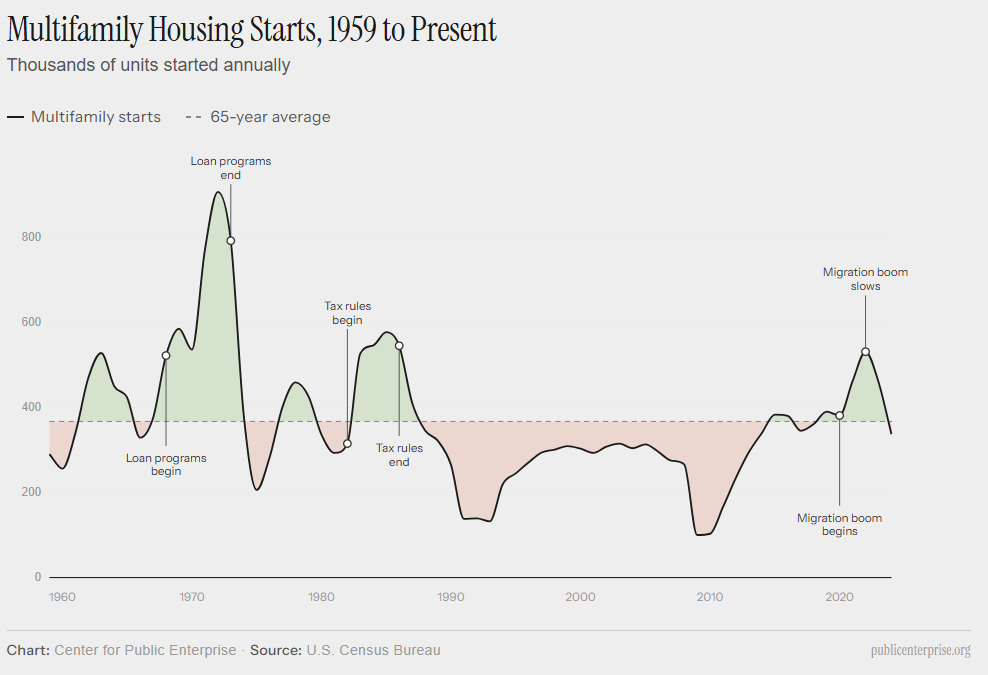
The Center for Public Enterprise published a report titled, “Raising the Housing Investment Level,” stating that increased multifamily housing production is necessary to close the housing gap and address demand. The figure on multifamily housing starts from 1959 to the present documents' large cyclical swings in production, with starts reaching much higher levels in earlier policy eras than in recent decades. According to the report, multifamily construction surged in the late 1960s to early 1970s and again in the early to mid-1980s, when federal programs and tax policy more strongly supported apartment development, before falling back to significantly lower levels that have persisted since. For roughly the last three decades, production oscillates around a relatively narrow band of about 350,000 multifamily starts per year and is characterized as inadequate relative to both historic peaks and today’s housing needs. The authors argue that sustained output of at least 500,000 units annually over multiple years would be required to meaningfully reduce the shortfall.
| | |
NAHREP published its 2025 State of Hispanic Homeownership Report finding that Hispanic homeownership reached record level numbers. The report states Hispanic owner-households grew by 441,000 pushing to a total of 10.2 million. This marks the largest single-year increase in the report’s history and the biggest gain of any racial or ethnic group, underscoring the growing role Hispanic households play in the housing market. At the same time, the report notes that intensified immigration enforcement has dampened demand and disrupted the labor market, adding pressure to an already strained housing market.
Politico reports that the Trump Administration has denied disaster aid to Democratic-led states at a much higher rate than prior FEMA history. The article states about $250 million in aid has been blocked that likely would have been approved under earlier FEMA practices. The effect is a steeper and more uneven path to federal disaster relief for blue states, a stark departure from the more even-handed approach that has usually governed disaster relief.
A HousingWire op-ed authored by Joe Ventrone states that federal housing policy is in need of a full reset, drawing from three distinct eras for guidance: the moral drive of the 1960s, the market discipline of the 1980s, and the cross-sector collaboration happening today. Ventrone also makes the case that digital delivery could make housing policy more effective, more responsive, and better able to keep up with the scale of the affordability challenge.
A new report from the National Housing Trust explores promising practices in the design and implementation of stabilization funds that help preserve affordable housing in the near term. As affordable housing owners face increased challenges, the report explores how stabilization funds are emerging as a critical tool to preserve affordable housing by providing flexible financial support to right size debt, address deferred maintenance, or provide short-term operating support. The report profiles four states and local jurisdictions that are effectively stabilizing thousands of homes and ensuring the long-term viability of affordable housing portfolios. It outlines four key best practices that can serve as valuable models for other regions facing similar challenges.
| | The National Housing Conference is a diverse continuum of affordable housing stakeholders that convene and collaborate through dialogue, advocacy, research, and education, to develop equitable solutions that serve our common interest. | | Defending Our American Home since 1931 | | Copyright © 2024. All Rights Reserved. | | | | |