The RNA Transcript, July 12, 2021 |
|
The objectives of this council are to work collaboratively across disciplines, build a scientific community, and generate ideas and activities that advance RNA research and education across the University of Michigan.
This is a great opportunity to develop and implement ideas that enhance your curriculum and experience at U-M. The Council is also an excellent platform to further engage with peers, mentors, and faculty from the RNA research community.
|
|
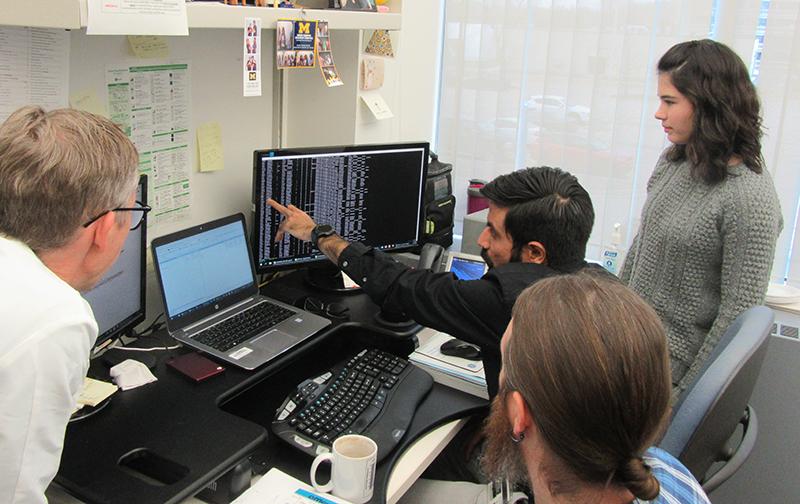
In an article published in the journal RNA [1], Karan Bedi, a bioinformatician in Mats Ljungman’s lab, Department of Radiation Oncology at the University of Michigan Medical School, investigated the efficiency of splicing across different human cell types. The results were surprising in that the splicing process appears to be quite inefficient, leaving most intronic sequences untouched as the transcripts are being synthesized. The study also reports variable patterns between the different introns within a gene and across cell lines, and it further highlights the complexity of how newly transcripts are processed into mature mRNAs.
[1] “Cotranscriptional splicing efficiencies differ within genes and between cell types,” Karan Bedi, Brian Magnuson, Ishwarya Venkata Narayanan, Michelle T. Paulsen, Thomas E. Wilson, and Mats Ljungman, RNA July 2021 27: 829-840; doi:10.1261/rna.078662.120
Photo: Karan Bedi explains the complex data analysis pipeline. Professor Ljungman is on the left – credit: E. Paymal
|
|
Tuesday, July 13, 8:00 pm ET | Center for RNA Science, Institute for Basic Sciences and Seoul National University, Korea
Olivia Rissland (UCAMC), Jin-Hong Kim (IBS/SNU)
|
|
August 6–7, 3rd International Webinar on Nucleic Acids & CRISPR
REGISTRATION (Mid Term Date: 15/07/2021-149$; Final Term Date: 26/07/2021-199$)
"Cracking the code of DNA and RNA: New insights into the structure and functions of nucleic acids"
This event is a broad audience gathering for exploring the advancement in DNA, RNA, epigenetics, and innovative techniques at molecular and chemical levels.
|
|
September 9–10, Rust Belt RNA Meeting 2021, Columbus, Ohio
Keynote speaker: Professor Hashim Al-Hashimi, Duke University School of Medicine
We are pleased to be a sponsor of this event.
|
|
For press releases and blog articles about your upcoming top journal publications,
|
|
Our members' publications are available through Altmetric. Five queries are currently available: "RNA," "microRNA," "Transcriptome," "Translation," and "Molecule." Please make sure to have at least one of these key words in your title or abstract. Below are recent highlights.
|
|
The RNA helicase DHX36/G4R1 modulates C9orf72 GGGGCC hexanucleotide repeat- associated translation, Yi-Ju Tseng, Siara N. Sandwith, Katelyn M. Green, Antonio E. Chambers, Amy Krans, Heather M. Raimer, Meredith E. Sharlow, Michael A. Reisinger, Adam E. Richardson, Eric D. Routh, Melissa A. Smaldino, Yuh-Hwa Wang, James P. Vaughn, Peter K. Todd, Philip J. Smaldino, Journal of Biological Chemistry, 2021 Jun 23;100914. doi: 10.1016/j.jbc.2021.100914
Keywords: C9ORF72; DHX36/G4R1/RHAU; DNA helicase; Dipeptide repeat proteins (DPRs); Fragile X; G-quadruplex; Huntington disease; RNA helicase; Repeat-associated non-AUG translation (RAN); amyotrophic lateral sclerosis (ALS) (Lou Gehrig disease).
|
|
Previously considered “difficult to drug” on a structural and selectivity basis, considerable efforts in academia and industry are now being focused on targeting RNA as a therapeutic modality. These efforts are driven based on both the biological significance of RNAs, as well as a growing number of studies implicating aberrant RNA biology in many human diseases.
While biologic approaches continue to play an impactful and ever-growing role in RNA-targeted drug discovery, considerable efforts are now being devoted toward the targeting of RNAs with small molecules. In the issue, both a diversity of RNA types, as well as strategies for small molecule discovery, are highlighted.
|
|
Small-molecule inhibitors targeting Polycomb repressive complex 1 RING domain. Shukla, S., Ying, W., Gray, F. et al. Nat Chem Biol 17, 784–793 (2021). https://doi.org/10.1038/s41589-021-00815-5
Abstract: Polycomb repressive complex 1 (PRC1) is an essential chromatin-modifying complex that monoubiquitinates histone H2A and is involved in maintaining the repressed chromatin state. Emerging evidence suggests PRC1 activity in various cancers, rationalizing the need for small-molecule inhibitors with well-defined mechanisms of action. Here, we describe the development of compounds that directly bind to RING1B–BMI1, the heterodimeric complex constituting the E3 ligase activity of PRC1. These compounds block the association of RING1B–BMI1 with chromatin and inhibit H2A ubiquitination. Structural studies demonstrate that these inhibitors bind to RING1B by inducing the formation of a hydrophobic pocket in the RING domain. Our PRC1 inhibitor, RB-3, decreases the global level of H2A ubiquitination and induces differentiation in leukemia cell lines and primary acute myeloid leukemia (AML) samples. In summary, we demonstrate that targeting the PRC1 RING domain with small molecules is feasible, and RB-3 represents a valuable chemical tool to study PRC1 biology.
|
|
Postdoctoral Position to study viral non-coding RNAs at Mount Sinai School of Medicine, New York
The Pawlica lab in the Department of Microbiology at Mount Sinai School of Medicine is looking for a postdoctoral researcher to elucidate the functions of various small non- coding RNAs during coronaviral and herpesviral infections. We are using a combination of RNA biochemistry, bioinformatics and molecular virology to understand the RNA-centric virus-host interaction. The Pawlica lab is funded by a generous start-up package and R00 grant from NIH. The Department of Microbiology at Mount Sinai School of Medicine is a leader in viral research and offers an inspiring and collaborative environment.
|
|
Share your news
and comments,
|
|
|
|
|
|
|
|