Rail & Labor News from RWU
| |
Weekly Digest Number 7 - February 11th, 2025 | |
Welcome to the RWU Rail & Labor News! This news bulletin is produced and emailed out each Tuesday morning. We hope you find each week's news and information useful. If so, please share with co-workers, friends, and colleagues. If you like, you can sign them up to get all the news from RWU HERE. Or forward them the link. Got a hot tip? Please forward the article and a link to raillabornews@gmail.com. Note: If you read over this news bulletin each week, you will be sure to never miss the important news of what is going on in the railroad world from a worker's perspective! | |
THIS WEEK'S RAIL AND LABOR NEWS | |
Editor's Note: Tragedy has struck the rail labor community once again, as two BMWED brothers lost their lives in a crew van accident near Jonesboro, Arkansas. This heartbreaking incident underscores the ongoing risks rail workers face, even beyond the rails. Our thoughts are with the families of Brothers David Van Winkle and Timothy Foote, as well as the injured survivors. Rail labor must continue pushing for safer transport conditions and better protections for those who keep the industry moving. | |
BMWED-IBT / February 6
It is with profound sadness that we share the heartbreaking news of a tragic and fatal highway accident today just outside Jonesboro, Ark. involving two of our Brothers on BNSF.
Brothers David Van Winkle, 63, an 11-year member of AT&SFF Local Lodge 2433 and Timothy Foote, 61, a 10-year member of BSD Local Lodge 1533 were killed after their crew van was struck by a pickup truck while enroute to the jobsite this morning. Another Brother in the van, Zack Williams from AT&SFF Local Lodge 2433, is currently in the hospital in critical condition. Several more Brothers inside the van have also sustained injuries.
We ask that you keep these members, their families, and all those affected in your thoughts and prayers during this devastating time. Our Union family mourns together, and we will stand in solidarity to support those impacted. Our deepest and most sincere condolences go out to the families and friends of Brothers Van Winkle and Foote.
| |
Editor's Note: CPKC and the Teamsters Canada Rail Conference-MWED have reached a tentative four-year deal, though details remain undisclosed until ratification. While rail labor welcomes agreements reached at the bargaining table, the real test will be whether this contract delivers meaningful gains for workers or simply maintains the status quo. As always, the devil is in the details—ones we have yet to see. | |
Progressive Railroading / January 29
Canadian Pacific Kansas City and the Teamsters Canada Rail Conference Maintenance of Way Employees Division (TCRC-MWED) have reached a tentative four-year agreement for engineering service employees, the Class I announced yesterday.
Details of the tentative collective agreement will not be public until the agreement has been ratified, CPKC officials said in a press release.
"Working together with the TCRC-MWED, we are pleased to have reached an agreement that is good for our railroaders and their families across Canada," said CPKC President and CEO Keith Creel. "With another tentative collective agreement completed at the negotiating table, we can continue our work safely and efficiently serving our customers and delivering for the Canadian economy."
| |
Editor's Note: Rail electrification is a clear win for the environment, yet regulatory red tape continues to stall progress. While laws like NEPA and CEQA were designed to protect the environment, their expansion has allowed wealthy interests to weaponize them against projects that would reduce emissions and improve rail service. High-speed rail’s success hinges on overcoming these obstacles—otherwise, we risk letting bureaucracy derail a cleaner, more efficient future. | |
High Speed Rail Alliance / January 25
Rail electrification with overhead catenary, critical to high speed rail, is an unambiguous positive for the environment. It produces no air pollution at point of source, can be powered entirely by renewable energy, as California High Speed Rail will, and even using California’s current grid emits more than 100x less CO2 per passenger than diesel trains. More importantly, the faster acceleration, higher maximum speeds, and lower maintenance costs compared to other types of trains allow for higher levels of service, creating a demonstrated “Sparks Effect” of higher ridership that reduces emissions from cars. For these reasons and more, mainstream environmentalists have embraced overhead electrification as a climate solution.
Despite the obvious benefits of electric rail, environmental law has been misused to obstruct vital rail electrification projects. While the National Environmental Policy Act (NEPA) and California Environmental Quality Act (CEQA), California’s version of NEPA, provide critical protections against many environmentally damaging projects, over time their scope has been expanded by the courts, enabling abuse by wealthy interests.
|
|
Editor's Note: Transit Equity Day serves as a reminder that public transportation is more than just a service—it’s a civil right. Recognized on Rosa Parks’ birthday, this day highlights the ongoing fight for accessible, affordable transit for all. While free rides from agencies like L.A. Metro and RTD are a symbolic gesture, true transit equity requires long-term investment, fair labor agreements, and a commitment to expanding service where it’s needed most. | |
Progressive Railroading / February 4
Today, several U.S. transit agencies are honoring Transit Equity Day by offering free rides to the public. Transit Equity Day is recognized annually on the birthday of Rosa Parks, who refused to give up her seat on segregated public bus in 1955, helping to launch the Civil Rights Movement.
Transit Equity Day highlights the efforts of transit providers, labor unions and advocates of equity in public transportation, said Los Angeles County Metropolitan Transportation Authority (L.A. Metro) officials in a press release.
Along with L.A. Metro, the Regional Transportation District–Denver (RTD), the North County Transit District (NCTD) in California, among others, announced that they are offering free rides on all modes of public transportation in honor of Parks’ birthday and Transit Equity Day.
| |
Editor's Note: South Australia’s decision to bring its rail services back under public control is a rare victory against privatization’s broken promises. Despite claims that privatization would improve efficiency, the reality often leads to higher costs, diminished service, and worker uncertainty. With no break fees paid to undo the damage, this move signals that public ownership remains the best way to ensure reliable, accountable transit—something rail labor has long understood. | |
EIN Presswire / February 3
Increased security and CCTV headline benefits for commuters as rail operations are returned to public control four years after they were sold off by the Marshall government - despite the former Liberal premier’s pledge that he didn’t have a privatisation agenda.
The return of train services to public hands today – with trams to follow later this year – realises a major Malinauskas Labor Government election commitment.
The State Government announced in April last year that it had reached agreements with the private rail operators to bring train and tram services back into public hands in line with Labor’s pledge – which was made before the private contracts were ever signed. Under these agreements, the State Government will not pay any break fees.
| |
Editor's Note: Judging by some of the rhetoric and budget cutting mania of the new administration - including that here from the new DOT Secretary - Amtrak and passenger rail transportation generally is about to come under severe attack, just when things were looking somewhat promising. | |
Montana Free Press / February 5
Following decades of penny-pinching, the first half of the 2020s appeared to be the beginning of a golden age for passenger rail investment in the United States.
Since 2021, Amtrak has received approximately $32 billion from the federal government as a result of the Infrastructure Investment and Jobs Act, allowing the national passenger railroad to address a years-long backlog of infrastructure and equipment upgrades. The act also provided funding to study the expansion of Amtrak’s network — including reviving a second route across Montana, the North Coast Hiawatha, that hasn’t had service since 1979.
While the fruits of that historic investment are still years away in some instances, officials had other reasons to celebrate. During fiscal year 2024, Amtrak carried a record-breaking 32.8 million passengers, a 15% increase over the previous year and a return to its pre-pandemic ridership. The railroad also brought in $2.5 billion in ticket revenue, a record amount in its 53-year history.
| |
Editor's Note: CPKC has secured another tentative four-year deal, this time with the United Steelworkers representing clerical and intermodal employees. While the railroad touts its third agreement of the year as a success, the real measure will be whether workers see meaningful improvements in wages, conditions, and job security. As always, we will be watching closely—because a “deal” doesn’t always mean a fair one. | |
Progressive Railroading / February 5
Canadian Pacific Kansas City today announced it has reached a tentative four-year collective agreement with United Steelworkers (USW) representing clerical and intermodal employees in Canada.
USW represents approximately 600 employees in Canada. Details of the tentative collective agreement will not be released publicly until the agreement has been ratified, CPKC officials said in a press release. The tentative agreement is the third the Class I has reached this year in Canada, said CPKC President and CEO Keith Creel.
| |
Editor's Note: With BNSF’s Cajon Subdivision among the busiest freight corridors in North America, its diesel consumption is a major environmental concern. As the railroad expands capacity—including the Barstow International Gateway—short-haul freight shuttles between the ports and inland hubs present a clear opportunity for electrification. If railroads are serious about efficiency and sustainability, pilot programs for electric freight should be a priority, not an afterthought. | |
Californians for Electric Rail / Jan 19
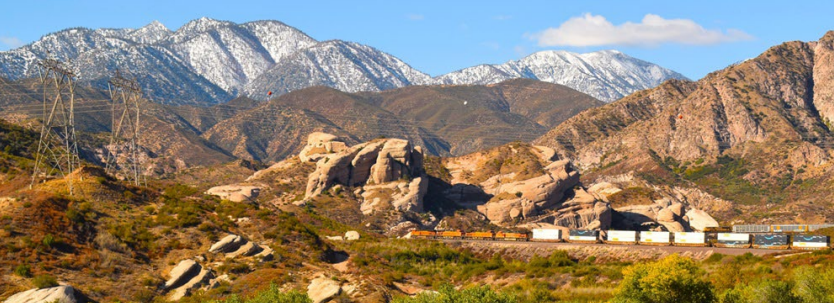
The BNSF Cajon Subdivision, part of the ‘Southern Transcon’ between Los Angeles and Chicago, is one of the busiest segments of freight railroad in North America. The 2023 Anacostia/Pacific Harbor Lines short haul rail study gave a 2022 estimate that the BNSF Cajon Subdivision had an average of 66 freight trains per day, and 2 passenger trains (the Amtrak Southwest Chief). The ‘practical capacity’ of 99 trains per day was estimated based on the segment’s current infrastructure, which includes long sections of double-track. The steep grades, combined with the freight train frequencies, means that Cajon Pass is responsible for a significant portion of all diesel fuel consumed by locomotives in Southern California.
BNSF Railway intends to grow traffic on the Cajon Subdivision and the rest of the Southern Transcon to Chicago, on which the railroad been making capacity investments. BNSF's massive Barstow International Gateway (BIG) is under development on the west side of Barstow6 . This proposed ‘inland port’ development is heavily tied to the Ports of LA/Long Beach freight traffic, utilizing the concept of "short-haul freight shuttle" trains between the Barstow area and the ports. The business model depends on the contents of international 40' containers to/from the ports being transloaded to 53' containers going to the rest of the USA. Port of LA/Long Beach-BIG short-haul rail would be a prime pilot application for electric freight trains.
| |
Editor's Note: The Port of Baltimore’s introduction of an electric railcar mover is a small but significant step toward reducing emissions in rail operations. While the Zephir’s impact—cutting 16,000 gallons of diesel per year—is a drop in the bucket compared to industry-wide fuel consumption, it signals that electrification solutions are advancing. The real question is whether railroads will scale up these efforts or continue treating sustainability as a PR exercise. | |
Freight Waves / February 3
The Port of Baltimore’s Wallenius Wilhelmsen terminal rolled out an electric railcar mover in what the port says is a first for the contemporary U.S. maritime industry.
The zero-emissions LOK 16.150E, manufactured by Marmon Rail’s Zephir division of Italy, features an 80-volt rechargeable battery system with onboard charger powering two 40-kilowatt, alternating current, brushless motors. At just over 21 feet in length, the 63,900-pound Zephir has drawbar pull of 39,500 pound-force.
In a promotional video, the port said the Zephir is expected to reduce diesel fuel consumption by 16,000 gallons annually, removing 13.87 tons of nitrous oxide and 182 tons of carbon dioxide emissions.
| |
Editor's Note: For decades, the Howard Street Tunnel in Baltimore has presented a huge bottleneck for freight rail movements in the busy northeast corridor. The advent of double stacked container trains 4 decades ago exacerbated the problem. Finally the tunnel is being reconfigured to eliminate the bottleneck. But despite decades of exorbitant profits by tunnel owner CSX, the railroad has waited for public money to fund the project. | |
Progressive Railroading / February 4
CSX yesterday announced the Howard Street Tunnel in Baltimore has closed officially for reconstruction as part of an initiative to modernize the nearly 8,700-foot-long tunnel and enable double-stack intermodal service along CSX’s Interstate 95 rail corridor.
On Feb. 1, the project reached a milestone with the removal of rail spikes, marking the next phase of work on the tunnel project, CSX officials said in a press release.
Scheduled for completion by the end of 2025, the initiative aims to increase vertical clearance in the 125-year-old tunnel and address 22 additional obstructions along the corridor between Baltimore and Philadelphia, improving connectivity to key Midwest markets.
| |
Editor's Note: Two years after East Palestine, rail carriers and their lobbyists are still running circles around Congress while communities remain at risk. The RAIL Act is back on the table, but let’s not kid ourselves—corporate money has kept real safety reforms buried under a pile of industry talking points. Rail barons cry about “overregulation” while they slash crews, delay inspections, and gamble with public safety. If lawmakers are serious about accountability, they’ll stop letting Wall Street write railroad policy and start putting workers and communities ahead of corporate profits. | |
Ideastream Public Media / February 3
U.S. Representatives Emilia Sykes, Democrat, and Mike Rulli, Republican, both of Ohio, are set to reintroduce rail reform legislation Tuesday, two years after a Norfolk Southern train derailed in East Palestine. Sykes, Rulli and other lawmakers made the announcement during a news conference Monday.
Sykes first introduced the Reducing Accidents in Locomotives Act after the derailment in 2023. The RAIL Act aims to hold railroad corporations accountable and ensure safety of residents and business located nearby railroad tracks.
"We've had two years to get it done and no one was willing to do it," Sykes said at the news conference. "But I hope to be proved wrong, and there's nothing else that I would want more than to be proven wrong."
| |
Editor's Note: Parallel Systems’ self-driving rail cars are just the latest attempt to replace workers with machines—safety be damned. Despite repeated demonstrations, these glorified tech experiments can’t even meet the most basic safety standards, failing critical tests and putting communities at risk. The fact that they can’t properly warn oncoming traffic at crossings should be enough to send them back to the scrap heap, but we all know how this game works: Wall Street and Silicon Valley see dollar signs, and regulators look the other way. Rail workers have spent generations fighting for real safety measures, not half-baked automation schemes designed to gut the workforce. If they want to gamble with lives to boost profits, it’s time to remind them that rail labor still knows how to fight back. | |
SMART Union / February 4
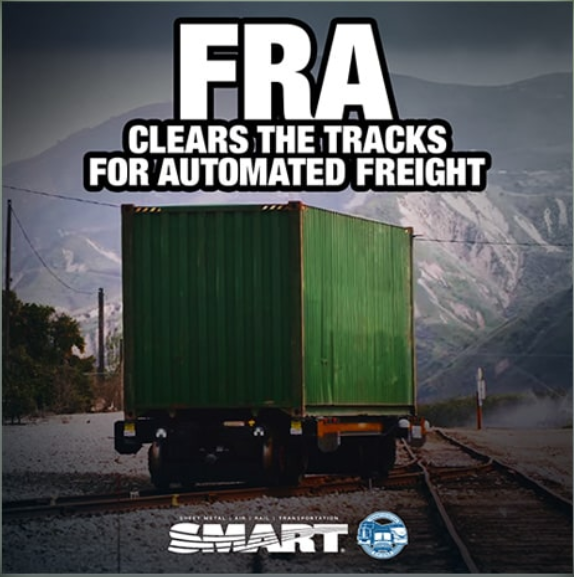
Union representatives have been attending demonstrations of Parallel Systems’ self-driving rail vehicles for years, and their findings have been alarming. These vehicles, which the manufacturer insists are “not rail cars,” consistently fall short of the basic safety standards necessary to protect both rail workers and the communities they serve. The prototypes have failed several critical safety tests, leading to mounting concerns.
One of the most significant safety flaws observed during testing was the vehicles’ failure to adequately warn oncoming traffic at road crossings. The horns and bells on these autonomous vehicles have been found to be insufficiently loud, creating a dangerous situation for workers, drivers, and pedestrians.
| |
Editor's Note: California’s High-Speed Rail project has faced plenty of hurdles, but few as predictable as political grandstanding. Trump’s latest attack on the project—calling it the “worst managed” he’s ever seen—conveniently ignores how freight railroads have pocketed billions while letting infrastructure rot. The reality is simple: Wall Street-backed railroads and their political allies don’t want public investment proving that passenger rail can work in America. While they gut freight networks for short-term profits, they smear high-speed rail as a “boondoggle” to keep the status quo intact. But the future of rail shouldn’t be dictated by those who profit off its failure. | |
KTLA / February 5
President Donald Trump has renewed his efforts to stifle California’s High-Speed Rail project that is currently under construction and would link the Bay Area with greater Los Angeles.
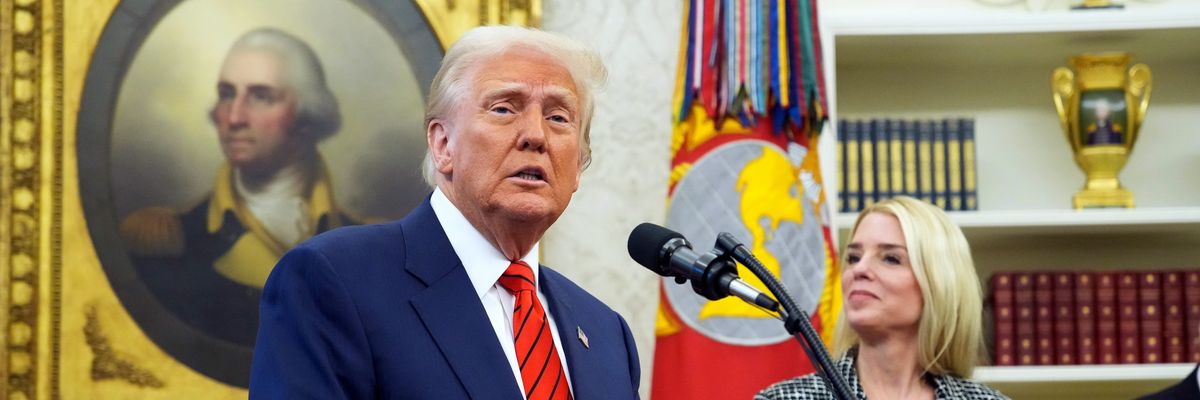
On Tuesday, as he addressed media in the Oval Office, Trump called the project the “worst managed project I think I’ve ever seen,” and said he would be personally investigating its funding.
It’s the latest effort from the Trump Administration to target California’s ambitious transit plan, which is the first publicly funded true high-speed rail system in the nation.
| |
NEWS FROM AROUND THE LABOR MOVEMENT | |
Each week, RWU includes a few articles about advances and developments in the larger labor movement that are of interest to railroad workers. Got an artcile to submit for possible inclusion next week? Email it along to raillabornews@gmail.com. Thank you! | |
Workers Compensation / February 7
U.S. Rep. Andy Biggs (R-Ariz.) introduced legislation in Congress that would eliminate the Occupational Safety and Health Administration.
The legislation, Nullify OSHA Act, or NOSHA, would abolish OSHA and instead replace it with state workplace regulations. Biggs, who is running for governor in Arizona, said this bill would put the controls of workplace protections in the hands of the state.
It’s not the first time he or other Republicans have tried to eliminate the agency established in 1970. Biggs first proposed doing away with OSHA in 2021 in response to OSHA enforcement of COVID-19 vaccination measures under President Joe Biden’s administration. OSHA’s policy originally was that employers with at least 100 workers either mandate vaccinations or require unvaccinated workers to wear masks on the job and undergo regular testing. OSHA’s policy was withdrawn after being blocked by the U.S. Supreme Court.
| |
Economic Policy Institute / January 28
Interest in union organizing is surging in the United States. Since 2021, petitions for union elections at the National Labor Relations Board (NLRB) have more than doubled. And public support for unions is near 60-year highs—at 70%. This growing momentum around union organizing—aided by the Biden administration’s support for worker organizing and appointment of strong worker advocates in critical agencies like NLRB—signals a powerful push by workers to improve wages, working conditions, and workplace rights. But despite this groundswell of support, new data from the Bureau of Labor Statistics (BLS) reveal a puzzling trend: Unionization rates continue to decline.
Research shows that 60 million workers would join a union if they could. The disconnect between the growing interest in unionization and declining unionization rates can be explained by the fact that there are powerful forces blocking the will of workers: aggressive opposition from employers combined with labor law that is so weak that it doesn’t truly protect workers’ right to organize.
| |
|
Common Dreams / February 5
Former Democratic National Labor Relations Board member Gwynne Wilcox sued U.S. President Donald Trump in federal court Wednesday over her dismissal from the NLRB in late January.
Wilcox was first appointed to the body—which safeguards private sector workers' rights to organize—in 2021 by then-President Joe Biden and was re-confirmed for a five-year term by the Senate in 2023.
On January 28, Trump dismissed both Wilcox and NLRB General Counsel Jennifer Abruzzo, who, alongside Wilcox, helped strengthen workers' rights to form unions and went after employers it accused of undermining those rights. Given that Biden dismissed Trump's first-term NLRB general counsel on his first day in office, Abruzzo's firing was expected.
| |
WEEKLY DERAILMENT DEPARTMENT | |
Each Tuesday in this news bulletin, RWU does our best to present a picture of what has been happening over the course of the previous week in terms of derailments in North America, and investigation determinations of previous accidents. NOTE: This list is by no means comprehensive. Smaller and less consequential mishaps are generally not reported here. If the wreck results in injury or fatality, or is especially damaging/extreme, a full article will appear as a feature in the dozen or so rail articles above. Know of a train wreck? Please feel free to forward a link to raillabornews@gmail.com for possible inclusion next week. Thanks! |
| | | |