The Heat Will Kill You First | |
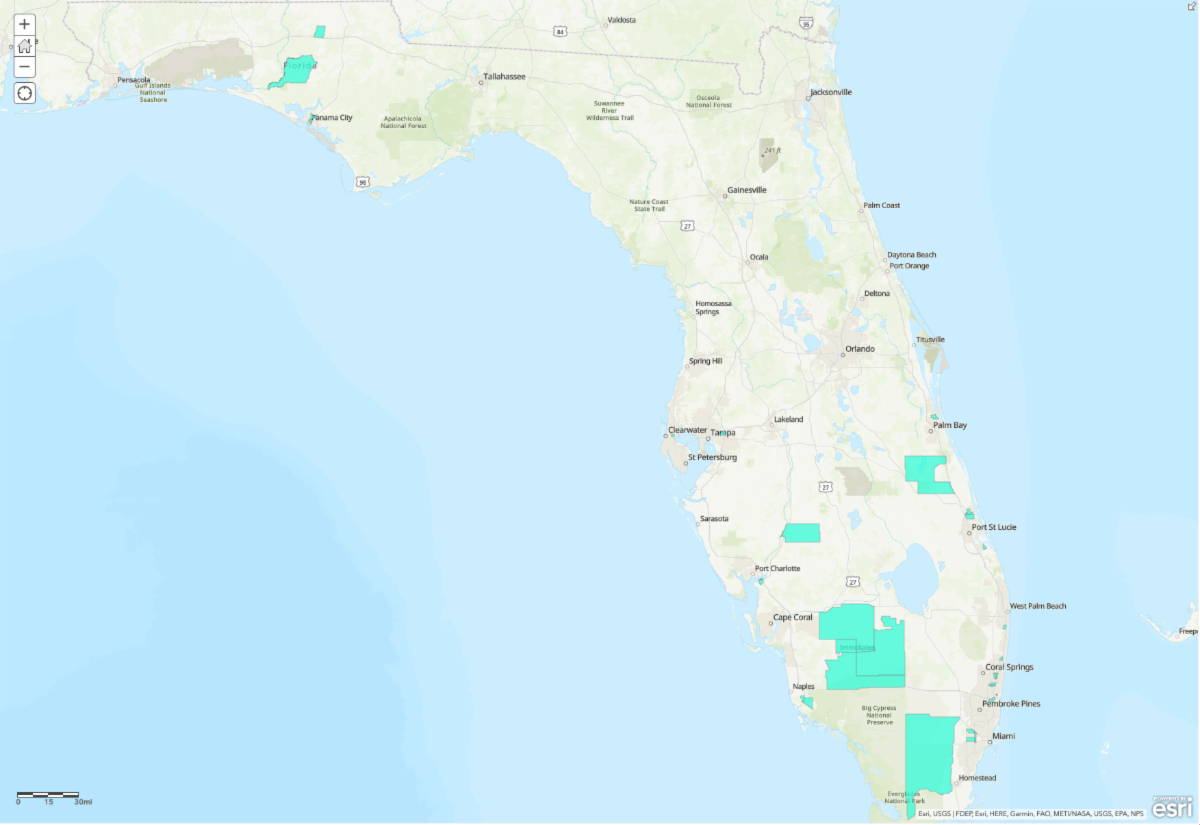
FEMA Designates 32 Community Disaster Resilience Zones in Florida | |
|
In September, FEMA announced an initial 483 census tracts nationwide that will be eligible for increased federal support to become more resilient to natural hazards and extreme weather worsened by the climate crisis – known as Community Disaster Resilience Zones (CDRZ). FEMA will use the CDRZ designations to direct and manage financial and technical assistance for resilience projects in these areas.
The CDRZ designations identify communities most at risk of the effects of natural hazards and climate change using a tailored version of the National Risk Index that takes into consideration socioeconomic vulnerability as well as physical exposure and risk. An initial 32 CDRZ designations have been identified in Florida.
| |
White House Releases National Climate Resilience Framework | |
The White House’s new National Climate Resilience Framework outlines more than a dozen essential measures that help prepare the nation to adjust to the accelerating impacts of climate change.The impacts of a warming world are already being felt, and this year the United States has experienced a record number of billion-dollar climate and weather disasters, according to the National Oceanic and Atmospheric Administration. | |
|
Can Florida’s Coast Survive Its Reliance on Development? | |
A new paper "Can Florida’s Coast Survive Its Reliance on Development? Fiscal Vulnerability and Funding Woes Under Sea Level Rise" is now out in the Journal of American Planning Association, open access. How much will sea level rise will affect local government revenues in Florida? A LOT: 211 municipalities, $619 billion in assessed property values that currently contribute $2.36 billion. Some 64 municipalities have 50%+ of revenues sitting within 6.5 feet of current sea levels. We pair our spatial analysis with a statewide survey of coastal planners and show that there is no relationship between the level of fiscal risk & prioritization of adaptation planning. | |
"Scientist in Every Florida School" Program Looking for Scientists | |
Are you a university-based, tenure-track researcher interested in and/or currently doing science communication? Your are invited to participate in an exciting research study aimed at understanding how scientists construct identity and engage in public outreach. Your valuable insights will ultimately contribute to the development and support of scientist communicators nationwide. | |
|
Each Climate Café is designed to be an informative, casual gathering that encourages conversations focused on groundbreaking climate science. The discussions will highlight related research underway at the Rosenstiel School so that ideally, these innovations can be applied to help our community adapt in a changing climate.
October 18, 2023
Searing, sweltering, stifling: How record-high temperatures and a marine heat wave baked South Florida this summer.
November 8, 2023
Water, water everywhere...
January 17, 2024
The future of climate
For all three dates:
3:30pm Reception at Salt Waterfront, 4:00pm Program in auditorium
University of Miami Rosenstiel School of Marine, Atmospheric & Earth Science
Admission is free
| |
|
Dr. Ebrahim Ahmadisharaf’s postdoc’s Eunsaem Cho's research entitled "Into the hurricane: Unraveling Hurricane Ian's terrifying impacts on Florida" was selected as the People's Choice Award at FSU's 5-minute Research Competition.
CONGRATULATIONS!
| |
If you have any climate-related research, news items, or events that you would like to submit for consideration in the next newsletter, please email them to info@floridaclimateinstitute.org
| |
Other Upcoming Events & Webinars | |
|
Florida Climate Week | October 2 - 8, 2023 | virtual
Climate Smart Floridians Course | October 5 - November 9, 2023 | virtual
CALM Week | October 9 - 14, 2023 | Gainesville, FL
Integrating Resilience in Design, Part 1 | October 11, 2023 | virtual
Climate Service Providers Academy | October 17 - November 28, 2023 | virtual
Playing Models | November 2 & 3, 2023 | Gainesville, FL & virtual
Optimizing Solutions for Resilient Coasts | December 1, 2023 | Gainesville, FL
DEP Resilient Florida Grants Webinar Series | various dates | virtual
| |
Job, Internship, and Fellowship Opportunities | |
|
Florida
Director, Climate Academy, University of Miami | Coral Gables, FL
Climate Resilience Project Manager, AECOM | Tampa, FL or remote or hybrid
Water Resources Manager, Resilient Environment Dept, Broward County | Fort Lauderdale
GatorCorps (applications due 10/6/23), University of Florida | Gainesville, Cedar Key, & Jacksonville
| |
|
National, International, and Remote
Maryland Sea Grant Coastal Climate Specialist, University of Maryland Sea Grant | Queenstown, MD
Associate Director, North Carolina State Climate Office, North Carolina State University | Raleigh, NC
Director, Coastal Resilience, Audubon | Oyster Bay, NY or Greenwich, CT
Applied Researcher, Climate Solutions, Conservation International | various | Arlington, VA
Applied Climate Scientist, The Nature Conservancy | MN, ND, or SD
Manager, Global Climate Cooperation, Environmental Defense Fund | remote
Manager, Climate Resilient Coasts & Watersheds, Environmental Defense Fund | remote
| |
|
Amora-Nogueira, L., Smoak, J. M., Abuchacra, R. C., et al. (2023). Linking centennial scale anthropogenic changes and sedimentary records as lessons for urban coastal management. Sci Total Environ, 902.
Bravo-Avila, CH & Feeley KJ. (2023). Variation in the Drought Tolerance of Tropical Understory Plant Communities across an Extreme Elevation and Precipitation Gradient. Plants (Basel), 12(16).
Crotty SM, Pinton D, Canestrelli A, et al. (2023). Faunal engineering stimulates landscape-scale accretion in southeastern US salt marshes. Nature Communications (Vol. 14).
Feeley KJ, Bernal-Escobar M, Fortier R, et al. (2023). Tropical Trees Will Need to Acclimate to Rising Temperatures-But Can They? Plants, 12(17).
Fox, R. A., Bacon, A. R., Enloe, H. A., & Bean, E. Z. (2023). Development of sandy soil properties within subtropical residential landscapes. SN Appl. Sci., 5(10).
González-Zamora, Á., Almendra-Martín, L., de Luis, M., Gaona, J., & Martínez-Fernández, J. (2023). How Are Pine Species Responding to Soil Drought and Climate Change in the Iberian Peninsula? Forests, 14(8).
Gupta R, Bhattarai R, Kalita PK, et al. (2023). Evaluation of long-term impact of cereal rye as a winter cover crop in Illinois. Sci Total Environ, 877.
Kang N, Jang CJ, & Elsner JB. (2023). More than unfamiliar environmental connection to super typhoon climatology. Sci Rep, 13(1).
Kelly, D. L., & Molina, R. (2023). Adaptation Infrastructure and Its Effects on Property Values in the Face of Climate Risk. Journal of the Association of Environmental and Resource Economists, 10(6).
Khan, N., & Mehmood, A. (2023). Revisiting climate change impacts on plant growth and its mitigation with plant growth promoting rhizobacteria. South African Journal of Botany, 160.
Kim, D., Park, D. - S. R., & Matyas, C. J. (2023). Spatial Variations in Tropical Cyclone Rainfall over the Western North Pacific According to ENSO Phase. Journal of Climate.
Kuang, B., Schelly, C., Ou, G., Sahraei-Ardakani, M., Tiwari, S., & Chen, J. (2023). Data-driven analysis of influential factors on residential energy end-use in the US. Journal of Building Engineering, 75.
Linda Shi, W. B., Tisha Holmes, Ryan Thomas, Anthony Milordi, et al. (2023). Can Florida's Coast Survive Its Reliance on Development? Journal of the American Planning Association.
Majnooni, S., Nikoo, M. R., Nematollahi, B., & et al. (2023). Long-term precipitation prediction in different climate divisions of California using remotely sensed data and machine learning. Hydrological Sciences Journal.
May, J., & Bourassa, M. (2023). Atmospheric Dynamic Response to Coupling Currents to Wind Stress over the Gulf Stream. Atmosphere, 14(8).
McDonald, B. W., Baruzzi, C., McCleery, R. A., Cove, M. V., & Lashley, M. A. (2023). Simulated extreme climate event alters a plant-frugivore mutualism. Forest Ecology and Management, 545.
Milordis, A. C., Butler, W. H., & Holmes, T. J. (2023). What is slowing progress on climate change adaptation? Evaluating barriers to planning for sea level rise in Florida. Mitig Adapt Strateg Glob Change, 28(42).
Pakdehi, M., Ardestani, M., Niksokhan, M. H., Barkdoll, B. D., & Ahmadisharaf, E. (2023). Using Analytical Hierarchy Process for Excess-Chlorine Risk Assessments in a Water Distribution Network: A Case Study. J. Environ. Eng.
Pappo, E., Wilson, C. H., Pitts, J. J., Hammond, W. M., & Flory, S. L. (2023). Toward a new perspective on evaluating climate change resilience of agroecosystems. Ecosphere, 14(9).
Pau, S., Griffith, D. M., Zampieri, N. E., & Costanza, J. (2023). Longleaf pine savannas reveal biases in current understanding of savanna biogeography. Global Ecology and Biogeography.
Perondi, D., Fraisse, C. W., Watson, J. A., Boote, K. J., Zotarelli, L., & Huffaker, R. G. (2023). Assessing the impact of sowing dates and ENSO in a drought index-based insurance for soybean. Climate Risk Management, 41.
Raich JW, Kaiser MS, Dornbush ME, et al. (2023). Multiple factors co-limit short-term in situ soil carbon dioxide emissions. PLoS One (Vol. 18).
Roose S, Ajayamohan RS, Ray P, et al. (2023). Pacific decadal oscillation causes fewer near-equatorial cyclones in the North Indian Ocean. Nat Commun, 14.
Shilling, E. N., Eckert, R. J., Sturm, A. B., & Voss, J. D. (2023). Porites astreoides coral populations demonstrate high clonality and connectivity in southeast Florida. Coral Reefs.
Southworth, J., Ryan, S. J., Herrero, H. V., Khatami, R., Bunting, E. L., Hassan, M., et al. (2023). Latitudes and land use: Global biome shifts in vegetation persistence across three decades. Front. Remote Sens., 4.
Storrie L, Loseto LL, Sutherland EL, et al. (2023). Do beluga whales truly migrate? Testing a key trait of the classical migration syndrome. Mov Ecol, 11(1).
Wang, F., Xu, X., Zhang, F., & Ma, L. (2023). Structure of the Atlantic Meridional Overturning Circulation in Three Generations of Climate Models. Earth and Space Science, 10(7).
| |
About Us
The Florida Climate Institute (FCI) is a multi-disciplinary network of national and international research and public organizations, scientists, and individuals concerned with achieving a better understanding of climate variability and change.
| | | | |