Don't Miss These Opportunities from the Network! | |
Apply to Join a National Kinship Learning Cohort for Family Resource Centers
We are collaborating with our subject matter experts at the National Family Support Network to launch two national peer learning cohorts designed to strengthen kinship engagement through Family Resource Centers (FRCs). One cohort will focus on school-based FRCs & kinship engagement, and the other on engaging male kin caregivers through FRCs. FRCs will learn from peers implementing promising kinship strategies, test and refine practical approaches, strengthen the area of focus (school-based engagement or male kin caregiver engagement), and contribute to emerging national practice. Applications are due by Saturday, February 28.
| Join Us for Our TWO March Webinars! | |
Kinship Peer Liaisons: Harnessing Lived Experience to Support Families
2:00 p.m. – 3:30 p.m. ET
In keeping with our practice, the webinar will be one hour, followed immediately by an open Q&A session that will last for half an hour.
Peer connections are an underutilized yet infinitely powerful source of support for kinship families, who often feel alone and overwhelmed on their journey. As a supplement to support services by professionals, a peer liaison approach connects kin caregivers to each other for emotional, informational, and instrumental support. The presentation from Dr. Ramona Denby-Brinson, of the University of North Carolina at Chapel Hill, and her team will focus on KinCarolina’s kinship peer liaison model, which has earned our Exemplary Kinship Practice designation.
| |
|
Across the Map, Around the Table: Six FRC Models Lifting Up Kin Caregivers and Grandfamilies
2:00 p.m. – 3:30 p.m. ET
In keeping with our practice, the webinar will be one hour, followed immediately by an open Q&A session that will last for half an hour.
Learn how Family Resource Centers (FRCs) are creatively supporting kin caregivers and grandfamilies across the country. This webinar will spotlight six FRCs spanning rural and urban communities, immigrant-serving and faith-based programs, and school-based and mobile models. You’ll hear from programs in Arizona, Idaho, Kentucky, Louisiana, New Jersey, and Virginia that are recognized for their leadership and innovation in serving kinship/grandfamilies. Two kin caregivers will speak, along with program staff from six FRCs. We are co-hosting this webinar with the National Family Support Network (NFSN), a subject matter expert organization. NFSN Co-Executive Director Brenda McChesney will serve as the facilitator.
| | | | We’ve given our LinkedIn page a glow up! Visit us to check out our new banner and other new graphics. While you’re there, you’ll see the latest news, data, and replicable practices and tools to support your work with kinship families. Follow our page to keep up with the latest kinship news between monthly issues of this newsletter. | | What's New From the Network? | |
Family First Prevention Services and Programs – Reimbursement for Culturally Adapted Services and Programs for Native Children and Families
This resource, prepared for the Network by our partners at the National Indian Child Welfare Association, focuses on evidence-based prevention services in the Title IV-E Prevention Services Clearinghouse that have been shown to be effective for Native people and Tribal communities, and the separate criteria for federal approval and funding of culturally based Tribal programming.
| | |
|
New Mexico Commits to Universal Child Care
In November of 2025, New Mexico became the first state to offer free child care to residents, regardless of income. And there’s a special provision for grandparents who are raising their grandchildren. This tip sheet offers information and links about the New Mexico program, as well as a brief update about investments in child care around the country
| |
Welcoming Subject Matter Expert Noah Duncan
We are thrilled to announce a new addition to our incredible group of subject matter experts – Noah Duncan. Noah serves as Director of Foster Insights, a child welfare data analytics team based at the University of Chicago. His team partners with state child welfare agencies across the country to translate complex administrative data into actionable insights that support family, kin, and community connections for children. Read more about Noah on our website and check out his one-pager on using the Adverse Placement Score as part of the A Home for Every Child initiative.
| |
| |
Tax season is fast approaching, and there are special considerations for kin caregivers and kin who adopted children in 2025. Check out our LinkedIn post to learn more and access a tip sheet on tax credits created by the Supporting Grandparents Raising Grandchildren Advisory Council. | | Individual Assistance Spotlight | | | | The Network is responding free of charge to individual technical assistance (TA) requests from professionals who work in systems and organizations that serve kinship/grandfamilies. To request assistance on the array of issues impacting kinship/grandfamilies, please complete our request assistance form. | | |
We answer questions and respond to requests of all sizes. Some questions focus on a very specific topic and/or location, while others are much broader. Below, we share an example TA request and response. As is typical for this spotlight, the request below only required an email response. Many of our requests benefit from more intensive invovement from our TA team. We often host meetings with peers or other subject matter experts; review data and policies; and provide specific guidance to help enhance programs, implement policies, or otherwise improve services for kin.
Request
I am looking for some very specific training that I'm not sure if you all have or not (although, I assume you do). I am training on recognizing and reducing bias for caseworkers surrounding kinship care. We have one agency in particular that has only worked with non-kin licensed foster parents. As they move into serving kin, many of the staff are struggling with the placements and expectations. We've already worked to increase awareness around the importance of kin placements, but we need help to decrease bias and long-held beliefs around kinship care. Sharing the importance of kinship care doesn't seem to be cutting it.
I appreciate any resources you could point me towards. I will continue to browse through the many resources you do have!
Response
Please take a look at our kin values training – it’s designed to address just what you’re seeing and get buy-in for kin-first approaches.
On this page, you’ll find a downloadable and editable PowerPoint template. The training is designed to be delivered virtually or in-person, either exclusively by kin caregivers or in partnership with them. While the full presentation takes half a day, feel free to edit it to suit your needs, and reach out with any questions.
We find the activity on slides 20-22 to be particularly impactful. The activity illustrates the benefits to children who are placed and supported with kin, while not at all diminishing the love and support of a good non-kin home.
To make an individual request, please complete this form and we will get in touch.
| | Alyssa Craven & Edith Hammond on Partnering with Kin Caregivers to Improve Programs | | Upcoming Presentations by the Network | |
- Network Director Ana Beltran will be presenting as part of the opening plenary of the virtual Strengthening School Supports for Kinship Caregivers and Grandfamilies Summit hosted by REL Appalachia. The Summit will take place on Wednesday and Thursday, February 25 and 26. Ana’s presentation will be at 11:45 a.m. ET on Wednesday. Register today to join the event!
- On Friday, March 27, Generations United Deputy Executive Director Jaia Lent will represent the Network and present at the 2026 KinFirst Convening in Ohio. Dr. Joseph Crumbley and Heidi Redlich Epstein, both Network subject matter experts, are among the other featured speakers. Registration is open.
- Also on March 27, Ana Beltran will participate in a convening of New England child welfare leaders working to develop their kin-first cultures.
- Our partners at the National Indian Child Welfare Association (NICWA) will be holding the 44th Annual Protecting Our Children Conference in Oklahoma City, Oklahoma, from Sunday, March 29 through Wednesday, April 1. During the conference, there will be several workshops about cross-system collaborations for kinship/grandfamilies:
- Representatives from Oneida Nation of Wisconsin will present on their efforts as part of the Network’s Bridging Systems for Kinship Families initiative.
- Tara Reynon from NICWA and Leland Kiang from Network partner USAging will present a workshop that will focus on collaborations between child welfare and Title VI Native American Aging Programs to support kinship/grandfamilies.
- Representatives from the Network’s evaluation partner, Child Trends, will also lead a workshop.
In-person and virtual registration options are both available.
| | What's New Around the Network? | |
Person- and Family-Centered, Trauma-Informed and Culturally Competent Approaches to Service Delivery for Family Caregivers – Action Guide Webinar
USAging and the Center on Aging, Trauma, and Holocaust Survivor Care of the Jewish Federations of North America
Thursday, March 19, 2:00-3:30 p.m. ET
| |
Keeping Families Together: Enhancing Kinship Care Through State Policy
National Conference of State Legislatures
| | This brief highlights and links to state policies that support kinship families. It features sections on defining kinship relationships, identifying and prioritizing kin, kin-specific licensing, supportive services and assistance, and long-term stability. Read it to learn what other states are doing and get inspiration for your own jurisdiction. | | |
|
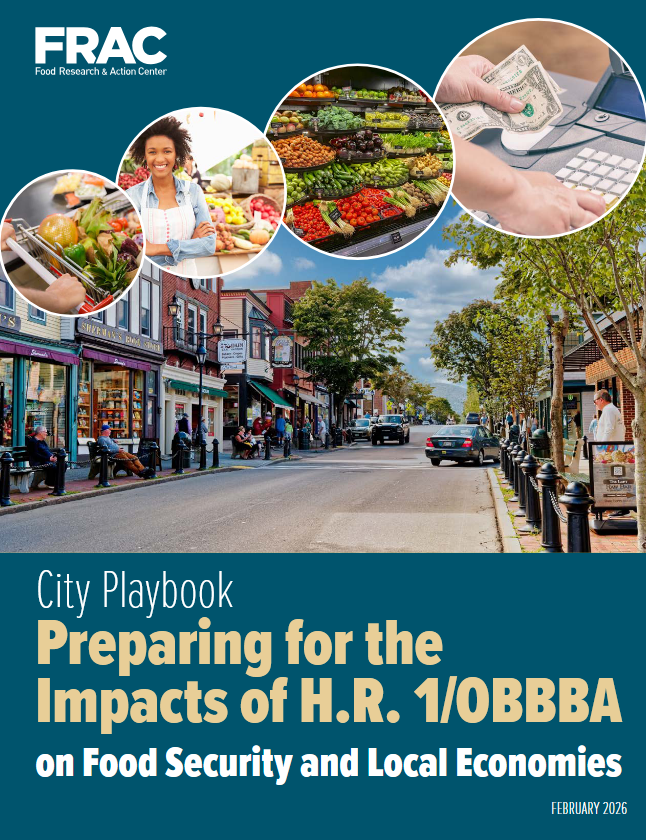
City Playbook: Preparing for the Impacts of H.R. 1/OBBBA on Food Security and Local Economies
Food Research & Action Center
| This playbook is designed to help municipal leaders understand the scope of what’s coming due to federal changes in the Supplemental Nutrition Assistance Program (SNAP). It seeks to help them anticipate challenges and prepare coordinated responses with state, federal, and community partners. The Food Research & Action Center is the Network's subject matter expert organization for nutrition. | |
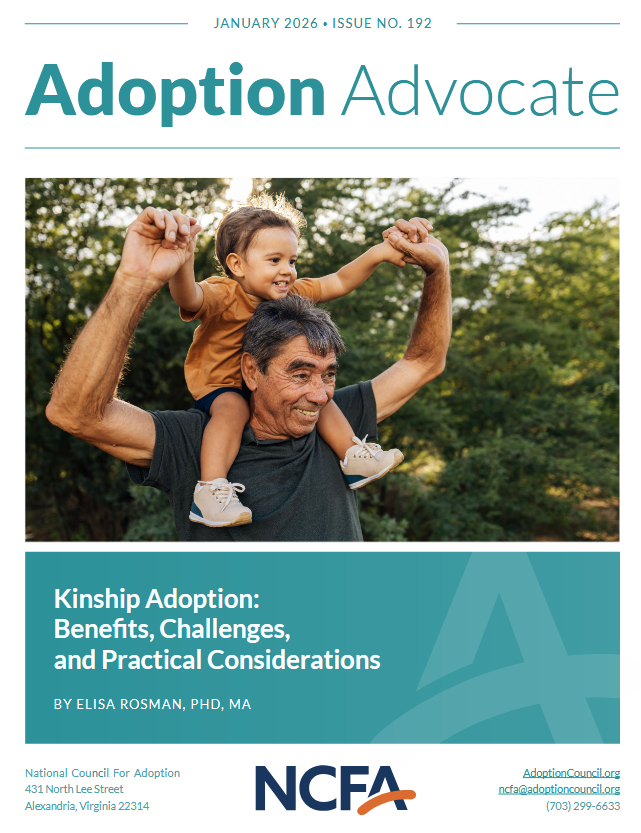
Kinship Adoptions: Benefits, Challenges, and Practical Considerations
National Council for Adoption
| This piece explores the unique considerations in kinship adoptions and suggests resources specially designed for these families. The Network is pleased to be quoted in the document and to have our website and some of our resources linked. | | | | |
Best Practices for School-Based Support Groups for Bereaved Students
National Alliance for Children’s Grief and Coalition to Support Grieving Students
| This new resource seeks to help school-based mental health professionals plan, implement, and sustain grief support groups for students who have experienced the death of someone significant in their lives. It offers practical strategies grounded in grief-informed care to support schools in meeting the needs of students who are grieving. | |
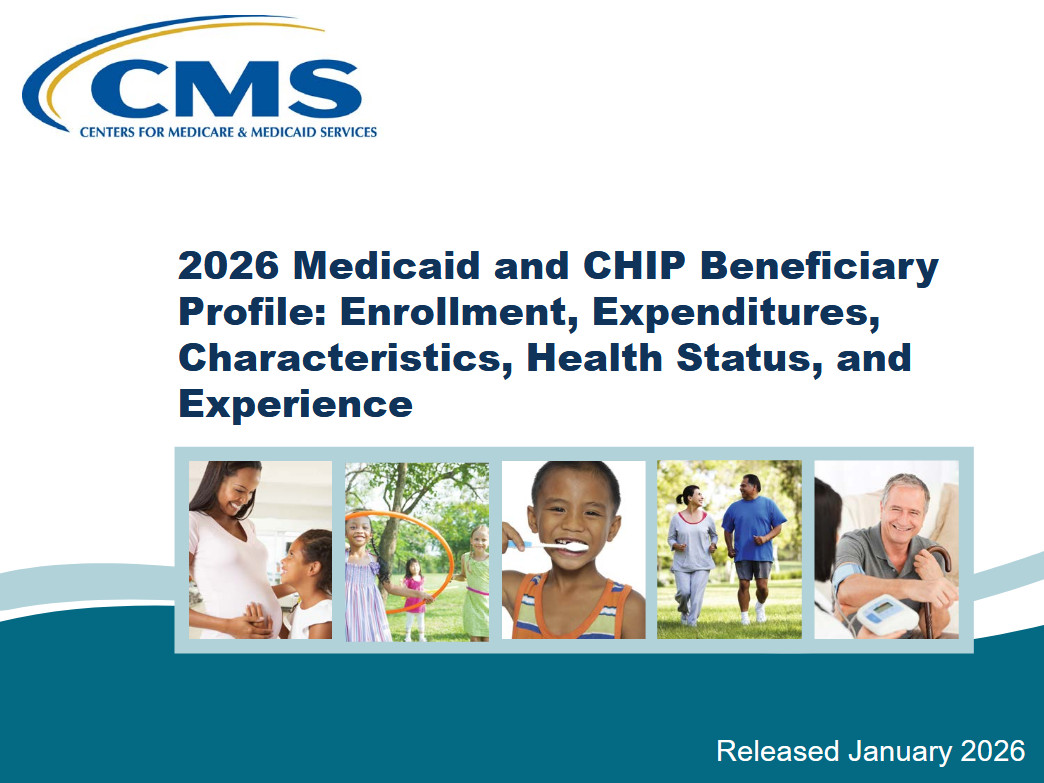
2026 Medicaid and CHIP Beneficiary Profile: Enrollment, Expenditures, Characteristics, Health Status, and Experience
U.S. Center for Medicare & Medicaid Services
| | | The Medicaid and Children’s Health Insurance Program (CHIP) Beneficiary Profile provides an overview of Medicaid and CHIP enrollment and expenditures, as well as the characteristics, health status, and experience of the beneficiaries served by Medicaid and CHIP. There is also an accompanying three-page infographic. | | |
|
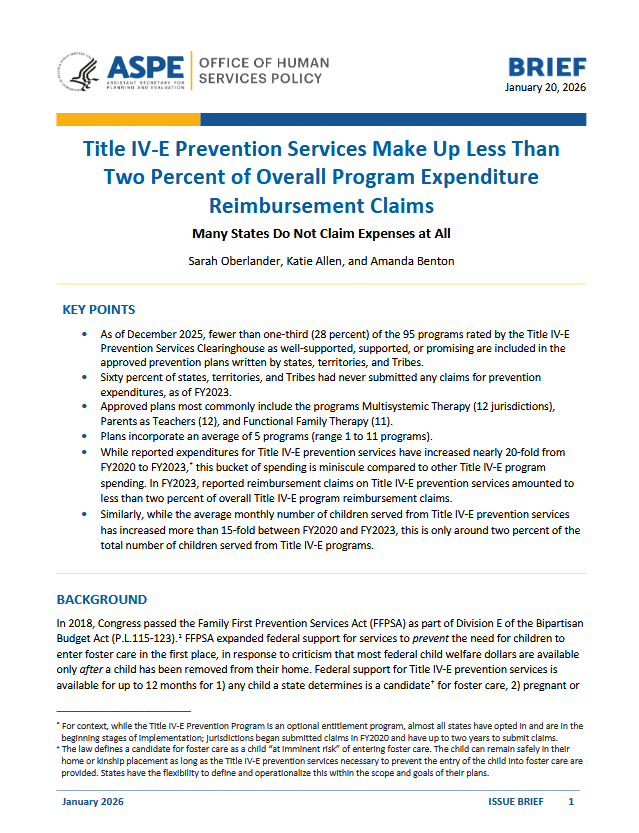
Title IV-E Prevention Services Make Up Less Than Two Percent of Overall Program Expenditure Reimbursement Claims: Many States Do Not Claim Expenses at All
Office of the Assistance Secretary for Planning and Evaluation, U.S. Department of Health and Human Services
| This brief, focused on the Title IV-E Prevention Program, explores how states, territories, and Tribes have been engaging in the program since it began. The content highlights the Title IV-E Prevention Services Clearinghouse process, as well as information from jurisdictions’ prevention plans and claimed expenditures. | |
Notable Funding Opportunities
(listed in order of application deadline)
| | |
Community Care Corps is accepting applications for grants to develop and scale innovative volunteer programs that provide nonmedical assistance to older adults, adults age 18 and older with disabilities, and family caregivers, including kin caregivers. Applications are due by 5 p.m. ET on Thursday, February 26.
Through its Community Health Impact Lab Micro Grants Program, the American Medical Association is awarding micro grants to physicians who have big ideas on how to address health-related challenges faced by people with limited access to care. The application deadline is Sunday, March 1.
The Bank of America Charitable Foundation is accepting applications in its basic needs and income creation focus areas. The application deadline is Monday, March 2.
The Robert Wood Johnson Foundation is accepting applications for its Local Data for Equitable Communities grant program. Eligible nonprofit organizations in the U.S. can apply for a grant to collect, analyze, and use data to address inequities in the physical, economic, and social conditions of a community. Applications are due by 3 p.m. ET on Tuesday, March 3.
The AARP Community Challenge is accepting applications that: deliver tangible improvements to communities, such as new crosswalks, benches, bike lanes, housing designs, and public space enhancements; leverage additional support from public, private, and philanthropic sources; help communities overcome policy barriers and implement lasting change; and foster new collaborations and increase community engagement. Applications are due by 5 p.m. ET on Wednesday, March 4.
The Hansen Family Foundation focuses on several areas that relate to kinship families, including disadvantaged children, education, and arts and culture. The Spring 2026 application opens on Sunday, March 2 and closes at 5 p.m. ET on Monday, March 23.
The Fiscal Year (FY) 2026 AmeriCorps Seniors RSVP Opportunity is now accepting applications. AmeriCorps Seniors RSVP volunteers have supported kinship families, including by tutoring children, helping prepare simple taxes, assisting victims of natural disasters, providing nutrition/food support, and facilitating opioid and substance use education workshops. Eligible applicants include Tribes, institutions of higher education, local governments, nonprofit organizations, states, and U.S. territories. Applications are due by 5 p.m. ET on Thursday, March 26.
Fiscal Year (FY) 2026 AmeriCorps State and National Competitive Grants are awarded to eligible organizations that engage AmeriCorps members in evidence-based or evidence-informed interventions to strengthen communities. The application deadline is Tuesday, March 31.
| | |
|
Administration for Children and Families (ACF), U.S. Department of Health and Human
Services, February 2, 2026
States and Tribes can now receive a 50% federal match to provide buprenorphine, methadone, and naltrexone to parents and kin caregivers when children are at imminent risk of entering foster care but can remain safely in the parent or kin’s home with access to these treatments. To support rapid implementation, interested states, Tribes, and territories can access sample program language and requirements through ACF's Children's Bureau. Technical assistance is also available through the National Child Welfare Center on Innovation and Advancement and the National Center on Substance Abuse and Child Welfare, the latter of which is a Network subject matter expert organization.
Administration for Children and Families (ACF), U.S. Department of Health and Human Services, January 26, 2026
In January, ACF launched a new public dashboard showing state-by-state performance data on critical child safety and permanency outcomes. This dashboard gives state child welfare agencies the ability to compare progress with each other, which ACF hopes will enable states to identify, collaborate on, and scale best practices to further innovation in child welfare. This new dashboard complements the AFCARS dashboard released in 2025.
|
| |
Please follow the Grandfamilies & Kinship Support Network on LinkedIn here! |
|  |
All of our previous newsletters are linked on our website, so you can access them anytime. |
| Did you receive this newsletter as a forwarded email? You can sign up to get it in your inbox every month! | | |
The Grandfamilies & Kinship Support Network is the only national technical assistance center for those who serve grandfamilies and kinship families. It was created to help guide lasting, systemic reforms. The Network is a new way to collaborate, to work across jurisdictional and systemic boundaries, to eliminate silos, and to help one another and be helped in return. Thank you for being part of it.
We'd love to hear from you! Please send any feedback on this newsletter to mweiss@gu.org.
| | |
The Network is supported by the Administration for Community Living (ACL), U.S. Department of Health and Human Services (HHS) as part of a financial assistance award totaling $9,950,000 with 95 percentage funded by ACL/HHS and $523,684 and 5 percentage funded by non-government sources. The contents are those of the authors and do not necessarily represent the official views of, nor an endorsement, by ACL/HHS, or the U.S. Government.
|
| | | |