Click here to open in browser.
SUNDAY, MARCH 15, 2020
Menominee Indian Tribe of Wisconsin
Response to COVID-19
The Menominee Indian Tribe of Wisconsin is taking preventative measures in regards to the potential spread of the COVID-19 virus.
 
An Incident Command Center has been created to include Ben Warrington-Incident Commander, Dr. Amy Slagle-Public Health Officer, Vaughn Bowles-Public Information Officer, and Menominee Nation News will be used to write and disseminate information. Information will be released as available and necessary as it relates to the Menominee reservation and county.
 
On Thursday, March 12, 2020 the Menominee Indian Tribe declared a State of Emergency, and approved immediate precautionary measures to be taken by the community and tribal employees (this response will change as necessary).
 
Menominee Tribal Clinic Corona Virus Response
From Dr. Amy Slagle, MD
Medical Director, Menominee Tribal Clinic
March 14,2020
 
The clinic wants to keep you updated about what we are doing to respond to the Coronavirus Pandemic. We have four major goals as we respond to the spread of virus and threats to the Menominee Nation:
 
1.      To do everything possible to stop the spread of the virus.
2.      To test those at greatest risk of getting very sick from the virus.
3.      To continue to provide other medical needs as safely as possible.
4.      To provide accurate information about the virus.
To accomplish these goals, we are changing many of the basic ways the clinic operates:
 
To Stop the Spread of the Virus:
·       People NOT being together indoors is THE MOST IMPORTANT WAY TO STOP SPREAD. If you are NOT sick, don’t come to the clinic. 
·       We will not see patients for regular check-ups, routine physical exams, dental cleanings, or routine eye exams.  If it is an appointment you would usually make when you feel fine, it will be postponed. This is to keep YOU safe. Adult vaccinations and vaccinations for anyone greater than 6 months old will be postponed.
·       The clinic has hired emergency staff to do more cleaning and disinfecting. Some clinic staff will also be assigned to help clean.
·       Patients who only need to pick up medications or have an urgent dental exam will use a separate entrance if they are not sick.
·       Patients who are coughing will put on a mask when they enter.
·       All patients entering the building will use hand sanitizer upon entry.
·       Patients identified with concerning symptoms will be routed to isolated rooms and will not walk thru the rest of the building.
·       When possible, pharmacy will dispense 90 days of medications. This cannot apply to controlled substances. We are working to start a home medication delivery system but may take some days to implement.
·       If you need to get paperwork to Contract Health MAIL the paperwork, do not come in the clinic if you are well. Address the envelope to Contract Health, Menominee Tribal Clinic, PO BOX 970 Keshena, WI, 54135.
·       Every day the spread of the virus changes and we are making changes quickly. These changes may not seem to make sense at first. These changes may cause frustration. Please know that all the changes are to keep our patients safe.
·       Patients with other acute medical problems such as injuries, heart problems, or breathing problems will continue to be evaluated. Call your provider’s nurse or the appointment desk at 715-799-5400. It is better for acute problems to be evaluated at the clinic instead of going to an Emergency Room.
 
To Evaluate Patients with concerning symptoms:
·        If you have concerns, call the nurse of your doctor or provider to evaluate your risks. Do not come to the clinic without calling. If calls become overwhelming, we will need to take steps to create special phone numbers.
·       Patients with concerning symptoms leave Registration and enter isolated rooms through the west entrance. Some patients may be directed to the west parking lot by nurses. Parking space will be available by these entrances.
·       We do have the ability to perform the virus test but we have very limited supplies. For this reason, we can only test those patients with the greatest risk of infection or risk of severe illness if infected. If more supplies become available, we will test more people.
·       If you are evaluated, you will be sent to a hospital if you are severely ill. If you are not severely ill, you will be sent home and you will be on ISOLATION which means you cannot leave home until you are recovered or your test turns out negative.  Test results take 48 hours.
·       The clinic has limited supplies of personal protective equipment which means we cannot share this equipment with patients. Our staff need the equipment to protect everyone. 

Future Concerns:
·       If the virus becomes very widespread in our community, it will not be possible to test or evaluate everyone. In that case, it will be very important for you to STAY HOME if you are not short of breath or feel extremely weak.
·       The spread of virus and what to do about it changes daily. What the clinic is doing today may change quickly. Please know that everything we are doing is to keep our patients safe.

To provide accurate information:
·       We are working with the Tribe’s Incident Command Center to get information out in all ways possible including tribal websites and social media, flyers with meals, and in food distribution sites. Be aware that cable TV channels and social media sources may have inaccurate information, especially if the source is opinions about news, not reporting news. Some TV channels and social media sites are heavily influenced by politics. Some people or countries may be spreading false news to harm us.
·       The Center for Disease Control (CDC) and the Wisconsin Department of Public health are trustworthy sources of information:
MEDICAL FACTS ABOUT CORONA VIRUS
FROM DR. AMY SLAGLE, MD
MEDICAL DIRECTOR, MENOMINEE TRIBAL CLINIC
PUBLIC HEALTH OFFICER MITW CORONA VIRUS INCIDENT COMMAND
 
1.      The Virus: Corona virus is a germ too tiny too see. It is new to people so doctors and scientists are just learning about how it spreads, how sick it makes people, and how long it lives outside the body.   We know it spreads easier than other viruses. We know it makes older people and people with medical problems sicker than younger people.   
 
2.       How it spreads:  The virus lives in the lungs, throat, and nose. You spread virus by sneezing, laughing, and coughing. You spread virus by coughing or sneezing on your hand then touching a surface.   You catch the virus by breathing in drops of fluid people put in air or leave on surfaces. You catch virus by hugging or kissing. You catch virus by touching your mouth or eyes when virus is on your fingers.  We now know that people who are not sick but have the virus can spread it. The most important way to prevent spread is for people to avoid public places unless absolutely necessary. Young healthy people may not fear the virus but they can spread it to older or sick people without even knowing they have the virus.
 
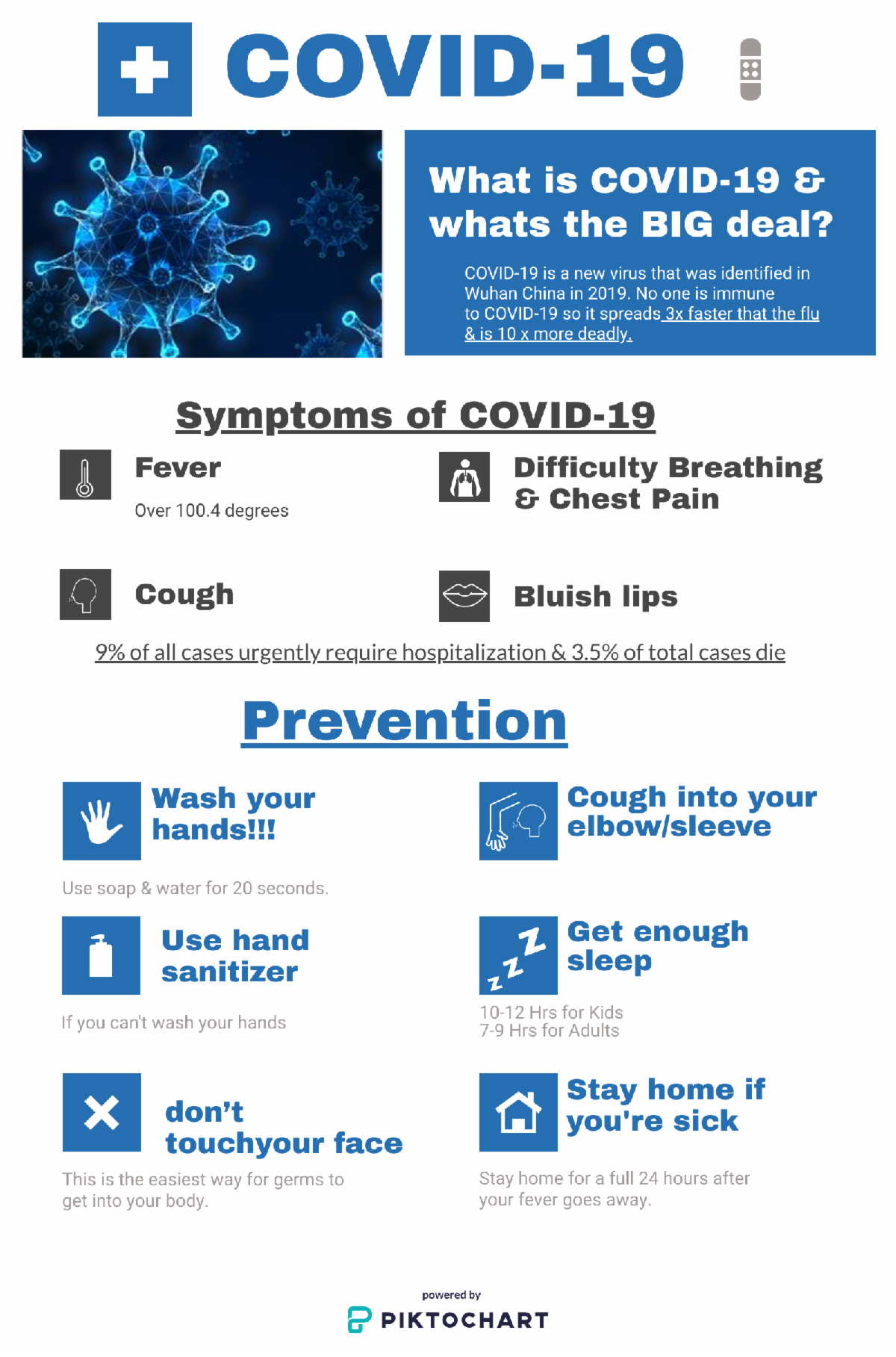
3.      What are the Symptoms?  Fever, dry cough, and shortness of breath are common. Some have muscle aches and are very tired. Some people get infection in their lungs called pneumonia. This can make it hard or impossible to get oxygen. Your lips can turn blue if you don’t have enough oxygen.  Other organs in the body fail when there is not enough oxygen. Some people die even if in the hospital. We do not know exactly how likely it is to die from the virus. We do know people with lung disease and who can’t fight infection are more likely to die.  
 
4.      When should I see a doctor? If you get the symptoms call your doctor’s office. A nurse will help decide if you need to see a doctor or be tested. You will be asked questions about recent travel and your medical problems to help determine if you should be checked out. Many other viruses cause some of the same symptoms so these questions must be asked. If the infection becomes widespread in the community it will take longer to contact your medical provider.
 
5.      What are the treatments?  Mild symptoms can be treated just like a common cold or the flu. Resting, drinking lots of fluids, taking Tylenol or Ibuprofen for fever and aches help. Sicker people may need fluids through a tube in the vein and extra oxygen.  The sickest people need a machine to breathe for them and medicine placed in their veins to keep their blood pressure up. Antibiotics do not treat Coronavirus. There is no vaccine to prevent Coronavirus. 
 
6.      How long are people sick?   Mild symptoms may last days to a few weeks. If pneumonia happens, it could take weeks to improve and months to recover.  
 
7.      What is Isolation?  If you are diagnosed with Coronavirus and can recover at home, you cannot leave home until you are over the illness for 14 days or longer. Medical experts decide how long. 
 
8.      What is Quarantine?   People who have been around someone with Coronavirus also have to stay home, even if they have no symptoms.  They can go to the grocery store if needed, or the doctor if they get symptoms. People in quarantine have to stay home until the person with Corona virus they were around is over symptoms for 14 days or determined by medical experts.  
 
9.      Isolation and Quarantine are necessary to prevent spread of Coronavirus to others.
 
10.    How easy is it to get a test? So far, there are not enough test kits to test everyone. That is why you must explain your travel history and medical problems to help decide how likely it is you have the virus or could get very sick from it. So far, only a few places are performing the tests so samples have to be sent to labs in cities. For our area, the lab is in Madison. If very large numbers of people get symptoms, there won’t be enough doctors and hospitals to take care of everyone.  This is the reason preventing the spread of virus is so important.
 
11.   Information about the virus changes daily.  Consult a trustworthy news source such as the CDC or the Wisconsin Department of Health for the most updated information.:
 
On TV and social media please make sure you are listening to REPORTING of news, not DISCUSSION ABOUT news. 
 
I will send out new information about the virus as the most important news becomes available.
 
The most important information I can give you is to stay home and out of public places as much as possible.
CORONAVIRUS SAFETY INSTRUCTIONS
FROM DR. AMY SLAGLE, MD
MEDICAL DIRECTOR, MENOMINEE TRIBAL CLINIC
PUBLIC HEALTH OFFICER, MITW CORONA VIRUS INCIDENT COMMAND
 
The spread of the Coronavirus threatens everyone, including the members and families of the Menominee Nation. The Coronavirus spreads easier and causes worse illness than other viruses which cause sickness. All people must now take the Corona virus seriously.  There are things you can do to protect yourself and those around you:
 
1.      Social distance:  when people are together, keeping as far apart as possible prevents spread of virus. The recommended distance is six feet apart. Think of this in places like the grocery store, work, even at home. Avoid hugging, kissing, and shaking hands.   MOST IMPORTANTLY STAY HOME AS MUCH AS POSSIBLE.  
 
2.      Stay home as much as you can: this is the SINGLE MOST IMPORTANT thing you can do. Virus spreads the more people are together. Movie theaters, concerts, celebrations, parties, restaurants, bars, and sporting events are examples of where virus spreads easily. JUST STAY HOME!  
 
3.      Cover cough and sneezes:  Cough and sneeze into your elbow. This keeps drops of fluid from your nose and mouth from reaching other people and your hands. The virus lives in these drops. If you cough or sneeze into the air, the drops reach other people. If you cough or sneeze into your hand, the drops end up on what you touch. The virus spreads to other people when they touch what you touched. 
 
4.      Wash your hands:  many times a day. This washes away the virus on your hands. You may have touched a surface where someone else left virus. Use soap and lather well. Make sure to wash the back of your hands and in between your fingers. Wash hands for 20 seconds. Sing the ABC song twice while washing; that will take 20 seconds. Wash your hands after you use the bathroom. Wash your hands after sneezing or coughing.  Wash your hands after eating. Wash your hands as soon as you get home. If you are not at home, use a clean paper towel to turn off the faucet, use another clean paper towel or air machine to dry your hands. Even use a clean paper towel to open the bathroom door after washing.
 
5.      Remember others: the virus is more likely to kill people over 60 and people with weak lungs or who can’t fight infection. You could spread virus to someone who could die from it. So, it is everyone’s responsibility to use the safety behaviors above. Think of those you love and everyone around you.

Although younger people are not at as high of a risk as others, they can still be carriers of the virus. As such it is highly recommended younger people also practice preventive measures.
Numerous sources will help people keep updated and informed on latest COVID-19 developments
With numerous new details and stories emerging about the Coronavirus/COVID-19 every day, if not every hour, people might have trouble following everything and keeping up with the details.

However, many places throughout Menominee Reservation/County are doing what they can to the best of their abilities to get information out to the public in a timely and succinct manner.

•Menominee Nation News
The Menominee Nation News department is now releasing articles daily, including weekends, on the tribal response to Menominee Indian Tribe of Wisconsin (MITW) declaring COVID-19 an emergency, which mention things from closures to some basic health hygiene steps people can take to prevent the spread of the disease. Updates are going up on the Menominee Nation News Facebook site daily. People who subscribe to the “Menominee Nation News” e-newsletter are also getting special daily letters informing them about some of the latest news in the area regarding how the potential threat of COVID-19 is being handled in complete news articles. If people have not yet subscribed to the “Menominee Nation News” e-newsletter they can do so by simply texting the word ‘MENOMINEE’ to 22828. People may also want to consider subscribing to print issues or picking them up at area distributors, though some of the information contained in them will largely be review of how COVID-19 was handled during the past two weeks to month, and the online sources will provide more timely information.

•Other Tribal Websites
MITW will release more information on the following platforms as it becomes available:

•Other websites:
The following websites also plan to give timely updates to the best of their ability:

•COVID 19-Hotline
MITW has established a Tribal Emergency Hotline at 715-799-7000 where people can press #5 for COVID-19 information. Note, this is not a nurses hotline nor is it a medical line and if people are experiencing mild symptoms they think may be related to COVID-19 they should contact their usual healthcare practitioner and if they are having an emergency case they think may be related to COVID-19 they should call 911, and in both cases mention if they think they might have the virus (these steps are also highly recommended in any other case of physical discomfort or emergency).

•Menominee Public Access Chanel
Currently there are also plans to put information about COVID-19/Coronavirus and the tribal responses on Menominee Public Access Channel Spectrum 979. Thus, people in the Menominee Reservation/County area who have Spectrum cable are encouraged to tune into this channel to get further updates and advice, much of which is the same material that is also available at online sources.

•Digital Signage
Many of the digital television signs that have gone up throughout the tribal buildings and mention such multiple things as news, job openings and meetings, may also be used to promote COVID-19 information. Some of the entities like schools that also have digital signage visible to the communities out front are also likely to mention things like when and if they are closed due to Coronavirus and when they will re-open.

•Word of mouth
If people don’t have access to any of the aforementioned options, it is encouraged that information about COVID-19, closures, etc. be shared with them.

However, be forewarned many health authorities are now saying that social distancing is the best option to help stop the spread, so people should only go near others if absolutely necessary and keep a distance of at least 6 feet between themselves and others and they should also wash or sanitize their hands before and after social interaction regardless of age as even those who seem to have lower risk of getting sick from COVID-19 can still act as carriers.

If telephoning is your preferred or back up way to contact someone it is also advisable for you to clean/wipe your phone after you use it.

Computer users should also remember to wipe their keyboards and mouses too.
ATTENTION COLLEGE STUDENTS:
With the COVID-19 virus shutting down a number of social institutions, including colleges and universities across the country, the Tribe’s emergency response team are strongly suggesting any students who have returned from a “hot spot” from around the country to self-quarantine for a period of 14 days.

A “hot spot” area are those with ten or more actively known cases of COVID-19.

Through initial research, medical experts have found that people are most contagious while exhibiting no visible symptoms.

With many of the tribe’s returning college students living in a family home comprised of older relatives, the emergency response team is urging those students to limit contact with family members, especially elder family members who may be more susceptible to the COVID-19 virus.
What is the difference between isolation and quarantine?
Isolation and quarantine are public health practices used to stop or limit the spread of disease.

Isolation is used to separate ill persons who have a communicable disease from those who are healthy. Isolation restricts the movement of ill persons to help stop the spread of certain diseases. For example, hospitals use isolation for patients with infectious tuberculosis.

Quarantine is used to separate and restrict the movement of well persons who may have been exposed to a communicable disease to see if they become ill. These people may have been exposed to a disease and do not know it, or they may have the disease but do not show symptoms. Quarantine can also help limit the spread of communicable disease.
Isolation and quarantine are used to protect the public by preventing exposure to infected persons or to persons who may be infected.

Our Menominee way is to help others
During this time of uncertainty, it is important to remember to check in on others, especially our Elders, and offer to help where you can.

  • Maybe you have a relative who needs meds, but can't make it to the clinic-offer to pick up medication for them
  • If your going to the grocery store, offer to pick up something that someone needs
  • Schools are closed and working parents will need assistance with child care-offer to keep the children while they work
  • Offer to help with house cleaning
  • Offer to take care of pets as needed
  • Call relatives and see how they are doing
  • Donate Blood
  • Also remember to take care of yourself

Think of ways we all can help each other get through this. We're all in this together.

When helping others, please keep in mind that health providers are currently encouraging social distancing of at least 6 feet.
MITW will release more information on the following platforms:
Tribal Emergency Hotline: (715) 799-7000 press #5 for COVID-19 information
Menominee Public Access Channel 979 on Charter/Spectrum

Please share the information with others who may not have access to these options.
In case you missed it...
Here are links to the previous updates that were sent out:

Menominee Nation News office hours: Monday - Friday, 8:00 a.m. - 4:30 p.m.
Devan Erdmann
Director/Editor

Joshua Sederstrom
Administrative/Design Assistant
Patrick Delabrue
Reporter

Christopher Anderson
Reporter
Menominee Indian Tribe of Wisconsin | Menominee Nation News
Ph: (715) 799-5167 | Fax: (715) 799-5250
© 2020