While often mistranslated as leprosy, tzara’at was not in fact a communicable disease. Ramban points out that the very same tzara’at could infect homes and clothing. This was clearly not a biological infection, but rather something spiritual. While Chazal indicate that tzara’at was a punishment for speaking lashon hara, Ramban gives it a somewhat positive spin.
Ramban (Vayikra 13:47) points out that tzara’at only occured בהיות ישראל שלמים לה’ יהיה רוח השם עליהם תמיד—when Bnei Yisrael were whole/complete with Hashem, His spirit was always upon them to keep them healthy. This means that when they would sin, Hashem would remove His divine protection, leading to physical abnormalities and health concerns such as tzara’at. Elsewhere, Ramban points out (Vayikra 26:11) that when Bnei Yisrael are on a high spiritual level, our physical well being and spiritual well being are intimately connected. In Biblical times, when a person experienced negative or harmful events, they could find out if Hashem was sending them a message by consulting with a Navi (prophet), who had the ability for Hashem to communicate with him or her. The Navi could interpret that message, explain what Hashem was trying to teach this person, and help guide them towards teshuva.
But after the destruction of the Beit Hamikdash and the resulting exile, we lost this lofty status. There is no more nevuah and while throughout the generations we’ve experienced much hardship, we do not and can not know why Hashem does and allows certain things to happen. The gemara takes this notion so far as to declare, מיום שחרב בית המקדש לא נתנה נבואה אלא לשוטים—since the destruction of the Beit Hamikdash, it is only fools who pretend to have prophetic powers.
Despite the major differences between modern times and when the Beit Hamikdash stood, there is an important lesson we can learn from tzara’at. As part of the purification process, the metzora was secluded outside of the camp—בדד ישב מחוץ למחנה. As a spiritual ailment, his tzara’at wasn’t infectious and his isolation was not meant to protect the community, but rather to urge and create a conducive environment for the metzora to reflect and consider how his life would be different when he emerged from his seclusion.
This particular point may resonate quite well in our current situation. We too are isolated and quarantined. And, living in a period without nevuah, we do not and can not know why Hashem brought this pandemic to us. What we can do, though, is take a lesson from the metzora and use this time to think about how we will emerge spiritually stronger from this situation.
If I may humbly make one suggestion: For the past many weeks, we have been davening from home. We have been without our minyanim, communities, and our shuls. Many of us are eagerly anticipating when we can go back to shul, even in a very limited manner, since it represents so much more than a building in which we pray. But precisely because it represents so much more, it demands a higher level of respect and sanctity.
Perhaps one way we can spiritually improve is by considering how we can elevate and enhance our kedushat beit haknesset (sanctity of our shuls), whether it be by behavior, decorum, or activities theirin. We can practice even now—when our homes are effectively are mekomot tefillah—by consistently setting aside a particular location, when possible, in which to daven each day and by keeping that space and time free from distractions, behaviors, and attitudes that might detract from the kedusha of our makom tefillah.
Hopefully, in the merit of our actively seeking to spiritually improve, Hashem will send a speedy refuah for all who need it, and speedily create a safe environment in which we can start transitioning back to normal.
Shabbat Shalom,
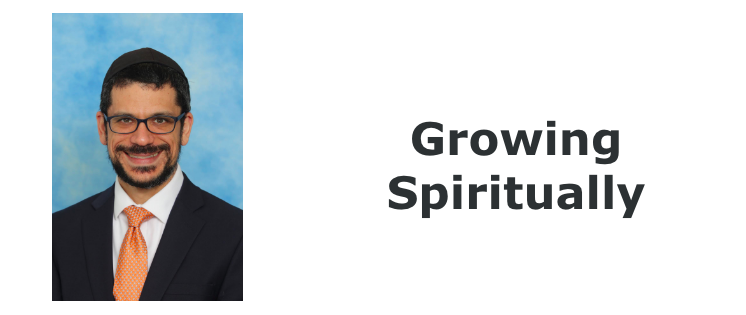
Rabbi David Shabtai
|
|
Commemorating
Yom Hashoah
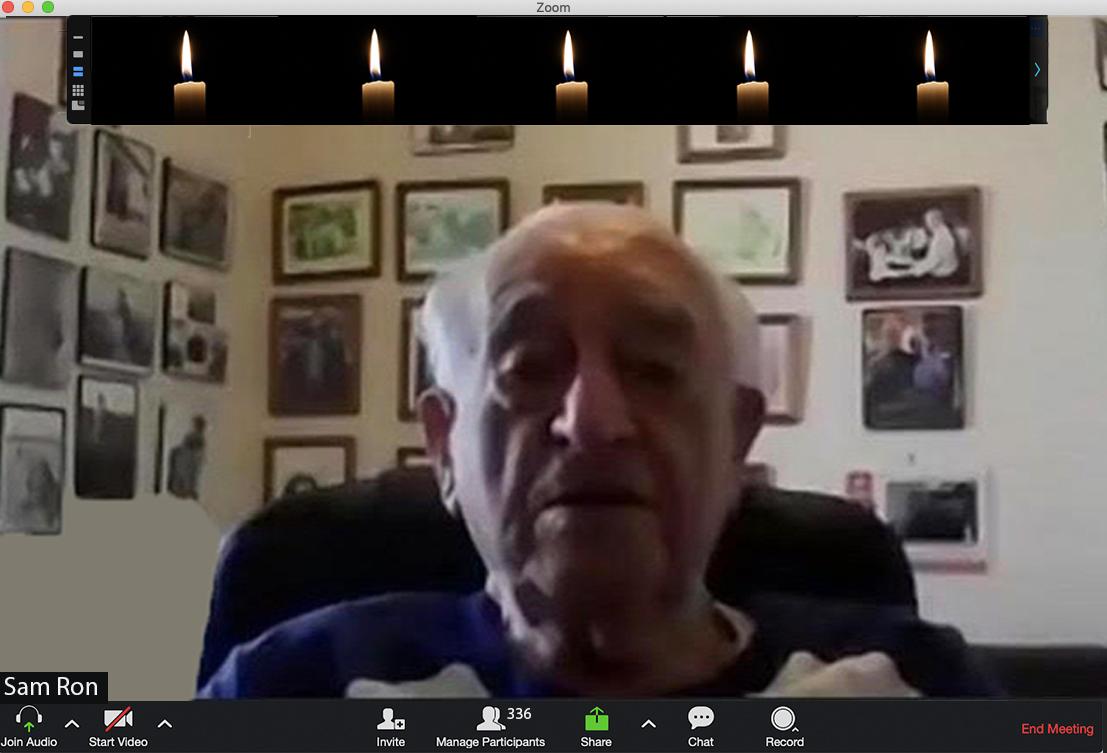
Virtual Program with Holocaust Survivor Sam Ron Inspires Students to Never Give Up and Never Forget
|
|
Graphic by Penina Kahane ('22)
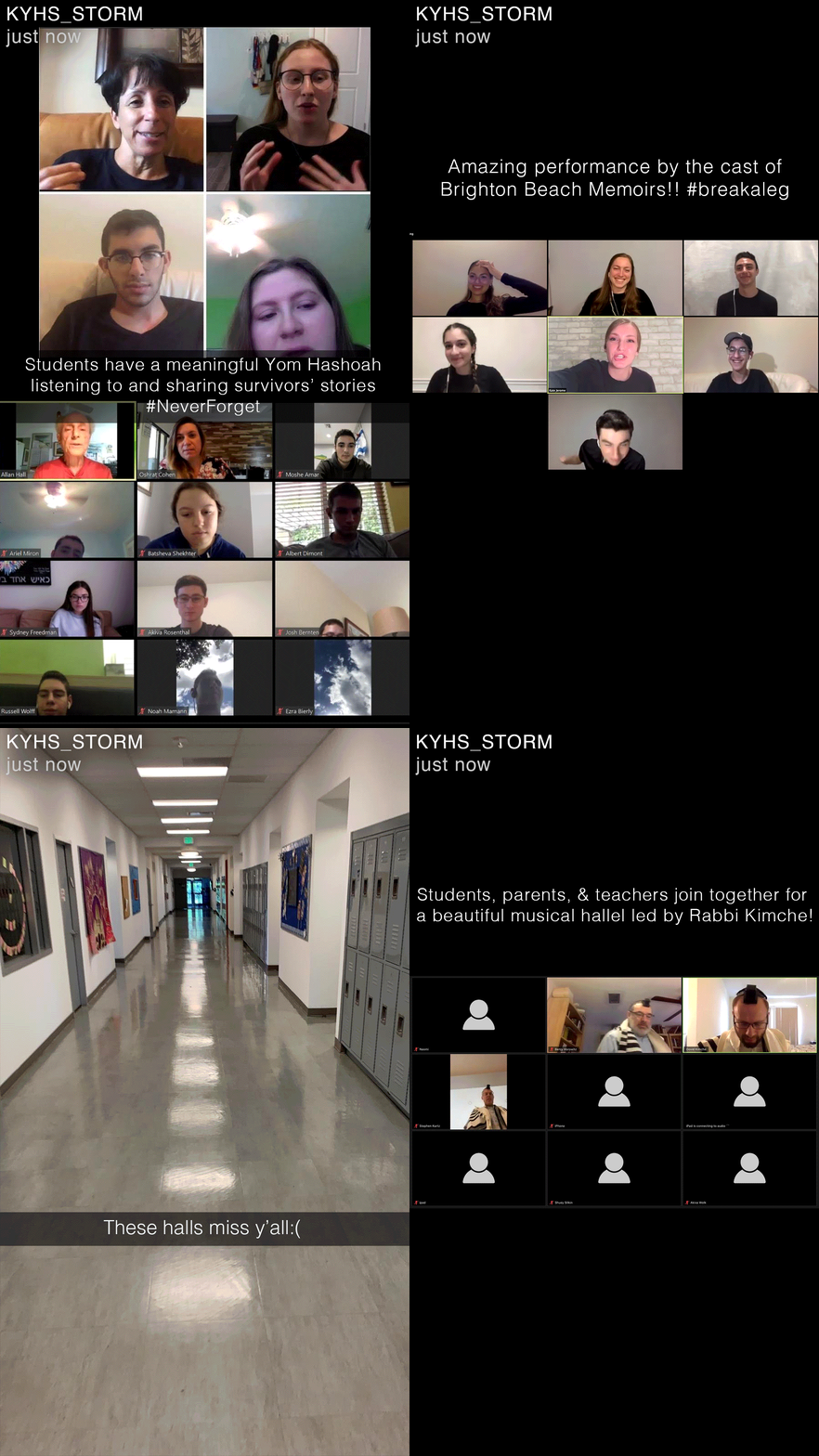
This past Tuesday, in honor of Yom Hashoah, all KYHS students and administration got to hear from Mr. Sam Ron on his experience in the Holocaust. Mr. Ron’s story is an incredible display of the type of endurance and strong faith we should all strive to acquire. One of many admirable things about Mr. Ron was how through all his hard times, he was still able to come out of it with faith and pride for being Jewish.
His first experience was being sent to live in a ghetto before being sent to the concentration camps where he worked very hard. After all this, he took the death march. Years later, Mr. Ron continues to rerun to Europe to march, but in a different way. He participates in the March of the Living. He has gone for 11 years already, but sadly this year he was unable to go due to the Coronavirus. The fact that he is able to relive this march, shows us all how much strength he has!
After being liberated, he emigrated to Israel and fought for Israel’s independence in 1948. Following this, he moved to America where he married his wife. Today, he lives in Sinai Residences, just next door to us! Hopefully, when we return to school we’ll be able to meet him in person.
He has devoted so much of his time to teaching people about the Holocaust and his story! It’s our job to carry on this story to assure that history doesn’t repeat itself. History will not repeat itself as long as we don’t let it!
Mr. Sam Ron concluded with teaching us the importance of being good to one another so we can stand together and be strong against any forces that ever want to bring down the Jewish people again. Thank you so much to Mr. Ron for taking the time to share his story to all of us. You have taught us so many important lessons that we will cherish forever.
Article by Marielle Askenazi ('23)
|
|
The Show Must Go On!
Cast of Brighton Beach Memoirs Performs a Phenomenal Script Reading Over Zoom
|
|
Graphic by Chana Schandelson ('22)
On Thursday, the student cast of Brighton Beach Memoirs hosted a staged reading of the play. The night began with some opening words from Jill Lustig, the amazing director of the show. The production tells the story of a Brooklyn family in the midst of the Great Depression. With appearances from Steven Gallitzer, Rachel Pinkus, Yoni Kurtz, Chani Kaminetsky, Talia Stauber, Galia Palmer, and David Borrocas the show was one of a kind. The cast used small props like hats, baseball gloves, glasses, and hairbrushes to make the show come to life from the comfort of their own homes. Thank you to everyone who made the show possible! Although students can no longer physically attend school or programs, the show must go on!
Article by Zohara Lam ('23)
|
|
Mah Nishtana This
Year's Sedarim
Reflections on an Interesting Pesach Experience
|
|
Graphic by Ariella Mayer ('23)
This year's Pesach was weird, to say the least. While many of us would have liked to be away, perhaps in Israel or at a Pesach program, we were all stuck at home with our families because of the quarantine. Pesach this year gave us a great time to bond with our families and even to bond with each other via text messages and weird sleep schedules.
People, as we found out, found a way to have fun even though they were stuck at their houses. Senior Amitai Tokayer remarked how Pesach was nice, and although it was a little weird to only be with his immediate family, he still had fun by playing basketball and reading.
Quarantined Pesach was a new experience for all of us. Sophomore Emma Schenker said, “Pesach over quarantine was definitely a new experience but it was nothing to complain about. I spent hours playing games with my brothers and had loads of time to read and relax.”
Quarantine, as many expressed, gave many people the chance to become true masters at different board games. Junior Yosef Ovadia mentioned how he spent most time chilling with his family inside while playing board games, but also enjoyed games of basketball and ping pong.
Personally, Pesach was weird, but new and enjoyable. The Seders were nice and interactive, and my family stayed up every night laughing and playing. I met with my neighbor friends (but 10 feet apart) every day and we spent hours discussing anything and everything, from cars to religion to politics.
Quarantine is a special time for us all. We have a real chance to build many new and lasting relationships. Even though we’re all locked up, we are experiencing new things which will guide us in the future. A good Shabbos to everyone, and stay safe and healthy.
Article by Judah Berman ('21)
|
|
|
|
|
|
|