Weekly News From Los Alamos County
March 2, 2022
|
|
Inside this newsletter you will find...
The Epidemiology Corner, State of the Union News, This Week's Survey,
COVID-19 Data and more.
|
|
|
|
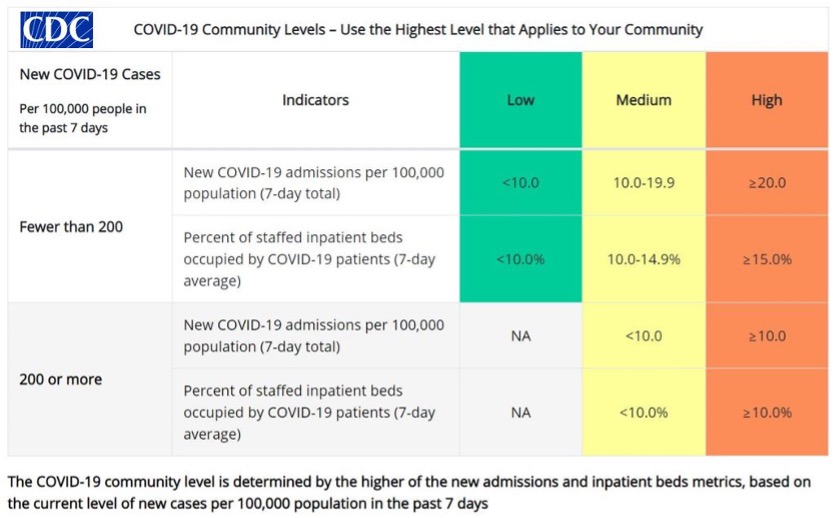
CDC Releases New COVID-19 Community Risk Framework...
"The new approach is geared
to preventing healthcare systems from being overwhelmed
by severe disease..."
|
|
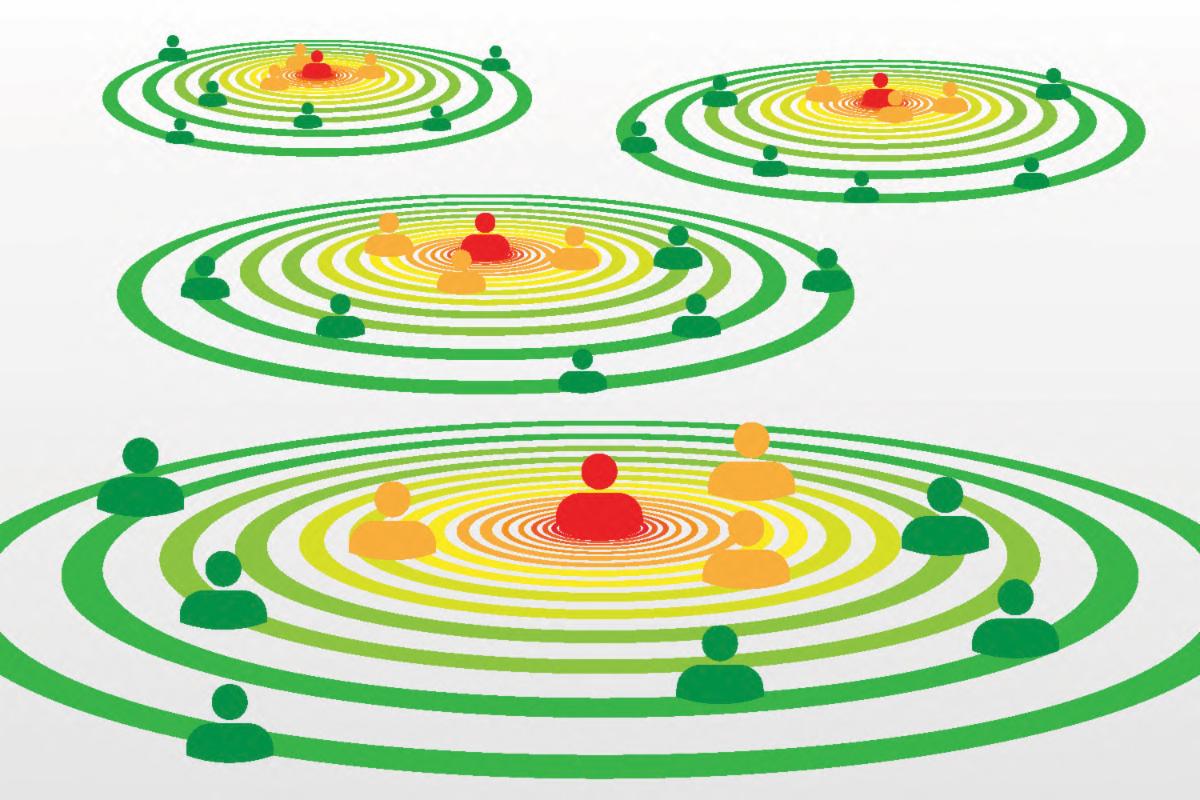
The US Centers for Disease Control (CDC) recently released a new COVID-19 Community Level risk framework to help individuals, households, and communities decide what prevention steps to take based on the latest data and local context and needs. Risk levels can be low, medium, or high and are determined by looking at three measures: (1) the number of new COVID-19 cases in an area, (2) hospital admissions, and (3) hospital beds. Unlike the prior framework, which focused solely on community transmission, the new approach is geared to preventing healthcare systems from being overwhelmed by severe disease. It also directs specific prevention efforts toward people at high risk for severe illness, which includes the elderly and persons with predisposing medical conditions. While community transmission continues to be monitored, the two hospital indicators are the main drivers which determine community risk. Vaccination to reduce severe disease, hospitalizations, and death remains the key measure for reducing the burden of COVID-19.
Access CDC risk framework at HERE.
|
|
CDC Drops Contact Tracing Recommendation
President Biden unveiled a plan aimed at ushering the United States into what some are calling a “new normal.”
Almost two years after the director of the Centers for Disease Control and Prevention (CDC) called for 100,000 contact tracers to contain the coronavirus, the C.D.C. said this week that it no longer recommends universal case investigation and contact tracing. Instead it encourages health departments to focus those practices on high-risk settings.
Britain ended contact tracing last week, while Denmark and Finland are among other nations that have scaled back the use of contact tracers. New York City announced on Tuesday that it was ending its main contact-tracing program in late April and moving toward treating the coronavirus as another manageable virus.
The original goal of contact tracing in the United States was to reach people who have spent more than 15 minutes within six feet of an infected person and ask them to quarantine at home voluntarily for two weeks even if they test negative. The aim was to reduce transmission while Americans who tested positive monitored themselves for symptoms during their isolation. Case investigation is used to identify and understand cases, clusters and outbreaks that require health department intervention.
More than 20 states still have statewide contact-tracing programs, according to Hemi Tewarson, the executive director of the National Academy for State Health Policy. Ms. Tewarson said that contact tracing could not keep up with the Omicron surge, and that it was no longer as effective a tool if people are testing at home and not reporting results.
|
|
The White House unveils a new Covid strategy, but it will need congressional funding.
In his State of the Union address, President Biden outlined a program that would allow Americans to be tested for the coronavirus at pharmacies and given free antiviral treatments on the spot if they test positive.
The White House unveiled its long-awaited new coronavirus response strategy on Wednesday, a 96-page plan aimed at turning the corner on the worst public health crisis in a century, while preparing for the next threat — in part by accelerating research into vaccines that could be deployed within 100 days of the arrival of a new variant.
The plan, aimed at ushering the United States into what some are calling a “new normal,” has four main goals: protecting against and treating Covid-19; preparing for new variants; avoiding shutdowns and fighting the virus abroad.
But there is a big hitch: Much of the plan requires funding from Congress. The administration recently told congressional officials it could need $30 billion to boost funding for the pandemic response.
Many of the other initiatives — including the plan to quickly develop vaccines, which was announced in November — are not new. But taken together, they amount to a blueprint for the next phase of the response, though the White House insists the fight against Covid is far from over.
The idea behind the strategy is to get the nation out of crisis mode and to a place, Mr. Biden has said, where the virus will no longer disrupt everyday life. The plan included a pledge for the administration to work with Congress to “give schools and businesses guidance, tests and supplies to stay open, including tools to improve ventilation and air filtration.”
Covid treatments have been developed, including the Pfizer drug Paxlovid, which will be integral to the “test and treat” initiative. Although those pills have been relatively scarce since they were authorized late last year, Mr. Biden said in his speech Tuesday night that “Pfizer is working overtime to get us one million pills this month and more than double that next month.”
To read the full article, click HERE and scroll past the article highlighted above.
|
|
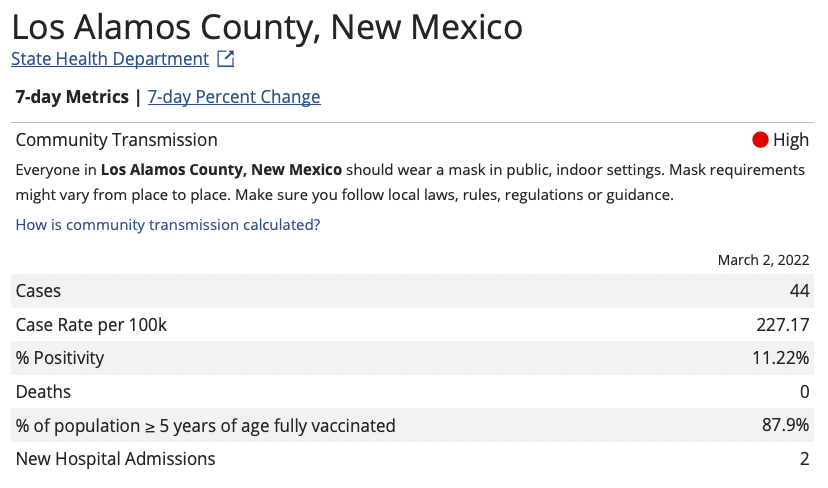
CDC COVID Data Tracker - March 2, 2022
To get today's break down of positive case data, demographics information, vaccine status and more for Los Alamos County or other counties across the United States, click HERE
|
|
|
|
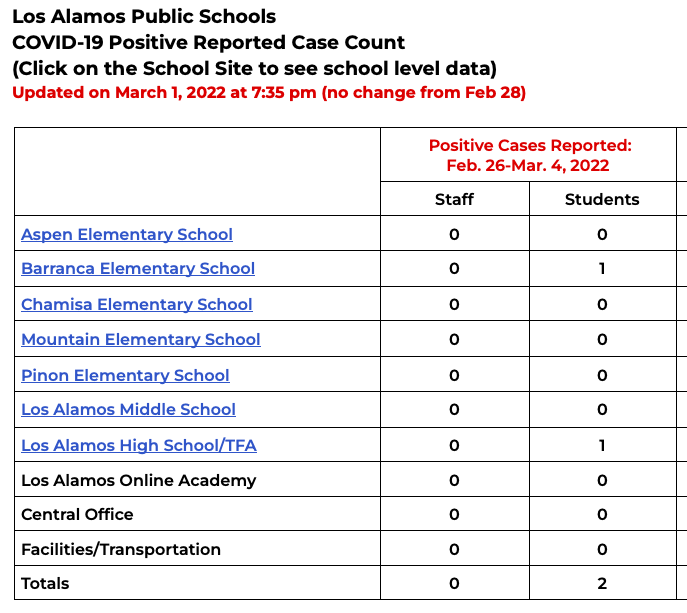
LAPS COVID-19 Positive Reported Case Count
Cases Reported between
February 26 - March 1
Total: 2
|
To learn more about reported COVID-19 cases in the individual LAPS schools, click HERE.
|
|
LAC Emergency Manager's Report to Council for March 1, 2022, click HERE
|
|
Johns Hopkins
COVID-19 Status Report Dashboard for
|
|
Mayo Clinic Vaccine Tracker
To see how many people are vaccinated and compare progress across states, click HERE
|
|
NMDOH Epidemiology Reports Updated February 28, 2022
View data showing the percentage of new cases each week by race/ethnicity, as well as by age groups and gender. You will also find in-depth epidemiology reports - click HERE
|
|
The charts available with this TOOL layout the key metrics for understanding the reach and severity of COVID-19 in a given area.
|
|
Have a question? Email us. |
|
Vaccine/Booster Information |
|
Los Alamos County Vaccine/Booster Resources
Visit the County COVID Page for information regarding vaccinations/boosters, click below:
|
|
Testing Resources for Los Alamos County |
|
Additional Los Alamos County Testing Resources
Visit the County COVID Page for information regarding testing, click below:
|
|
What else would you like to see in this newsletter?
Click below to email us your feedback and questions!
|
|
|
|
|
|
|