|
Law enforcement officers are first responders, just like firefighters and paramedics. But while an EMT wouldn’t be expected to intervene in a battery or search a business with a smashed window if they were first on scene, a deputy will absolutely render first aid as soon as they come across an injured person. Recently, the new class of recruits got a two-week crash course on how to save a citizen’s life or their own if they’re the first on scene at a medical emergency.
“Most of the time we’ll be the first one on scene,” said Recruit Granit Dedushi. “We can’t get EMS until the scene is clear. If the scene is unsafe we can’t bring them in.” If a deputy responds to a shooting, for example, paramedics and Sunstar will stage in a location that is nearby, but far enough away to keep them safe until deputies have made sure there’s no active threat.
One of the first and most crucial things the recruits learn is how to stop bleeding. A person can bleed out from a major arterial injury in two minutes or less. Arteries are the high-pressure vessels that carry oxygenated blood from the heart to the rest the body, and when they are severed from a gunshot or other trauma they can cause a subject to bleed out very quickly. The window to save a life is extremely narrow, so all Pinellas County Sheriff’s Office deputies carry a tourniquet.
A modern combat application tourniquet is a bit more sophisticated than the improvised belt you might have seen in movies. That doesn’t really work. An effective tourniquet needs to be tight – really tight. “When our classmates applied a tourniquet on us they would twist it until it felt like your leg or arm was on fire, which told us that it was applied correctly,” said Recruit Matthew Anderson. “If you’re in pain, you know it’s working.” High and tight is the motto – put the tourniquet as high as possible on the limb, and turn the windlass tight enough that the bleeding stops. One of the instructors, a nurse, used a vascular doppler that let the whole class hear the test subject’s radial pulse. As the tourniquet tightened, his heartbeat abruptly stopped as blood stopped flowing. If he’d been bleeding out from a severed brachial artery, this would have saved his life.
At any moment, a seemingly trivial call could turn into a life or death situation for a deputy. Any traffic stop could become an active gunfight, any call could be an ambush. “You need to know how to tourniquet yourself, so that’s something that we train with on a daily basis,” said Recruit Dedushi. “We’ll get hit randomly walking down the halls and they’ll say tourniquet left arm or tourniquet left leg and you have to be able to get that on in under 30 seconds.”
Many of the recruits had taken a CPR course before, but the instructors not only made sure the information was fresh in their minds, but also ensured that they were up to date on the latest standards of care. New science can change the preferred treatment methods as some things are shown to be more effective. Not long ago, back blows were added to the standard abdominal thrusts when responding to an adult choking patient, something even those with prior military first aid training didn’t know about.
Opioid-related deaths have plunged dramatically, thanks to the prevalence of Narcan, a nasal spray that can quickly and safely reverse the deadly effects of drugs like fentanyl. Every deputy carries Narcan, and the recruits learned how to identify an opioid overdose, how to administer Narcan, and what to expect when it takes effect.
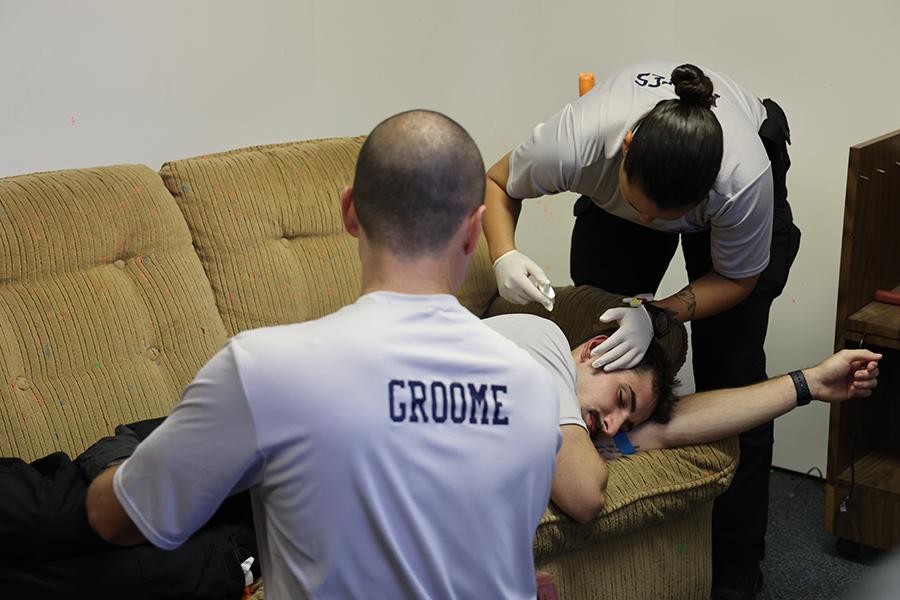
At the end of the first aid unit, the recruits got the chance to put everything they learned into practice with realistic scenarios. Just like in the firearms and defensive tactics components of their training, the Academy instructors strive to make the scenarios as realistic as possible. For one scenario that will probably stick in these recruits’ memories for their entire law enforcement career, they brought in a nurse with some impressive special effects skills to create realistic representations of wounds on a volunteer recruit.
In the scenario, a fellow law enforcement officer checked out for lunch at their house and now isn’t answering the dispatcher. They probably just turned their radio down, but a pair of deputies is sent to check on them, just in case. When they peer into the doorway they see a shocking sight.
“They had prosthetic injuries and fake blood gushing out,” said Recruit Dedushi. “I had blood all over my hands.” The volunteer patient had a realistic gunshot wound to the upper arm that was bleeding profusely, and a second gunshot wound to the chest. The recruits had to make use of all of their training in this emergency. Their first instinct was to help the victim, who was bleeding out, but where was the shooter? If the recruits both tended to the victim, they might become victims themselves. Instead, one began applying a tourniquet while the other cleared the mock apartment. Only when the scene was safe could they both focus on life saving measures. In the midst of treating him, they had to remember to get a suspect description and call for the support they might need, such as the helicopter, K-9, and additional units for a perimeter.
They’d practiced tourniquet application hundreds of times, so the arm wound was quickly addressed, but the penetrating chest wound needed different treatment. They had to use a dressing that would let air inside the chest cavity escape but keep outside air from entering, which could cause a collapsed lung. They’re issued chest seals, but recruits learned that in a pinch, they can improvise and use plastic wrap or a snack bag with good result.
The volunteer victim was a superb actor, moaning and passing out on cue. When the recruits saw signs of hypothermia and shock, they raised the victim’s legs to increase blood back to the heart, and covered him with a blanket to keep him warm.
The realism of training helps prepare them for the real world. “I find it easier to learn like that because it’s hard to imagine that blood is spilling out, but if it is actually happening you know how to respond and you just spring into action,” said Recruit Dedushi.
Recruit Anderson agreed. “They made it as realistic as possible because that’s what we’re going to see on the street if someone gets shot. It helps us mentally prepare for that situation.”
|