Weekly update from the National Housing Conference | |
News from Washington | By Brittany Webb
| | |
Key pieces of housing legislation reintroduced
Representatives Darin LaHood (R-Ill.) and Suzan DelBene (D-Wash.) reintroduced the Affordable Housing Credit Improvement Act (AHCIA) in the House of Representatives, a bill that would produce an estimated 1.6 million additional affordable homes over the next decade and is strongly supported by NHC and many of its members. This bipartisan legislation aims to expand and enhance the Low-Income Housing Tax Credit (LIHTC), the nation's primary tool for financing affordable rental housing. AHCIA would make key modifications to the LIHTC program that would expand its capacity to produce affordable housing and make the program more efficient. The modifications include increasing credit allocations by reinstating the 12.5% cap increase that expired in 2021 and further expanding authority by 50%; lowering the bond financing threshold from 50% to 25%; and providing basis boosts for properties serving extremely low-income households and developments in rural and Native American areas.
Representatives Mike Kelly (R-Penn.) and John Larson (D-Conn.) also reintroduced the Neighborhood Homes Investment Act (NHIA). Modeled after the LIHTC, the NHIA seeks to create a new tax incentive to build and preserve over 500,000 affordable, single-family homes for homeownership in under-resourced communities over the next decade.
“Hard-working Americans ready for homeownership need more opportunities to find a modest, affordable home. The Neighborhood Homes Investment Act is a smart solution that will seed thriving communities, attract thousands of jobs, and unlock new economic potential – after all, homes are where jobs go to live,” said Sarah Brundage, President and CEO of the National Association of Affordable Housing Lenders (NAAHL).
These reintroductions reflect a continued bipartisan commitment to addressing the nation's affordable housing shortage through targeted tax incentives and public-private partnerships. Companion bills are expected to be reintroduced in the Senate later this month.
| | | |
Nearly 350 housers gather for NHC’s Solutions for Housing Communications
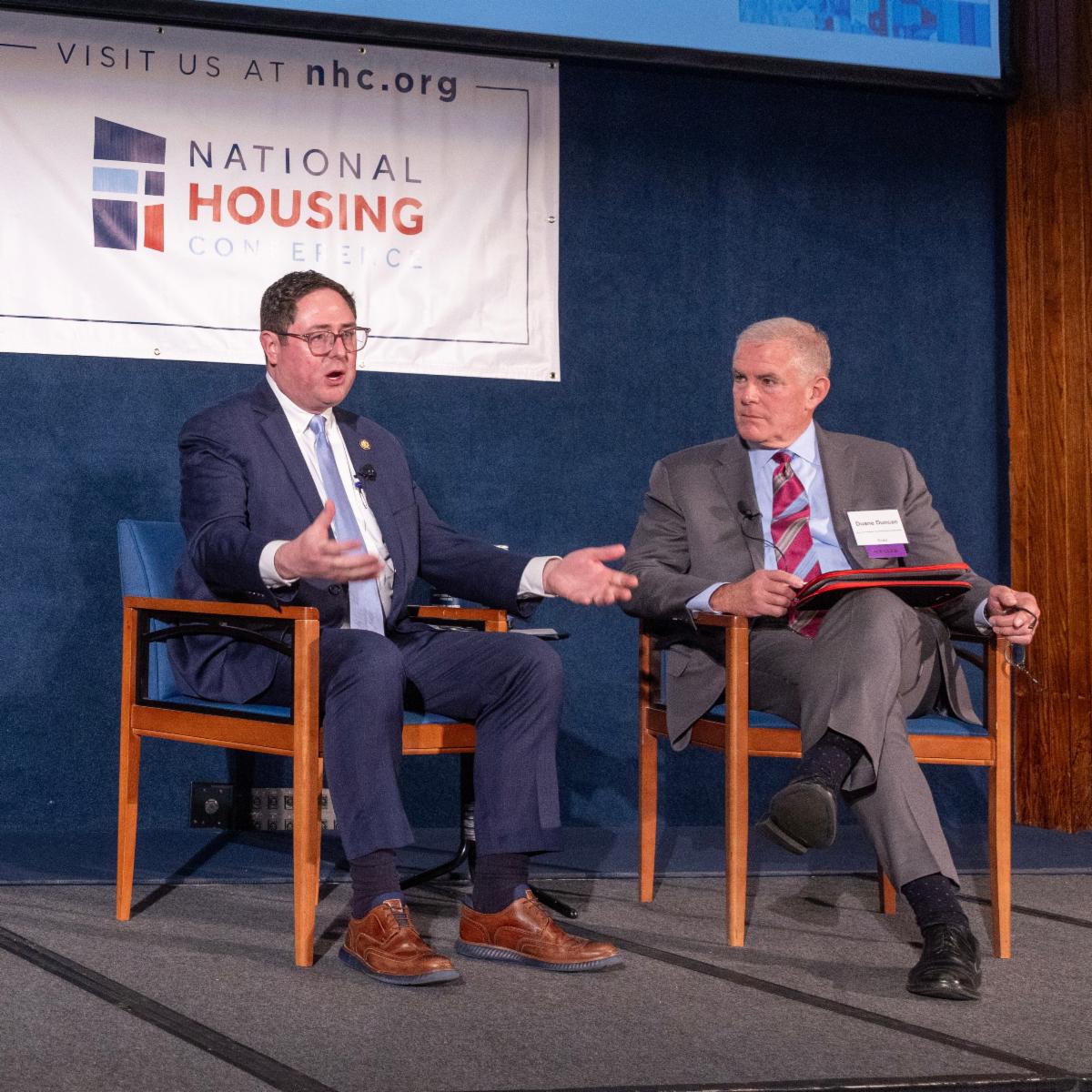
Last week in Washington, D.C., NHC brought together nearly 350 housing communicators, advocates, policymakers, and industry leaders from across the country, both in person and online, for its annual Solutions for Housing Communications convening to exchange ideas and strategies centered on improving and advancing affordable housing conversations.
“I think you’re going to see housing move forward in a bipartisan way,” said Rep. Mike Flood (R-Neb.), Chairman of the House Financial Services Subcommittee on Housing and Insurance, in a fireside chat with NHC Board member Duane Duncan, Senior Vice President of Government and Industry Relations at Enact. “We’re going to have to have Democratic buy-in.”
Rep. Flood highlighted bipartisan efforts he is leading with Rep. Emanuel Cleaver (D-Mo.) to reauthorize two key HUD programs, the HOME Investment Partnerships Program and the Community Development Block Grant (CDBG) Program, both of which provide federal assistance to states and localities with the aim of developing new, affordable housing. The representatives are currently seeking input from housers on insights and best practices for reauthorization.
Additionally, Rep. Flood emphasized his strong support for the Low-Income Housing Tax Credit program and cautioned against a fast-paced approach to privatizing the GSEs. “My position is that we get through this year, let the FHFA director get his feet on the ground, and have that conversation in the first quarter of 2026,” he said.
Attendees also heard from The Washington Post’s Rachel Siegel, The Wall Street Journal’s Nicole Friedman, Bloomberg CityLab’s Kriston Capps and NPR’s Jennifer Ludden who shared their perspectives on seeking good sources, utilizing data to advance housing narratives, and navigating public policy through personal stories. They stressed the importance of recognizing their audiences and tailoring their reporting towards those readers.
In a world where navigating differing perspectives can feel more challenging than ever, Hayley Hoffman, MA, LPC, of the Imago Center of Washington, DC, guided attendees through conversational exercises designed to strengthen communication skills. Hoffman emphasized the importance of intentionality, empathy, and structured dialogue as key tools for fostering trust and collaboration in both professional and community settings.
Other panels brought together experts to discuss a range of topics in the housing communications space, including constructing productive dialogue with policymakers, effectively utilizing digital tools to convey housing narratives, evaluating successful communication strategies in housing initiatives, and fostering new relationships with new allies in affordable housing advocacy and development. All panel sessions will be made available to watch at nhc.org.
NHC extends its gratitude to JPMorganChase, Rocket Mortgage, NeighborWorks® America, Freddie Mac, National Association of REALTORS®, and Living Cities for their generous sponsorship of this event.
| | | |
Partnering with NHC’s Housing Visionary Awards Gala and its distinguished honorees elevates your organization’s visibility, deepens engagement, and opens the door to valuable networking with over 500 influential housing leaders and stakeholders.
We offer sponsorship levels tailored to fit every organization’s needs – starting at $3,500 up to $50,000. Depending on your sponsorship level, benefits could include:
- Additional Gala tickets.
- A Gala Tribute Book ad.
- Listing in the Gala Tribute Book.
- Listing in printed and electronic marketing materials.
- Acknowledgement in opening and closing media presentations.
- Prominent listing of company logo, name, and website link on the event website.
- Recognition in Gala opening remarks.
- Recognition as a Networking Reception sponsor or as a Dessert Reception sponsor.
Tribute Book ads are available from $750 for a quarter-page to $2,500 for a full-page placement. Tickets are $1,000, but NHC members at or above the Full membership level receive half-price tickets.
For more information, please contact NHC's COO Amanda Mitchell at amitchell@nhc.org.
| | | |  | | |
Bipartisan members request HOME, CDBG input
Chairman of the House Financial Services Subcommittee on Housing and Insurance Mike Flood (R-Neb.) and Ranking Member Emanuel Cleaver (D-Mo.) have issued a public request for comments to gather stakeholder input on the potential reauthorization of the HOME Investment Partnerships Program (HOME) and the Community Development Block Grant (CDBG) program. These two U.S. Department of Housing and Urban Development (HUD) initiatives are pivotal in supporting affordable housing and community development nationwide but have not been reauthorized in over 30 years.
In January, HUD published a Final Rule for the HOME program. However, its implementation has been delayed until April 20 due to review by the new administration, which is evaluating rulemakings for certain equity provisions it does not support.
Reps. Flood and Cleaver are inviting feedback from local officials, community organizations, and residents to help shape future legislation aimed at enhancing the effectiveness and reach of these programs. Select commenters may be invited to present their ideas in person in Washington, D.C.
A list of guiding questions about the programs is available, and responses will be accepted through April 25. Comments can be submitted via email to FloodCleaver@mail.house.gov. NHC will be working with its members to submit input on both programs.
| | | |
Bipartisan, bicameral housing supply act introduced
The House and Senate each introduced legislation aimed at improving the nation’s housing policy by providing localities with resources to overhaul zoning and land use and spur development. The Housing Supply Frameworks Act would allow the federal government to work with stakeholders to establish a framework helps cut through red tape and barriers to increasing supply. The House bill was introduced by Reps. Mike Flood (R-Neb.) and Brittany Pettersen (D-Colo.), while the Senate bill was introduced by Senators Lisa Blunt Rochester (D-Del.), John Fetterman (D-Pa.), Mike Crapo (R-Idaho), and Thom Tillis (R-N.C.). The bill is endorsed by over 140 housing advocacy organizations, including NHC.
“The rising cost of housing is putting the American Dream out of reach for working families across our country,” said Rep. Flood. “We need an all-of-the-above approach to addressing America’s housing crisis. To this end, the Housing Supply Frameworks Act helps establish suggested best practices for state and local governments across the country who want to break down barriers holding back development and innovation in housing and construction.
| | | |
HUD extends foreclosure relief for hurricane victims
HUD announced a 90-day extension of foreclosure moratoriums for FHA-insured single-family mortgages in areas affected by Hurricanes Helene and Milton. This measure aims to support over one million borrowers in Florida, Georgia, North Carolina, South Carolina, Tennessee, and Virginia as they continue recovery efforts. The foreclosure moratoriums, now effective through July 10, 2025, prohibit mortgage servicers from initiating or completing foreclosure actions on affected FHA-insured mortgages. This is the second extension, following the initial moratorium set to expire on April 11, 2025.
HUD Secretary Scott Turner emphasized the department's commitment to aiding disaster-impacted communities, stating that the extension offers families additional time to stabilize their lives and properties.
| | | |
Section 4 funding reinstated
Enterprise Community Partners and Local Initiative Support Corporation (LISC) announced that HUD has reinstated nearly $40 million in Section 4 capacity building grants, reversing a prior termination notice issued in late February. These grants are instrumental in aiding communities nationwide to develop and preserve affordable housing. In response to the initial termination, housing groups came together to send a letter in support of maintaining the grants.
“It’s with extraordinary gratitude that I announce that we have prevailed in our effort to reclaim millions in HUD funding to support affordable homes nationwide,” said Shaun Donovan, Enterprise President and CEO. “For over three decades, Enterprise has been a national steward of Section 4, a HUD funding source that we’ve leveraged to create 45,000 affordable homes in the last 10 years and support 700+ community organizations doing the hard work of bringing down housing costs for Americans nationwide.”
Michael Pugh, LISC's President and CEO, said, "We are overjoyed to resume this essential work and to continue LISC’s long-standing legacy of driving positive, measurable economic impact where it’s needed most. With renewed support from HUD and our ongoing commitment to identifying additional private funding sources, we are focused on the future—to build stronger communities together."
This reinstatement follows a series of funding freezes and contract cancellations by the Trump administration, which placed many affordable housing projects in jeopardy.
| | | |
MBA advocates for veteran housing program ahead of House hearing
The Mortgage Bankers Association (MBA) submitted a letter to the House Veterans’ Affairs Subcommittee on Economic Opportunity in support of the VA Home Loan Program Reform Act, bipartisan legislation that would authorize a permanent partial claim program under the VA Home Loan Program. The move comes as the Department of Veterans Affairs prepares to sunset its temporary Veterans Affairs Servicing Purchase program on May 1.
In the letter, MBA emphasized that a permanent partial claim option would align VA’s loss mitigation tools with other existing programs and “provide VA with a long-overdue, effective and stable loss mitigation option.”
MBA President and CEO Bob Broeksmit stated earlier this month, “The work must start immediately to strengthen the VA’s loss mitigation toolkit, and that includes implementing a permanent partial claim option, a foreclosure avoidance tool that is widely used in every other government loan program. MBA is eager to continue to work with the VA and Congress to protect veterans and ensure that they can utilize the housing benefit they earned through their service.”
| | | |
NHC’s Housing Resource Center surpasses 10,000 visitors
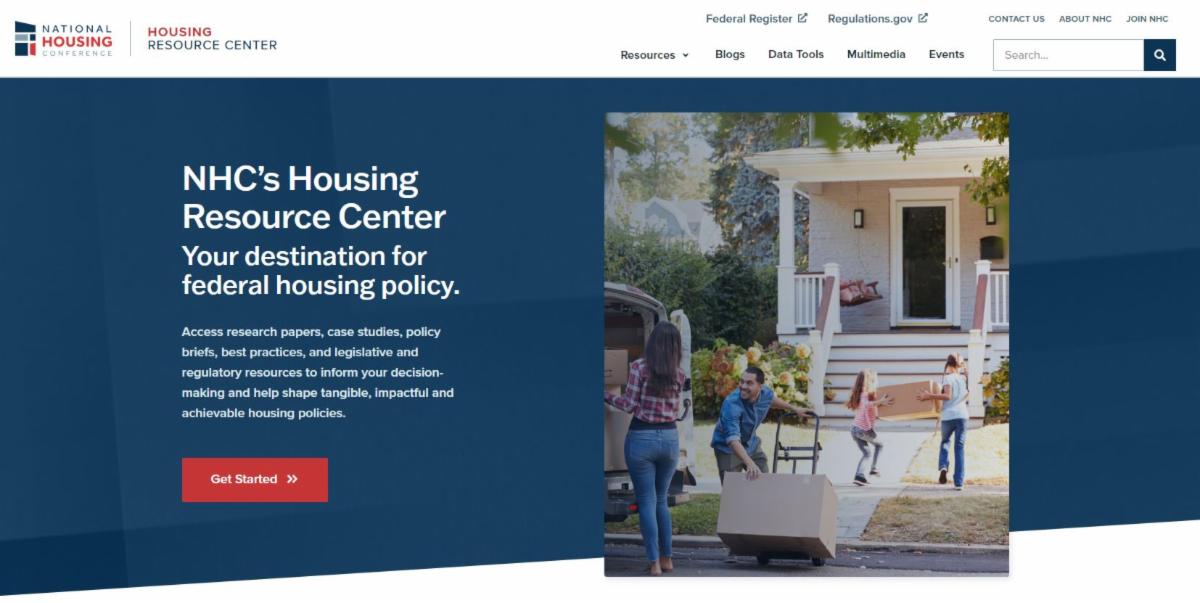
After just one year since its launch, NHC’s Housing Resource Center (HRC) has officially surpassed 10,000 unique visitors, cementing its place as the definitive destination for anyone seeking to navigate the complexities of federal housing policy.
The strong user engagement reflects growing demand for reliable, centralized housing information. As federal housing issues continue to evolve rapidly, policymakers, advocates, researchers, and practitioners are turning to the HRC as their trusted source for timely updates and comprehensive resources.
Updated weekly or more, the HRC offers access to a robust and expanding library of more than 2,000 curated resources, all housed in an easily searchable and centralized platform. These resources include everything from news articles and issue papers to research, congressional actions, and toolkits, making it easier than ever to stay informed on the latest developments in housing and community development.
| | | |
FFB Risk-Sharing program shows growing uptake
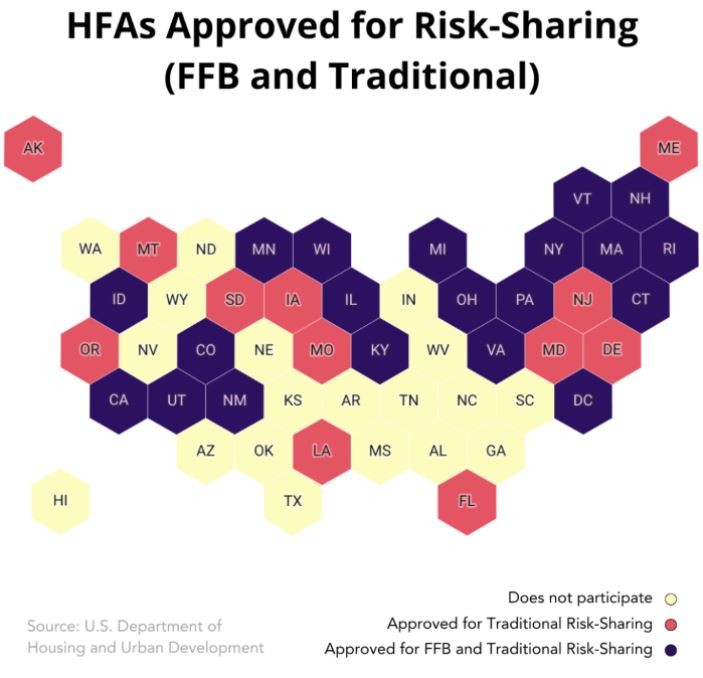
A growing number of state and local housing finance agencies are leveraging the Federal Financing Bank (FFB) Risk-Sharing Initiative to bolster affordable housing supply, according to NAAHL. The FFB risk-sharing program is a collaboration between HUD and the Treasury Department that enables housing finance agencies to originate FHA-backed multifamily loans with shared risk, ultimately lowering borrowing costs and supporting small and rural projects. As of April 2025, 38 Housing Finance Agencies (HFAs) across 34 states are approved participants in the program, reflecting a total investment of over $19.9 billion in financing and 219,000 affordable units.
| | |
The Subcommittee on Oversight and Investigations of the House Financial Services Committee held a hearing Tuesday to discuss alleged mismanagement of funds at HUD. The committee heard testimony from Stephen Begg, the new Inspector General for HUD, who asserted that HUD’s IT systems were outdated, hindering data collection and oversight and leading to improper payments and difficulties in preventing fraud. Democrats on the committee raised concerns about DOGE’s involvement with the department, raising questions about its legal authority, potential impact on crucial HUD programs, and staffing.
An article by The New York Times discusses how climate change is impacting housing in the New York region. It highlights the increasing challenges homeowners and renters face due to rising sea levels, more frequent flooding, and extreme weather events. The piece also examines the efforts by city planners and policymakers to adapt infrastructure and housing policies to these environmental changes, including socioeconomic disparities that can make underserved communities more vulnerable than others.
The NYU Furman Center published a report this month examining success rates in the Housing Voucher Program at both the national and Public Housing Agency (PHA) levels. Key findings include a significant decline in success rates and a rise in search times between 2020 and 2022, with considerable variation across different PHAs based on factors like rural/urban location, size, and the median rent in their county. Notably, the initial cohort of Moving-to-Work (MTW) PHAs largely avoided this decline, potentially by using greater flexibility that is afforded to them. The study highlights the feasibility of using administrative data for these estimations and recommends annual reporting to better understand and improve the program's effectiveness.
| | Renew your NHC membership today! | | Watch this video to learn more about how NHC represents diverse leaders across the housing spectrum, including lenders, homebuilders, affordable housing advocates, real estate professionals, housing development corporations, housing finance agencies, and more, to address today's pressing housing issues. | | |
Your involvement is essential to addressing today’s housing challenges, and NHC relies on active members to maximize our impact and remain a leader in tackling today’s housing issues.
NHC membership offers exclusive networking opportunities, access to our weekly Member Brief, and other key housing resources such as our Housing Resource Center, Paycheck to Paycheck database, and Employer Assisted Housing Toolkit. We look forward to working with you to address America's housing challenges.
| | The National Housing Conference is a diverse continuum of affordable housing stakeholders that convene and collaborate through dialogue, advocacy, research, and education, to develop equitable solutions that serve our common interest. | | Defending Our American Home since 1931 | | Copyright © 2024. All Rights Reserved. | | | | |