"Only when the tide goes out do you discover who's been swimming naked."

– Warren Buffett (1994)


In June 2024, then-22-year-old Leopold Aschenbrenner published a 165-page essay titled Situational Awareness: The Decade Ahead, outlining his vision for artificial general intelligence (AGI) and the companies he believed would power the AI revolution. That paper became the blueprint for his hedge fund, Situational Awareness LP, which quickly became one of Wall Street's biggest success stories.


The fund concentrated heavily in AI infrastructure companies including SanDisk, CoreWeave, Bloom Energy, and Nebius. Investors rushed in. Within two years, the fund was reportedly managing more than $45 billion and had generated an astonishing return of nearly 450% through the first six months of 2026.


Last Wednesday, the tide went out.


As AI momentum abruptly reversed in July, many of the fund's largest holdings sold off sharply. The fund reportedly employed roughly 4-to-1 leverage, meaning every dollar of investor capital controlled approximately four dollars of stock. As losses accelerated, lenders issued margin calls, requiring additional collateral. To raise cash, the fund was forced to sell its largest positions. Those sales pushed prices even lower, triggering additional margin calls in a vicious cycle of forced liquidation.


Within days, nearly the entire public equity portfolio had been unwound, with many of those positions ultimately acquired by Ken Griffin's Citadel Securities. There is an interesting irony in that outcome. During the 2008 financial crisis, Griffin himself was forced to navigate similar fire-sale conditions to keep Citadel afloat.


Conviction can be a tremendous advantage. When combined with excessive leverage and a lack of discipline it becomes a tremendous liability.


On Thursday, the market, lead by strong earnings reports from names like Microsoft, Amazon, and Palantir, rallied. This week all of the major indices, the Dow, the S&P 500, and the Nasdaq, have each reached new all-time highs.


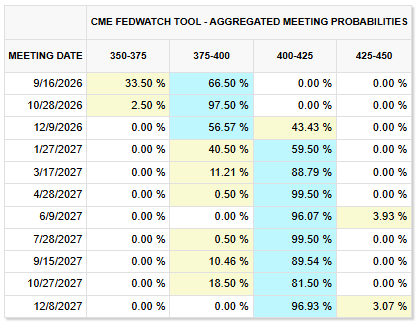
At the beginning of the year, Wall Street largely expected the Federal Reserve to deliver multiple rate cuts during 2026. We have yet to see a single cut. In fact, Fed Funds futures now imply that interest rates are actually likely to increase by 0.25% at September's Fed meeting. The market now expects rates to stay near today's 3.75%-4.00% range for several more meetings before gradually moving modestly higher into early 2027. I've included a chart below with the latest probabilities.

The reason for the change? Inflation.


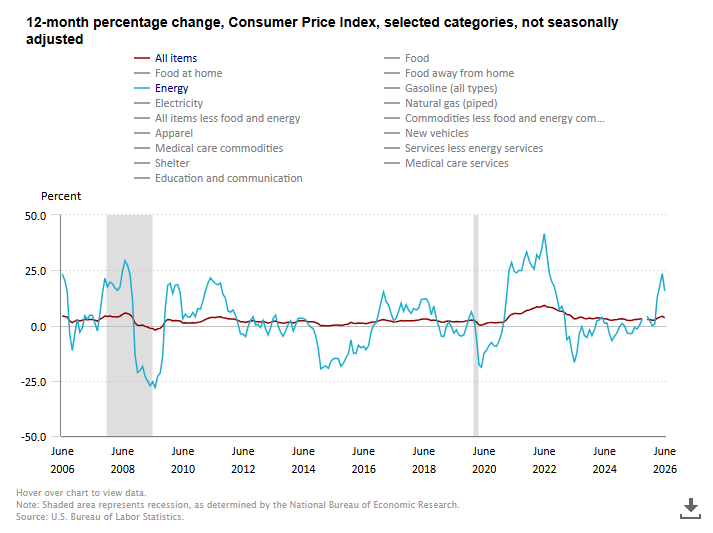
After peaking in June of 2022 at 9.1%, the Consumer Price Index (CPI) got as low as 2.4% in February of 2026 before a spike to 4.2% in May. The latest spike raised fears among some Fed governors that higher interest rates would be necessary to bring inflation to the Federal Reserves long-term 2% objective. To say the least, that is debatable (as evidenced by CPI numbers through the 2010s.) I would argue the money supply would be a more important place to look for long-term inflation targets, but that is a different conversation for a different day.


Back to the current CPI readings. If you actually look into the data, there is one clear catalyst for the latest spike: energy prices.


Geopolitical conflict in Iran pushed oil prices higher earlier this spring/summer, lifting gasoline prices and contributing to recent inflation readings. While those pressures are already moderating, the Fed has consistently stated it wants greater confidence that inflation is sustainably moving back toward its target before lowering interest rates.


At the same time, many of the most persistent inflation categories, including shelter, have continued to gradually cool, while goods prices have remained relatively contained.

Of course, inflation and interest rates aren't the only variables investors will be watching during the second half of the year. Corporate earnings, GDP, unemployment, geopolitical developments, and the approaching midterm election cycle all have the potential to influence market sentiment and increase short-term volatility. As always, markets will spend the coming months trying to price in events long before they actually occur.


Expectations change. Narratives change. Markets change.


Nobody has a crystal ball.


That's why our investment process has never depended on making bold predictions. Instead, we focus on building disciplined portfolios that can navigate a wide range of market environments. We stay strategic rather than emotional. We manage risk as carefully as we pursue opportunity. Most importantly, we review every position we own every single day so that when the tide goes out, we're prepared to respond thoughtfully rather than react impulsively.


Markets will continue to surprise us. They always have. Our responsibility isn't to predict every twist and turn. It's to help you navigate them with discipline, perspective, and confidence.


As always, thank you for the trust you place in our team.


Kent Brace

Sources: Factset, CME, U.S. Bureau of Labor Statistics,

Kenneth C. Brace, CIMA® 

Vice President, Investments / Crescent Wealth Management

Address: 124 Verdae Blvd., Ste. 105, Greenville, SC 29607

Direct: 864.900.4905 Office: 864.464.9626

Email: kent@crescentwm.com   Website: www.crescentwm.com

Advisory services offered through NewEdge Advisors, LLC, a registered investment adviser. Securities offered through NewEdge Securities, LLC. Member FINRA/SIPC. NewEdge Advisors, LLC and NewEdge Securities, LLC are wholly owned subsidiaries of NewEdge Capital Group, LLC. 


NOTICE: This email communication including all attachments transmitted with it may contain confidential information intended solely for the use of the addressee. If the reader or recipient of this communication is not the intended recipient, or you believe that you have received this communication in error, please notify the sender immediately by return email and PROMPTLY delete this email including all attachments without reading them or saving them in any manner. The unauthorized use, dissemination, distribution, or reproduction of this email, including attachments is strictly prohibited and may be unlawful.