RETIREMENT SECURITY MATTERS

A forum for retirement savings innovation, together.

Vol 108 | November 19, 2026


Greetings! Greetings! welcome to Retirement Security Matters—your forum for retirement readiness innovation with fresh thinkers, state and federal policymakers, service providers and other creative thinkers. 

It is the season of pumpkins here, and other great things about to be served on plates in interesting, convivial rooms. With that in mind, we bring you some excellent reading and a moment for yourself. Sit down, chillax, enjoy.


In this edition:


  • John Thompson of H&R Block—On Fitting our Savings System to More Americans
  • By the Numbers—Auto IRAs today
  • … and an Auto IRA [reality] Check
  • Message in a Bottle—did you miss it?
  • Hot Sauce 🌶️ Cool Stuff—our favorite researchers weigh in, and
  • … Pix of the Week!

View as Webpage Comments or content suggestions? We welcome both. Have something about your program or work you’d like to share? We are all ears.

Built for You? Fitting Our Savings System to More Americans 

⏱ 3-minute read

As Vice President, Financial Services at H&R Block, John Thompson leads products built around real household finances, drawing on nearly 30 years in tax and financial services and his time as Chief Program Officer at the nonprofit Financial Health Network.


Our savings system assumes a steady job, a regular paycheck, and a plan at work. For millions of Americans, that’s not real life. John Thompson sees the gap every tax season. H&R Block’s own data suggest many of its clients don’t have a workplace plan, and about half saved nothing for retirement last year.


John thinks tax time can help close that gap. This year, H&R Block says it helped families enroll in about 2 million Trump Accounts. Next up: the Saver’s Match and TrumpIRA.gov in 2027. We highlight three thoughts from our conversation below – don’t miss out on the rest of it – HERE (⏱ 9-minute read)


More doors are opening


Alongside our employer system, state Auto IRA programs like OregonSaves and 16 others help solve what John calls the hardest problem: getting started. In 2027, TrumpIRA.gov will offer an account to workers who don’t have one, and the new Saver’s Match will add federal money to their savings, with the first deposits in 2028. For H&R Block, that means teaching nearly 60,000 tax pros what these accounts are and how they fit together. “We know this program is going to exist, and we know we have a game-changing opportunity to help people,” John says of the Saver’s Match.


Trump Accounts showed what’s possible


Engagement started strong for a voluntary program and soared with human involvement. John shares: “Thirty percent of all the children we saw, ages zero to 18, signed up for an account.” Among families eligible for the $1,000 federal deposit, 90% of those receiving assistance through H&R Block signed up for a Trump Account. In offices, where families worked face to face with a tax pro, the rate hit 99%. “You can’t get 99% of people to do anything, much less something good,” John says. Treasury has since opened accounts for most eligible children automatically. Families still need to claim them and request the $1,000 on Form 4547, and helping them finish those steps is H&R Block’s job now.


“Access we’ve got to solve, but how can we 
sustain the behavior?”

— John Thompson


Simple, but important


John notes: With IRAs at tax time and the Saver's Match, we're introducing people to financial markets they may never have been part of. “I still watch people struggle with the basic questions for opening an investment account. What's my risk tolerance? I don't know. What's my investment experience? Bad. Those questions can be super scary and get people to say, ‘Ah, maybe I shouldn't do this.’


So how do we make getting someone into the market simple, but also appropriate? It shouldn't be a throwaway moment either, because you are taking risk. Half of our customers aren't saving. What happens if we solve all that? Now we've put people into a system they need to be competent in and able to fend for themselves in. Balancing simplicity with respect for the market is really important to me.”


Our savings system wasn’t built for everyone, but together we are remaking it. Alongside the employer-based retirement system, Auto IRAs, TrumpIRA.gov, the Saver’s Match, and Trump Accounts give more Americans a place to start. Within that ecosystem forward-looking organizations are thinking hard about how we help them keep going.


From tax time to financial health? Dive into the full conversation with John here.


John Thompson – Thank you! If you’d like to connect with John you can reach him on LinkedIn. You can follow H&R Block here.


By the Numbers: State Auto IRAs Today

⏱ 2-minute read

A special thank you to Angela Antonelli and the Georgetown Center for Retirement Initiatives for this data. You’ll find more detailed metrics and information on their site, here.


We read it so you don’t have to! Bottom line: about 1.5 million Auto IRA savers have saved about $3.4 billion. More detail below.


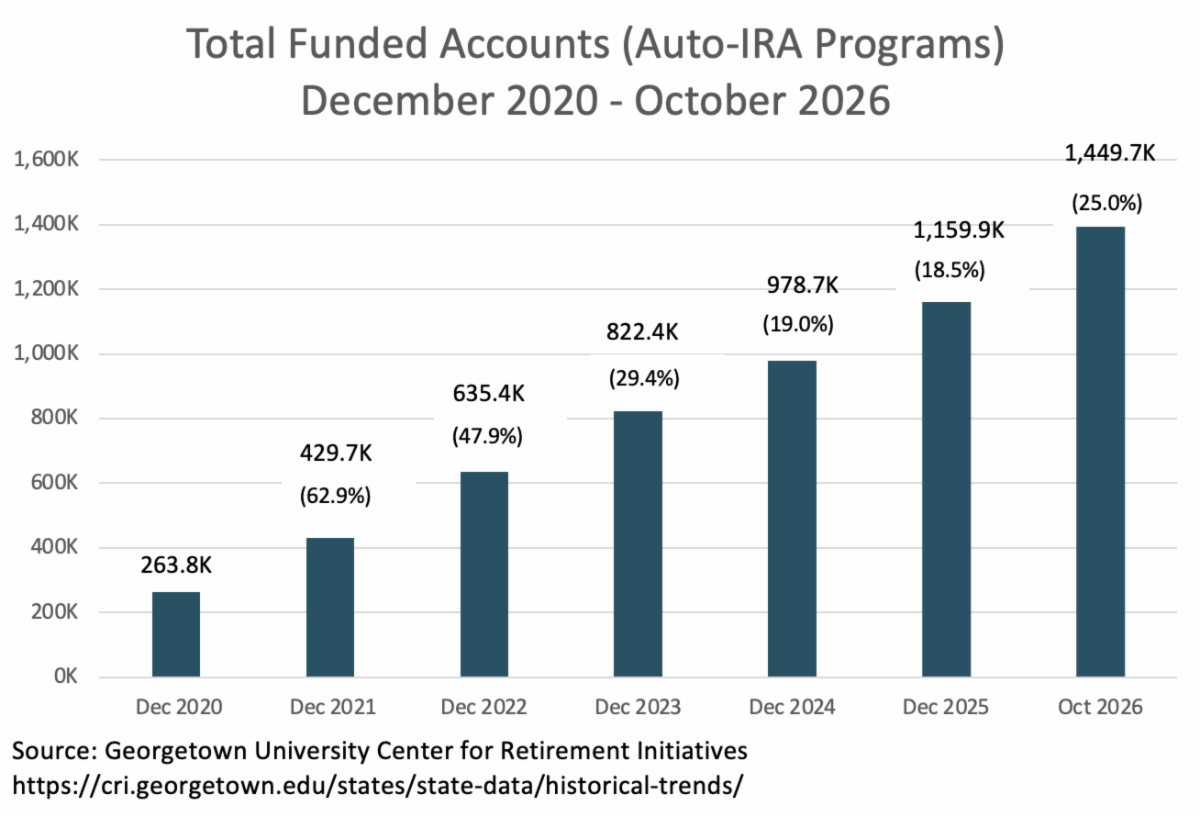
Total Funded Accounts

As of October, about 1.5 (actually 1.449) million workers are saving for retirement through Auto IRA accounts, up 25% from 1.16 funded accounts at year-end 2025. Strong annual growth continues, propelled by expanded coverage in states like New York and New Jersey, Minnesota and Rhode Island, which together brought in about 145,000 of these new accounts this year. California is a powerhouse and brought in 90,400 new funded accounts on their own.

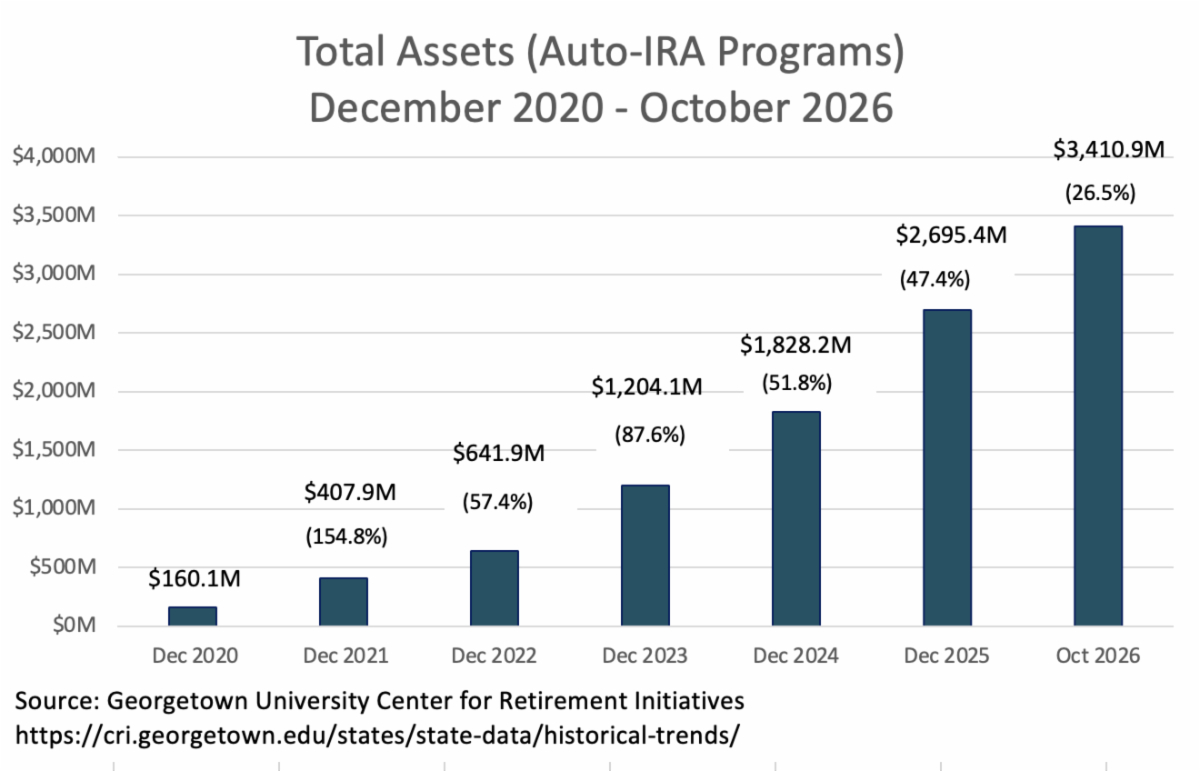
Total Assets


State Auto IRA programs now hold a combined $3.4 billion as of October 2026. This puts the average account size across all programs, all accounts at about $2,350. As we like to say, well above the famed $400 the average American could not scrape up for an emergency in 2016*. In Oregon, the longest running program, that figure is $3,246. In California it is $2,881. The newest programs naturally have average account sizes below $1,000.


*My Secret Shame – The Atlantic Monthly, May 2016.

Auto IRA [Reality] Check
⏱ 2-minute read

Heard in a room yesterday: “Auto IRA programs are still tiny—only about 1.2, 1.4 million savers—they’ve barely moved US retirement savings at this point.”


My ears fell off my head. Literally. I won’t be able to hear anything you say today.


The speaker, a friend, was off just a bit but mostly right. At 1.5 million funded accounts, Auto IRAs are still a small part of the national scene of more than 100 million active retirement plan accounts (figures vary by source). And although the volume of accounts has grown at a compounded annual rate of about 34%, to some this feels SLOW.


They point to the high number of folks theoretically covered—I’ll SWAG this at about 18 million Americans for the moment—when all current programs are fully rolled out—and the gap from today to there. They also look at 1.5 million compared to the number of private sector working Americans—which we’ll SWAG at about 145 million people. (I know all my research friends are swooning at the swagging. Hang in there).


Does it matter? We think it does, in these ways.


1 – States (and maybe one city soon) have shown that the very simple auto-enroll, auto-escalate, streamlined investment menu model works. It works, folks.


2 – Auto IRAs have carved out a legitimate space in the retirement savings ecosystem—covering workers who aren’t going to get paycheck-based retirement savings access elsewhere.


3 – And, the programs have surfaced legitimate challenges we are going to face in other places. These include the high account rejection levels associated with KYC/CIP, the detachment and lack of engagement you see for a chunk of participants in ‘automatic’ settings, and the differences between what’s allowed for an IRA vs. what’s allowed for an institutional retirement account. If we get a federal standard for paycheck-based access to retirement savings, we’ll see these issues again.


4 – are these growth rates anemic? Y’all know we’re biased, but we don’t think so. With limited levels of enforcement and high levels of ‘newness’, programs continue to roll steadily forward. And we like annual account growth rates that exceed 25%.


Stay tuned for what’s coming our way in 2027.


Retirement security matters! / Lisa


Message in a Bottle
⏱ 3-minute read

We brought you so much good stuff in our last edition, we bet you didn’t have time to read it all. For a quick recap of 2026 to date and a crystal ball into the year ahead, check out this piece – Tide Check 2026. - (⏱ 5-minute read)

Refreshing! Made with the assistance of our friend, ChatGPT

Hot Sauce 🌶️… Cool Stuff
⏱ 1-minute read

Hello 🥧 Pumpkin—you made it this far! As you prepare for a delightful Thanksgiving week, we bring you six goodies from the retirement world. You’ll love:


1 – From William (Hunter) Railey, Angela Antonelli, and Peter Thompson and hot off the press: Why State Retirement Savings Programs Are the Foundation for Building a National Retirement Savings Strategy. A history of Auto IRA programs in the US – key design features – and six things federal policymakers can do to leverage these programs as part of a national coverage strategy.


2 – from DCIIA’s Retirement Research Center—Does Financial Advice Actually Pay?—fast facts from Suriya Kolluri and Catherine Reilly on changes in net worth when accounts are advised, or not. Heard in a room this week—is Tech bringing us closer to a ‘more (personalized) advice for all world?


3 – From AARP with DCIIA - Financial Wellness Benefits: What the Research Shows and What Workers Want. Workers said: More help, period. An emergency savings account. Peace of mind about running out of money. An annual financial checkup. Incentives to take part. Privacy and trust. Personal, action-oriented support.


4 - Our friends at the Urban Institute - Mingli Zhong, Joseph Rosenberg and Catherine Harvey share Four Ways Policymakers Could Extend the Saver’s Match Benefit to More Workers with Low Incomes—and fresh data by state on Saver's Match impact - with and without enhancement. Are you a state or a policymaker? Check it out!


5 – How to think about claiming Social Security—a life-informed spin, with Derek Tharp: Personality, longevity insurance, and the timing of Social Security claiming. We are hearing a lot about SS these days—from funding levels to new claiming names (e.g. Minimum Benefit v. Early Claiming, and Maximum Benefit v. Late Claiming). One size may not fit all.


6 – And here’s a Social Security claiming explainer from the TikkyTokky—volume alert! Cary Green with advice for married couples. Why is this here? People are getting their info from the socials—not from static and official web pages. Watch and learn.


AND NOW ... we bring you Pix of the Week!

From the Tiny Cabin in the Woods—fun things this week: Greenhouse moments and dog buns. May your Thanksgiving be awesome. 🍁🍂

That’s it for this edition. ❤ Hug your people and change the world.

If you like this piece, please stick with us. We’ll be back in about 30 days. If you don’t like it, please unsubscribe below. Comments for us? Please let us know. Want your own subscription? Request one here. All information shared is from public sources or used with express permission. We do engage actively and thoughtfully with AI, and we welcome your insights.

Massena Associates provides process, policy, and implementation consulting on retirement savings programs and products.


Our clientele includes public entities, policy organizations, and private sector providers. Our specialty – efficient, targeted results. We are an active speaker on retirement security topics, including state-facilitated programs, MEPs and more.


If you’d like to explore working together, we welcome the conversation. Connect with us here, and at 339-236-0684.


RESOURCES you can use:

Looking for a great retirement savings innovation resource? The Center for Retirement Research at Boston College develops and hosts terrific content and proprietary research related to states, financial security, social security, and more.


The Defined Contribution Institutional Investment Association (DCIIA) is dedicated to enhancing the retirement security of America’s workers. To do this, DCIIA fosters a dialogue among the leaders of the defined contribution community who are passionate about improving defined contribution outcomes. DCIIA's site provides a range of public and member-specific resources.


The Georgetown Center for Retirement Initiatives, Led by Angela Antonelli, GCRI provides excellent information on state-based and other retirement security innovation and policy.


Pew’s Retirement Savings Project studies the challenges and opportunities for increasing retirement savings and is another great resource - check out the work of John Scott and his terrific team.


If you want a great source of broad-based, consumer-focused retirement news, Jeffrey H. Snyder’s The Morning Pulse is your ticket. You can subscribe here.


massenaassociates.com

Linkedin  X