|
|
Visual Art Source is a nonprofit platform, our mission to further the discourse of both visual art, the the Visual Art eNewsletter, and social, political and cultural issues as seen through an art critical lens, The Democracy Chain eJournal.
You are invited to support the writers who make it all possible. Please click the any of the cups. Please forward the eNewsletter and while you are at it follow us on social media.
|
|
|
This Week's Contents
(scroll to see the full content of each article; please click the cup and compensate the writer)
|
|
Sarah Charlesworth,
"Neverland"
|
Melina Ausikaitis,
“Fall in the Leaves"
|
Gaylen Hansen,
New Paintings
|
|
Please consider our sponsoring venues |
|
Sarah Charlesworth, "Neverland"
by Jody Zellen
|
|
Continuing through July 7, 2023
Sarah Charlesworth first exhibited the photographs from her “Neverland” series in 2002. These brightly colored images followed “0+1” (1999), much more subdued photographs that explored the threshold of vision. They were all shades of white, which made it hard to distinguish the picture from the background. Charlesworth (1947-2013), associated with the "Pictures Generation,” was well known for her conceptually based works that often incorporated appropriated materials. Her iconic images from "Modern History," for instance, including “Herald Tribune January 18 - February 28, 1991” and “Arc of Total Eclipse” (1979), presented the front pages of different newspapers with everything removed except the header and a selection of relevant but detached pictures.
|
|
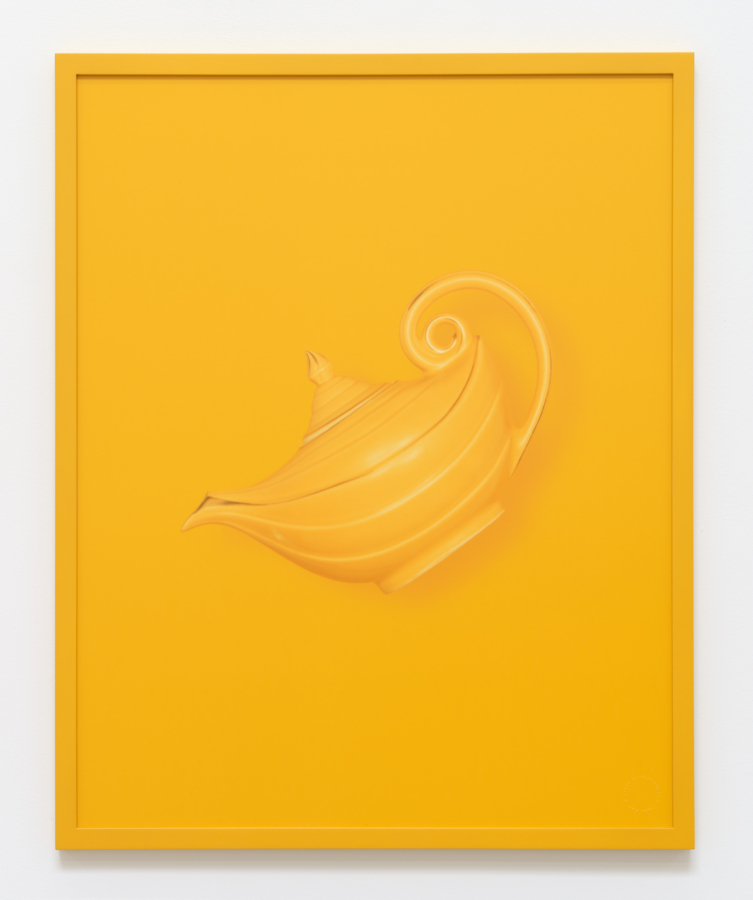
Sarah Charlesworth, “Teapot,” 2002, Fuji Crystal
archive print with lacquered frame, 28 1/2 × 23”
|
|
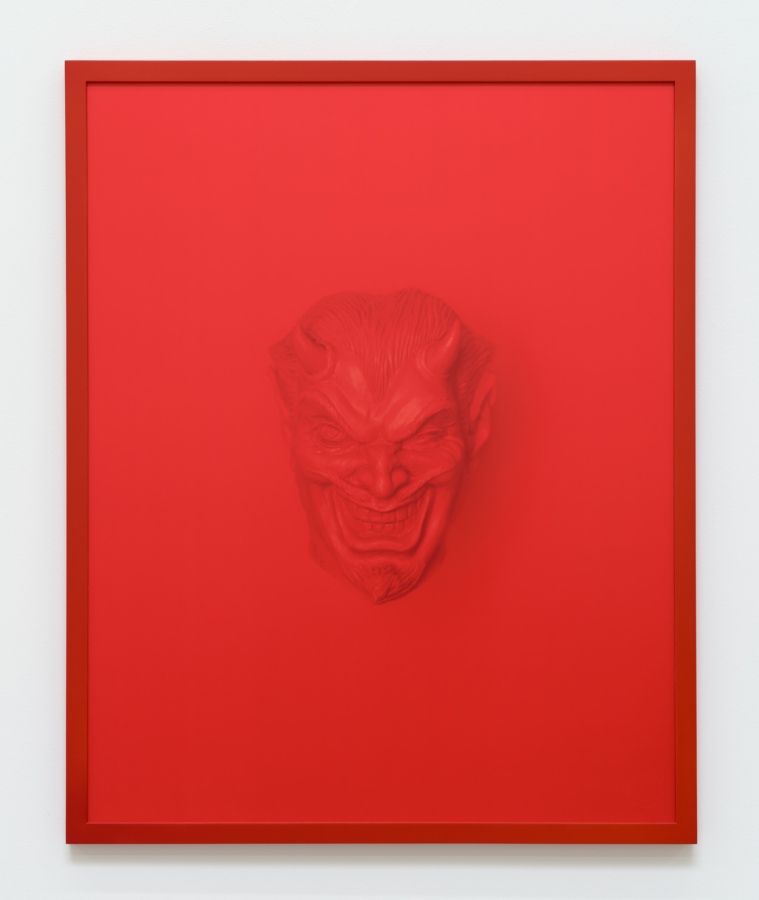
Sarah Charlesworth, “Devil,” 2002, Cibachrome
with lacquered wood frame, 28 1/2 × 23”
|
|
Charlesworth often displayed her works in a line or as a grid, to allow viewers to compare and contrast image size and placement of the featured image within the layout of the front page. Her approach to photography, particularly her formal elegance and conceptual rigor, have influenced a subsequent generation of artists and photographers.
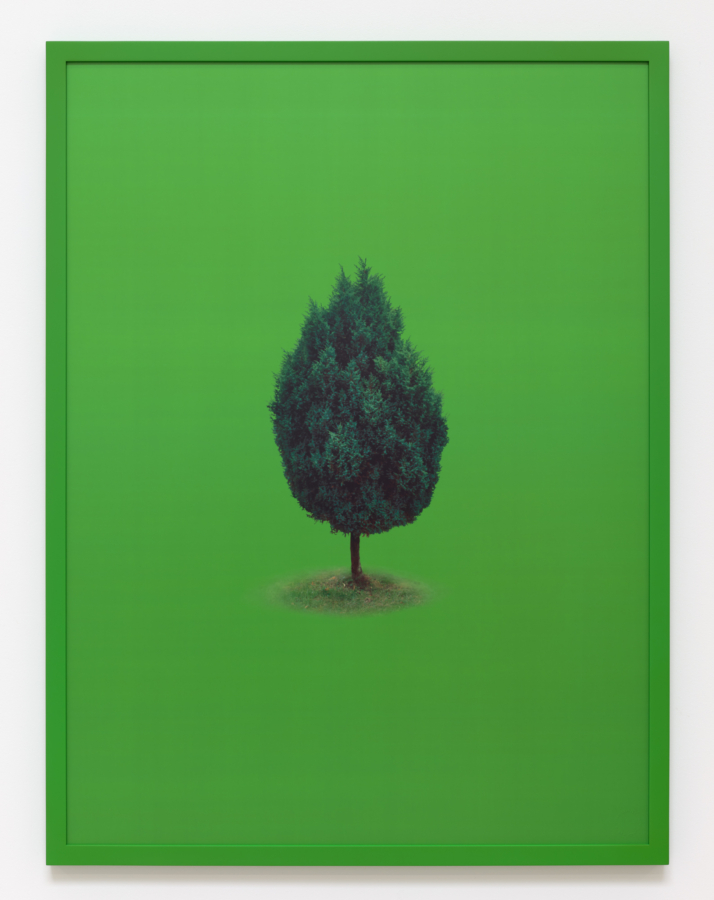
Seeing “Neverland” again not only reminds us of the tragedy of Charlesworth’s untimely death, but also poses questions like: What might have come next? How would she have reacted to AI? What kind of images would she have created with this new technology? In “Neverland,” Charlesworth stepped away from appropriation in favor of photographing objects in the studio, each one placed on a matching monochromatic and vividly colored background. The results are striking and unsettling. For “Teapot” (all works here created in 2002) Charlesworth placed an ornate yellow teapot against a similarly hued background. The teapot appears to be in mid-pour, although no hand holds it nor does any liquid come from its spout. A typical household object, in this context it also references Aladdin's magical lamp.
“Devil,” “Candle,” and “Pencil” are all bright red photographs with each displaying the similarly colored object of their title. Centered in “Devil” is a completely red devil mask, whereas in “Candle” the flame stands out as a realistic orange-yellow. In “Pencil,” the point and end are true to life — black lead encased in wood.
|
|
Sarah Charlesworth, “Tree,” 2002, Cibachrome
with lacquered wood frame, 41 1/2 × 31 1/2”
|
|
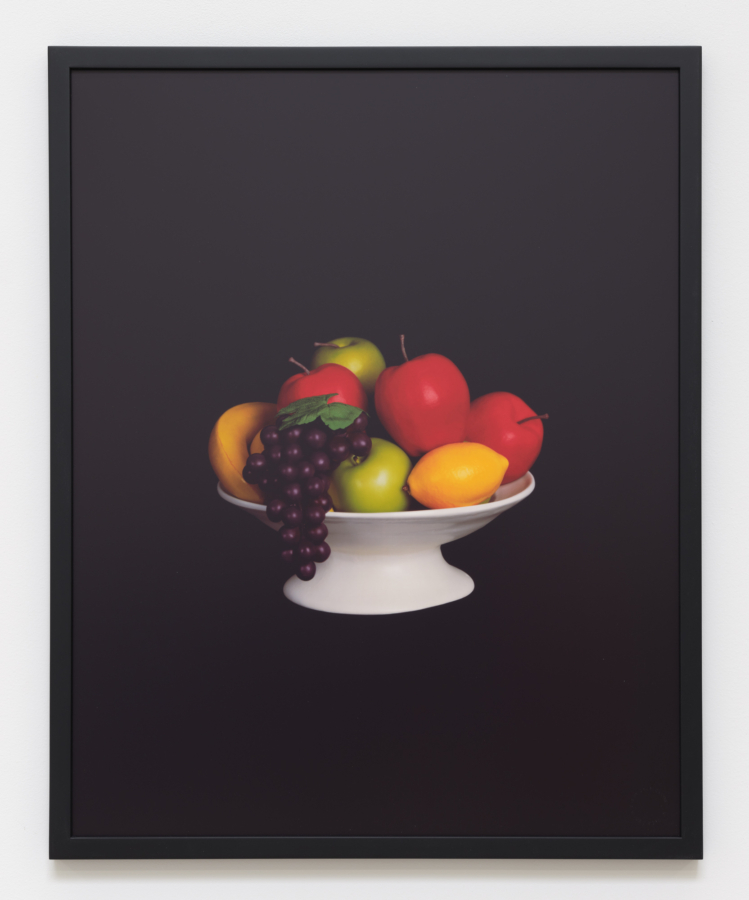
Sarah Charlesworth, “Fruit Colored Fruit,” 2002,
Cibachrome with lacquered wood frame, 28 1/2 × 23”
|
|
While it is noted that in “Neverland” Charlesworth digitally manipulated her images for the first time, it is impossible to know the extent. Did Charlesworth find a red candlestick holder that matches the red of an extremely long candle that floats in a deep red shadowless space? Or did she use a computer to match the colors?
Unusual scale shifts also occur across the images. What size was the small tree in “Tree?” Was it smaller or larger than the pipe in “Pipe” (itself one among many homages to Réne Magritte's “The Treachery of Images,” 1929)? While Magritte's painting of a pipe was not a pipe (but paint), Charlesworth's depiction is neither pipe nor paint, but rather a photograph of a pipe. Other art historical associations include references to the still life tradition. “Fruit Colored Fruit” — red and green apples, a lemon, bananas, and grapes are all draped over a white bowl set against a black background. Similarly with “Teacups,” a precarious tower of teacups and saucers.
By titling the series “Neverland,” Charlesworth evokes the fictional, faraway, magical island associated with Peter Pan. The images are infused with a surreal aura, despite the fact that for the most part, Charlesworth focuses on ordinary objects. Through her lens, coloration, and conceptual savvy, she elevates these "things" into something extraordinary. Whether straightforward, or digitally manipulated, the photographs from “Neverland” have an enduring and powerful resonance.
|
|
|
|
Jody Zellen is a LA based writer and artist who creates interactive installations, mobile apps, net art, animations, drawings, paintings, photographs, public art, and artist’s books. Zellen received a BA from Wesleyan University (1983), a MFA from CalArts (1989) and a MPS from NYU's Interactive Telecommunications Program (2009). She has exhibited nationally and internationally since 1989. For more information please visit www.jodyzellen.com
|
|
Melina Ausikaitis, "Fall in the Leaves”
by Robin Dluzen
|
|
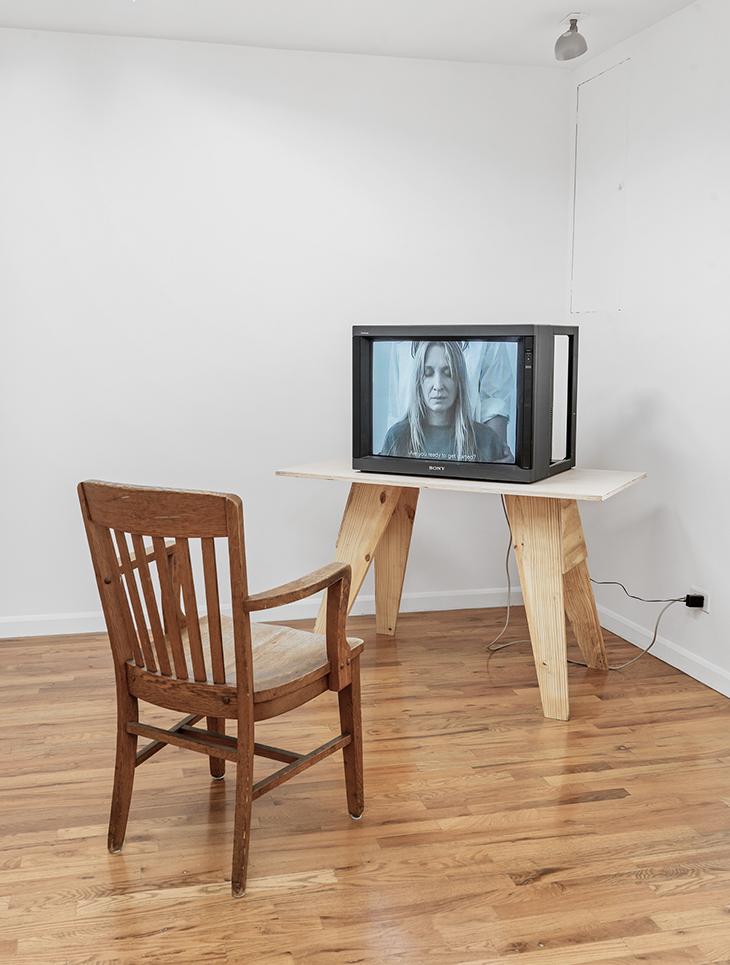
Melina Ausikaitis, “Fall in the Leaves,” 2023, Video, 6:27, music
by Melina Ausikaitis and Nate Kinsella, directed by Mike Gibisser
|
|
Continuing through June 17, 2023
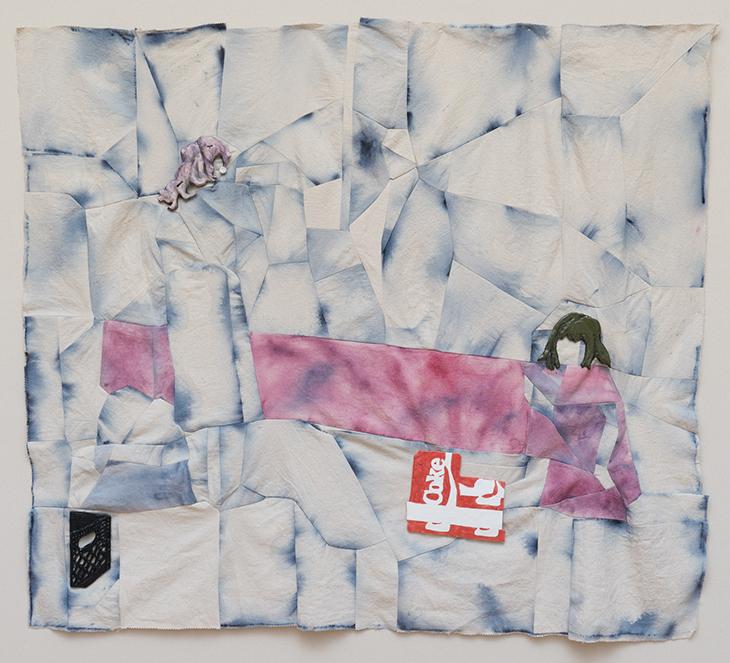
Melina Ausikaitis’ artworks in her show “Fall in the Leaves” feel like memories: soft, indistinct scenes punctuated by bits with weight and form. Wall-bound works are derived from the multidisciplinary artist’s own family photos — of which we see only one, reproduced in the exhibition statement. It corresponds to “Williams Wedding 1985,” wherein chunks of ceramic anchor a scene composed primarily of blocks of blue-tinged fabric sewn tightly together. The seams function as outlines, subtle delineations barely suggesting figures and objects. The ceramics — a red-and-white case of Coke, disembodied hairdos of a woman and a girl, a corner of a black milk crate — are the only true details, the only pieces that seem solid and tangible in the midst of their ethereal ground.
Between “Williams Wedding 1985” and Ausikaitis’ corresponding photograph, we are visually guided into and through the familiar sensation of accessing memories. There is a difference between deciphering what has truly been imprinted on the mind, however, and what, perhaps, only seems to be because a photograph of it exists.
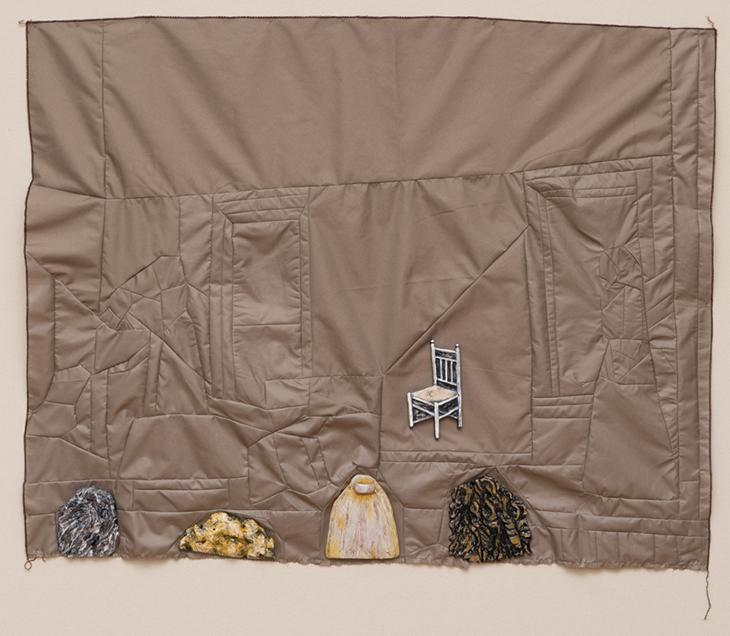
Further situating memories as something apart from the actual, the display of Ausikaitis’ four fabric and ceramic pieces reinforces her scenes as constructs. In “The Crucible,” loose threads hang from the corners of a theater vignette, while in “Mark 1973,” the sewn “corner” of a room juts out at an angle from the picture plane.
|
|
In all, the assembled fabric is tacked onto bare, stretched canvases peppered with tiny, hand-sewn x’s, the substrate serving as a reminder that this, the memory, is not the illusion of representation or actuality, but a picture that has been composed. All the evidence of the maker’s hand — the stitches, the hanging threads, the ceramic appliqués — establishes these works as comprising a subjective, indeed a profoundly personal pursuit. |
|
Melina Ausikaitis, “Williams Wedding 1985,”
2023, dyed canvas and ceramic on canvas, 60 x 60”
|
|
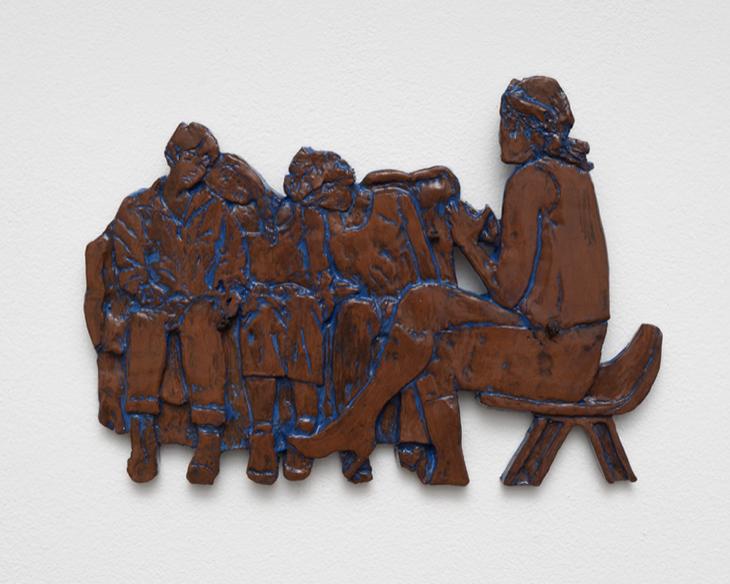
Melina Ausikaitis, “MHC session
2011,” 2023, ceramic, 9 x 12”
|
|
The exhibition shares its title with both a video piece (directed by Mike Gibisser) and the song featured within it (co-authored by the artist and Nate Kinsella). In the video, Ausikaitis re-enacts her own experience with hypnosis from over a decade ago. Through the course of the episode, the artist seemingly plays dead, her tongue hanging out of the corner of her mouth. She laughs exuberantly, and also sobs. The film is composed of several long shots, with Ausikaitis’ face giving the only evidence of the suggestions being conjured behind her closed eyes. At one point, she mouths the words to the song playing over the scene, the lyrics referencing the myth of Artemis and Actaeon — invoking the idea that seeking and glimpsing might not lead towards anything but oblivion.
Together, the video and Ausikaitis’ pictures provide an allegory for the pursuit of memory recall. While truth may seem like the objective or destination behind this pursuit, perhaps achieving truth is as futile as it is subjective. And while they might even trigger real emotions in the process, maybe impressions and suggestions are all that truly remains.
|
|
Melina Ausikaitis, “The Crucible 1990,” 2023, nylon and ceramic on canvas, 60 x 60” |
|
|
|
Robin Dluzen is a Chicago-based artist and writer. Her writing has appeared in Visual Art Source, Art Ltd., Chicago Art Magazine, Art F City and others. Her artwork has been featured in venues throughout the country including the Dorchester Art Project in Boston, MA; Indiana University Northwest in Gary, IN; Bert Green Fine Art in Chicago; Tiger Strikes Asteroid in Chicago; the Union League Club of Chicago; Ukrainian Institute of Modern Art in Chicago; and the Hyde Park Art Center in Chicago. For more information, robindluzen.com
|
|
Gaylen Hansen, New Paintings
by Matthew Kangas
|
|
Continuing through June 30, 2023
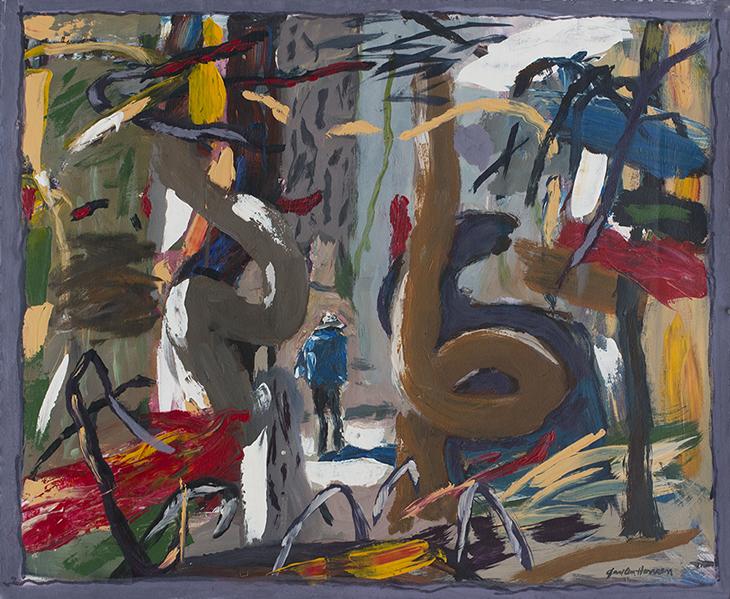
At 102, it’s hard to fault Gaylen Hansen for repeating himself or recycling earlier ideas: he’s had so many. His new works are his most vigorous paintings yet, fraught with a determined anger and courage that match perfectly his lifelong views on the endangered environment and the relationships between animals and humans. A few earlier oils are peppered into the mix to help visitors new to his work learn how smooth and enclosed his imagery and touch once were.
|
|
Gaylen Hansen, “Forest Walker,” 2023, acrylic on canvas, 36 x 43 1/2” |
|
Prophet of climate change, poet of the outdoors, twisted apostle of westward expansion, Hansen has played many roles in his long career. Since his Seattle debut in 1959, he has explored his own backyard, garnering worldwide acclaim. Connected in some ways to San Francisco Bay Area funk artists such as William T. Wiley, Robert Arneson, and Wayne Thiebaud (all of whom he knew), Hansen transcended their influences, as well as his youthful flirtation with Abstract Expressionism.
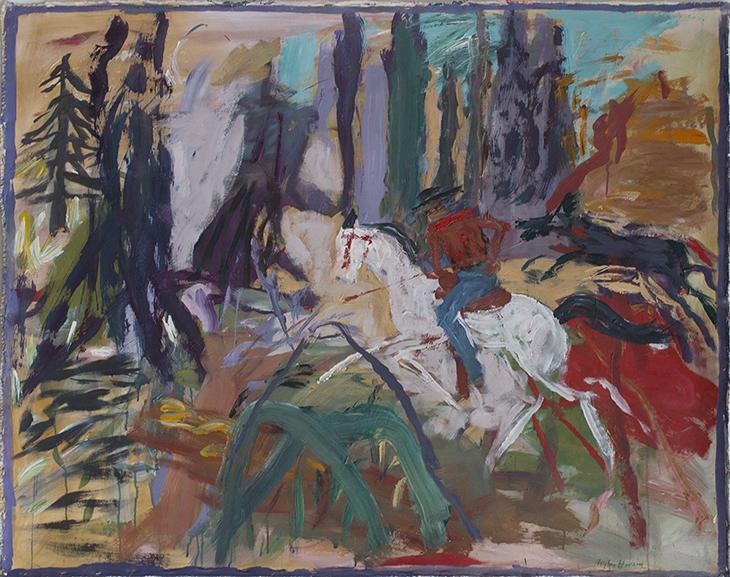
The new grouping consists of nine big oils on canvases, eight smaller ones, plus the five aforementioned earlier works. We trace the locked-in elegance of “Woman and Yellow Fish” (1982) through the snarling dogs of the 1980s and 1990s, to the current agitated vistas of evergreen forests, a late development resulting from his move from eastern Washington to Whidbey Island north of Seattle. In every case, he depicts animals with personalities and humans with animal-like dilemmas. Man and animal co-exist in a seething or freezing climate, each encountering the other on the verge of mutual extinction. Among these, “Forest Walker,” “Fallen Tree,” and “Rider on White Horse” dazzle with slashes and gashes of brilliantly colored paint, light years away from the dry surfaces and mordant wit of his legendary work that received acclaim from New York art critics as diverse as John Russell, Carter Ratcliff, Gerrit Henry, Kay Larson, and Eleanor Heartney.
|
|
Gaylen Hansen, “Rider on White Horse,” 2023, acrylic on canvas, 47 1/2 x 60" |
|
One significant anointing of haute celebrity status was his inclusion in the 1979 “Sustained Visions” show at the New Museum by its controversial curator Marcia Tucker. From then on, Hansen was untouchable, free to expand and explore his own private Idaho with its tamed wildlife — bison, bears, wolves, buffalo, and grasshoppers — not to mention wild domestic pets, vicious cats, dogs, and dive-bombing birds. No one was safe from his alteration of their clichéd Western symbolism and each was transformed into a character in a narrative with the artist’s personae of The Kernal and Mountain Man. Autobiographical, yes, but also universal and symbolic of the plight of humanity in a natural world going out of control.
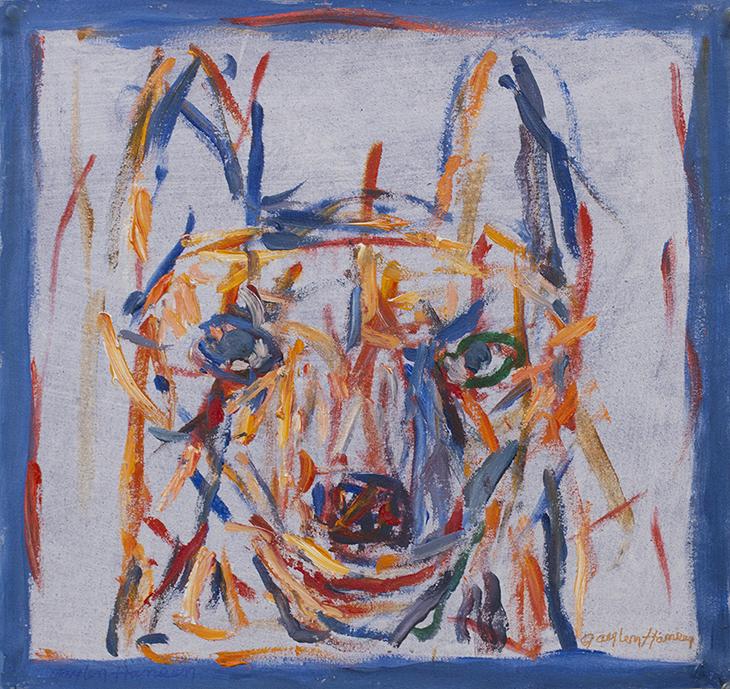
“Two White Dogs,” “Red Dog,” and “Head of a Dog” are terrifying with their white, sketchy outlines as if they are dematerializing before our eyes. Ghost-like, they may prefigure their own extinction or immolation at the hands of global warming. Despite the changes, certain motifs and themes remain, only to be refined to the status of genius: the scale disproportion between animals, insects and humans; his refusal to sentimentalize or glamorize the tightly abbreviated scenery of the Pacific Northwest, Canada, or Idaho where he grew up on a farm before attending Otis Art Institute; and the persistent themes of inter-species sex and the instinct-driven pursuit of procreation in the animal world. Survival is equated with sex, as in “Two Dogs, One Green” (1984) with its erect genitalia and “Cosmic Dogs” (2021) where under the full moon one dog chases another with reddened tail gushing forth.
|
|
Gaylen Hansen, “Head of a Dog,” 2022, acrylic on canvas, 19 3/4 x 19 1/4” |
|
Besides the Bay Area artists, Hansen has paid his debt to older artists he acknowledged in interviews such as Henri Rousseau (Hansen did his own “Sleeping Gypsy”); Giorgio Morandi; and Philip Guston, whom he most resembles in his segmented compositions, smooth yet thick paint application, cartoonish figuration (which Hansen arrived at first), and autobiographical personae. Yet forsaking Guston’s urban angst, Hansen has explored four main categories, all set in a mythical, personal Far West: Nature at rest; Nature gone awry; Nature as threat to man; and Man as threat to Nature. With enough to fill a lifetime and more, the beloved centenarian shows no sign of exhausting or even depleting his internally driven vision of power mediated by humor and zest.
After Hansen’s show and two more, Linda Hodges Gallery is closing after 40 years. A stalwart, Hodges became a home for regional artists making it big elsewhere (Alfredo Arreguin in addition to Hansen), as well as a showcase for younger artists poised to break through, like Hollis Sigler, Jim Lutes, Andrea Joyce Heimer, and Theodore Waddell. Her presence and guidance, credibility and gracious personality, will be missed.
|
|
|
|
Matthew Kangas writes regularly for Visual Art Source eNewsletter; Ceramics: Art & Perception (Australia); and Preview (Canada). Besides reviewing for many years at Art in America, American Craft, Art Ltd., Vanguard and Seattle Times, he is the author of numerous catalogs and monographs, the latest being the award-winning Italo Scanga 1932-2001. Four anthologies of his critical essays, reviews and interviews were issued by Midmarch Arts Press (New York) and available on Amazon at Books by Matthew Kangas.
|
|
|
|
© 2023 TDC/VAS
Contact Information:
231 Cedar Heights Dr., Thousand Oaks, CA 91360
Ph: (213) 482-4724
|
|
|
|
|
|
|
|