The Miles Franklin Newsletter
|
|
From The Desk Of David Schectman
|
|
How much longer can physical silver remain nearly 100% premium to spot without attracting MAJOR interest in the physical?
|
|
This is not an April Fools issue. I have never been more serious.
David's Commentary (In Blue):
It’s been overwhelming
.
There is so much information coming at us, from every angle, that it makes my head spin. Well, it’s not spinning anymore. Reality has set in – make that clarity. In fact, I’ve never seen the future this clearly. More on that shortly. First, I want to talk about the Excelsior Amusement Park which is only 3.9 miles from where I live now.
My father was an insurance salesman for John Hancock. Every year they had a picnic for the agents and their families at – Excelsior Amusement Park. When I was 10 years old, my parents took me to the annual picnic. One of the events was a race for the kids. The way my parents told the story, I was way in front of the pack when all of a sudden, I stopped to pick a flower, and finished last. That story tells you a lot about me. I have always marched to a different drummer. I am wired to see the world through a different prism. I will address that shortly.
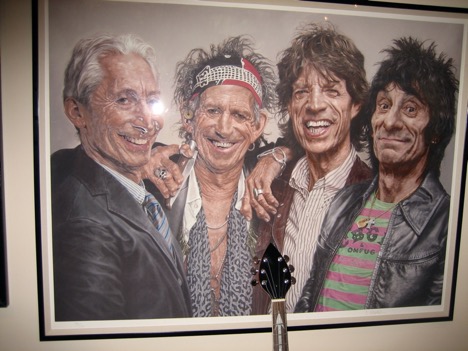
A few years later, when I was in high school, I would go to the Excelsior Amusement Park during the summer break and eat cotton candy and go on all the rides. My favorite place was the Fun House. I’ll get back to that in a moment, but first a couple of interesting tid bits: The Excelsior Park bandstand is where on June 12, 1964 the Rolling Stones performed. It was one of the stops on their first American tour. They took the stage to a very small unappreciative audience. They were still relatively unknown in the U.S. at the time. During a set break Mick Jagger went across the street to get a soda at the Chelsea Drugstore and that is where he met the “local hippy,” Mr. Jimmy. The result of that chance encounter was arguably the Rolling Stones greatest hit,
You Can’t Always Get What You Want.
|
|
And I went down to the demonstration
To get my fair share of abuse
And man, did he look pretty ill
I sung my song to Mr. Jimmy
Yeah, and he said one word to me, and that was "death"
I said to him:
[Verse 4]
[Outro]
Ah yeah!
Ah yeah! Yeah
|
|
The amusement park was torn down in 1973. On the very location where the Stones performed Maynards Restaurant now resides. Susan and I go there often during the summer and have a beer and burger on the dock by the lake. Getting back to the Excelsior Amusement Park and connecting the dots to today’s newsletter, my favorite part of the park was the Fun House. You gave them a couple of tickets (you didn’t pay cash for the food or rides, you used tickets that you purchased from a stand inside the park) and you had unlimited access to half a dozen different rides inside. My favorite ride was a large circular bowl with a large wooden railing that ran all along its perimeter. It started to spin, slowly at first, then it gained speed and went faster and faster and the G forces increased until the centrifugal force would pin you against the wall. It was crazy fun. When it stopped you would be dizzy and it took a while to regain your balance and composure - and hopefully you didn’t throw up. That was then. That’s the kind of feeling I’ve been experiencing for the last two weeks. My head is spinning from information over load and it has taken a while for me to regain my (mental) balance and start thinking clearly again.
There is nothing new about what I am about to write now. I am just connecting the dots. Here is what I see – and I wish I didn’t.
Last night I woke up and everything fell into place. The thing is, nothing is “certain” besides death and taxes and the rest are all “probabilities.” Doing nothing is a choice. That means outside forces will make your choices for you. I do not want to be drifting down a riven in a canoe without a paddle. I want to steer my life and that means making choices. If the outcome cannot be guaranteed, then it boils down to the most probable outcome. Human nature makes it difficult to accept grim outcomes. We all are happiest when we see the bright side of things and are optimistic about our future. Being pessimistic is frowned on even if the views are realistic. Look at the message coming out of Washington right now. Don’t worry, be happy, everything will be back to normal before you know it. The “before you know it” has been pushed back from Easter Sunday until the end of the month. It will be pushed back again, and probably again after that.
One way to get into trouble is to accept the line, “This time it’s different.” Well, this time it IS DIFFERENT. And the main reason people don’t understand it – yet – is because we are looking at several events happening at the same time and one of them is getting most of the headlines - at the expense of the others, which are the real game changers. Now I ask you, which is which? Am I talking about Covid-19 Pandemic - or the bailout plan and shortages of gold and silver? Take a guess.
Like most people, my focus has been toward the Pandemic. It is frightening and fascinating at the same time. But the Coronavirus will resolve itself. We will find a vaccine and a cure. It will most likely end up being a nasty disease to be sure, but not fatal for most of us. We will develop antibodies to lessen the danger it poses, and eventually, it will become something we are able to live with, like the flu.
But the bail-everything-out-no-matter-the-cost attitude of the Fed and Congress is another matter. I will state upfront, the dollar will not survive this. The lesson we should have learned from the Coronavirus is the power of exponential growth. In the early stages, the virus moves along in a relatively flat line until it reaches a level where you suddenly notice the exponential growth. It’s the end of a hockey stick that goes straight up. All of a sudden. Ka Boom! (Be sure and read the Peak Prosperity article at the end of today’s newsletter)
In 1983, when I started working in the precious metals industry, the national debt had just topped one trillion dollars. That was the accumulated total of two hundred and six years of deficits, including the debts incurred during the War of 1812, the Spanish
|
|
American War, the Civil War, WW1, WW2, the Korean War and the Viet Nam war. At this point I am re-printing a portion of the newsletter I published on March 20
th
which dealt with this topic.
Oh, how quickly things can change. In the last couple of weeks, I witnessed an extraordinary, once-in-a life-time, make that a once-in-a-century event. It was like being doused with a bucket of cold water. It took my breath away. It didn’t seem real.
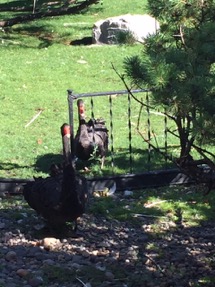
Suddenly, out of nowhere, a black swan appeared, and yes, they really do exist. (The swans pictured below belong to my friend Bill Mack and live in a pond in the back yard of his art gallery.) I did not know what the black swan would be, or when it would arrive. It has arrived and it’s nothing like the picture below. Yup, that old Chinese proverb is here to haunt me again: “Be careful what you wish for, your wish may come true.”
I didn’t expect the black swan would be a Pandemic. No one did. But it turned out to be the pin looking for a bubble and there were several bubbles ready to be popped. I wanted
something
to jump start the bull market, so I could increase my wealth, and also because it would be nice to be validated. I had not been wrong, just early, and my faith in precious metals and my understanding of the underlying problems were indeed right. Yes, I got it, but at a cost.
Since my eyes were opened over 35 years ago to the Austrian Economists way of seeing the world, I have viewed the economy and money through a different prism than my friends, family and frankly most people do. I was exposed to brand new concepts - like all debt must be paid, either by the lender or the borrower and that debt and deficits do matter. I learned that gold and silver are money and that once Nixon took us off the gold standard in August, 1971, there would eventually be a point in the future where the runaway monetary inflation it caused would catch up with us. But that was in 1985, and I never thought it would take 35 years for the piper to be paid.
I think the people at the Fed are clueless, not dumb, just clueless. They do know how to keep the game going, that’s for sure. They kept kicking the can down the road and they kept the economy from having to face a severe recession or depression for at least two or three decades. That was much longer than I ever thought possible. But the thing is, the longer you put off dealing with a problem (like a tooth ache) the worse it becomes and the greater the pain when you finally are forced to deal with it.
Why isn’t this obvious to everyone? It is so simple, so clear? I mean it took 206 years for our National Debt to hit One Trillion Dollars. That is a lot of debt. And as of right now, with the Coronavirus shutting down our economy, we will probably add a rock-bottom minimum of three trillion more to the debt in THIS YEAR alone. I have seen projections that our debt will top $30 trillion by 2030. I think that is way too conservative. We could get there in the next year or two. If ever Richard Russell’s phrase, “Inflate or die” was relevant, it is now.
Let the math of this sink in and ask yourself, how can the dollar survive this and still retain value? Maybe you can come up with a different answer than I have, but from my vantage point it can’t and the dollar’s century long reign is about to come to an end. And when it does, we are all screwed. Well, not everyone. There is still gold and silver to be had and guess what, you can trade your dollars in for real money, money that is not being inflated away right before your eyes, money that is no one’s liability and cannot default.
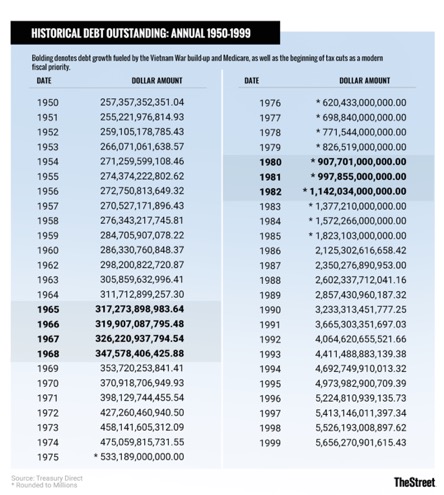
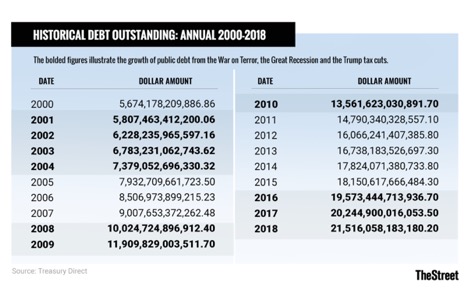
Look at the charts below. It took 5 years for the National Debt to grow from 1 trillion to 2 trillion. It took 5 years for it to grow from 2 trillion to 3 trillion. It took 3 years to grow form 3 trillion to 4 trillion. It took 4 years to grow from 4 trillion to 5 trillion. It took 6 years to grow from 6 trillion to 7 trillion. I guess President Clinton did something worthwhile after all. He did manage to balance the budget - once. Then things started to really speed up. It only took 2 years to grow from 7 trillion to 8 trillion and 1 year to grow from 8 trillion to 9 trillion and 1 year to increase from 9 trillion to 10 trillion and 1 more year to increase from 10 trillion to 11 trillion, in 2009, The next jump was from 11 trillion to 13 a jump of two trillion in just 1 year, and it was followed by an increase from 13 trillion to 14 in 1 year and then it jumped by 2 trillion which lasted for lasted 2 whole years before rising another 1 trillion in 2014, 2015, 2016, 2017 and 2018. In 2019, the National Debt increased to --- drum roll please, $21,516,058,183,180.20. But that is looking in the rearview mirror. The National Debt clock today sits at $23.3 trillion and I guess we can add another $3 trillion to that staggering number by the end of the year and probably much more.
|
|
Why is this important? Simple. How do you think the Dow was able to reach 29,000? Do you know where the Dow was when the National Dept fist hit $1 Trillion in 1982? It finished the year at
1,046
. How could the Dow rise from 1,046 to
29,000
in 38 years? Stock brokers say, “Look what a great investment the stock market has been for decades.” Yes, if you are looking for how much it grew. It’s impressive growth. But how did it happen? Why did it happen? Because, along with our national debt and increasing dollar-centric money supply, which since 1971 was no longer anchored to gold and was free to expand to infinity, the newly created debt and money had to go somewhere. A lot of it ended up in the stock market. There was ample new money available to invest in stocks, and cars and houses and everything. The process has a name. It’s called inflation, which is loosely defined as more money chasing goods and services. Everything went up in price.
I remember buying a new Corvette in 1975 for around $4,000, give or take and a Mercedes 250SL roadster a few years later for around $10,000. I know, I owned both of them at the time. What do they cost today? A corvette starts at $59,000 and a Mercedes roadster starts at $91,000. You can pick any example you want. Everything, including stocks, has exploded in price right along with the National Debt and the flood of money created by the Federal Reserve. That is what made it possible to buy stocks and things. It all worked pretty well – until it didn’t. And the “It didn’t” just showed up, as an unexpected guest at our front door. With an announcement: THE PARTY IS OVER. And you know what, things will never be the same again.
But that’s just part of the problem. Gold and silver have been money for 5,000 years and they always recapture that role when paper currencies falter. The dollar’s future is now cast in stone and even before the Coronavirus appeared, central banks were starting to sell treasuries and buy large amounts of gold. They could see the handwriting on the wall. Demand was starting to increase but the jolt that changed everything was the Fed’s response to the Covid-19 virus. When I say our phones have been ringing off the hook non-stop, 24/7 since March 12, one day after my birthday, that would be accurate. Industry wide, demand has never, in my 35 years of experience, been this strong. The result is – we are running out of product to sell. Literally overnight, it all flipped, and it changed from plenty of supply and a lack of demand to a lack of supply and overwhelming demand.
What does that mean? Well, it means that the wholesale premiums, the prices that all the retail dealers have to pay to buy gold and silver to sell to the retail buyers (you) are rising rapidly. In the past our cost was $2.00 or so an ounce above spot (Gold Eagles and Maple Leafs) and today I purchased 300 Gold Eagles at 6% - or $100 over spot - for myself. And trust me when I tell you it was very difficult to fill the order. It looked like there were no Eagles or Buffalos or Maple Leafs available at any price and I was about to purchase half ounce gold coins from England. That’s the bottom of the barrel, but if you want gold, you take what you can get these days. But I lucked out. We are well connected with the largest wholesales in the country and I was able to fill the order. In a week or two it may not be possible. I am telling you the truth.
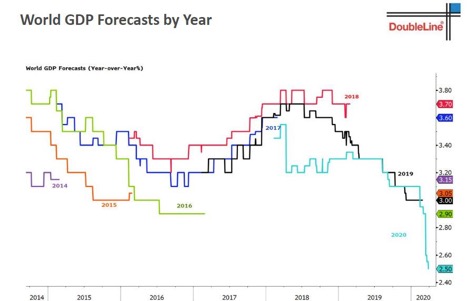
The South African Mint is closed down until at least April 16. The Royal Canadian Mint is closed until further notice. The US Mint in NY closed for a day because a supplier was diagnosed with Covid-19. They plan to re-open, until Governor Cuomo or President Trump close down all non-essential businesses in New York. That should happen any day now. The three largest refineries in Switzerland are closed. All the mints and refineries will close. For weeks, or months? Who knows, and when they do open, the damage to the global GDP will be there for everyone to see and the stock market will be on the way down to oblivion.
|
|
This latest rally is manufactured. The insiders goosed it up and are now, I suspect, unloading their positions, at a higher price, to the pollyanas who have been talked into “buy the dip.” For every buyer there is a seller and the smart money, the insiders, are most likely the ones behind the sell orders. Anyone who really understands what is happening with the Coronavirus and the economy and Fed QE to infinity would sell their stocks as fast as possible.
Once the insiders are out of the market, there will be a LOT of money on the sidelines and I believe enough of it will seek out the safety of gold and silver to ensure that gold and silver will not be available at any price. They will jump to the front of the line. We will be next, but that may not be good enough. And the public will be out of luck.
This is like a game of musical chairs and there are only one or two chairs left and I do not want to play that game any longer. The risk is too great now. You better be early because if you are late, you are out of luck.
It is no longer a matter of price. It is a matter of supply. The demand is there, and it is stronger than I have ever seen it, even in the good old days when silver hit $50 and gold topped $1,900. The problem is supplying the demand. I have often written that this is what would happen, and it is happening now. The fat lady has sung. The only logical investment strategy that makes sense to me now is – “Return of principal not return on principal.” Do not worry about the price. It will cost you a lot to buy gold or silver now, in spite of the paper-generated unrealistically low spot prices. Coins and bars are NOT available at Comex quoted prices. Be happy to find supply, any supply from now on. It matters not whose face is on a coin or whose name is on a bar. An ounce is an ounce. It is about the number of ounces you own, not about what their price in dollars. It is totally illogical that with the problems that have been laid bare and the Fed’s reaction, plus a falling stock market, that gold and silver should be falling. It makes no sense. I am not complaining. I have picked up another 350 ounces of gold in the last few days, and it will be shipped off to my account with Brinks in Canada. The lower the price, the better. These prices - $1,550-$1,600 gold and sub-$14 silver will not last. Those are the spot prices, not what it actually costs to procure the physical metal. New all-time highs are already baked in the cake and then up from there.
|
|
|
|
LeMetropole Café
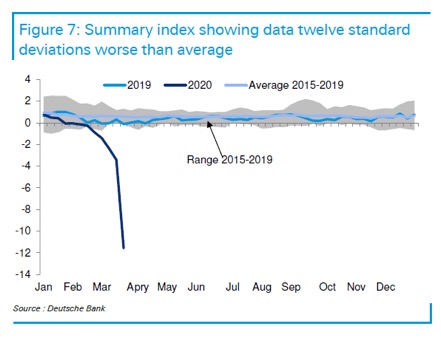
* Deutsche Bank's index of early U.S. economic indicators has "essentially gone into free fall indicating data which is about 12 standard deviations worse than average."
*Seabridge Gold Inc.
@GoldSeabridge
|
|
|
|
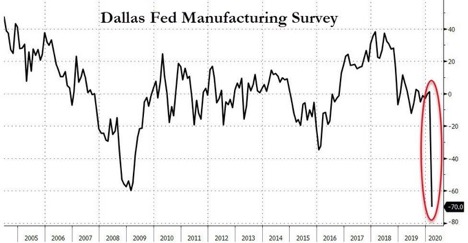
*Today’s Dallas Fed Manufacturing Outlook survey for March fell from +1.2 in February to -70.0, far below the -10.0 expected. This is the survey’s fastest collapse ever. Source: Bloomberg
|
|
|
|
Behavioral Finance
Gold Bar Shortage Deepens: Credit Suisse Tell Clients "Do Not Bother Asking" for Gold Bars
* GoldCore remains open for business and when they become available, we are buying coins and bars from our government mint and large refinery suppliers and from our clients. Premiums have surged and we are paying 1.5% over spot to clients for gold kilo bars and higher premiums for smaller bars and bullion coins (1 oz). We are only selling to clients who have cleared funds on account and are on our Buyer's List.
* 'Epic' gold shortage prompts preppers, bankers and high net worth alike to try and acquire ‘unaffordium and unobtanium’ gold but mints, refiners, banks and dealers globally are sold out.
* As the coronavirus pandemic takes hold, retail and institutional investors and banks are encountering severe shortages of gold bars and coins according to industry participants (see Wall Street Journal story below).
* Epic gold shortage prompts those concerned about systemic collapse including preppers, bankers and high net worth alike to try and acquire gold bullion which has become 'unobtanium’.
* Credit Suisse Group AG, which has minted its own bars since 1856, told clients this week "not to bother asking" for gold bars.
* Dealers are sold out or closed for the duration and in London, bankers are chartering private jets and trying to finagle military cargo planes to get their bullion to New York exchanges, according to the WSJ.
* Gold prices are consolidating after the near 8% gain last week and remain one of the best performing assets in the last twelve months and year to date.
|
|
This is absolutely a must-see video. Check out Chris Martenson at Peak Prosperity and get the lo-down on the Corona Virus and find out what we did wrong and are still doing wrong. It didn’t have to be this way.
|
|
|
|
Peak Prosperity
For more than a decade, our advice here at Peak Prosperity has been consistent: own hard assets like gold and silver, manage your stock & bond portfolio risks, grow some of your own food, diversify your income streams, and cultivate a resilient lifestyle.
Why?
Because our entire economic system — with its over-financialization and dependence on perpetual exponential debt growth — is unsustainable.
Anything that is unsustainable, by definition, will someday stop.
We didn’t know what the ‘pin’ would be that would ultimately pop the fantasy – war, Peak Oil, maybe even a pandemic? But we knew whatever it was, it wouldn’t really matter in the end.
So, we advised resilience and sustainability. We begged, nudged, and enticed people to learn new skills. We practiced what we preached. We said “it’s time” over and over again, and provided reams of data to support our positions.
Few could hear it. But a small critical-thinking contingent of the population did, and undertook actions to make their lives and the larger world a more resilient, more beautiful, and better place to live.
And yet, after so much time cautioning about it and preparing for it, it feels otherworldly to be finally confronted with the actual end of “what was.”
It’s really here. This isn’t a dress rehearsal. The curtain has gone up and the show has started.
I find myself alternating between excitement and deep anxiety. Maybe several times in the same hour.
Excitement because this is a historic moment, one that offers us all a chance to reform things for the better. Deep anxiety because there are some very dark outcomes that are open possibilities.
First Things First
I realize that your main concern is probably keeping you and your loved ones protected from the coronavirus. And it should be. That’s job #1.
Then help your neighbors and community. Be calm and a steady rock for those who are just now slamming through their own adjustment process.
Remember: It’s The Pace of Change That Gets You
I’m mainly writing today to warn you of the all-too-likely reckless official reactions to the twin crises of the coronavirus and the market meltdown it has triggered.
They may very well destroy the financial system and by extension the economy. And perhaps your favorite fiat currency, as well.
The endgame to a massive economic mania like the one that’s now bursting – so comprehensive that we’ve long referred to it as the “Everything Bubble” – is never pretty. Fun on the way up; violently painful to portfolios and future dreams alike on the way down.
What has been a multiyear gentle escalator to new highs and is now a free-falling elevator back to the lows. This has always been our concern.
The business cycles of old — that the Federal Reserve mistakenly thought they could control if not outright banish — were fairly routine, and slow survivable affairs. But the end of a credit bubble, like we’re in now, is an event best described as nasty, brutish and short.
To illustrate: a huge part of ever-higher stock prices was driven by corporate stock buybacks. This represented not just some of the buying pressure in recent years, but quite often 100% of it. How long do you think it took corporate C-suites to stop those buy-back programs? It happened so quickly it might as well have been a light switch slapped to the off position.
Perhaps the most damaging aspect of the bursting Everything Bubble will be the loss of faith in the idea that central banks knew what the heck they were doing. Of course, this faith was misguided and misplaced right from the get-go.
We’ve seen it literally evaporate over the past few weeks as bazooka blast after bazooka blast of central bank liquidity have failed to do anything but provide a very temporary speed-bump towards lower stock prices.
The bottom line here is that Humpty Dumpty is broken and cannot be put back together again. We are not going back to “the way things were”.
Ka Poom!
For many years now, my fellow co-founder Adam Taggart and I have subscribed to the
Ka-Poom! theory
put forward by Erik Janszen.
The initial “Ka-” phase is a debt implosion – a deflationary collapse, dragging asset prices downwards, that precedes a supernova event.
The following “Poom!” phase is that supernova, brought about by the all-too-predictable reaction of the monetary and fiscal authorities to print and deficit-spend like crazy to desperately avoid facing the consequences of the preceding decades of poor decisions.
First a collapse in debt (Ka-) and then an explosion of money printing (Poom!). Deflation then inflation. The size of the former dictating the dimensions of the latter.
In this model, “too much money printing” results (predictably) in too much debt. Unable to see any other way out of this predicament besides creating ever more debt, central banks are forced (well, self forced) to do anything and everything necessary to keep more credit (debt) flowing into, and accumulating in, the financial system.
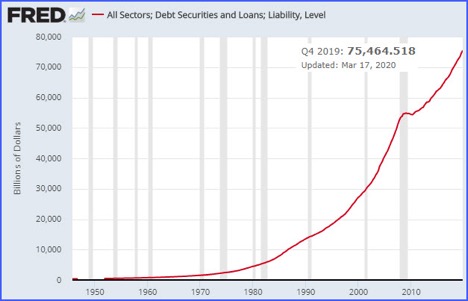
This next chart is of the total amount of debt in the US. Not liabilities, such as underfunded pensions and entitlement programs, just debt.
|
|
|
|
The chart above is a shape with which you should now be quite familiar. It is a non-linear chart. Debts have been compounding – that is growing exponentially – for close to 50 years. Ever since the abandonment of the gold standard in August 1971, to be precise.
That little bump right there around 2008 very nearly wrecked the entire financial system.
During that scary moment, rattled bank CEOs were yanking cash out of their own ATMs to squirrel away. We later found out in the biographies of Mervyn King (Bank of England) and Hank Paulson (Treasury Secretary) that the entire banking system had been just hours away from completely shutting down.
But even more troubling is that no lessons seemed to have been learned from the Great Financial Crisis. Instead, the debt and credit excesses have vastly increased since then.
And now, here we are, in worse shape than even back then. By a long shot.
That’s what the above chart says.
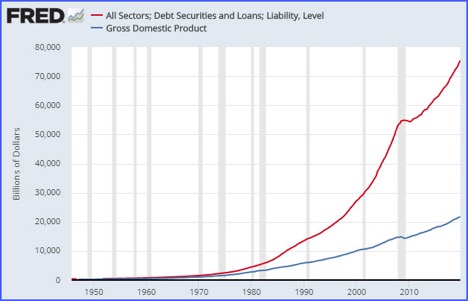
Worst of all, most glaringly of all, was the enormous self-deceit the world embraced that it was somehow possible to grow debts at a faster pace than income – forever. That there wouldn’t be any ‘moment of reckoning’ that would someday arrive.
So, let’s add back in the national income (GDP) and visually compare the growth in debt vs the growth in national income:
|
|
|
|
Well, that’s just nuts. We’ve been growing our debts at a much faster rate than our income. For decades now.
This is an obviously flawed system that cannot stand the test of time. It was a temporary delusion that somehow became enshrined as official policy. It became so deeply entrenched that it was heresy to even point out its obvious flaws. Believe me, I’ve been on the front lines of that battle and have the scars to prove it.
But it’s just so blindingly obvious isn’t it?
One cannot grow one’s debts faster than one’s income forever. That’s not even a difficult concept to grasp. Yet that’s been the official policy of the world’s central banks, for decades — especially the US Federal Reserve.
The Future has Arrived
It’s not terribly difficult to understand why our leaders pursed this doomed path.
By issuing more credit, past debts can be serviced right now. More credit in the system also gooses economic “growth”– which I’m putting in quotes because debt-based growth is not true growth. It is merely future prosperity, pulled into today and spent.
Which feels great in the moment. But it creates a real problem for the folks who will have less prosperity in the future, but still be stuck paying today’s debts.
The amount of debt in the world has exploded since the Great Financial Crisis of 2008. Across every nation and every sector – corporate, household, students, autos, states, municipalities, and sovereign nations alike.
As with life, the bill always comes due. But the central banks just kept kicking the can down the road. Maybe somehow tomorrow it will all work out, has been their thinking. Honestly, I’ve never seen any plan or detailed roadmap that went beyond that terribly unsophisticated hope.
Their ‘plan,’ such as it is, has been a one-trick pony: lower interest rates.
Which you can get away with until you hit 0%, and then everything goes haywire. Case in point: Europe experimented with negative interest rates only to succeed in hobbling their pension system and destroying bank capital (and quite possibly their entire banking system).
The central banks made the collective bet that nothing would ever go wrong, and that the future Adam and I have been warning about would never arrive.
Well, they’ve lost that bet. The coronavirus has swung a wrecking ball of reality straight into the flimsy thinking of the central banks — which has now been exposed to be as shallow as it was fraudulent.
Sadly, it was always just a matter of when, not if.
Endgame = Raging Inflation
All of which is preamble for the rest of this report. I am raising this now so you can properly prepare. Forewarned is forearmed.
The data that’s streaming into my computer from sources all over the map is both astonishing and shocking.
While the stock market gets all the attention in the media, the real action is in the credit and bond markets.
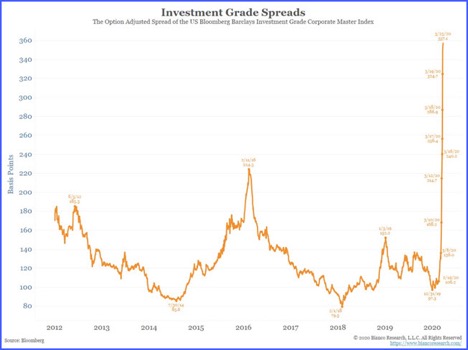
2016 was a very dicey moment for the financial system. You may not have even noticed, but back then I was sending out quite urgent warnings. Thankfully(?) the central banks of the world conspired to print up many trillions to stave off another massive financial accident, which the below chart reflects:
|
|
|
|
But if that “Matterhorn” in 2016 was dicey, then what should we make of the absolute “Everest” that’s arisen in the past month?
Without going into arcane details, the interpretation of the above chart is that ‘something very big’ has broken down.
Investment grade corporate debt is being shunned at a record pace. So, the Federal Reserve, which created this mess in the first place, is now in the business of buying corporate debt, too. If they didn’t nobody would. And even with that buying having been announced, the huge spreads in the above chart still exist.
That tells you just how broken the debt market is.
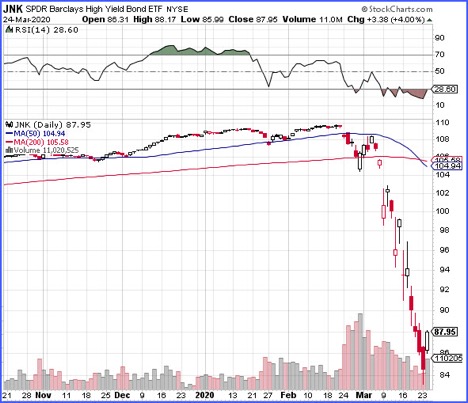
The junk bond market, which lies on the riskiest edge of the corporate bond landscape, way over on the wrong side of the railroad tracks, is in near free fall:
|
|
|
|
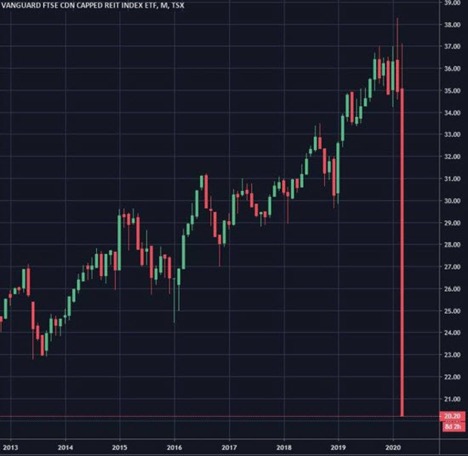
Many other measures of stress are also in “cliff diving mode” including this REIT for Canadian commercial real estate:
|
|
|
|
There are too many other such charts to attempt to show them all.
This means there’s only one possible solution left to the managers at the top.
The “Ka-” phase is clearly reflected in the falling trajectories of the charts above.
Now we’re about to enter the “Poom!”
What else is there for the central planners to do? Sit idly by and watch their entire livelihoods and treasured system implode?
They have to “do something”. To do nothing would be to admit they were wrong all along.
And watch as the horrific consequences of their prior policy failures ruin their hopes and dreams, and those of their peers, and countrymen. Nope, they’ve got to do something.
We’re already learned that truly massive money printing is in the works. It will also involve gargantuan stimulus bills from the fiscal side of the operation (in tonight’s town hall, President Trump said he’s hoping to see a $6 trillion package).
One part is the currency printing machine (aka the Federal Reserve) and the other is the money disbursement machine (aka the federal government).
Note what’s about to happen: there will be millions of people out of work, and millions of impacted businesses not able to produce goods or deliver services. But there will be trillions of new currency units floating around seeking to be spent.
More money + fewer goods & services = textbook inflation. Lots and lots of inflation.
The price of gold is already telegraphing this. Stocks may well respond too, although that’s more difficult to assess because some companies are not going to survive this no matter how many dollars are printed up and distributed.
When inflation really gets cooking…maybe by year end?…what can the Fed do to control it? Not much.
Their tool kit really only includes the ability to mop up excess dollars and taking them out of circulation. But it really can’t do that.
What do you suppose will happens if they try? The Fed could also raise rates, but it’s difficult to type that without snickering because everyone knows that if rates were hiked the whole system would implode anyway due to the fact that there’s just too much debt in the system.
Even a tiny hike would place enormous demands on interest payments at an already perilous time. So that’s not going to happen.
Our prediction is that the Fed is going to find its hands tied. It won’t be able to do anything to stop the tremendous inflation it’s now in the process of unleashing.
Conclusion
The beginning of the end is upon us.
The ‘end’ in this case is the final shredding of what’s left of the financial system resting, as it does, on a pile of “too much debt.” When debts get too high like this, the only question that needs answering is “Who’s going to eat the losses?”
The power brokers and the bankers, who the Fed actually mainly represents, are quite keen that the answer to that question be “not them.”
Which leaves you and me. The taxpayers. How to make them pay? Easy. Inflation.
Which means to survive, if not thrive, during this next phase you’ll want to be in hard assets as much as you can. Gold. Silver. Land. Timber. Quality real estate. Productive enterprises with locally sourced raw and intermediate feedstocks. That sort of stuff.
You’ll want to be holding as few currency markers (dollars, euros, pounds, yen, etc.) as possible.
That’s what’s coming next.
Remember: it wasn’t the coronavirus that created this situation. This is a self-inflicted wound whose origin is many decades in the past. One based in a really dumb idea – that debts could be compounded at 2x the rate of income – and it somehow never got properly challenged at the right levels.
If this theory of mine is correct, it means that by the end of this story, the US dollar and its analog the US Treasury bond, will become the roach motels in financial history. Big money will scurry into those refuges only to become trapped and die there.
Get ready. Start positioning for inflation, even the remainder of the “Ka- “phase is playing out.
Here comes the “Poom!”
~ Chris Martenson
|
|
METALS Premium Spike: Huge Economic Problems in Crisis Times!
|
|
Private Safe Deposit Boxes
|
|
Unencumbered / Segregated Storage
|
|
About Miles Franklin
Miles Franklin was founded in January, 1990 by David MILES Schectman. David's son, Andy Schectman, our CEO, joined Miles Franklin in 1991. Miles Franklin's primary focus from 1990 through 1998 was the Swiss Annuity and we were one of the two top firms in the industry. In November, 2000, we decided to de-emphasize our focus on off-shore investing and moved primarily into gold and silver, which we felt were about to enter into a long-term bull market cycle. Our timing and our new direction proved to be the right thing to do.
We are rated A+ by the BBB with zero complaints on our record. We are recommended by many prominent newsletter writers including Doug Casey, Jim Sinclair, David Morgan, Future Money Trends and the SGT Report.
For your protection, regardless of where you live, we are licensed, regulated, bonded and background checked per Minnesota State law.
|
|
Miles Franklin
801 Twelve Oaks Center Drive
Suite 834
Wayzata, MN 55391
1-800-822-8080
|
|
Copyright © 2020. All Rights Reserved.
|
|
|
|
|
|
|