Wednesday December 9, 2020
Trump Administration Finalizes Permanent Expansion of Medicare Telehealth Services & Improved Payment for Time Doctors Spend with Patients
On December 1, CMS released the annual Physician Fee Schedule (PFS) final rule, prioritizing CMS’ investment in primary care and chronic disease management by increasing payments to physicians and other practitioners for the additional time they spend with patients, especially those with chronic conditions. The rule allows non-physician practitioners to provide the care they were trained and licensed to give, cutting red tape so health care professionals can practice at the top of their license and spend more time with patients instead of on unnecessary paperwork. This final rule takes steps to further implement President Trump’s Executive Order on Protecting and Improving Medicare for Our Nation’s Seniors including prioritizing the expansion of proven alternatives like telehealth.

"During the COVID-19 pandemic, actions by the Trump Administration have unleashed an explosion in telehealth innovation, and we're now moving to make many of these changes permanent," said HHS Secretary Alex Azar. "Medicare beneficiaries will now be able to receive dozens of new services via telehealth, and we'll keep exploring ways to deliver Americans access to health care in the setting that they and their doctor decide makes sense for them."

WHO Against Mandatory Coronavirus Vaccines: Latest Updates
The World Health Organization (WHO) has said persuading people on the merits of a COVID-19 vaccine would be far better than trying to make the jabs mandatory, adding individual countries will decide as to how they want to conduct their vaccination campaigns.

Meanwhile, Indonesia on Monday received its first shipment of coronavirus vaccine from China with more than a million doses, with another 1.8 million expected to be sent next month.
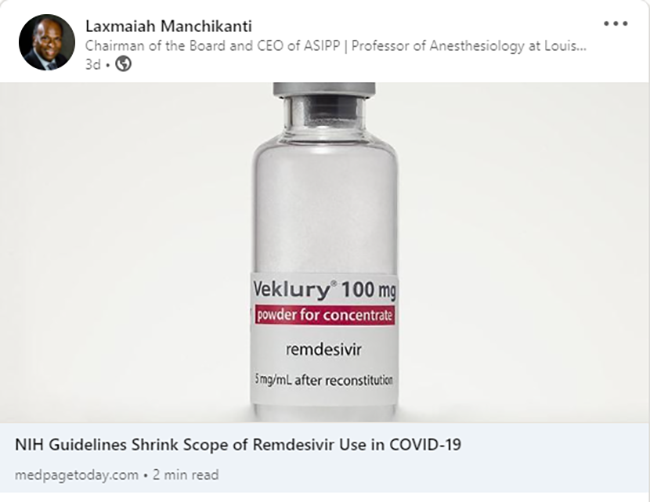
Updated NIH guidelines narrowed the scope of recommended use for remdesivir (Veklury) in hospitalized COVID-19 patients, and the quality of evidence backing the drug's use also took a hit.
Join Dr. Manchikanti on LinkedIn for more recommended reading.
(LONDON) It took barely a second. She rolled up her sleeve and Britain's Margaret Keenan became on Tuesday the first person to receive the Pfizer-BioNTech vaccine shot outside of clinical trials, as the first mass coronavirus immunization campaign in the West began.
It’s undeniably difficult to be a doctor right now. It’s even harder to be an out-of-work doctor. For physicians struggling with reduced wages, furloughs, and layoffs, there is some hope in sight as viable vaccines begin to emerge and be distributed. In the meantime, there are tactics you can employ to land your next job.
ASIPP is now offering our members the benefit of a unique revenue cycle management/billing service. We have received a tremendous amount of interest in the ASIPP billing and coding program. One question we continue to receive is what the negotiated rate is for practices. The rate is 3% for ASIPP members and includes...

Last week, the CMS announced the 2021 Medicare & Medicaid Physician Payment Schedule Final Rule. ASIPP will analyze the rule and provide a detailed summary soon.

The 2021 Annual Meeting will take place at the Hilton New Orleans Riverside.

Registration coming soon!
December 15, 12-1:30pm
1.5 Credit Hours

This intensely practical webinar presented by Vicki Myckowiak, will discuss the ten most important steps you can take to meet legal requirements and achieve effective compliance.

During these hard times, ASIPP would like to help our members by offering additional benefits for renewing your membership by December 31, 2020.

Attendees of the live webinar are eligible for an "attendee discounted" price. Those that did not attend the live webinar course are subject to "recorded version only" fees. Recorded versions do not include CME.

All sessions from the September 2020 meeting are available through June 2021 for a reduced fee. On-demand registration also provides access to all of the great resources available in the exhibit hall.
Up to approximately 8% of the population in the United States suffers from chronic pain. Unfortunately, this pathological phenomenon remains incompletely characterized, poorly understood, and challenging to treat. Extensive data has shown that opioid medications are inappropriate and ineffective in treating chronic pain and are burdened with numerous detrimental adverse effects ranging from addiction to mortality. Across the past decade, neuromodulation with spinal cord stimulation (SCS) has been utilized increasingly for treating chronic pain refractory to standard-of-care management with good efficacy. Learn more